

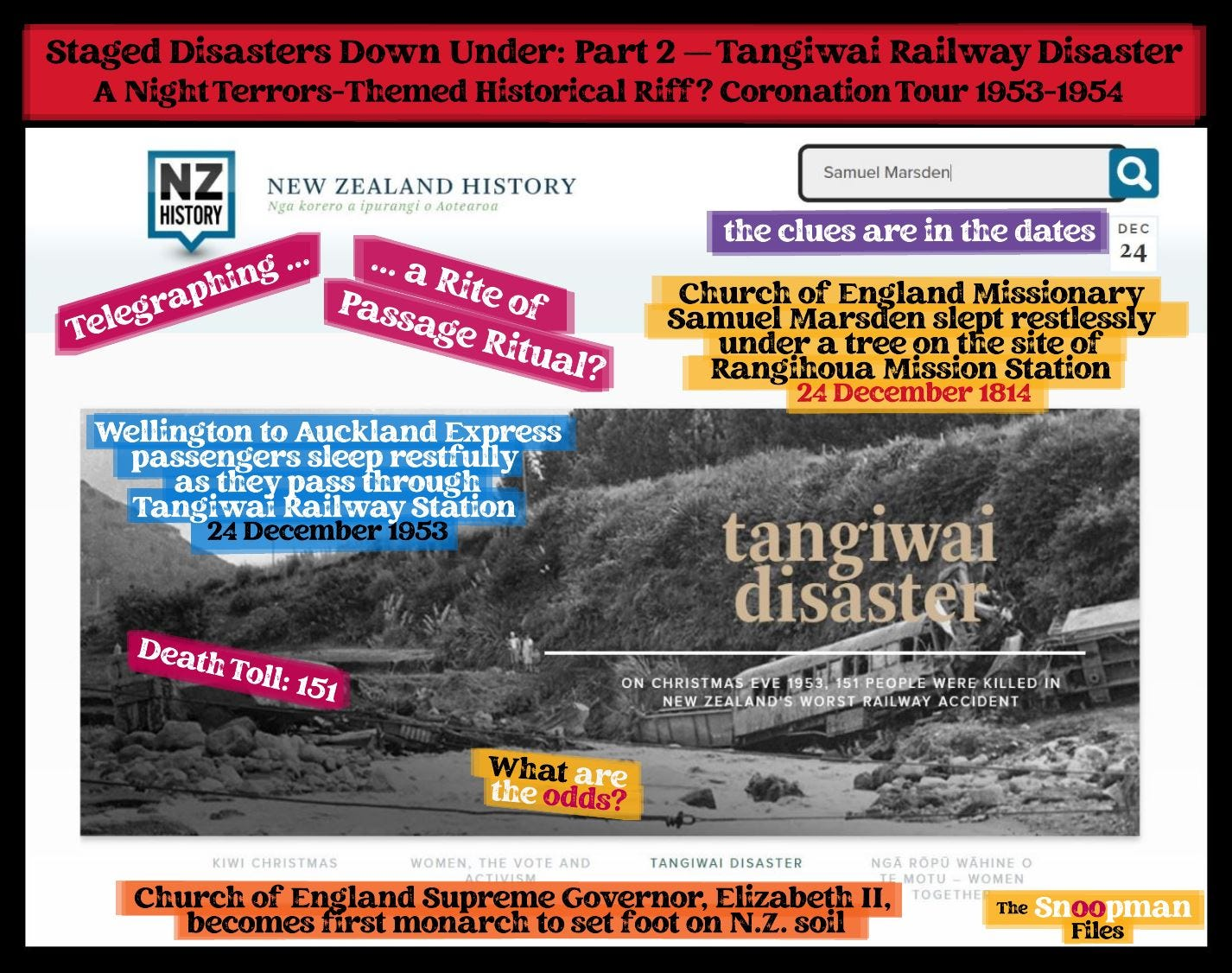

Tangiwai Railway Disaster, 24 December 1953 — Death Toll: 151
This Staged Disasters Down Under series reveals crises in New Zealand that were thematically encoded with historical riffs to signal authorship, cooperation, promises, threats, scapegoats, and caution — while telegraphing hidden objectives — in plain sight. Staged crises occur with precision timing to riff off historical events so that the newsmaking psycho-dramatic terror theater, simultaneously performs as cryptic signals intelligence, boasts its ritualized spectacular power and functions to maintain discipline among a cryptocracy.Some Māori language places encountered in this dispatch: Whangaehu River (pronounced Fung-ga-aye-who), Waiouru (pronounced Why-oo-rue), Ruapehu (pronounced Rue-a-pay-who), and Tangiwai (pronounced Tung-ey-why), which poignantly denotes a place of the 'weeping waters', as derived from tangi, to weep or lament; and wai, or water. (Dictionary of Maori Place Names, A.W.Reed)
➳ Introduction to the Tangiwai Railway Disaster: 24 December 1953 — Death Toll: 151
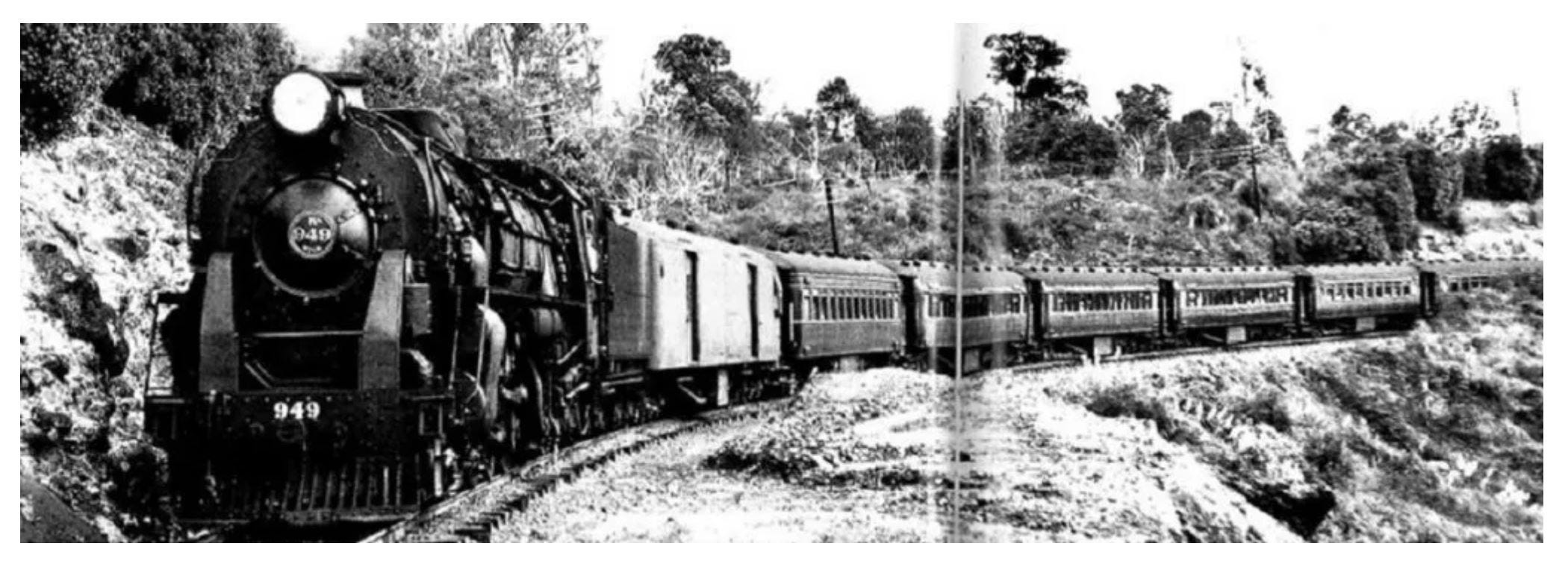
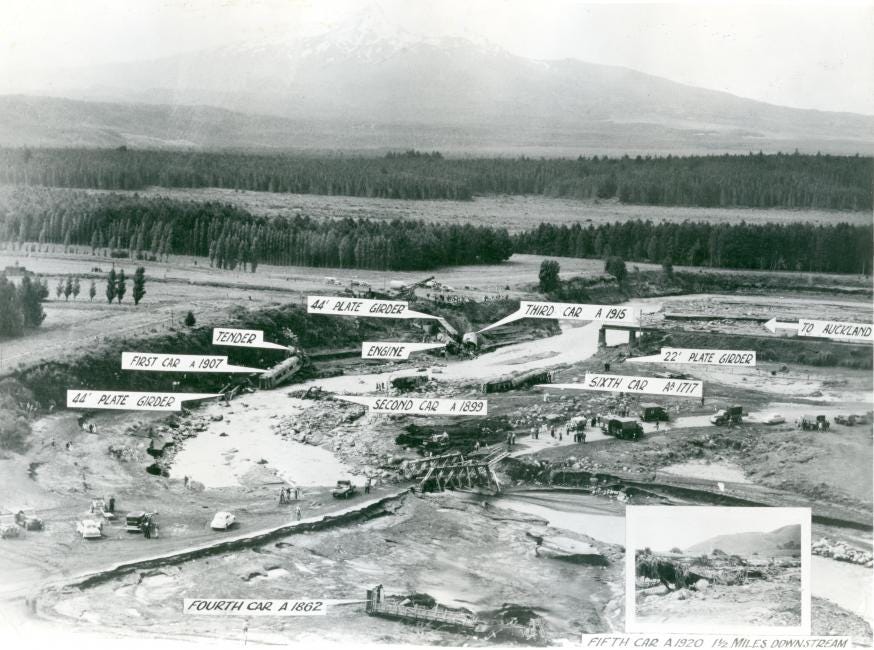
Snapshot: The loss of Train No. 626 carrying 285 people at Tangiwai on Christmas Eve 1953 was a staged catalytic event scripted to feature 'night terrors', as a rite of passage offering during the Coronation Tour of 1953-54. This ritualized massacre killed 151 in a muddy lurid laundromat.At 10.21pm on the evening of December 24th 1953, or Christmas Eve, an oil-powered steam locomotive and its first five carriages plunged into the Whangaehu River, at Tangiwai, located to the south of Mount Ruapehu, in the central plateau region of New Zealand’s North Island. A sixth carriage soon followed, while three first class carriages and the postal and guard vans remained on the tracks. The raging river and its icy slurry of boulders smashed the train like it was caught in an unholy tantrum.
Of the 285 aboard the train, 151 died and the disaster clocked in as the world’s eighth worst railway accident. In the geographically isolated archipelago of two million people, the tragic news shocked the nation on Christmas Day. Everyone knew someone who knew the dead, the survivors, the rescuers, or the bereaved.
The terrible news was reported as an accident and the inquiry absolved any blame.
Former Māori Television news and current affairs editor Steve Snoopman presents the case that the Tangiwai Railway Disaster was staged as a ritualized rite of passage.
A cover-up of New Zealand’s worst railway disaster occurred at the public inquiry.
This crime was ‘necessary’ to not simply protect the state from insurance claims. But also, the official cause of the disaster, which was essentially classified as an ‘Act of God’, was ‘necessary’ since that finding hid a terrific secret.* The lahar that smashed a railway bridge, causing an express night-train to plummet into a swollen river, was in fact staged by an emergent cryptocratic dark state inflicting this rite of passage ritual.
A 2002 documentary found that two mountaineers had carried out an independent study of the Crater Lake in 1950 and sent their report to the Geological Survey Branch of the Department of Science and Industrial Research (DSIR) in 1951. They warned of the dangers of build up in the Crater Lake and suggested methods for a controlled release. They were ignored. Their letter only appeared as an index in the main body of Tangiwai Inquiry Report. The ‘Narrative’ held that no one was to blame for the lahar.
Yet, this train terror theater was timed to riff off the same evening that the Church of England’s trailblazing first missionary slept restlessly in the Bay of Islands in 1814.
And, so what better way for this train terror theater to happen, than the day after the the first reigning British Monarch set foot in New Zealand? As the head of the Anglican Church, the Queen’s landfall in the archipelago coincided with the then-official date that the Church of England missionary, Samuel Marsden, made landfall at Rangihoua, the site of the first Christian Mission Station. And, what sick psychopathic humor for the Tangiwai Train Tragedy to feature a pier that lost its footing in a lahar like a loose tooth knocked free from the ‘bridge’ of the mouth by a thumping fist in an explosive playground fight? After all, the pier that failed first had been damaged in a lahar in 1925. And, how fitting it was the newly-minted monarch, Queen Elizabeth II, could in effect scoop a ‘breaking news’ broadcast to the world, announcing a “most grievous railway accident”, which effectively hid the terrorism.
And since this first broadcast as ‘Monarch’ outside the British Isles just happened to coincide with the historical date of December 25th in 1814, marking the first Christian sermon performed in New Zealand by the Rev. Marsden, who had slept like a man with night terrors on Christmas Eve, it was particularly uncanny for a night train terror ‘accident’ to occur while many passengers slept restfully on the Wellington to Auckland Express. Especially, given that the British Monarch is the Supreme Governor of the Anglican Church of England, or Anglocized Catholicism.
In her first Christmas Broadcast as the British Monarch, Elizabeth of the House of Saxe Coburg and Gotha also spoke of a new kind of empire forged over the past-half century, that drew upon the spirit of the ‘Prince of Peace’. Elizabeth II claimed the British Commonwealth exemplified the supreme ideal of the ‘brotherhood of man’.
Potently, this ‘Prince of Peace’ was an invention of the Roman Imperial Cult prior to the Flavian Dynasty, that created the phantom Jesus Christ character in part to assimilate Jews into the Roman Empire following the First Roman Jewish War of 66CE to 73 CE. This Roman Imperial Cult, which began as an institution with the rule of Julius Caesar, plagiarized mythological elements from prior city state cults to create this phantom messianic prophet character who would uncannily foretell the key events of the First Roman-Jewish War. The Gospels attributed to Matthew, Mark Luke and John were part of a broader literary fraud to assimilate the pagan cults into the Roman Empire’s new imperial project to forge a hegemonic religion: Christianity.
To gain early adherents to this Romanism religious cult, an ‘institutional bridge’ was built to help pagans move from the world of their traditional religious beliefs to the new world of the Christian faith. The Catechumenate was this institutional bridge. The early churches of Rome developed a rigorous training program to prepare apprentices for baptism. This commitment to preparation was called a catechumen.
Ergo, a rail bridge was destroyed to gain a commitment from the apprentice perpetrators to symbolically signal a new institutional bridge was to be constructed to reforge the new Roman Empire. This occult flipping of meaning is called inversion.
As such, this dispatch explores the ‘Tangiwai Disaster’ as a novel Gladio staged terror event, as part of a series of ‘worst of type disasters’ inflicted upon New Zealanders, to shift the political center of gravity by embroiling state, district and city officials. Ergo, the public inquiries are performative theater and are part of the cover-ups, to deflect attention horizontally among the monkeys to cue arguments about blame, while never imagining the cause is a pyramidic cryptocracy inflicting novel Trojan Horse attacks.
In essence, the Tangiwai Railway Disaster metaphorically telegraphed a ticket price paid to join the Gladio reign of terror, amid the Queen’s land-lady Coronation Tour.
During World World II, Winston Churchill had conceived of a ‘stay behind army’ in Western Europe, that would be supplied with weapons caches behind enemy lines.
After the war, this idea morphed into a ‘stay behind army’ to defend against the vast Soviet Russian Empire. But, after the success of Operation Gladio, which involved agent provocateurs disrupting the Italian election campaigning in 1948, as well as assassinations and bombings, the stay behind army networks were trained by the CIA and MI6 to carry out ‘fourth generation warfare’ across Western Europe. These operations were inflicted upon the citizenries of every NATO country through to 1990, when the terrorism attacks were exposed as being conducted by the stay behind armies. Gladio worked because communists were blamed for the bombings of train stations, buses, and planes, shootings and assassinations. Thus, a structure of contrived ignorance shielded the perpetrators while communist groups were fingered.
Gladio’s ‘strategy of tension’ was designed to shift the political center of gravity away from communist parties and socialist governments to right wing parties favouring unbridled capitalism capable of hoofing it past regulators all the way to the bank, while constructing the architecture for police state formation with sly syndicates.
But, New Zealand’s population was too small and connected to carry off the kind of false flag attacks envisaged for Western Europe because no one would believe New Zealand’s communists were that militant. And, people generally immigrated to the South Pacific archipelago because they wanted a fresh start, away from such strife.
Since the core idea of Gladio was to shift a nation’s political center of gravity in favour of right wing parties by associating terrorism with communism, the mayhem makers of New Zealand’s emergent cryptocracy initially pursued a strategy to blame nature for disasters, or the incompetence of a crew, and later, it would be ‘systemic failure’.
A cryptocratic dark state would inflict disaster terrorism to politically capture the nation by embroiling successive administrations in crisis cover-ups over time.
Therefore, the opening of the Royal Visit was not only riffing off the historical record of the trail-blazing Church of England missionary Reverend Samuel Marsden. But also, the mayhem-makers behind the Tangiwai Rail Bridge ‘accident’ gleefully overlayed their own cryptic cypher onto the Coronation Tour with their symbol sorcery, by riffing off the same historical moments and some others — to hack reality.
Black humor is detectable in the symbol sorcery. This wretched rite of passage ritual symbolized a ‘ticket price’ paid to further the integration of New Zealand with the Commonwealth. The replacement railway bridge would potently signify an ‘institutional bridge’ to train initiates to be loyal subjects to the Commonwealth.
The Tangiwai Rail Bridge No. 136 became an activated talisman in a new dark secret zeitgeist of techno-sorcery, that exploits places for their names, history, or symbolism.
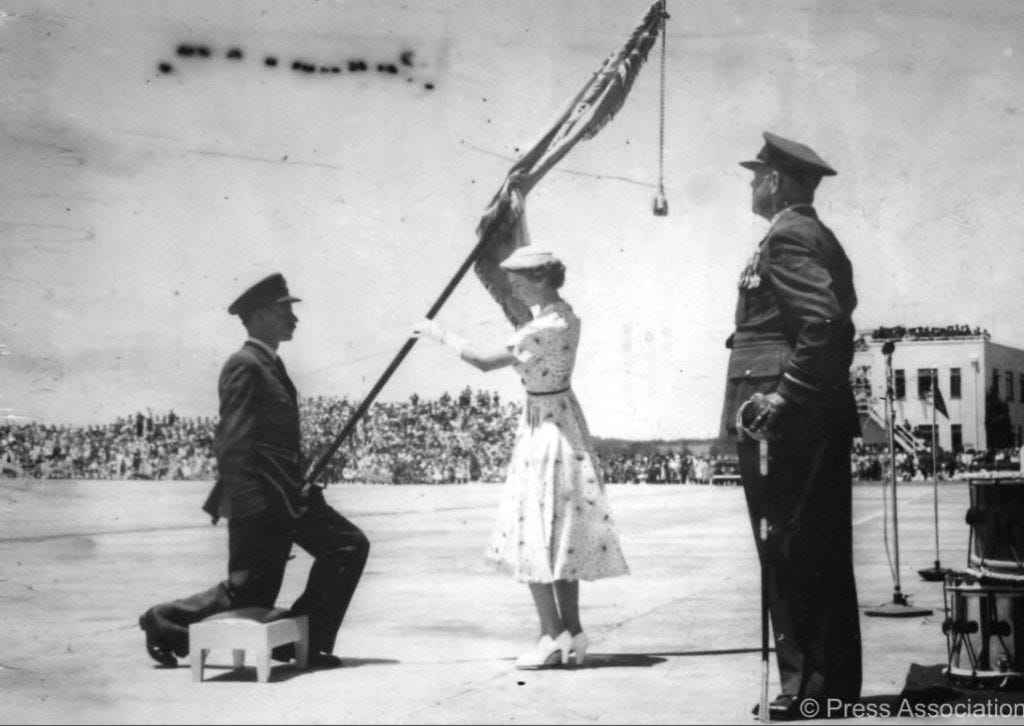
And so, when Queen Elizabeth II presented a new flag, or the Queen’s Colour, to the Royal New Zealand Navy at the main administrative base for the Navy at Devonport, on 24 December 1953, the timing actually riffed off the historical hoisting of the Union Jack atop the Rangihouia Pā, on December 24 1814. Potently, it was at Rangihouia Pā that the first Church of England Mission Station would be built.
The emergent cryptocracy behind the ‘rail accident’ at Tangiwai had signalled their looming mayhem two days prior. On December 22nd 1953, two Royal New Zealand Air Force pilots flying Mustang fighter aircraft crashed in fog while en route to Whenuapai Air Base in West Auckland on the same date, December 22nd in 1814, that Reverend Samuel Marsden landed three horses at the site of the Rangihoua Mission Station. The squadron of Mustang fighters set out flying below minimum safe altitude following the coastline, after leaving Ohakea Air Force base. They were due to flyover the SS Gothic to welcome the royal couple as they aproached the City of Auckland.
The mayhem makers’ cryptic psychopathic humour was codified into the crashes of the Mustangs. After all, the name Mustang derives from the free-roaming wild horse of the Western United States, descended from horses brought to the Americas by the Spanish conquistadors. The Mustang crashes were the ‘go signal’ for the Tangiwai op.
On the same date that a missionary’s seahorse anchored at Solstice in 1814, two Mustang skyhorses crashed at Solstice, telegraphing an ironhorse’s imminent demise.
The planners would also mock the victims, the survivors and rescuers as well as the bereaved, by structuring this catalytic disaster terrorism event to play out like a ‘Royal Game of the Goose’-themed board game. By codifying this disaster terrorism with a night terrors metaphor, the cryptocratic dark state performed an exhibition of spectacular power on the watch of Freemason Prime Minister, Bro. Sidney Holland.
Princess Elizabeth was named as the new monarch on February 6th 1952, the day that her father King George VI died after a period of declining health. What are the odds that the King of the British Commonwealth and Empire would die on the historical date of the first signings of the 1840 Waitangi Treaty? It gets curiouser and curiouser.
Is it not strange that the Coronation took place on June 2nd 1953, 14 months later?
After all, her father’s coronation occurred in an efficient six months after being named king. And while the coronation of Edward VII took 18 months to organize in 1902, and George V’s crowning in 1911 took 13 months, these dawdling delays were a bit more understandable given that communication and travel weren’t as fast and there were delicate matters of shifting allegiances, while Britain was plotting WWI.
It’s like a black operation involving a ‘worst of type’ disaster needed military planning.
How spooky that the place selected for a black operation was called ‘Tangiwai’, given that it is an anagram of the place-name, ‘Waitangi’. Especially, since the British Sovereign is heir to the Realm of New Zealand for a period of no less than forever. At least, that’s the fraud of the English version of the Waitangi Treaty. When in fact, the mission to treat with ‘the natives’ was theater and the mechanisms to construe paper sovereignty were gained in 1840 occurred by another route. Those card plays started with the boundary extension of New South Wales to envelope New Zealand, were blown like a giant gum-bubble on June 15 1839, and essentially ended with the Royal Charter of November 16th 1840. Who in their right mind in the British Establishment would argue with Queen Victoria, about a rort more obvious than the time the Romans made up a fiction that ‘Saint Patrick’ talked Ireland into ceding sovereignty?
Since the Queen made the error of failing to be born a man, she could not be the Grand Master of English Freemasonry. But, as the supreme head of several other important civil, religious, and military orders, the British Monarch can wield power.
Once such chivalrous feudal institution, is the Sovereign Military Hospitaller Order of St. John of Jerusalem, of Rhodes and of Malta. It is Snoopman’s contention that the ‘Hospiltallers’ were used as a transmission mechanism to wield power by stealth, as well as the Royal Victorian Order. In the aftermath of Tangiwai, numerous personages were awarded Royal Victorian Order medals as Coronation Tour Honours. Some key figures were knighted, becoming like a Carrollian Queen of Hearts’ ‘Pack of Cards’.
The Order’s Priory in England tracked the progress of the Dominion’s membership, meaning a profile of useful assets with their contact details was facilitated via reports.
The supposition presented here is that following World War II, a kind of warfare was imported into New Zealand that was so novel in its nature, that neither its immigrant or native populations would suspect they were being subjected to a psychic-voodoo.
This novel covert, or clandestine, warfare has featured a general trend in increasing its techno-prowess, while the cryptocratic dark state network grew in size, sway and sophistication. But always, one characteristic remained a constant; a thematic riffing off historical events to signify a cryptographic disaster, where the worst types of tragedy out-do the previous ‘bests’ in natural disasters, or unintended human-made crises. Or, where a calamity is staged to look like an illness, a lone wolf or beyond N.Z.’s control.
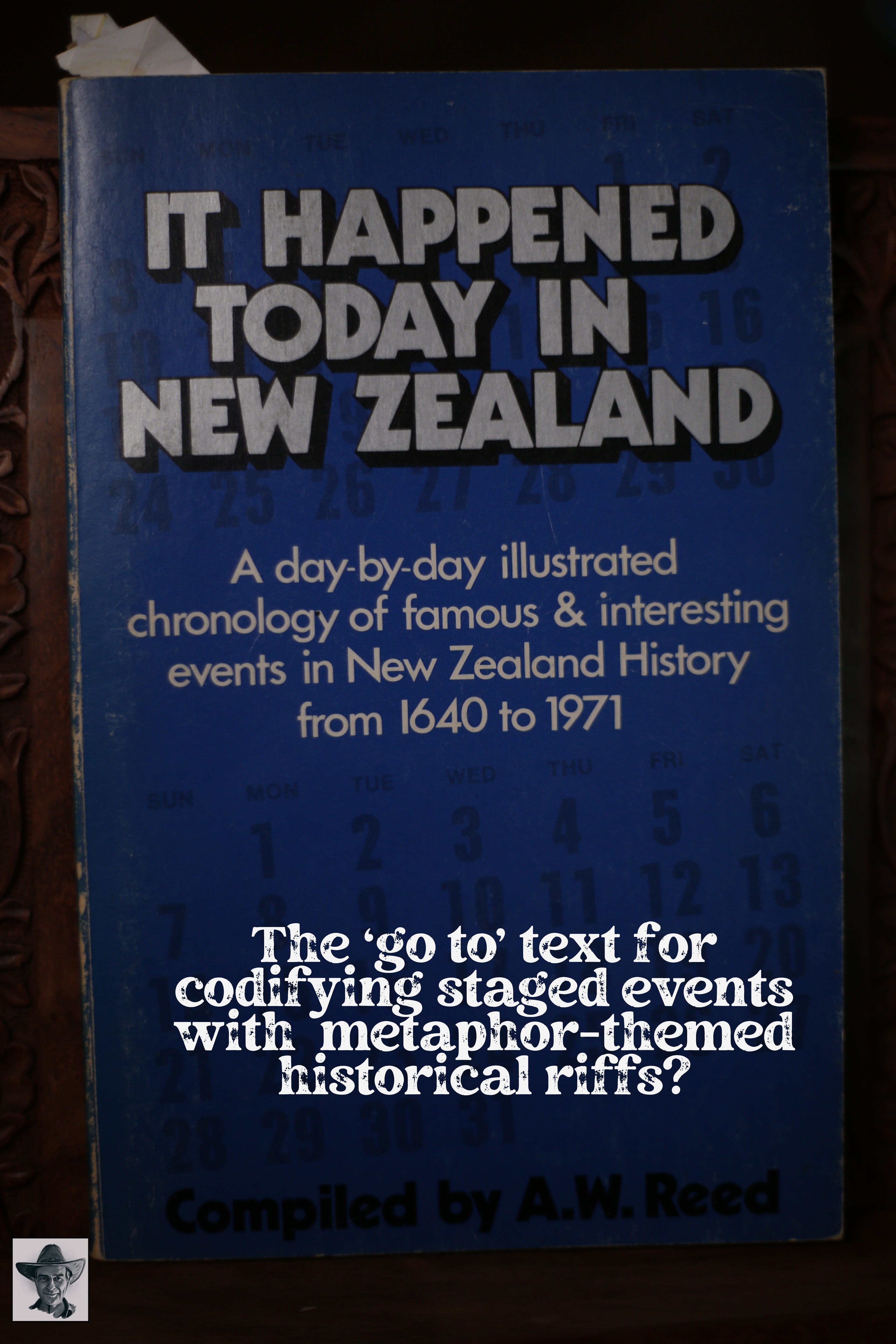
This Staged Disasters Down Under series revisits: the Ballantynes’ Fire, 18 November 1947; Tangiwhai Disaster, 24 December 1953; Brynderwyn Bus Tragedy, 7 February 1963; Kaimai DC-3 Disaster, July 3 1963; and the Wahine Disaster, 10 April 1968.
This series of ‘worst types of disasters’, or the diabolical attempts to make them so, joins up with the Darkest Days by Dates Down Under series, starting with the Mount Erebus Disaster in 1979 and ending with the Manawanui Grounding in 2024.
Brazenly, ‘the news’ is weaponized as a vector conveying codified signals that the ‘incidents’ were staged. Date riffs are a key detectable sign communicating threats, cooperation, authorship, and to telegraph covert objectives, scapegoats and rewards.
This isn’t to say that the news media are ‘all in’ on the rort. Most would be appalled.
Ergo, there lurks another layer to New Zealand’s recent past and the trail of meta-data reveals encrypted ‘glyphs’ or ‘runes’ of a network who ‘hex’ targets in terrible tricks.
Snoopman’s time travelling tale traces an epitome of evil most of his fellow monkeys might thunk could only happen in horror novels, epic noir flicks or grim stage plays.
As such, this heretical dispatch teaches snoop-readers how to apply Sherlock Holmes or Agatha Christie logic to Nancy Drew or Scooby Doo enduring mysteries, current crimes and unfolding news events in order to spot-light the spooky darkness.
Key Findings: The horrific Tangiwai Disaster was deliberately staged as a rite of passage ritual to telegraph New Zealand’s place as a staging ground for experiments in a novel kind of warfare. The Christmas Day radio announcements by Freemason Prime Minister Bro. Sidney Holland, and the Supreme Governor of the Church of Engand, Queen Elizabeth II, signalled a Masonic-Protestant plot.

This exhibition of spectacular power demonstrated how staged disasters could be inflicted as Trojan Horse attacks without the citizens realizing they had been targetted. In turn, the weaponized mayhem would compromise officials in cover-ups in various cities, districts and regions over time — to pull the political center of gravity into the orbit of a cryptocracy.  The techno-sorcery underpinning the Tangiwai Disaster signalled a cryptic Anglocized night terror-theming. The themed date riffing is the dead giveaway of a Trojan Gladio operation.
This series cites the NZ History website, administered by the Department of Internal Affairs, as well as A.W.Reed’s 1973 compedium of significant events entitled, It Happened Today in New Zealand, and also other sources. News headlines are reworked into collages, with graphical colouring-in by Snoopman. Terrorism, according to the Oxford Universal Dictionary [1933 Edition revised 1964. 3rd Edition], is a system of terror, government by intimidation; the system of the ‘Terror’ (1793-4); a policy intended to strike with terror those against whom it is adopted; the fact of terrorizing or condiiton of being terrorized (such as in 1798 during the French Revolution).
*The adjective “terrific” derived from the Latin word “terrificus,” which means “causing terror or fear.” Terrific used to describe events that inspired fear or terror, but by the late 19th Century the adjective came to describe things deemed awe-inspiring. This shift in meaning paved the way for the contemporary usage of “terrific” as an adjective of praise and admiration, like humanity had come under the spell of dark wizards and witches skilled in symbol sorcery.➳ “The Scene from Hell”
At the time of the Tangiwai Railway Disaster on December 24th 1953, the tragedy was the world’s eighth worst rail disaster. With 151 dead, it ruined Christmas for many.
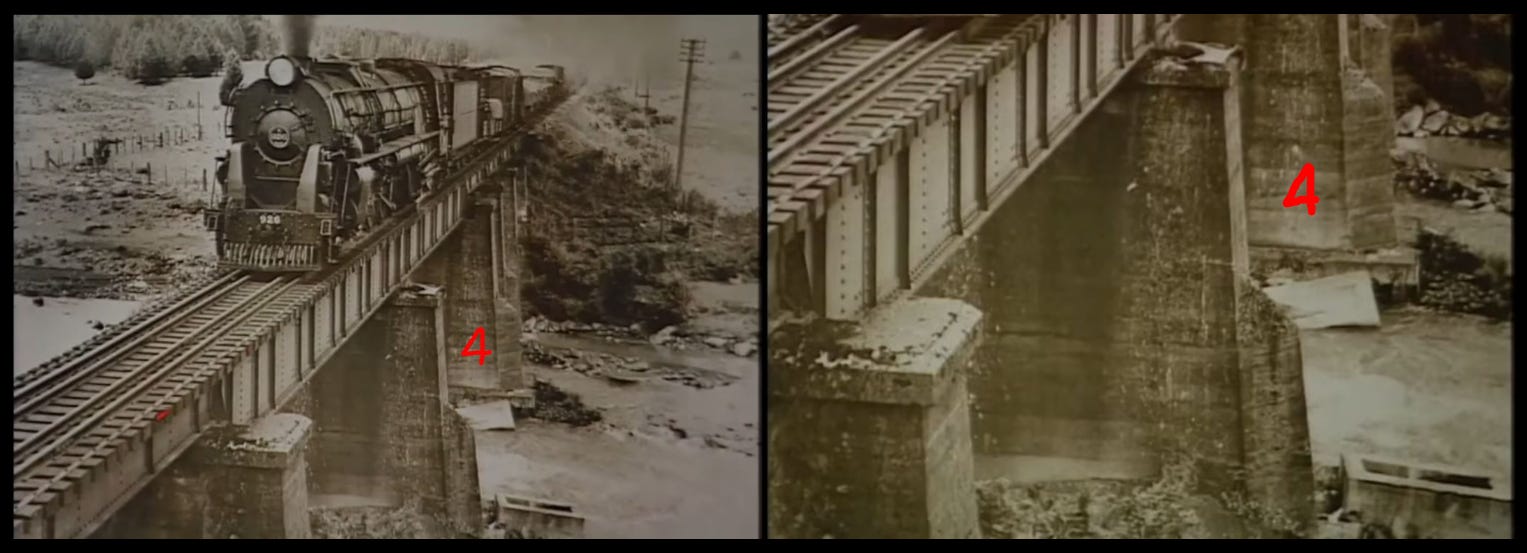
According to the official narrative, the icy tephra dam of the crater lake at the summit of Mount Ruapehu burst by natural forces at 8.02pm, unleashing a lahar that careened down the mountainous Whangaehu River. The lahar smashed column four of the Tangiwhai Railway Bridge shortly before the Wellington to Auckland Limited Express, Train No. 626, had passed through the Tangiwai Railway Station at 10.20pm.
At 10.15pm, Cyril Ellis a Taihape postman stopped a distance from the Whangaehu River road bridge. The river was a raging torrent passing over the side rails. In the distance, he saw the headlight of an approaching train. He climbed a fence, and ran 80 yards across a field and stood on the rail track waving a torch to alert the train driver.
A 2002 documentary, The Truth about Tangiwai disputes this version of the story.
Either the train driver, Charles Parker saw Ellis, or he caught sight of the raging waters, since the track to the Tangiwai Rail Bridge had become a peninsula.
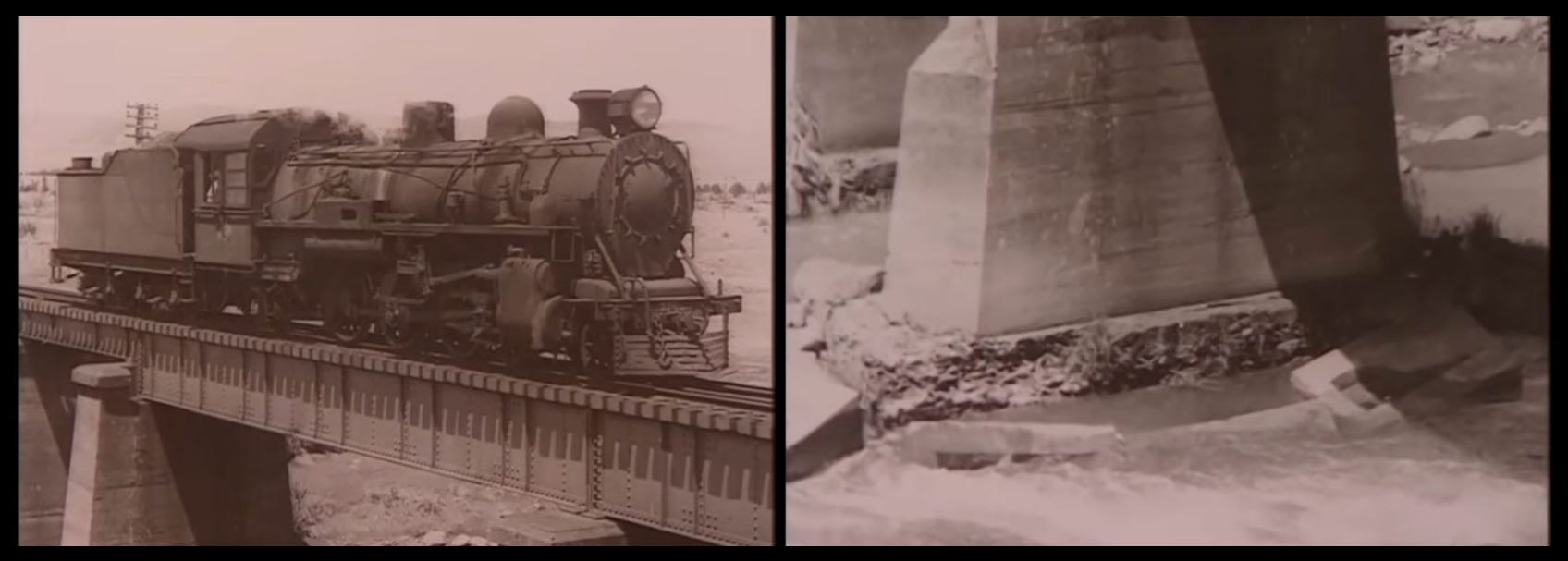
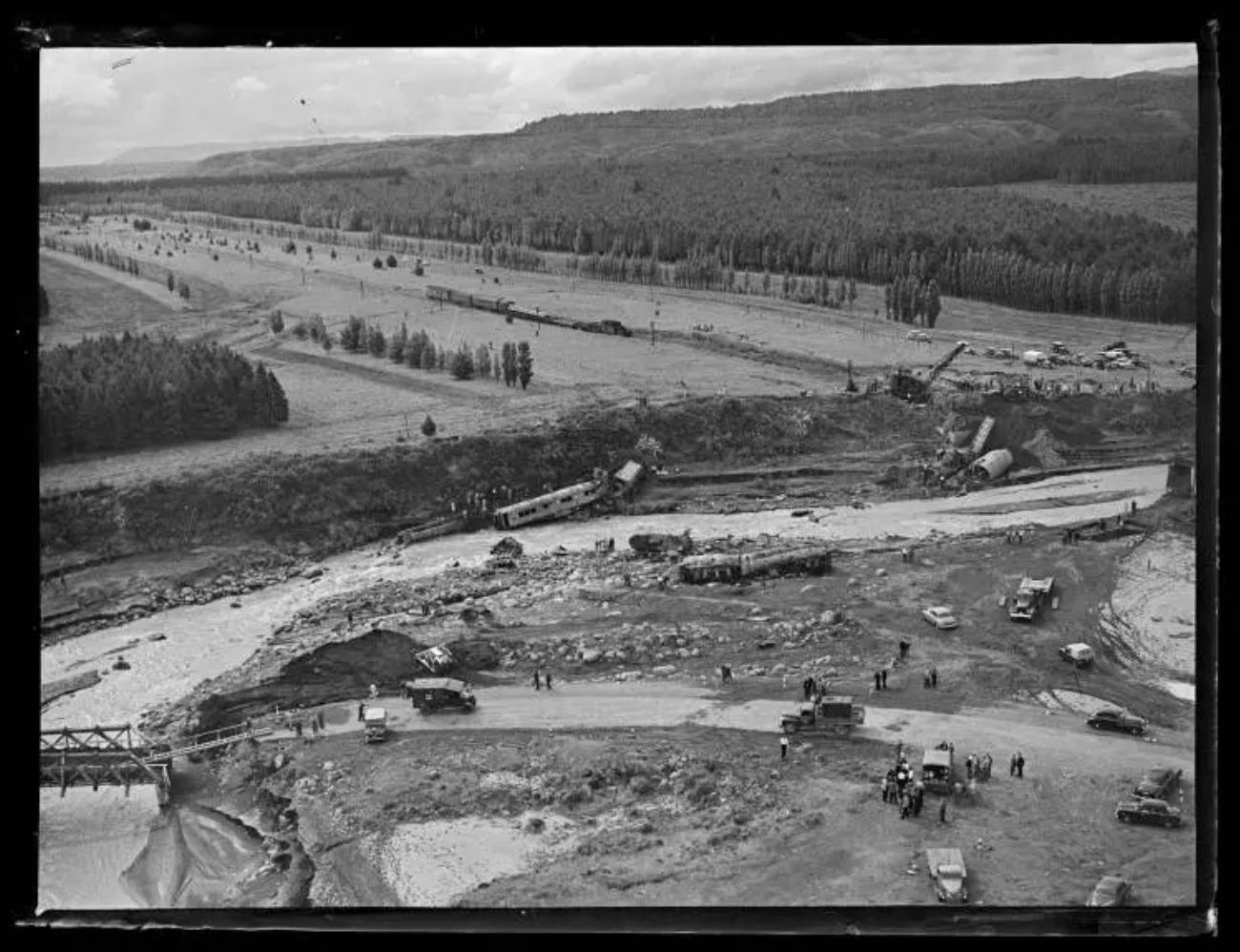
Moreover, with a fullbeam headlight, Parker likely saw the bridge was catastrophically damaged. By then, the fourth column, Pier No. 4, was carried away by the lahar, taking spans 2, 3 and 4 with it. Pier No. 5 followed and broke into at least two pieces, and its top portion was carried 50 yards downstream but the lower portion remained missing.
The crew applied the emergency brakes, sanded the tracks, shut off steam, and cut off the oil — but could only save half the train. The train driver Charles Parker, fireman Lance Redman, one first class passenger and 148 of the 176 second class passengers — all died. The demise of Nerissa Love, who was fiancée to cricketing fast bowler Bob Blair, was retold in the telemovie Tangiwai: A Love Story. But, like so many emotionally driven love story genre crisis flicks, such dramas accept the masked official narratives.
Cyril Ellis, the Taihape postman, boarded the back of the train after Locomotive KA 949 and the first five carriages of the Limited Express had plunged into the river. Van guard William Inglis didn’t believe Ellis, who had seen the locomotive and five carriages plunge into the river. They scooted through to the sixth carriage, which was teetering at the edge of the broken bridge. This was the first of the first class wagons. Ellis called out for passengers to calmly exit his way, while Inglis walked to the front, opened the door and exclaimed, “Good God, there is an engine and five cars in there!”
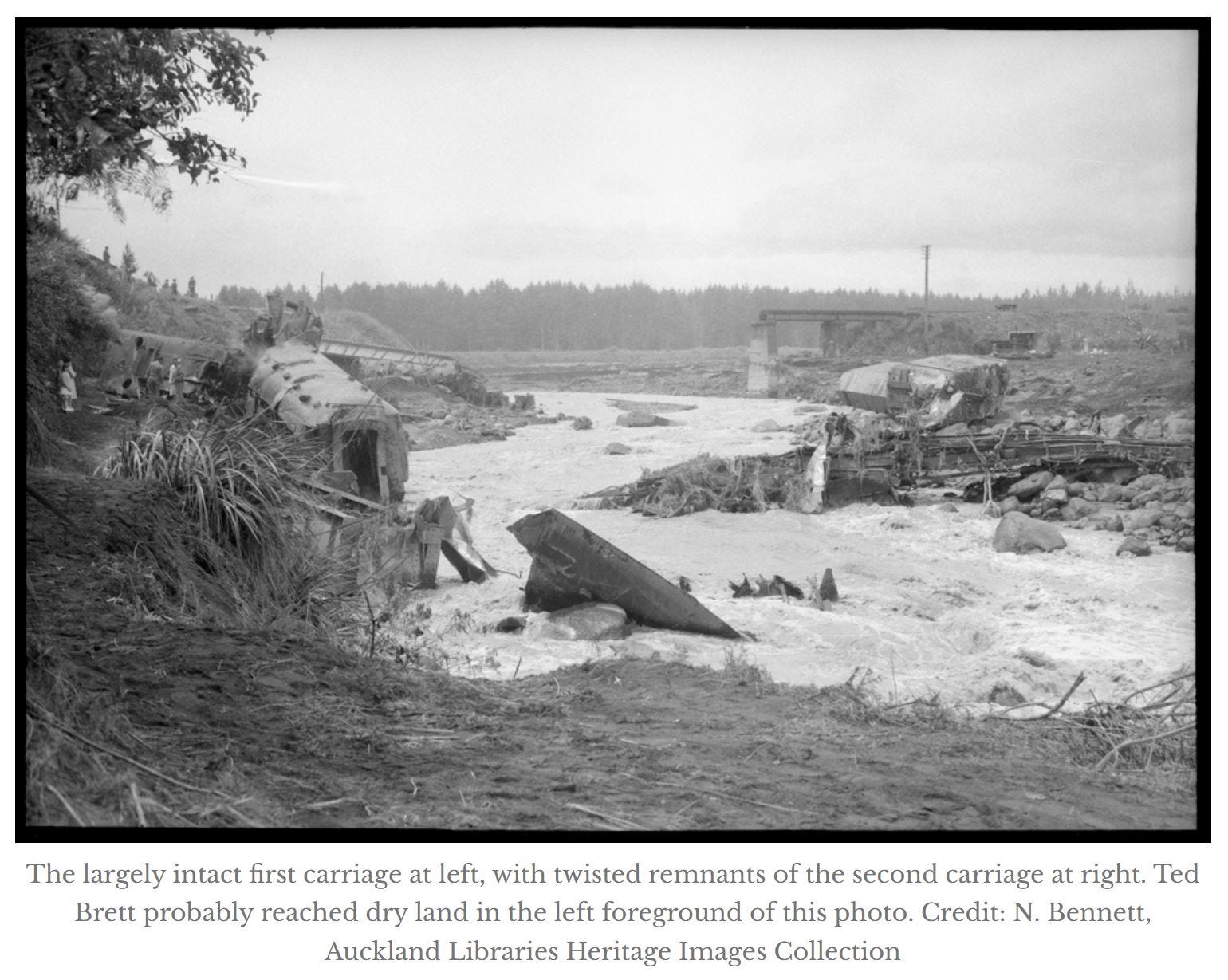
The coupling snapped and the sixth carriage fell into the raging lahar, filling rapidly.
Ellis, Inglis and passenger John Holman helped get all but one of the passengers out alive once the railcar car came to rest on the opposite bank, where they waited atop the carriage until the waters subsided. Ellis and John were awarded the George Cross for bravery, since they went back into ‘Car Z’, to save lives. Forty years later, Mr Ellis said he qualified as a fool, citing the adage, ‘Fools rush in where angels dare to tread’, in an interview for the 1993 TVNZ Heroes series episode, Tangiwai Disaster.
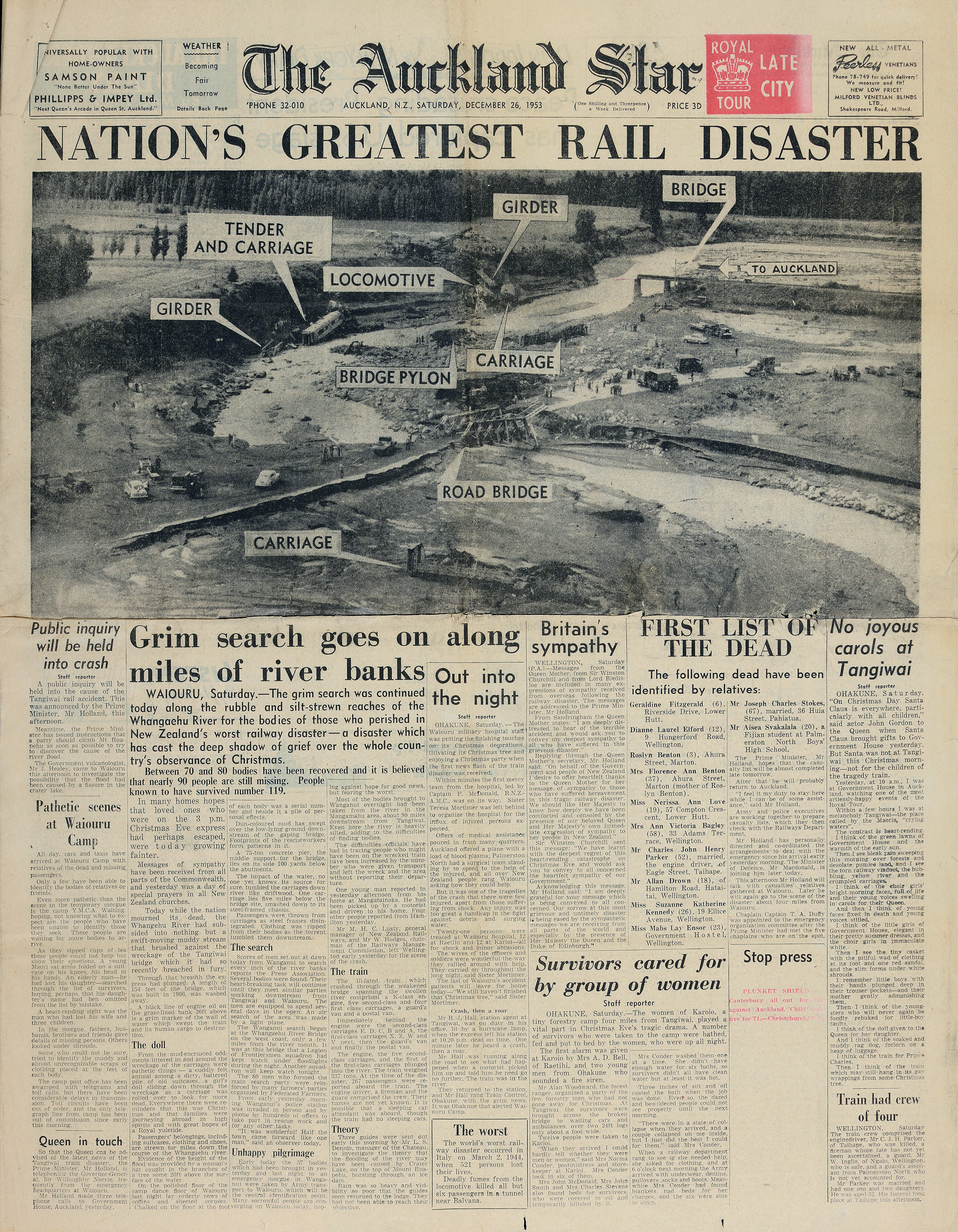
The only survivor from the second of the second class carriages, Richard Edward Brett, 18, known to all as Ted, heard the screech of “steel on steel” when the driver engaged the breaks at 200 yards out from the bridge. Ted was travelling from Palmerston North to Auckland for Christmas with his friend John Cockburn, 17, and John’s 12-year-old brother, Douglas. Although they had first class tickets, they found an elderly couple occupying their seats. John was one of 21 bodies never found, though the train tickets from his shirt pocket were recovered beneath the locomotive.
Many of the bodies and the survivors had their clothes stripped off them by the lahar.
The body of a 12 year-old girl was found to be standing upright, but buried in the sand. She was discovered because her hand was spotted poking out of the silt.
A woman buried up to her neck in silt prayed to be taken quickly, and was, by rescuers.
Bob Silk — a cop who was selected to drive the police minister and commissioner from Auckland to the scene because he was known to speed — rescued a girl saved by a dying half-faced woman whose had used her body as a shield, in a torn up carriage.
Silk said the young girl was the last survivor to be rescued in “the scene from hell”.
Ted Brett smashed a window to force his way out of the second carriage. After it was shredded through the tumult of the lahar, only the undercarriage remained. Blinded in the turbulent oily sulphury icy cold water, Ted felt a “pillow” move when it bumped into him and he held onto it. His grandson, André, believes the “pillow” was a descriptor for a boy who was passed to a local, Robert Somerville, at the riverbank. The “pillow” descriptor belied a humble working class etiquette that understates.
Ted fell for his dead friend’s sister, Patricia Cockburn, marrying her 17 months later.
Dawn Peterson, an excited school girl who was booked to board the train at Wellington, could not bring herself to step on the train when it came time to depart.
So many were travelling to glimpse the Queen in Auckland, on her Coronation Tour.
Bob Blair said he never enjoyed another Christmas. Lives were permanently altered.
Out of Tangiwai, a narrative was fashioned, fitted, figured, forged and fixed to an ‘unforeseen, unstoppable and unimaginable form of the N.Z. environmental tragedy’.
Indeed, Tangiwai is frequently described as an environmental-borne disaster, tragedy or accident. The official account, “Tangiwai Railway Disaster Report of the Board of Inquiry” found no one was to blame for the lahar causing the rail bridge to collapse and in effect it fingered ‘God’. In Weeping Waters: When Train Meets Volcano, Benedict le Vay’s 2013 book suggested New Zealand Railways was negligent in assessing risk.
In his article “Lahar Meets Locomotive: New Zealand’s Tangiwai Railway Disaster of Christmas Eve 1953”, University of Wollongong’s André Brett claimed the large-scale disaster at Tangiwai was “beyond imagination”. He highlighted the class dimensions of environmental disasters; only 28 of 176 second-class passengers survived, compared to 108 of 109 in first class. Yet, the 2002 documentary, The Truth about Tangiwai, made the case that the official inquiry was a cover-up, the catastrophe was foreseen, and the men with the receipts recounted how they had a solution for the crater lake — in 1951.
At the time of the 60th anniversary, André Brett, who is the grandson of Ted and Patricia Brett, described Tangiwai as “a natural disaster beyond any control.”
Yet, lurking in the meta-data of dates all of this time for 72 years, are the clues to a sinister story of dark forces — not of a natural kind — who were forging a cryptocracy.
➳ All Roads to the Scene from Hell Lead to Rome, via Tara, Jerusalem and London
The tragedy at Tangiwai not only involved a cover-up that embroiled the Government, and compromised state managers at the Department of Railways and the Department of Science and Industrial Research (DSIR). The Tangiwai Rail Bridge ‘accident’ was also encoded with a night terrors-themed reference to a historical event that marked the foothold of the Church of England’s presence in the archipelago of New Zealand.
Although as an event, the Anglican Reverend Samuel Marsden sleeping restlessly at the foot of a tree while surrounded by Māori warriors at the Bay of Islands village of Rangihoua on Christmas Eve, December 24 1814, is unrelated to the derailment of the No. 626 Limited Express train at Tangiwai, it’s symbolic potency as a historic night terrors episode tells a tale about why it was selected to riff off. Rev. Marsden was nervous about how the first Christian service on Christmas Day would land with the locals, and he had just come from Whangaparoa to the north, to lay to rest old animosities. Where Marsden’s arrival at the Bay of Islands to begin missionary work to assimilate ‘the natives’ into ‘British Civilization’, was delayed by five years after the convict ship Boyd had caught fire and sunk during an attack by Whangaparoa Māori avenging the ill treatment of a chief who had sailed with the ship from Australia, the Monarchy’s ‘landlord inspections’ to New Zealand after WWII were delayed by eight years due to the British Empire’s decline. Toffy London was a debtor before WWI.
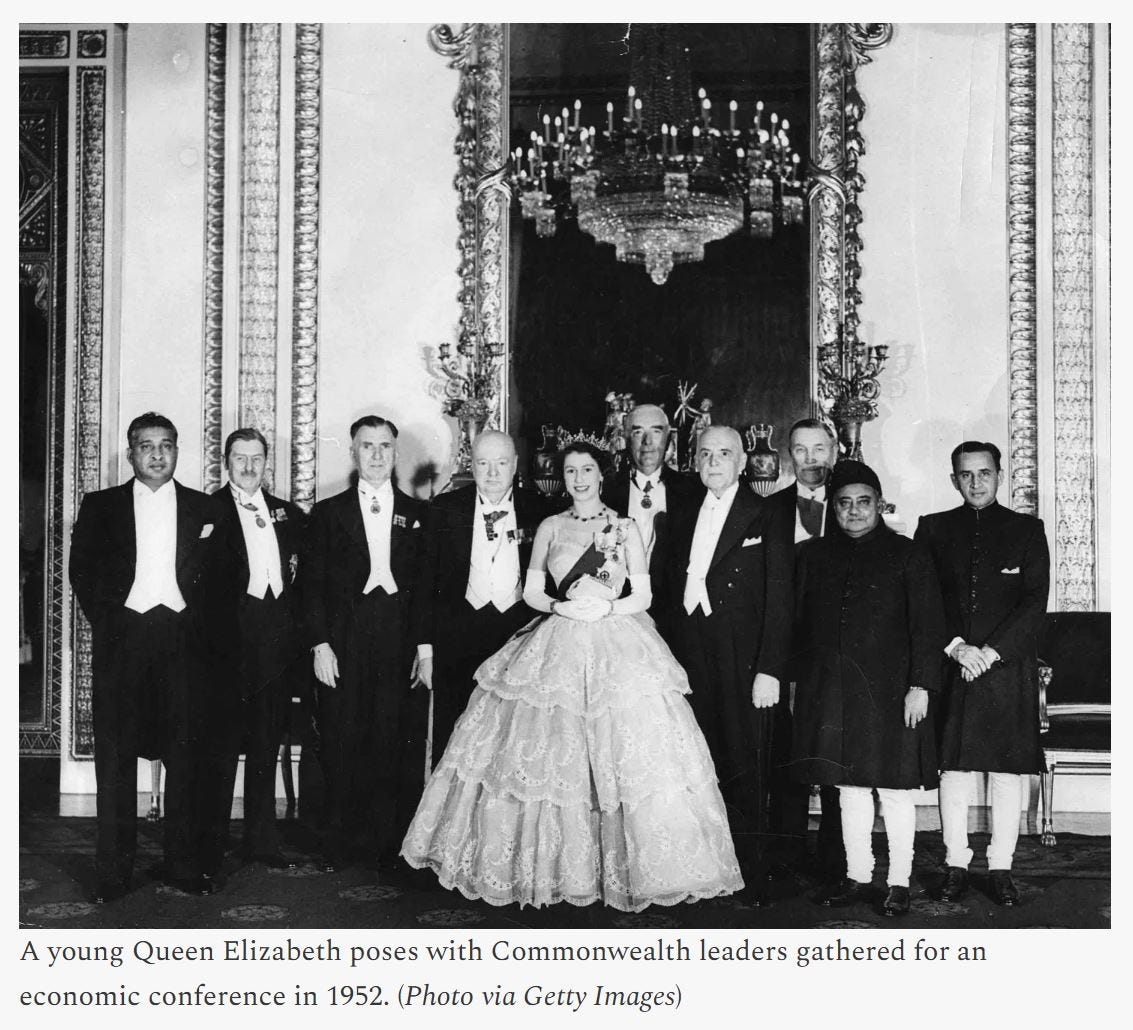
The U.S. President became the West’s new imperium. After the independence of India and Pakistan in 1947, George VI relinquished the title of Emperor of India in June 1948, and with this ‘jewel in the imperial crown’ lost, the King adopted the new title of Head of the Commonwealth. The King’s health delayed a tour too. He died February 6th 1952, prompting Princess Elizabeth to cut short a Royal Tour on his behalf.
Marsden, who was the credited as the driving force for establishing the Church of England’s missionaries in N.Z., was said to have landed at Rangihoua with horses, cattle and poultry, on December 23 1814, according to the New Zealand Department of Internal Affairs’ 1940 compedium entitled, A Dictionary of New Zealand Biography.
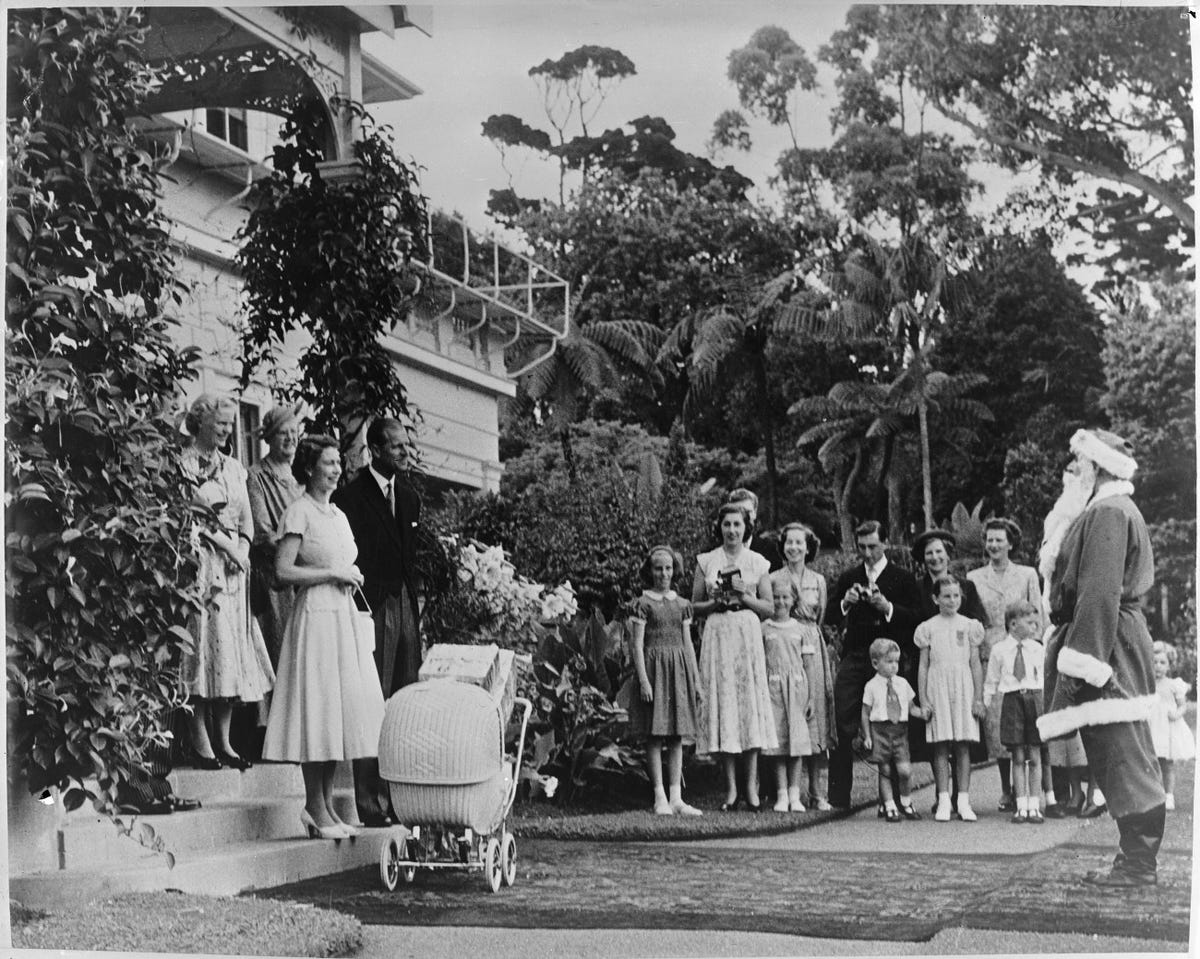
The Queen’s arrival on December 23 1953, to be timed to not only riff off this date, since her landfall on New Zealand soil was widely reported as a historic first. She was also the first reigning monarch to greet ‘her subjects’ on Queen Street, at Auckland.
Yet, none of the news coverage made mention of how Queen Elizabeth’s landfall in New Zealand coincided with the Government’s official date for the landfall of the first Anglican missionary in New Zealand, as far as Snoopman can tell. Indeed, Snoopman makes the case that had this ‘coincidence’ been widely known out at the time, New Zealanders may have been drawn to notice the other important historical moments related to the trail-blazing Anglican missionary’s first Christmas in New Zealand.
What better way to fix a sacrificial rite of passage than on Christmas Eve, by staging a newsworthy train terror theater event for the antipodean cattle class, horse class and their poultry on the ‘Antipodean Express’, than to time its occurrence to riff off the same Christmas Eve that Reverend Marsden slept restlessly with fitful night terrors?
Particularly, because the Queen’s planned historic first radio broadcast was on Christmas Day 1953. Elizabeth II would remark upon the “most grievous railway accident”. Especially, since this historic first radio broadcast riffed off Reverend Marsden’s performance of the first Christian service in New Zealand on December 25th 1814. The monarch is the Supreme Governor of the Anglican Church of England.
With no newspapers on Christmas Day, and with many caught up in the Prince of Peace festivities, the tragedy at Tangiwai became the Queen’s breaking news by radio.
And how uncanny that two days before the Express train No. 626 left the capital at Wellington Central Station at 3p.m. on that fateful Christmas Eve, two of the air force’s pilots chosen to perform a flypast for the arrival of the royal yacht SS Gothic as it approached Auckland, were killed in separate but related crashes, on December 22 1953. A squadron of Royal New Zealand Air Force (RNZAF) P-51D Mustang fighter planes had left Ohakea Airbase and headed up the West Coast bound for Whenuapai.
What are the odds the loss of two RNZAF Mustang fighter pilots on December 22nd 1953, would riff off the actual date of Rev. Marsden anchoring the Anglican faith in the Bay of Islands at 3p.m. on December 22nd 1814? This uncanny timing is consistent with a ‘go live’ signal to commence the termination phase of a black operation.
Conspirators need a way to cryptically communicate to those ‘in the field’, that officials have all of the ‘moving parts’ in place including to take an op live.
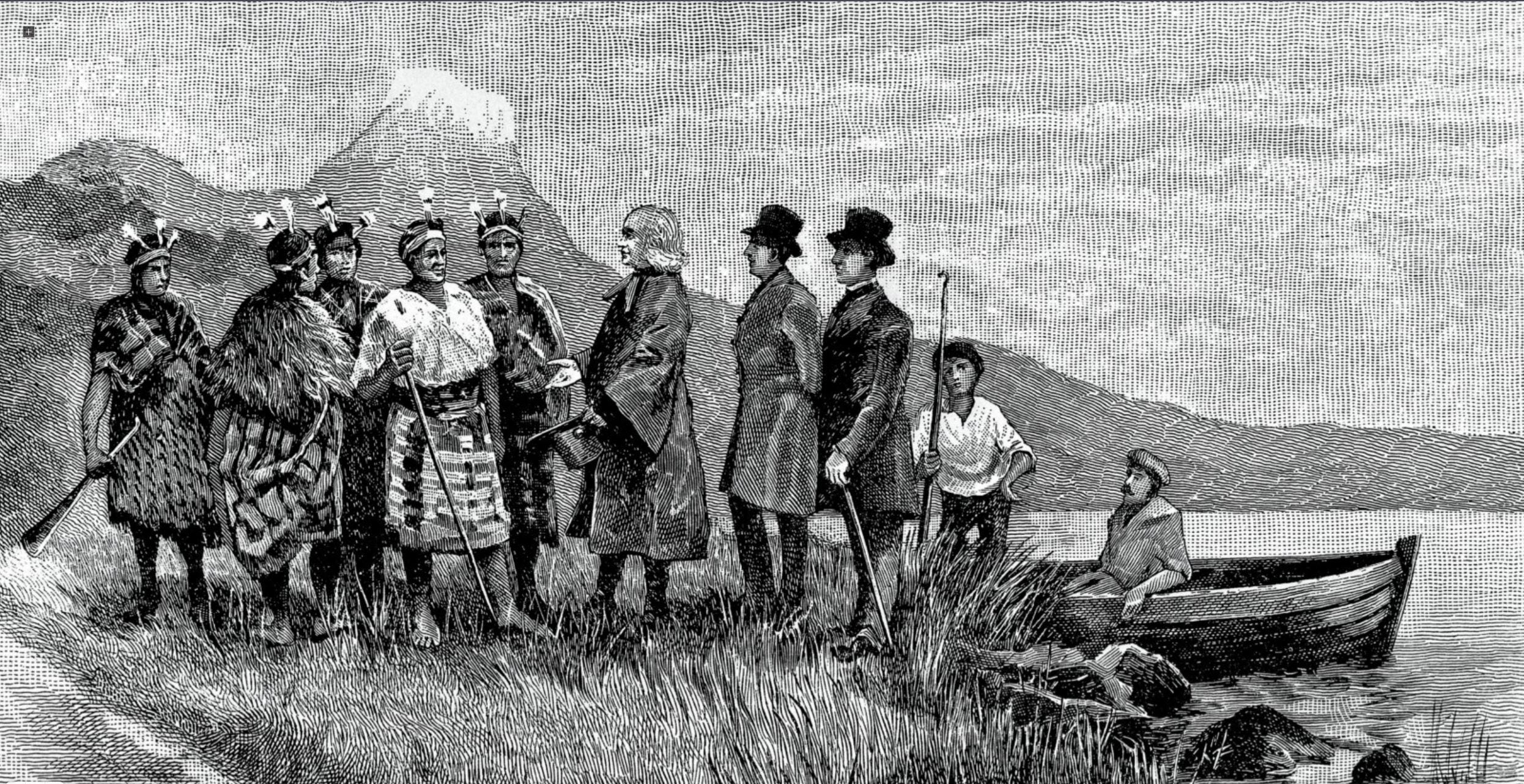
The New Zealand Dictionary of Biography 1940 edition had it that Rev. Marsden anchored at the village belonging to Chief Ruatara on December 23 1814. But, it was not specific about the date of landing a horse, which struck ‘the natives’ with amazement. According to A.W. Reed’s 1979 compedium, Two Hundred Years of New Zealand History 1769-1969, Marsden went ashore at Rangihoua with several horses and cattle, accompanied by missionaries Kendall, Hall and King, on December 24 1814, after arriving at Rangihoua Bay on December 22 1814. Whereas Digital NZ claims the horses were disembarked the same day, December 22. And, in George Finn's Datus: A Chronology of New Zealand from the Time of the Moa, published in 1932, Marsden arrived at the Bay of Islands on December 22 1814. In fact, it was the date 23 December 1814 that a site was selected at Rangihouia, Bay of Islands, for the first Church of England mission station. Hitting thick fog off Waitara, No. 2 Squadron leader Flight Lieutenant Max Stevens ordered his companions to break formation so they did not fly into each other. Officer Westrupp collided with the towering White Cliffs, while Stevens crashed in the bush above the Burton’s farm. The Mustangs were flying visually using the coastline as a reference, below minimum safe altitude, which became an ‘unforeseen’ problem in the fog. It would be easy for a military operation to create foggy conditions. After all, Britain’s Royal Air Force conducted weather-hacking experiments codenamed, Operation Cumulus, between 1949 and 1952 with the view to hamper enemies.
Operation Cumulus was put on hold indefinitely after thirty five people died in the Devon village of Lynmouth when a torrent of 90 million tons of water and thousands of tons of rock poured off a saturated Exmoor moorland in west Somerset, north of Devon in South West England. The deluge destroyed homes, shops, hotels and 29 bridges on August 15 1952. The disaster officially fingered “the hand of God”, but new evidence from previously classified government files suggests that a team of international scientists working with the RAF was experimenting with artificial rainmaking in southern Britain in the same week and could possibly be implicated, the Guardian reported, in 2001. The same year, the BBC found classified documents on the secret experiments were missing, but an investigative team found RAF logbooks and personal testimony that contested the Defence Ministry’s denials.
The Guardian reported there was a cloud seeding experiment that occurred between August 4 and August 15 1952. The newspaper linked scientists based at Cranfield school of aeronautics in Bedfordshire, who collaborated with the RAF and the MoD’s meteorological research unit based at Farnborough, with ICI chemicals, at Billingham.
How ironic the Mustangs would hit fog off Waitara given that the coastal village had been selected in a Masonic-Protestant plot to trigger a war, that escalated into the New Zealand Masonic Revolutionary War of 1860-1872, as Snoopman proved in 2017.
And so, what mocking humor that Rev. Marsden’s brig was called Active, given that he would become known as the driving force to establish the Church of England missionaries in New Zealand. Especially, since train No. 626 left Wellington Central Station at 3p.m. on December 24 1953 and would be derailed by a lahar from the Crater Lake of an active volcano. Particularly, since the Queen would announce news of a train tragedy featuring a driver of 33 years experience, in her scheduled broadcast on the fake birthday of the messianic phantom Christ figure, who was said to have been crucified 33 years later. During his ‘lifetime’, there were no records that he upturned the tables of money-changers in Herod’s Temple, and no-one journalled any accounts of his super-human feats such as curing blindness, walking on the Sea of Galilee and turning a poorly catered wedding into a banquet befitting of royals.
The reasons given for why there were no contemporary accounts of Pontius Pilate, the Governor of Judea, presiding over the trial of the phantom ‘historical figure’, Jesus Christ — who allegedly asserted to be the King of the Jews — are explained away with corny excuses to continue to suppress inconvenient truths even as the Gospels spread.
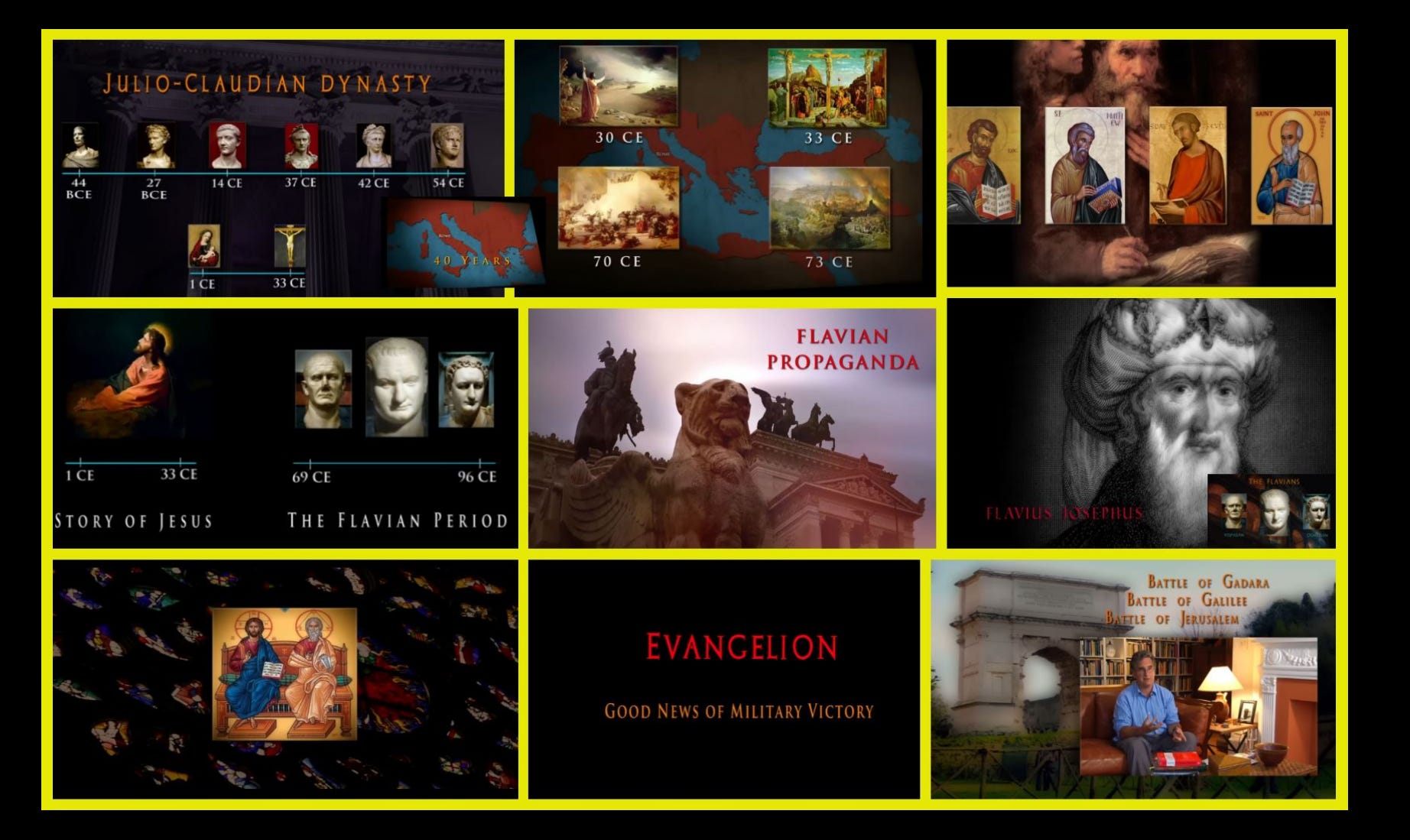
For example, Jesus was an insignificant peasant, and he lived on the far-flung edge of a sprawling empire, and besides, the sacking of Jerusalem in 70AD would have destroyed many records. Yet, the New Testament narrative has it that ‘Jesus Christ’ was a prophet, who successfully predicted the fall of Jerusalem after a war which Rome would win following three decisive battles against the Jewish Rebellion. The documentary Caesar’s Messiah posits that there are striking parallels between narrative elements from the Old and New Testaments and those of historian Flavius Josephus.
The Gospels were “backdated” by 40 years said Joseph Atwill, author of Caesar’s Messiah. He pointed out that Jesus started his ministry in 30 CE before the destruction of the Temple and it ended at Passover in 33 CE, which was 40 years before the end of the Roman- Jewish War at Passover in 73 CE, climaxing with the Battle of Masada.
The concept seemed simple enough. Since the Jews refused to convert to the Roman Imperial Cult of Caesar, the idea became to convert the enemy’s religion into a peace cult in order to mitigate the chances, scale and frequency of costly bloody stabby wars.
During the Jewish Rebellion of 66CE, the Judean messianic movement established a nation state, and began minting their own coins, after initially defeating the Romans. Although Rome had put down the rebellion, the risk that the messaniac movement could rise up in other colonies, drove the need to conjure a passifying religious hero.
According to the Gospels, Jesus predicted that within a generation, a messianic Son of Man would crush Galilee, encircle Jerusalem with a wall and raze the Temple. A generation was considered 40 years at the time. Uncannily, the Gospels’ ‘recording’ of Jesus Christ’s predictions came to pass. But, instead of the second coming being a Jewish messiah, Emperor Titus Flavius was announced as the messianic figure.
As a turn-coat hired historian, Josephus declared that the Jews’ prophesized messiah is Flavian Vespasian, who was a general who became emperor following the suicide of Nero, which followed the Roman Imperial Cult bureaucracy of the Julio-Claudian Dynasty, who projected the idea the emperors were gods starting with Julius Caesar.
A mythology to legitimize that dynasty was created in a conspiracy between three powerful families, the Alexanders, the Herods and the Flavians, to create a peaceful version of Judaism to counter the militant Jewish messianism factions. The Alexanders, who were a Jewish family that were Rome’s tax collectors in Egypt funded the writing, production and dissemmination of the Gospels as Roman propaganda.
While sacking Jerusalem the Flavians gained the Jewish messianic texts. They discovered a hidden literary code layered into the texts. This hidden code was used to insert cryptic passages of the Gospels that required deciphering to be understood.
A chronicle of past events could be used provide form and context for subsequent events by layering hidden meaning in texts. And so, an idealized prototype character and archetypes with stereotypic characteristics perform as dramatists, and can be used to superimpose past events in current ones, or use contemporary events to retell old stories. In Hebriac Typology connects prophets, such that the events of the life a prophet are transposed into the life of a subsequent prophet. This is supposed to demonstrate a divine pattern established by god, connecting the prophets over time.
The purpose is for later writers to decipher the meanings to layer new events.
Author of The Christ Conspiracy Dorothy M. Murdoch points that the phantom Chirst character was created out of sun god motifs lifted from other prior cultures, and that the alleged December 25th birthday was the end of the Winter Solstice, or the birth of the god of light after the end of a three day period when the sun appeared to be dying.
Pagan cults incorporated solar mythology to embed knowledge of seasonal cycles with rituals at sacred megalithic sites that were located on ley-lines to amplify the effect of the magneto-electric cosmos to produce an agricultural surplus to sustain society.
And then arose the power cartels of evil oligarchical families in the city states around the Mediterranean and Near East, who created solar god cults like fast food franchises.
Temples were spiritual toll-booths for collecting coins from tithes, fomenting machinations and profiling the population for initiates into the ‘mysteries’.
Among the ancients, sun gods became a common fixture in city state cults, and their mythical narrative elements became symbolic motifs in architectural sculptural reliefs. The city state cults integrated the cycles seasons, day and night, and great processions of the star constellations, with mythology to serve the legitimizing function of the state with its key institutions, the temple, market, and a military. The constellations were anthropomorphized as animals, or personified as human deities.
And so, Horus the Egyptian sun god was enemies with Set, the god of darkness. At sunrise, Horus would send Set packing and at sunset, set would conquer Horus. The battles between good versus evil, or light duking it out with darkness, was a universal duality expressed in myth, that was incorporated into monotheistic religions, as empires waged imperialist wars to impose conversions to forge universal religions.
As Peter Joseph showed in his 2007 documentary Zeitgeist the same key mythological elements featured across the ancient world to configure saviour solar messiah figures.
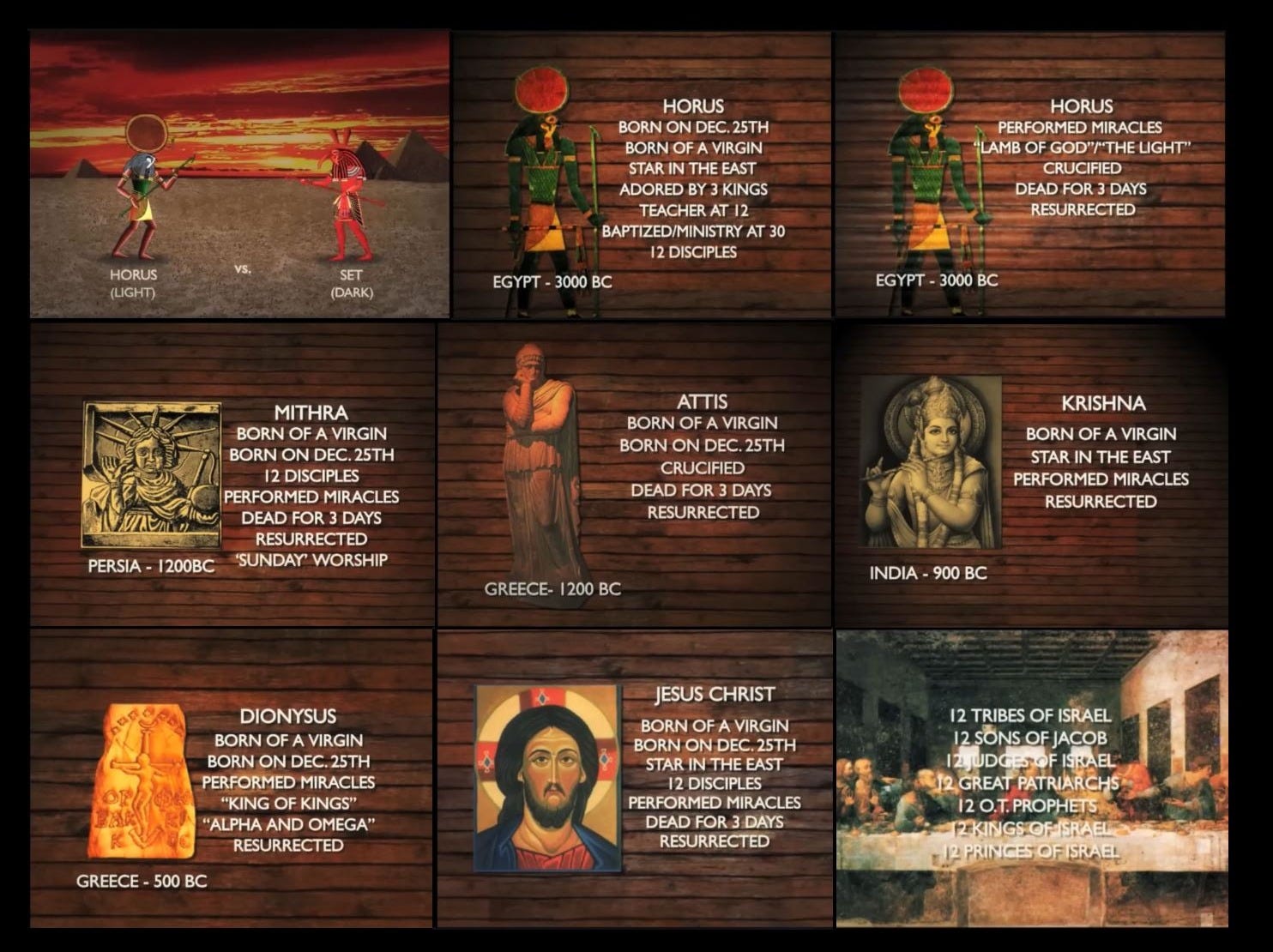
Ergo, the Gospels were phantasy literature because they transposed a sun god into a Jewish man, cast as the incarnation of a monotheistic God born to parents who made off to Bethelem at a time when a decree had been issued from Caesar Augustus, that all the world should be taxed. Apparently, the obedient citizens of the ‘Holy Land’ all returned to their own cities to be taxed, including Joseph, who was said to be of the house and lineage of King David, and his wife Mary who was about to pop out the world’s most famous messianic baby — if Luke’s Gospel is to be believed.
Roman General Vespasian had successfully prosecuted the war in Galilee and Judea and was preparing to lay siege to Jerusalem, when Nero suicided in 69CE. In the space of a year, four emperors would rule Rome. Vespasian manœuvred his way to power, after leaving his son Titus in charge of the siege over Jerusalem. Emperor Vespasian (69-79 CE) commenced the Flavian Dynasty claiming to be a so-called ‘Prince of Peace’. The Temple of Peace, which was built on the site of the market of the Republican era, the Macellum, and opened in 75CE, housed the most precious trophies accumulated from the conquest of Jerusalem, including the seven-arm candelabrum.
This myth-making in the physical world was reflected in Luke’s nativity scene, where angels trumpetted the ‘birth of Jesus’, heralding “peace on earth and good will to all men”. At the same time the Gospel of Luke was being written, Rome’s coinage was minted with the phrase “good will to all men”, James Valliant said in Creating Christ.
The noun Gospel in Greek means evangelion “good news of military victory”, claimed John Hudson in the documentary Caesar’s Messiah. In Ancient Greek, the word εὐαγγέλιον or evangelion, was originally used in a wartime context. When a distant battle took place, runners would bring messages back to the city, letting them know of developments on the front-line. Those who brought “good news” from the war were called evangelists, according to The Disciplemaker. The meaning migrated from the conflicts of city state-ruled empire to general secular meanings.
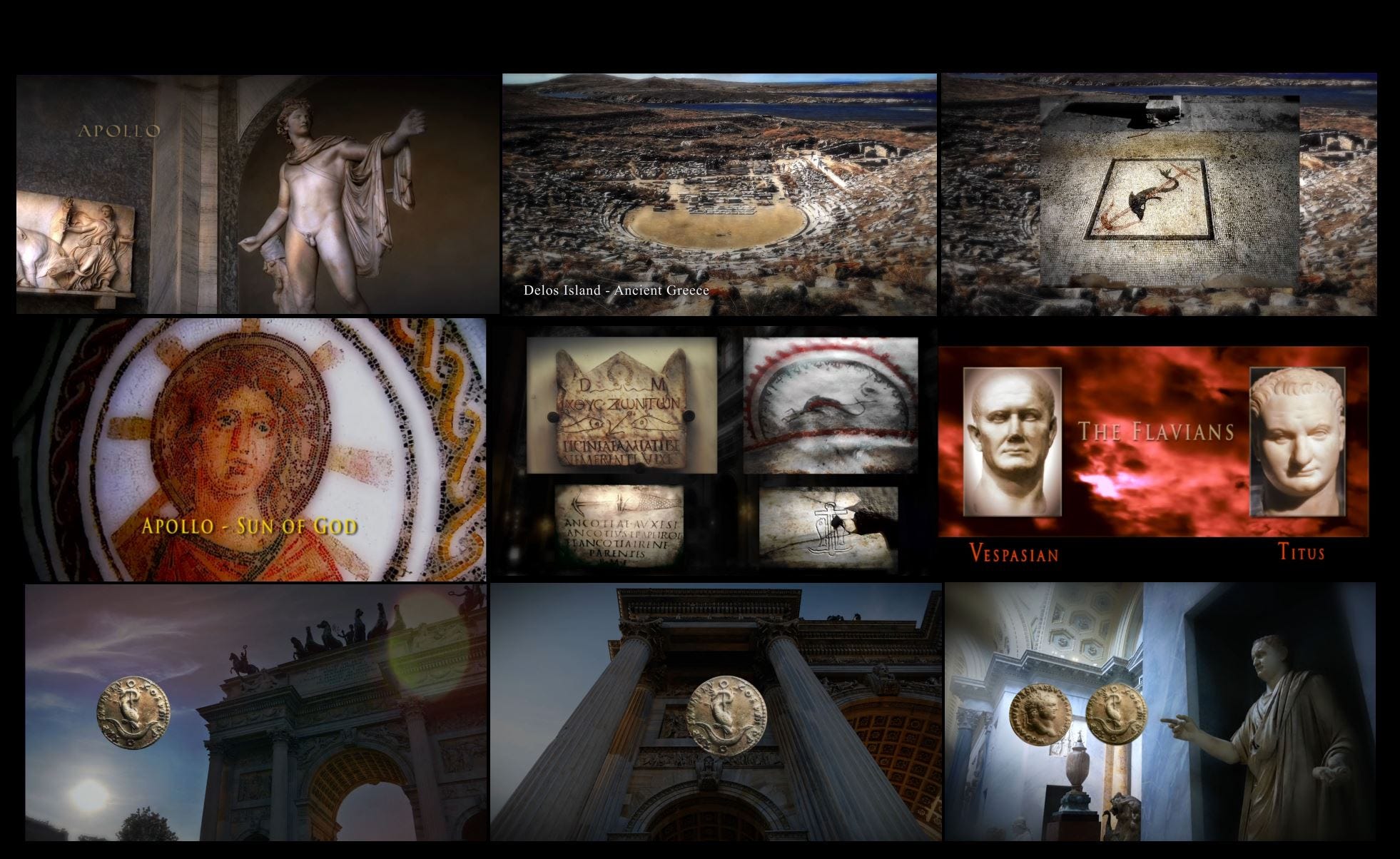
Thus, the Gospels were bragging serialized parables with a sly allegorical layering.
With the Jewish scriptures in their possession, and a comprehension on the codified workings of Hebriac Typology, the Flavians could rule with their ‘Prince of Peace’ propaganda, spreading fictional gospels that, in effect, predicted the Flavian Dynasty.
As the documentary Creating Christ shows, the Roman Imperial Cult bureaucracy of the Julio-Claudian Dynasty, who projected the idea their emperors were gods starting with Julius Caesar, was repurposed to promote the Flavian Emperor as the messiah.
Reading the runes, the servile sychophants employed in the Roman Imperial Cult read the room, and fell in with the victors’ narrative. A fictional prophecy surfaced in the New Testament Gospels to neatly correspond with the Flavians’ historical accounts.
These were faked events to shore up the Flavians claims to divinity, and signalled a deeper connection to a networked secret brotherhood. Author of Jesus of the Lost Goddess, Timothy Freke said the mystery schools taught the symbolism of mythological initiatory ritual, or a mythos, to assist initiates to undergo a spiritual awakening while acquiring this knowlege, a process termed a gnosis. Such mythos elements were later enmeshed into the messianic Jesus story. These symbols of the brotherhood networks, such as the cult of Mithraism, were linked to guilds of industry across the ancient world, and they later turned up in Freemasonry.
Sometime in the second century, the early churches developed a rigorous training program, known as the catechumenate, to prepare pagan peoples for baptism. This preparation entailed a commitment from apprentices called catechumen, to instill a discipline. The Catechumenate was an institutional bridge to help pagans move from the world of their traditional religious beliefs to the new world of the Christian faith.
However, by the fourth century early Christians were fighting in the streets over who had the correct version of the phantom Christ’s life. In 325 A.D., Emperor Flavius Constantine convened the Council of Nicaea, ostensibly to decide whether God incarnated as a man, or if Christ simply lived virtuously. Constantine hit upon the idea of a united church as the ideological glue to unite the Roman Empire.
After two months, the Council of Nicaea ratified the Nicene Creed — by vote.
The invented Christ had not simply lived virtuously. A monotheistic God had incarnated as a man, apparently. If the world’s most famous legendary messianic figure had been an exemplary human who lived virtuously, who would need a church?
The Salvation and Resurrection metaphors were state endorsed.
The Council of Nicaea had simply re-worked the monotheistic innovation of the alleged Hebrew prophets Amos, Hosea, Isiah and Micah, whom supposedly transformed the cult of Yahweh into the worship of the Earth’s first universal A-Lister God — who evidently directed the universe. The heroic fantasy character, Moses, is credited with introducing the covenant idea that eventually led to the creation of the world’s first monotheistic cult. Yahweh was a relatively minor deity, who made a covenant with the Israelites that if they followed his rules, he would restore them to ‘the promised land’. Yahweh had already led Abraham out of Ur to Canaan.
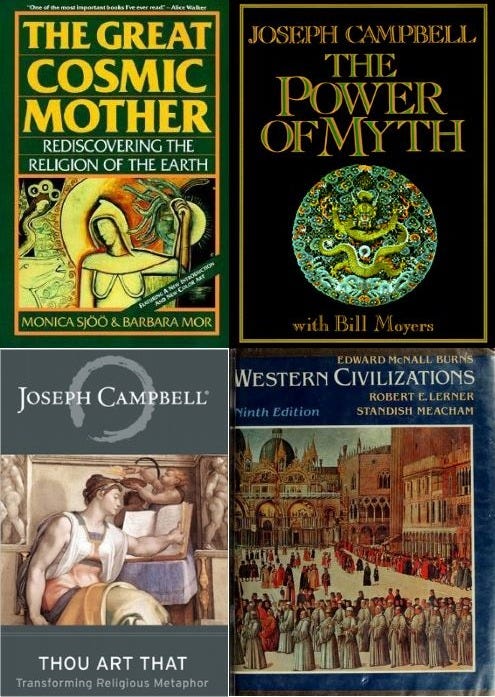
Moses — who allegedly led the Israelites from a miserable life of bondage in the Nile Delta region of Egypt — forged a confederation (that included other nomadic tribes), and that would become instrumental in the occupation of the land of Canaan or Palestine, to etch out a living as pastoralists. The confederation’s settlement in Palestine was a militaristic invasion, according to historians Robert E. Lerner Lerner, Standish Meacham, and Edwards McNall Burns in Western Civilizations.
According to the fantasy fiction of the Old Testament, Moses parted the Red Sea to allow the Israelites to escape Pharaoh’s pursuing army, creating a path through the waters on dry land, only for the sea to close again, drowning the Egyptians as a demonstration of God’s power and deliverance from slavery. This claimed ‘miracle’ served to free the Hebrews, confirm their faith, and solidify their new identity as God’s chosen people, escaping their Egyptian oppressors — as this corny tale goes.
One of the enduring mysteries of Roman Catholicism is how did menstrating women and girls ever fall for the idea of a Virgin Birth? What was this black humor needed?
The trailblazing scholar of world religions, Joseph Campbell stated in, Thou Art That: Transforming Religious Metaphor, the Virgin Birth metaphor, along with the Salvation and Resurrection metaphors, were commonplace elements in creation myths and religious cults across all major cultures. Ironically, the noun virgin — was defiled.
The Church needs to be fingered for this defilement; it occurred for political aims.
Many of the great cultural heroes of the past, mythic or historic, were said to be born of virgin mothers: Marduk, Gilgamesh, Buddha, Osiris, Dionysus, Genghis Khan, and Jesus. But, the virgin descriptor did not carry the connotations to sexual chastity that it does today. And so, an appreciation of the feminine in these ancient mythologies is lost on most ‘Westerners’ and Romanized lands where Rome’s Christianity has spread.
Beginning with Pope Benedict VIII, who banned priests from marrying in 1022 A.D., a succession of medieval popes repressed clergy sexuality in order to control staff positions and end offspring inheriting church property. In the medieval period, the males of nobility would serve in the administration, or the military or the monasteries.
While priests of Rome’s Church were allowed to marry, some clergy kept mistresses.
It took five popes and three centuries to elevate the myth of the Virgin Birth across the Christian World during the medieval period. The Cult of Mary was closely associated with a general rise in hopefulness and optimism in the twelfth-century of the West, according to Western Civilizations: Their History and Their Culture.
The ‘immaculate conception’ is conflated with the idea that celibate clergy are ‘married to God’. This belief is crucial to the Vatican’s deceptive power.
Rather, figures such as Ishtar, Diana, Astarte, and Isis were described as virgins to convey their sexual independence, according to Monica Sjöö and Barbara Mor in their 1987 book, The Great Cosmic Mother: Rediscovering the Religion of the Earth. Evidently, later Christian translators distorted the meaning into “sexually pure, chaste, never touched” to construct the Cult of a ‘Virgin Mary’. In other words, the virgin descriptor referred to a woman who was not married, or in a sexual relationship with a man.
Yet, corny myths pervading Romanism, or the ideology underpinning Christianity, were spread across Europe, Britain and the ‘New World’ — including ‘New Zealand’.
In 1814, the Solstice occurred on December 22nd at 02:49 pm, according to Drik Panchang; the same date that Marsden’s brig Active anchored at Rangihuoa — at 3pm.
In 1953, the Solstice occurred on 22 December 1953 at 3.31pm. The Mustangs that were to welcome the Queen the next day, crashed at 4.10 pm, the day of the Solstice.
Given the foregoing, the gleeful execution of evil evident in the Tangiwai Rail Bridge ‘accident’ point to a transnational cryptocratic dark state network inflicting mayhem.
And so, the transmission of prophecies down through time using Hebriac Typology, and the application of this stolen knowledge by the Flavian Imperial Court to construct the Christian religion with fictional Gospels, is instructional for Snoopman’s supposition that New Zealand’s history has been hacked for the best part of eight decades to inflict psychodramas featuring disaster terrorism and other crises.
It is uncanny that the designing of catalytic events that riff thematically off historical events, would commence with New Zealand-based events that occur in close proximity to key ‘moments’ in the public life of the monarch as she gained prestige following a half century marred by epic conflict, primarily of Britain’s own making.
How ironic that the Queen would speak of the Prince of Peace on Christmas day.
So, how poignant it was that the monarch would state in her Christmas Day speech from Auckland, about how the British Commonwealth was a new type of empire.
Remarking upon the settlements forged by adventurous heroes of Tudor and Stuart times and later pioneers, Elizabeth II said, “From the Empire of which they built the frame, there has arisen a world-wide fellowship of nations of a type never seen before.”
Queen Elizabeth II described the Commonwealth as an “entirely new conception” that bore “no resemblance to the Empires of the past”, effectively defining it as a new kind of association that was a voluntary, equal partnership rather than a traditional empire. This message was significant as it was not only the first time a reigning monarch had broadcast a Christmas message from outside the United Kingdom.
But also, because it came after the second ‘worst of type disaster’ to beset New Zealand in six years, and both occurred within two days of milestones for Elizabeth.
The Ballantynes’ Fire in 1947, which remains New Zealand’s worst fire disaster, happened two days before the Royal Wedding. And, the Tangiwai Railway Disaster occurred between the Queen’s arrival and her scheduled Christmas Day broadcast.
To be super-clear, Snoopman isn’t saying that it was necessary for the Queen to be privy to a plot that made a locomotive and its carriages plunge into a lahar-swollen river. Yet, he doesn’t rule out the possibility of her complicity, and same for the Duke.
In part 1 of this Staged Disasters Down Under series, Snoopman presented the case that the Ballantynes’ Fire was the historical moment when the secret rulers of New Zealand reset the nation’s political trajectory. The Ballantynes’ Fire of November 18 1947 is the event when a cryptocracy passed the point of no return, causing a permanent severance between the visible public state, and the deep state, to forge a cryptocratic dark state. And so, what are the odds the department store fire, which killed 41, occurred on the same date, November 18 in 1905, that the State Fire Insurance Act was passed. Especially, since 31 of the victims were the accounts and credit office staff, who were compelled to store the financial records and valuable equipment in the strong room, on the very day an external audit happened. It follows that the Tangiwai Railway Disaster was staged to perform as signals intelligence that telegraphed a new type of imperial glue would bind the Commonwealth to the Empire.
Ergo, the mayhem makers had embedded a cryptic matrix code into these news-making disasters, to perform like a ‘call sign’ that telegraphed its sponsorship by the date it occurred. This asymmetric method of communication provided a mechanism to not only communicate authorship. But also, a means to signal in metaphors, why the crisis event was staged, and who — if anyone — was to be scape-goated.
How fitting the cryptocracy would cryptically communicate in metaphors, given that Protestant Christianity was the British Commonwealth and Empire’s wallpaper of worthy will. After all, Christianity as a religion plagiarized the mythological elements of the cultural heroes and heroines of prior city state cults, who were also claimed to have supernatural powers. Especially, since Charlemagne’s despotic vision to Christianize his vast ‘Holy’ Roman Empire was by means of forcing conversion upon pagan prisoners of war across Saxony. This tradition carried on after the First Crusade in 1096AD, that over-reached in establishing the Crusader States, which the Muslims soon over-ran. After the First Crusade, numerous monastic military orders emerged dedicated to killing, torturing, maiming, raping, crippling, and otherwise terrorizing Pagans, Saracens, Infidels and Jews to ‘purify the planet’ for the ‘Prince of Peace’: Knights Hospitaller, Knights Templar, Knights Orders of the Holy Sepulchre, Order of Saint Lazarus, and the Teutonic Knights. These orders popped up all over the Middle East, Hispania, and the Baltics, as Dustin Asbury summarized in his article, “Charlemagne and the Legacy of Christian Political Violence”. All shared a strict code of conduct to follow the teaching of ‘Christ’ and to strike down his enemies, he added.
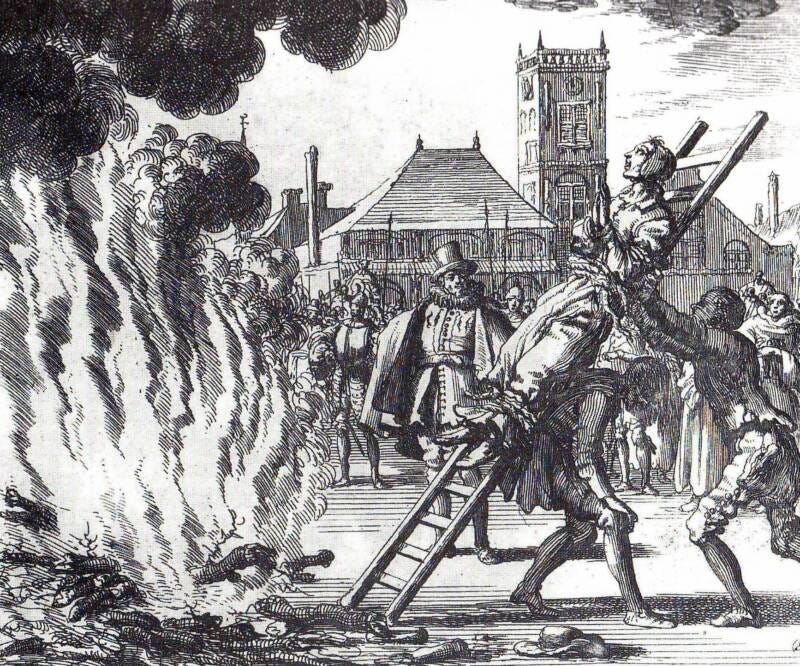
Estates were confiscated and chapels, churches and cathedrals built over sacred sites.
In 1688, when the ‘Glorious Revolution’ deposed the Catholic King, James II, a protestant monarch was propelled to occupy the throne at Christmas, 888 years after Charlemagne’s Coronation as Holy Roman Emperor on 25 December 800 AD. The installment of Prince William of Orange and his consort, Mary, to the English throne paved the way for the establishment of the Bank of England. The ‘Glorious Revolution of 1688’ — which resulted in Prince William of Orange becoming King William III on the British throne after they landed at Torbay, near Brixham, Devon, on November 5 with 250 ships — was secretly bankrolled by English Rosicrucian Freemasons, the Bank of Amsterdam, and Amsterdam Jews, and was part of a two-hundred year Venetian project to takeover Britain. James II was exiled from ‘Protestant England’.
Crucially, Sionist Rosicrucian Freemasonry came to rule over the British Monarchy and the Church of England, after having successfully achieved a political and business merger with the Dutch in 1688, as Nicholas Hagger found in his epic study, The Secret History of the West, that modelled for the patterns of revolutions, how secret societies plotted them and reasons for the subterfuge. Sionist Freemasonry is a revolutionary force committed to forging a universal empire under the rule of one monarch. French Templar Freemasonry developed into a revolutionary force committed to forge a universal empire under the rule of one federal republic. Thus, a hidden ‘Masonic Schism’ underpinned eight millenia of revolutions, wars, and coups d’état.
In this unholy tradition of political violence, Britain and America have constantly inflicted military interventions across the planet since World War II, supposedly purging the globe of evil, whether it was communism, narcotics, or terrorism.
Ergo, Queen Elizabeth’s reign of terror was just getting started. Her Christmas Day broadcast announcing the “most grievous railway accident” was the opening salvo.
Not surprisingly, the night terrors metaphor-laden historical riffing encoded into this tragedy was also entwined with transport-themed protestant and royal references.
A thematic undercurrent appears prior to the crisis, fixed to the event itself, and in the aftermath, masquerading as ‘news’ data to codify sponsorship, caution and to telegraph hidden objectives — as applied game theory predicts to bind the players.
The ‘signals’ show conspiring players are communicating their cooperation to take a plot ‘live’, to convey hidden goals and to broadcast their psychopathic humour.
And, since the Tangiwai Bridge collapsed because the footing of the bridge at Pier 4, had been damaged by a lahar in 1925 — and the subsequent remedial work that periodically occurred, was clearly inadequate — is it not uncanny that the lahar of Christmas Eve 1953 just happened to occur on the same date, December 24th in 1814, when the Church of England minister slept restlessly at a foot of a tree at Rangihoua?
All the more uncanny that the new monarch would claim in her Christmas Day broadcast that the British Commonwealth exemplified the supreme ideal of the ‘brotherhood of man’, that the so-called ‘Prince of Peace’ had allegedly preached. Elizabeth was referring to the mythology of the messianic meta-character, Jesus Christ. She boasted the Commonwealth in “the last half-century had proved itself the most effective and progressive association of peoples which history has yet seen.”
This ‘progressive association of peoples’ was propaganda that masked the reality about a British Secret Elite, who conspired to make two world wars happen to reforge the British Masonic Empire. This two-global war strategy hinged upon gaining footholds in German and Russian industry — between the wars — after luring both countries to smash each other, in order to build up their industrial bases for a bigger war. The British Secret Elite feared an enduring alliance between Germany and Russia. The international network of Freemasonry was mobilized for the Boer War of 1899-1902, as both a test-run of the bonds of the Commonwealth, and to gain the treasures of gold for a war chest, and diamonds for machine-cutting and drilling tools — all in preparation for WWI. In cahoots with American bankers, industrialists and state officials, the British Secret Elite were playing a long game to bind Britain and America into a global empire, whereby the United States would take the lead as the military power. After World War II, Britain was broke; the U.S. became the hegemon.
An airline workers strike, combined with the attraction of the Royals arrival in Auckland over the Christmas break, added to the demand for seats on the Express.
The Queen’s Coronation Tour was theater for a military intelligence operation.
Most New Zealanders don’t realize MI6 appraises the monarch’s overseas travel.
The date meta-data fits the pattern that the collapse of the natural tephra dam holding back Mount Ruapehu’s crater lake was a malicious engineered event.
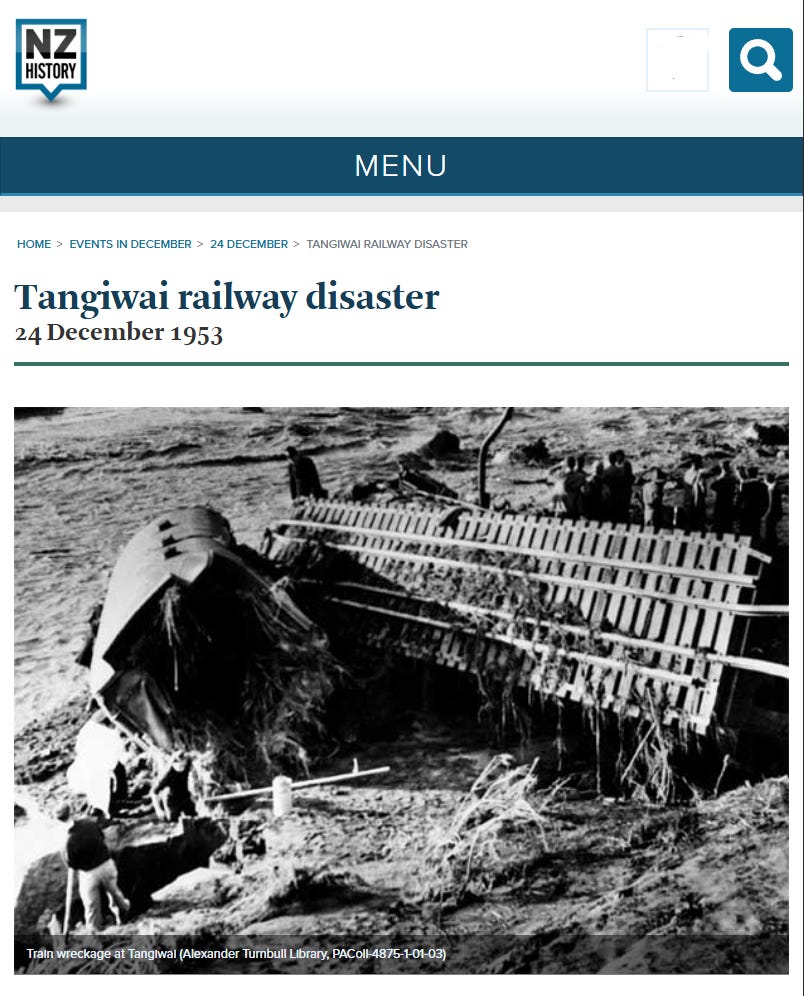
Where the Ballantynes’ Fire was the event when a cryptocracy passed the point of no return, the Tangiwai Railway Disaster was performed as a rite of passage ritual.
It codified New Zealand’s place as a staging ground for novel Trojan Horse terror events contrived to look like disasters, accidents or unforseen lone wolf attacks.
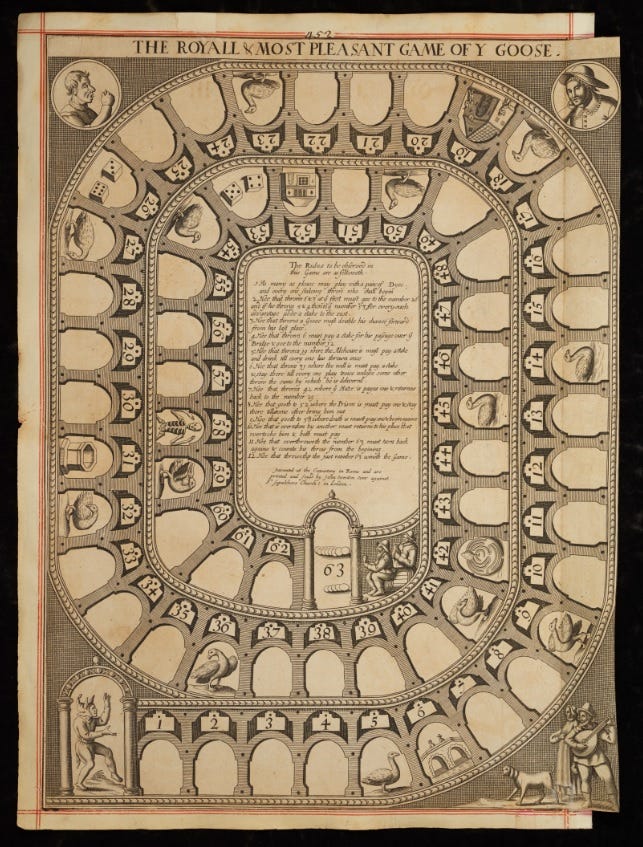
Like a twisted version of a ‘Game of the Goose’, which is an old dice-roll race game originally featuring 63 playing squares representing the “Grand Climacteric” signifying the crucial years of life, and where the Hazard spaces include the Bridge, which is thought to represent a rite of passage — a Terror Archipelago Edition could feature a ‘Tangiwai Bridge’ and a touring Queen expressing sympathy to the bereaved.
Indeed, in this Royal Game of the Goose, which is one of the first board games to be commercially manufactured, it is uncanny that the Hotel Hazard space made an appearance so quickly. Early on Christmas morning, Prime Minister Sidney Holland, was woken by the telephone in his room at the Grand Hotel, a few hundred metres from Government House, to tell him that the northbound express had crashed into the Whangaehu River. Since a Prime Minister has the political power to authorize an inquiry and has the potential to set the tone for a thorough wide-ranging investigation, the cryptocracy was signalling Holland was a controlled asset, it seems.
After all, Holland was a Freemason with the St Johns Lodge No. 37; Freemasons are obligated to not only help a brother out. The Masonic Brethren’s oath of allegience requires them to always follow orders from above. This means a Masonic prime minister can end up serving this hidden subversive British Masonic Empire.
Poignantly, in the Royal Game of the Goose there are six Hazard spaces. The Bridge represents a rite of passage; the Hotel represents the earth; Death refers to a new start; the Maze represents something wrong, and the Well and Prison spaces mean help is required. The game appears to have originated in Italy in the 15th Century as a spiral game created with the intent to symbolize ‘the fates’ humans experience in life.
Ergo, after the bridge disaster — deemed to have occurred by an earthly hazard — the Masonic prime minister is woken by a phone ringing in the Grand Hotel, symbolizing the earthly business. Mr Holland is advised the death toll is high and will likely rise, which adds to the potency of the Christmas Eve train tragedy at Tangiwai. And, while the various officials investigated the scene of the tragedy, its origins and the official records to determine cause, what happened and if anyone was derelict in their duties, they were in effect performing tasks on the Maze hazard space, where the dead got a new start. And so, Mr Holland authorized an inquiry, which in essence meant those officials who were culpable, had to sit still at the ‘Well’ Hazard Square, while Judge W. F. Stilwell presided over the performative theater as the chairman of the Board of Inquiry, to rescue them — lest they landed on the Prison space. That eventuality couldn’t be allowed to happen, since the point of the staged disaster was for it to function as a ‘rite of passage’ ritual on the eve of the monarch boasting how a new kind of empire was forged in half a century by a peace-loving brotherhood of man.
A conspiracy to reforge the British Empire was greenlighted at Lord Nathaniel Rothschild’s country estate on February 15th 1890, as Gerry Doherty’s and Jim Macgregor’s recount in Hidden History: The Secret Origins of the First World War. The 1890 scheme evolved into a plot for war against Germany with Russia as an ally to get the two to smash each other twice, because a British Secret Élite viewed the possibility of a trade alliance between Germany and Russia as a death knell to the British Empire. This Secret Élite established the Round Table Movement in 1909, which published a journal to get élites to rally around the Empire, promising a ‘universal peace’. The real plan was to destroy nation state autonomy, with super-imperialists ruling the world, as Guido Preparata’s Conjuring Hitler: How Britain and America Made the Third Reich, and William Engdahl’s A Century of War: Anglo-American Oil Politics and the New World Order — make abundantly clear. But, Britain over-reached, and it’s empire morphed.
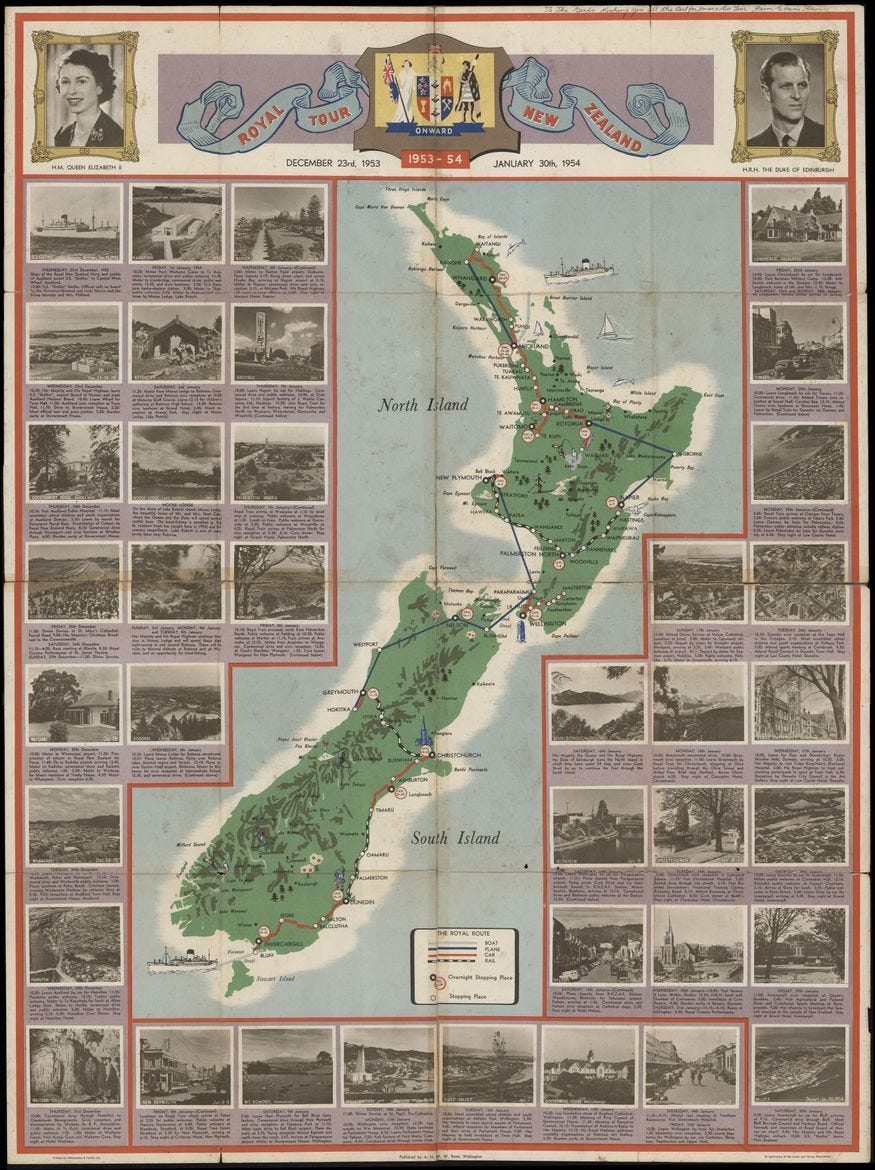
The new monarch was appealing to the idea and ideal of the Commonwealth as an ‘innovation’ to sustain a new kind of empire. Snoopman contends a masonic ritual had just taken place in which a railway bridge was destroyed, as a form of psycho-drama to symbolize the chasm between the uninitiated gentiles sacrificed on Christmas Eve, and the secret brotherhood, who had wittingly participated in reforging the Empire.
The ‘disaster’ codified a threat to maintain a cone of silence about the secret elect.
The better designed replacement bridge not only symbolized the price of this night terrors-themed ‘rite of passage’ ritual. This symbol sorcery also codified the need to ensure there were ‘institutional bridges’ built around this reforged “new kind of empire”, to ensure careful preparation of apprentice catechumen. The Protestant Freemason Lodges had proven to be an effective replacement to early the Christian Church’s Catechumenate during the second century of the First Roman Empire.
➳ Terror on the Antipodean Express
Lahar Definition: “A lahar is a type of mudflow that occurs in volcanic areas. Lahars may be formed by the waters of crater lakes being released by the collapse of the crater wall or by volcanic eruption, by the melting of snow and ice by volcanic heat, or by the action of rain on volcanic ash deposited on the steep slopes of volcanoes. They usually pick up large quantities of volcanic ash and other debris, and form a thick slurry that on account of its high density may carry even enormous boulders for many miles across fairly flat country once the initial momentum has been gained.” — Board of Inquiry ReportOn December 24th 1953, at 10.21pm the Wellington to Auckland passenger express train plunged into the raging Whangaehu River, at Tangiwai, south of Ruapehu.
Yet, there had been no storm that day and no rain had been forecast. Locals of the Volcanic Plateaux region knew the brewing danger of one of those mountains. Mount Ruapehu had errupted in 1945 and since that time the crater lake had been refilling.
The train had cruised through the Tangiwai Railway Station, one mile to the south of the Whangaehu River, at 40 miles an hour. The locomotive crew cut the oil, released sand and breaked on seeing the curved river-bed was a swirling flooded peninsula.
The sparks of the screeching train wheels were visible to Trevor Wildbore on the opposite bank, who had been in a car with Robert Somerville, driving from Ohakune.
A Board of Inquiry found the bridge had partially collapsed due to a raging torrent carrying boulders that had been unleashed by a lahar from Mount Ruapehu. The locomotive and the first six carriages derailed into the river, killing 151 people.
One of the enduring mysteries was why the Department of Railways, the Department of Science and Industrial Research and the Rangitikei Catchment Board had not coordinated their efforts in 1945, when Mount Ruapehu erupted, to monitor the lake.
In 1951, two men, Lewis Vause and Jim Mason, had produced a report after measuring the rate of the lake’s rise, raising concerns about what would happen in two to three years’ time. They described how to carry out a controlled release of the lake’s water to avert catastrophe. They presented this report to the DSIR’s Branch of Geological Survey. They received no response. The Inquiry received their report, minus their solution. Lewis Vause was adamant a cover-up occurred during the Board of Inquiry.
And, there was far more to the cover-up. The bridge had been damaged by a lahar in 1925 and it had not been properly repaired, despite locomotive crews reporting a fault.
At Taihape, the ‘Limited Express’ locomotive and crew were changed. Charles Parker, a special grade engine driver with 33 years of service, and fireman Lance Redman replaced the Wellington crew and Locomotive KA 949 was coupled to the Express.
That fateful night there were four passenger express trains scheduled for the main trunk line run to Auckland. A freight train travelling down through the King Country stopped at Karioi Station, located to the north of Tangiwai Bridge, to shunt wagons.
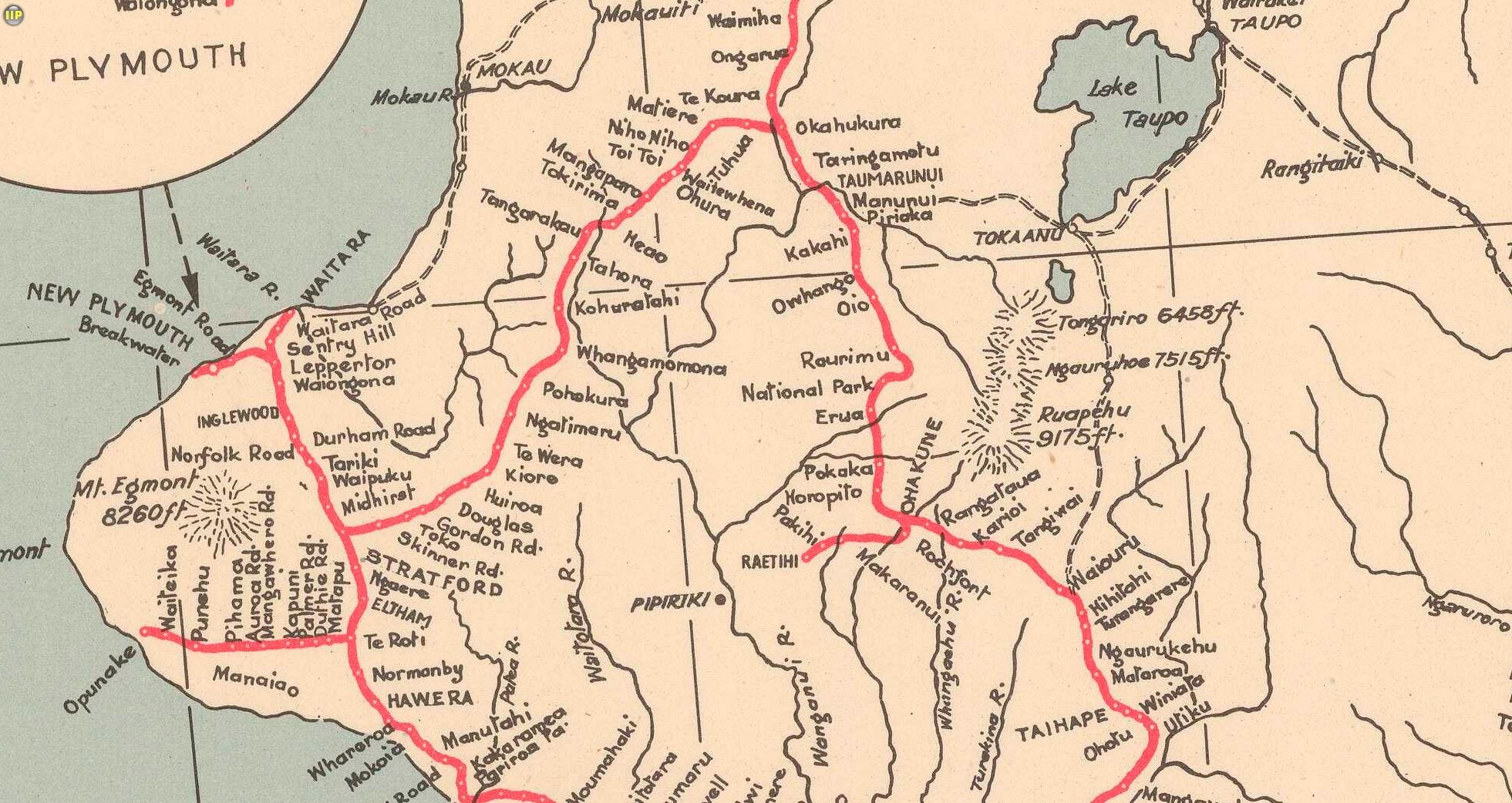
The freight train was running late, and was made to wait for the doomed Express to pass. This fateful decision meant that the freight train did not travel over the damaged Tangiwai Bridge. At 10.09 p.m., the Waiōuru Station master cleared the 467 tonne Express train to leave the station. Yet, at 9pm, a policeman at Waiōuru heard the sound of a roar coming from the direction of the mountain. Despite a rumbing roar originating from the Whangaehu River, one mile to the north of Tangiwai Railway Station, the Station Agent, Raymond Hall, from his signals hut let the No. 626 cruise on through, on time at 10.20 p.m. to its doom at a speed he described in the log book, as “approximately 40 miles per hour” and “going slower than usual”. No one rang him.
The No. 626, at 33 tonnes shy of 500 tonnes, screeched at 200 yards from the bridge.
Popular accounts of the Tangiwai Railway Disaster make it seem like there was a significant volcanic eruption that triggered the ejection of the crater lake contents.
At 8.02pm, an ash barrier on the edge of Mount Ruapehu’s crater lake collapsed.
Approximately two million cubic meters of water was hurtled down the river carrying ash from an eruption in 1945, along with huge chunks of ice, and sweeping up sand, silt, trees and boulders. Between 10:10pm to 10.15pm, the headwaters of this torrent reached the Tangiwai Rail Bridge, smashing a concrete pile, Pier 4, and collapsing spans 2, 3 and 4 at the northern end. At 10:20pm, the flood waters peaked, six yards above normal. The lahar wave took two hours and 15 minutes to travel the 38 km to the Tangiwai Bridge at an estimated average flow velocity of 4.7 m/s (16.9 km/hr).
The volume of flood at the bridge was estimated to be 30,000 cubic feet per second or greater, according to the Tangiwai Railway Disaster Report of 30 April 1954.
In volcanic terms, the lahar ‘eruption’ forces were a burp. The determining factor was the size of the rupture to the crater lake, adding to the flow. The timing was ‘perfect’.
The date meta-data fits the pattern that the collapse of the natural tephra dam holding back Mount Ruapehu’s crater lake was a malicious engineered event.
Not surprisingly, the metaphor-laden historical riffing encoded into this tragedy was a transport-themed one. It was also entwined with protestant and royal references. A thematic undercurrent appears prior to the crisis, fixed to the event itself, and in the aftermath, masquerading as ‘news’ data to codify sponsorship, caution and objectives.
The mayhem makers of the Tangiwai Rail Bridge ‘accident’ peddled a mythology that the bursting of the crater lake dam at 8.02 pm on the evening of December 24th 1953, was a natural event. Or, in insurance industry parlance, an ‘Act of God’.
Let Snoopman unbraid the psychopathic humour at play in the Tangiwai myth.
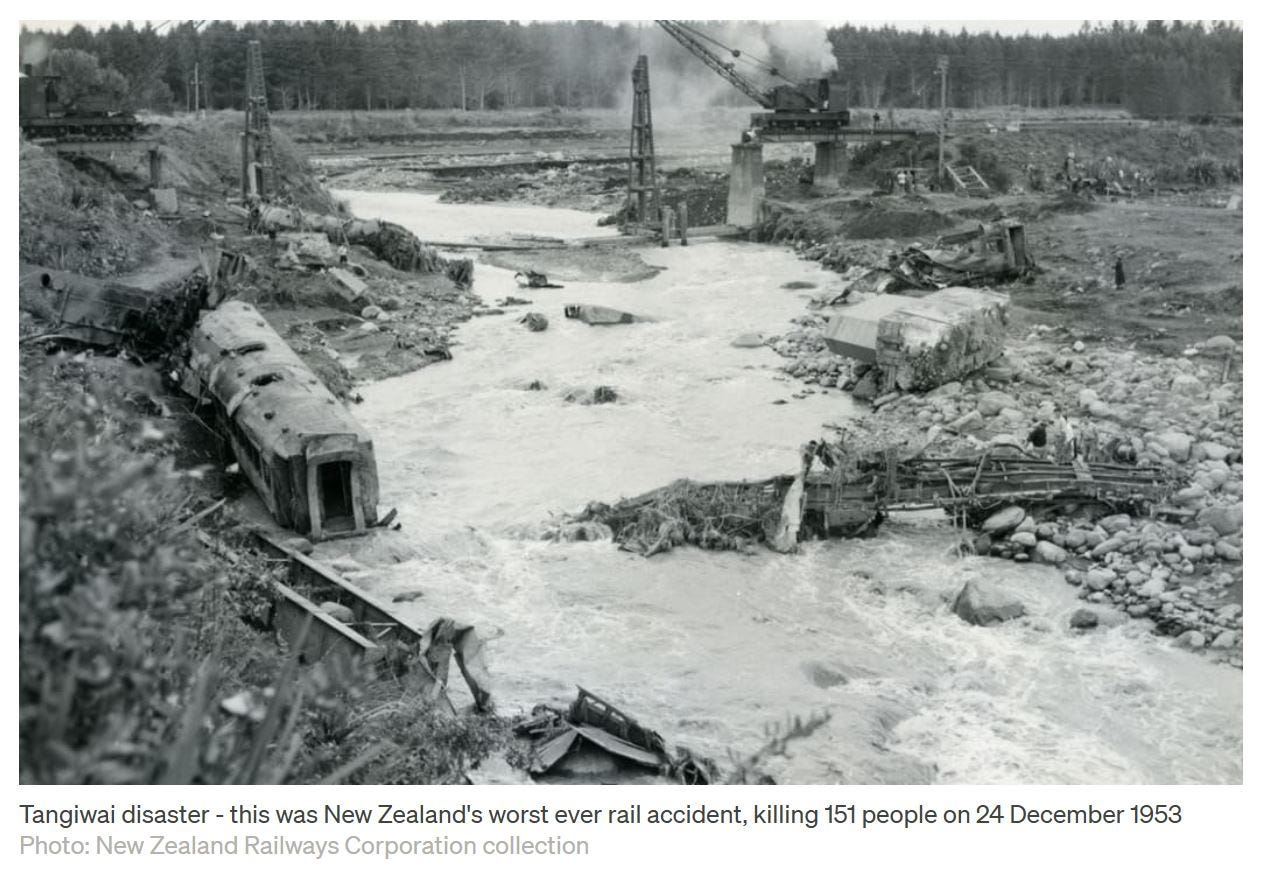
On Christmas Eve, the Wellington to Auckland Limited Express was packed with travellers intending to be with family for Christmas; a Christian event marking the alleged virgin birth of the world’s most famous messianic figure. And, passengers were also anticipating to see the Queen on Boxing Day at Ellerslie Racecourse in Auckland. But, the train’s destiny is doom and its destination is the tumultuous torrent of the Whangaehu River, at Tangiwai, or the place of ‘weeping waters’, as the name translates from Māori. Ergo, the ‘Tangiwai Disaster’ contains the ‘fingerprints’ of an élite criminal network hacking history to wreak havoc to help reforge an empire, while controlling the narrative arc. The inevitable public inquiry would find ‘God’ is to blame for N.Z.’s worst rail disaster occurring on the eve of Christmas, which marks the alleged birth of a cultural meta-character — Jesus — who just happened be born to a virgin just like Marduk, Gilgamesh, Buddha, Osiris, Dionysus, and Genghis Khan.
What are the odds the public inquiry into a disaster, featuring a train driver of 33 years service, would commence 33 days later? The driver does his best to limit the loss of life in his last seconds, aboard a passenger train whose weight is approximately 33 tonnes short of 500 tonnes, on the eve of a religious holiday celebrating the ‘virgin birth’ of a tax-loving carpenter, who was allegedly crucified at aged 33 years.
Snoopman wasn’t surprised to find to protestant missionary, transport and royal references, layered into the day of the disaster at the place of the ‘weeping waters’.
After all, the thematic historical riffing spun on a fulcrum of Christmas Eve 1953.
On December 24th 1814, Anglican Reverend Samuel Marsden slept restlessly at Rangihoua. The Church of England missionary was a major force in assimilating Māori to ‘British civilization’. And, on December 24th 1857, the first New Zealand steamship, the Governor Wynyard was launched at Auckland. This steamship was named after Lieutenant-General Robert Henry Wynyard, who was born on 24 December 1802, at Windsor Castle; he had managed constitutional issues in the 1850s.
On December 25th 1953, New Zealanders woke up to news of the aweful rail ‘disaster’. By noon on Christmas day, the horrific details spread to newsrooms across the globe.
In the 1987 revised edition of New Zealand’s Darkest Days, Bruce Morris wrote:
“In Māori, Tangiwai literally means weeping waters. And there have never been as many tears of sadness shed on Christmas in New Zealand, as there were in 1953”.
This news was carried by radio, since newspapers didn’t print on Christmas Day.
Given that the rail ‘disaster’ was codified with a transportation ‘firsts’ theme and also protestant and royal references, what are the odds the theming extended to another protestant and royal first on Christmas Day 1953, featuring a technological first for the new monarch? On December 25th, in her first Christmas broadcast as the British Monarch on her Coronation Tour, Queen Elizabeth II acknowledged Tangiwai, feigning sympathy for the bereaved. This broadcast was relayed from Government House, Auckland, via the new Himitangi Transmitting Station, and out to the world.
Since the British Monarch is also the Supreme Governor of the Anglican Church of England, what are the odds that Queen Elizabeth’s sympathy ritual riffed off Marsden’s performance of the first Christian service in New Zealand on December 25th 1814? After all, the ‘Tangiwai Railway Disaster’ happened while many of its passengers slept, on the date that the first protestant missionary Rev. Marsden slept restlessly, as someone might with a case of night terrors, under a tree at Rangihoua.
What are the odds that the Auckland-bound steam-train would plunge into the ‘weeping waters’ on the date of the first New Zealand built steam-ship, the Governor Wynyard being launched into Auckland Harbour, the ‘land of a thousand lovers’?
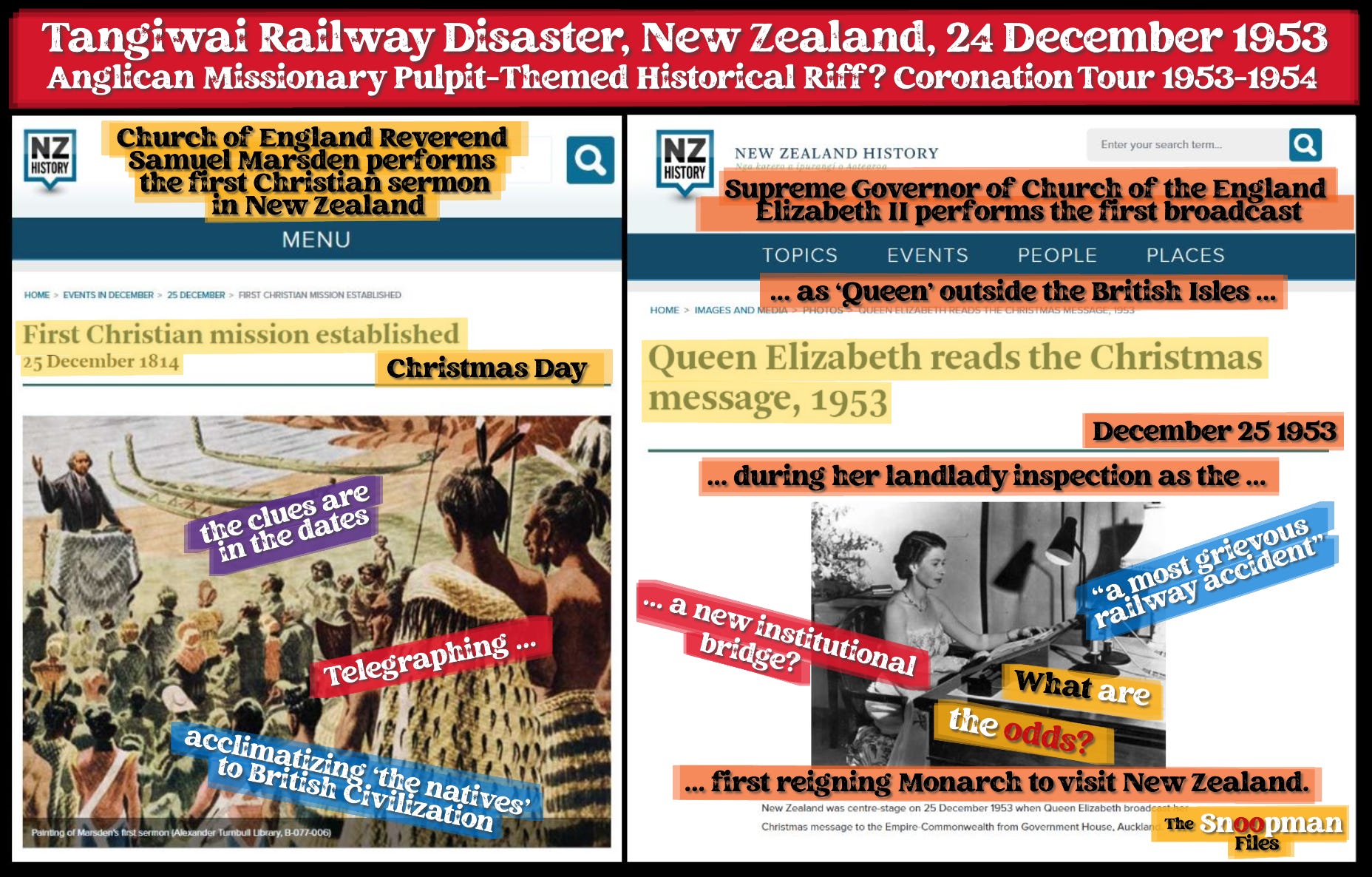
And so, the news of the Mount Ruapehu lahar commenced on Christmas Day following the bursting of the natural volcanic tephra dam. This news just happened to riff off the first ascent of Mount Cook/Aoraki by Jack Clarke, Tom Fyfe and George Graham in 1894. Their ascent clinched their place in mountaineering history as the first men to set foot at the summit of New Zealand’s highest mountain peak.
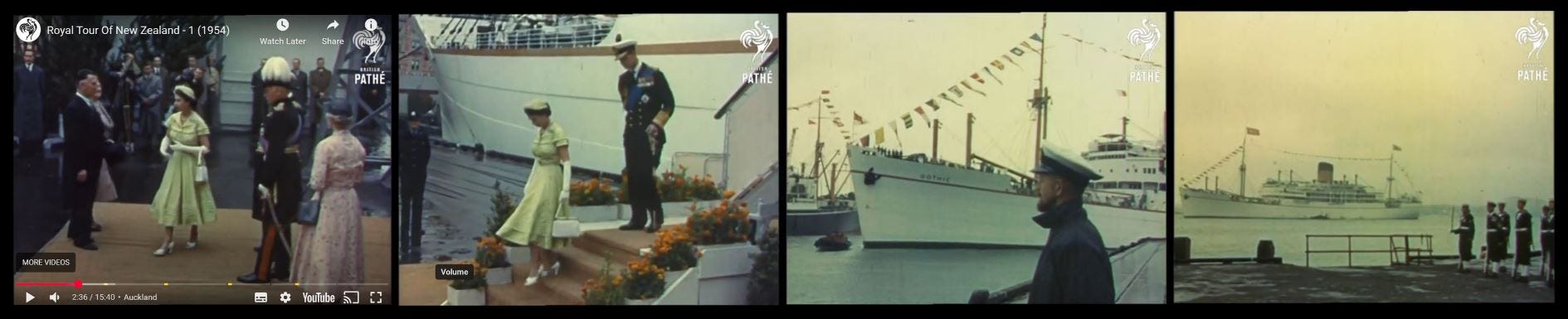
The Queen, who was also the Commander in Chief of the British Armed Forces, had arrived in New Zealand on December 23 with the Duke of Edinburgh, as part of a seven month-long landlady inspection tour of Her Majesty’s imperial possessions.
Uncannily, Her Majesty’s arrival found royal historical correspondence. On December 23 in 1846, the colony was divided into two provinces with a Royal Charter; ‘New Ulster’ and ‘New Munster’, but were later changed to the North Island and the South Island, to keep it simple for immigrants to embark on the correct ships at port.
The historical moment of Elizabeth II stepping ashore in Auckland City was captured by news crews. New Zealand Herald photographer Graham Stewart recalled his picture was the first time the newspaper ran a photograph on the front-page.
Elizabeth II was the first reigning monarch to set foot on New Zealand soil. It was an exciting year for New Zealand. A beekeeper scaled Mount Everest. An American vice president, who would later make the Watergate Hotel world famous, had also visited. And, it was the year that Auckland became the first city to introduce parking meters.
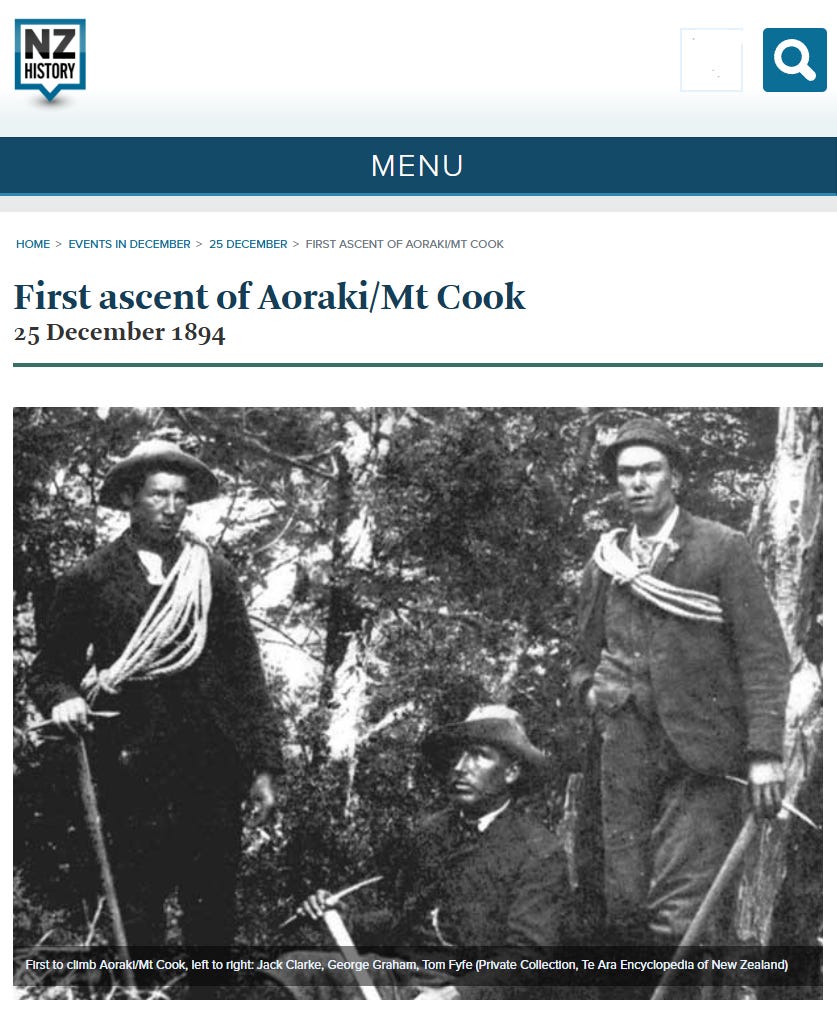
Was the publication of Queen’s photograph on the Herald’s frontpage on Christmas Eve morning, the ‘go signal’ to go live with the black operation to blow the crater lake?
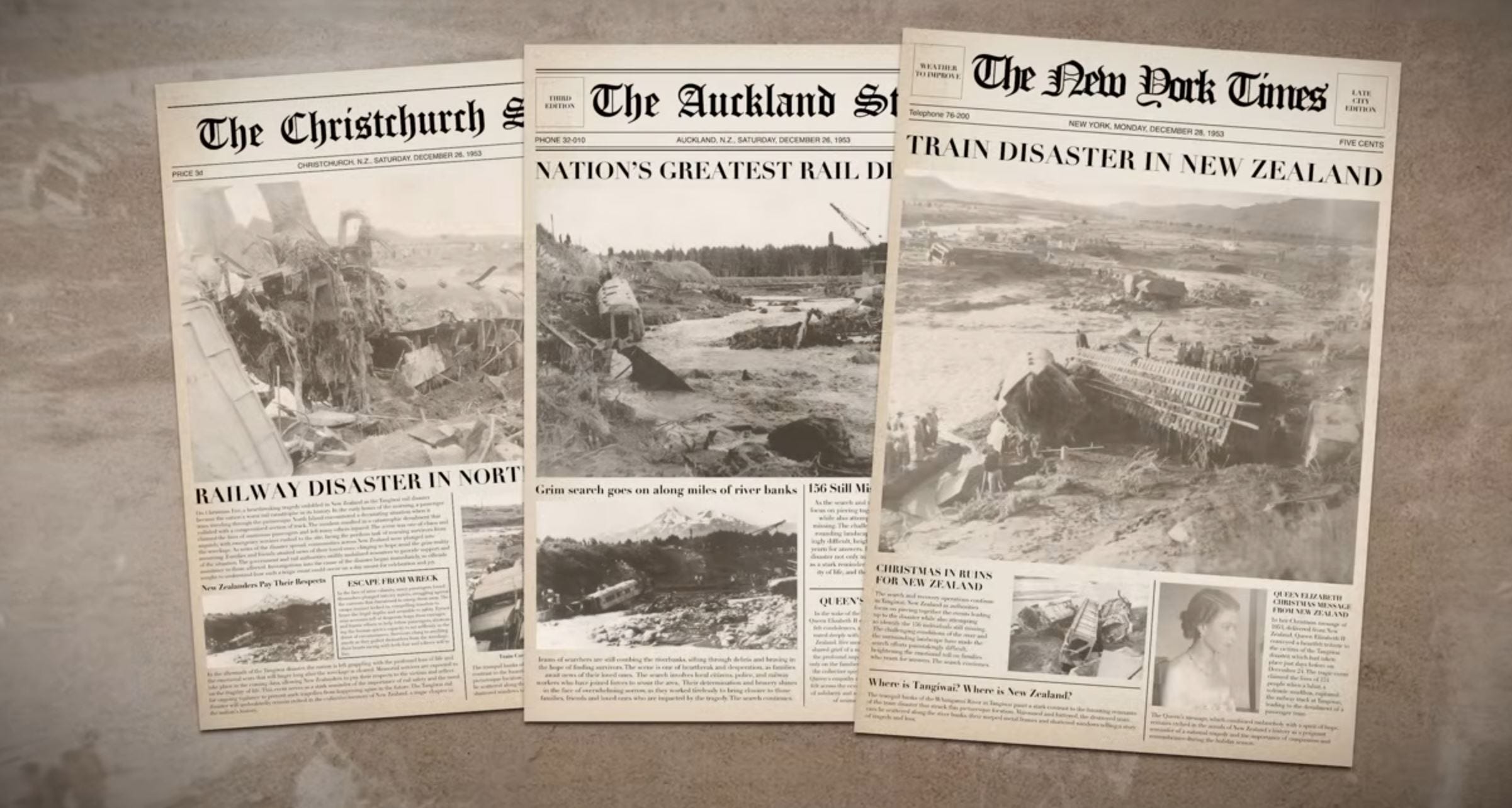
Mr Stewart said his photographs of the Tangiwai Rail Disaster also made the Herald frontpage, on December 26, as well as other newspapers, including the New York Times.
After the rail disaster made the front-page news with photographs, the New Zealand Herald resumed to leading with bland notices and adverts on the front-page.
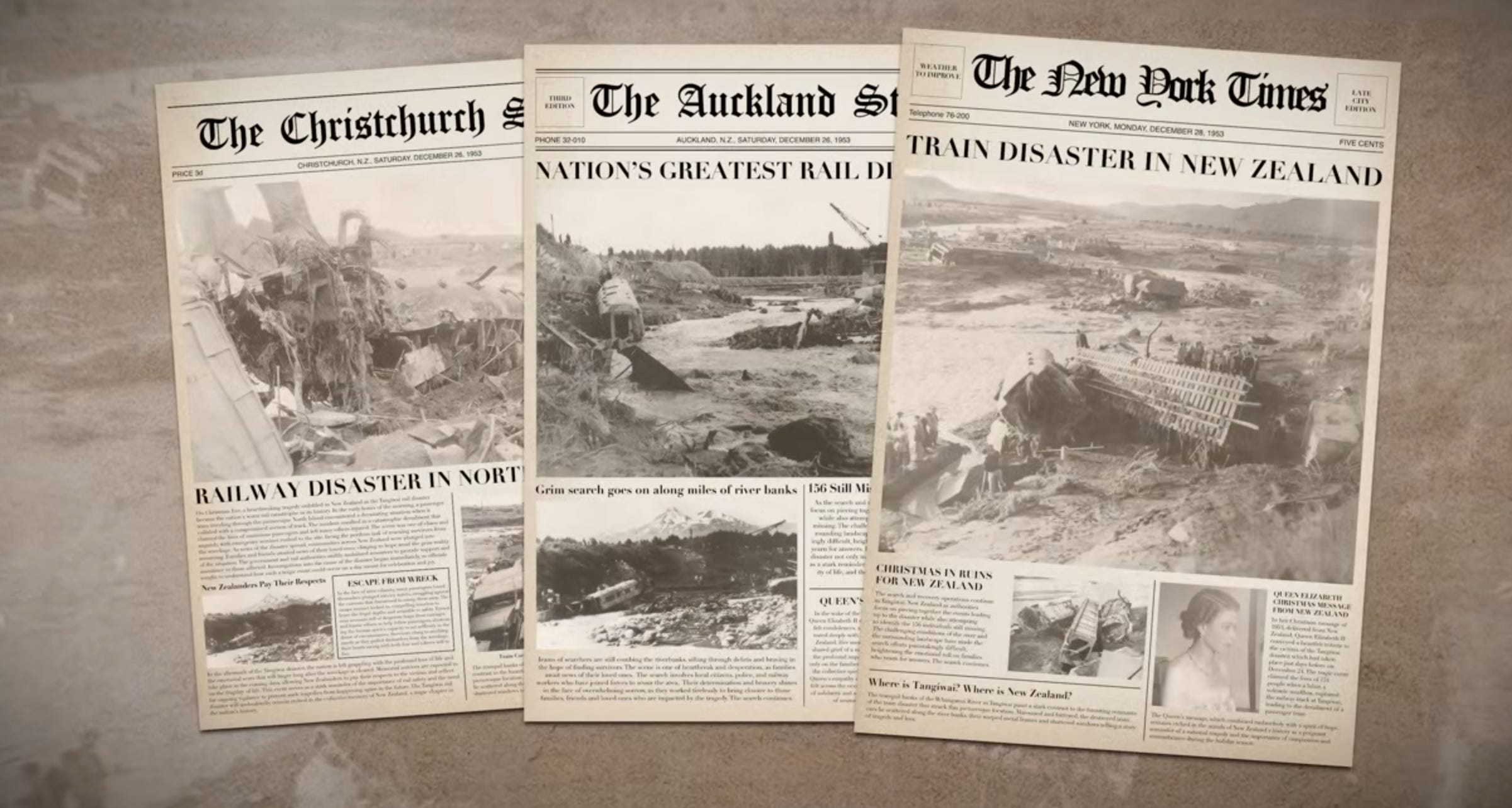
On 31 December 1953, Queen Elizabeth and Prince Philip were welcomed at the town of Te Kūiti, in the King Country. From there, the Duke of Edinburgh travelled by air to Wellington to attend a mass funeral for 21 unidentified victims. Later, that day, the Royal couple travelled to the Waitomo Caves and visited the glow-worm cave and Aranui Cave. They stayed the night at Waitomo Caves Hotel in the King Country.
Poignantly, on 31 December 1877, the provincial liabilities were added to New Zealand’s National Debt. The psychopathic humour taunted the dead. The cost of the disaster, including the investigations, clean-up and reconstruction would be added to provincial and national debt ledgers. Death and taxes had a fraternal friend: debt.
On January 7 1954, after a trip to the Watties canning factory at Hastings, the monarch boarded a train for Palmerston North. Ergo, the Queen expressed confidence in New Zealand’s Railways Department. How uncanny that on January 7th 1910, the administration of the Order of St John in New Zealand was undertaken by a Dominion executive, as any newsroom possessing a copy of A.W. Reed’s It Happened Today in New Zealand would know. The Monarch is the Sovereign Head of the Order of St. John.
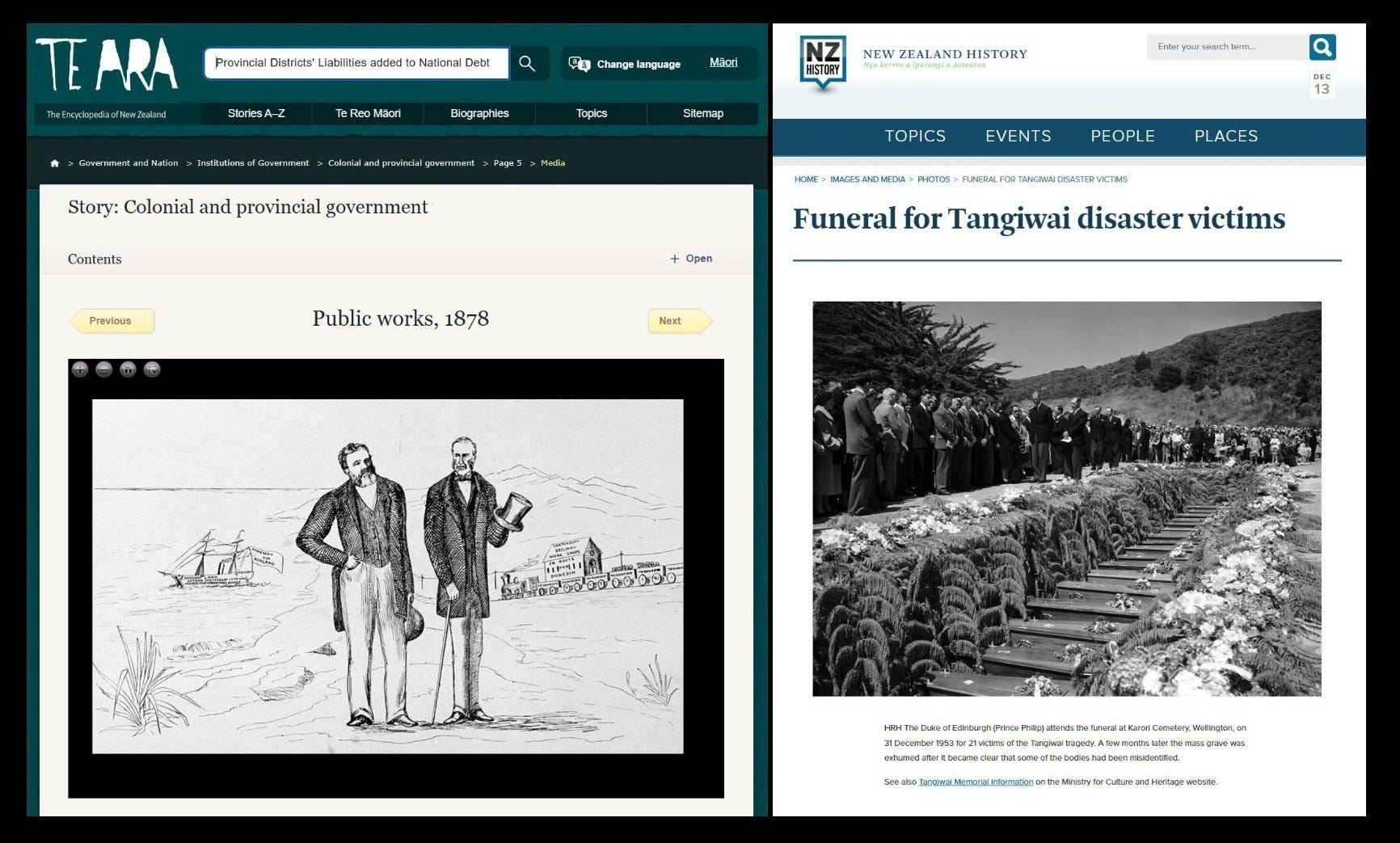
Therefore, this date carries a potency since the Sovereign Military Hospitaller Order of St. John of Jersalum, of Rhodes and of Malta is a descendant militant religious order that was first established in the ‘Holy Land’ and expanded to Cyprus, Rhodes and Malta as a “bulwark of Christendom against the onslaught of the Saracens”, as Denis Blundell framed the history in his preface to The Order of St. John in New Zealand, which was edited by Dr Rex E. Wright-St. Clair, and published by the Priory in New Zealand of the Order of St. John, Wellington, New Zealand in 1977.
The Crusades were described as a great socio-religious movement devoted to freeing the Holy Land from “the Moslems”. And so, we should not be surprised to learn that in 1915, during the First World War, amid flak copped by Winston Churchill, as First Lord Admiral of the Royal Navy, for overseeing the military ‘disaster’ at Gallipoli, the 33°Freemason bragged that “Australia and New Zealand [were] smiting down in the last and finest crusade the combined barbarism of Prussia and of Turkey.” The brutal truth was the British Secret Élite devised the Gallipoli Campaign in the Dardanelles to sacrifice Australian and New Zealand men. Tsar Nicholas II was promised the port city of Constantinople as a ruse to keep the Russians in the war on the Eastern Front. The Tsar failed to comprehend that one purpose of the ‘Great War’ was to get Russia to smash Germany, for the British feared an enduring trade alliance between them.
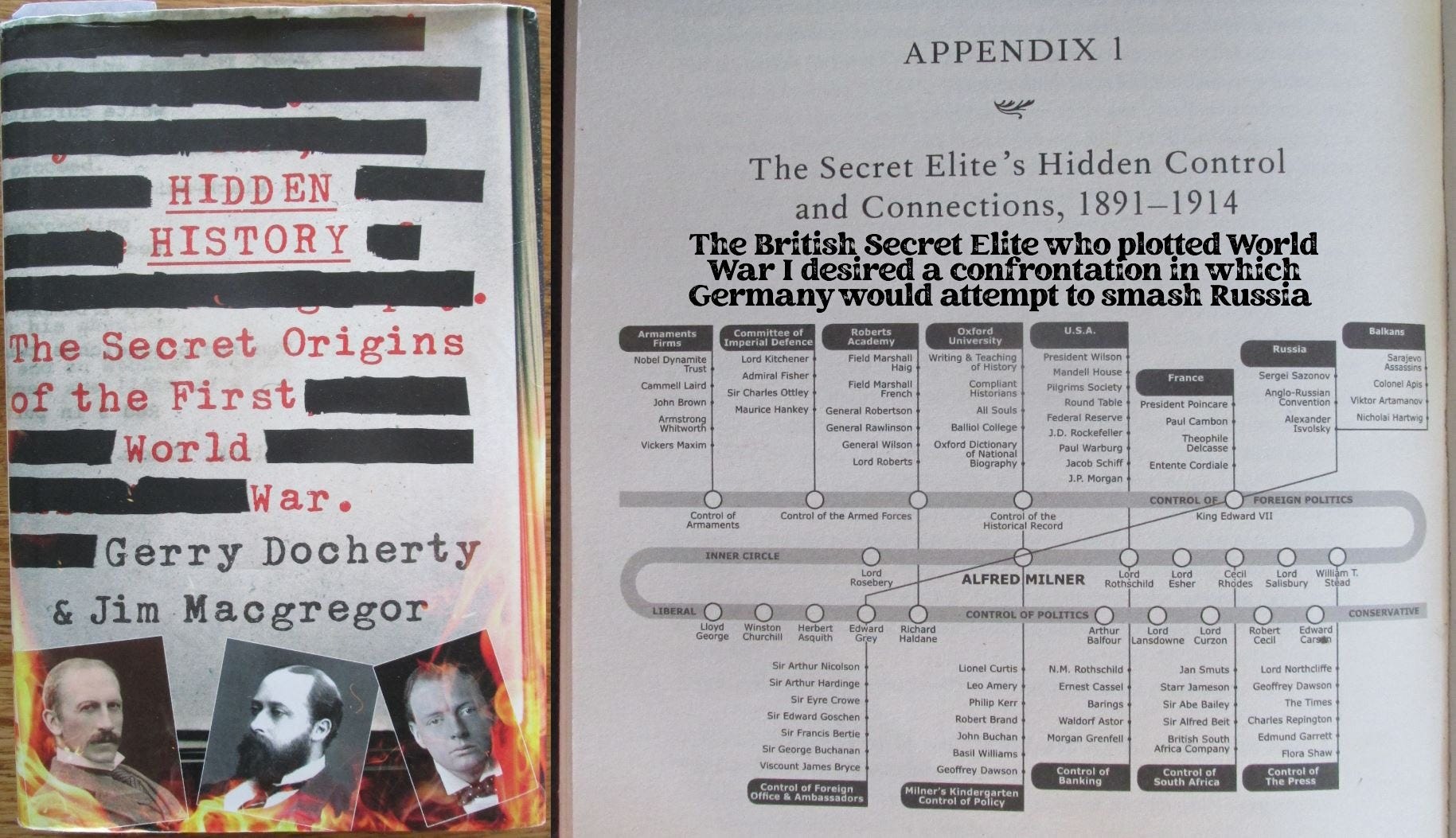
Given that British Empire was comprised of a visible Christian layer on the surface, and a subversive revolutionary Masonic layer below, Queen Elizabeth’s “brotherhood of man” rhetoric relayed around the British Commonwealth and Empire with potency.
His Royal Highness The Duke of Edinburgh was initiated into Navy Lodge No. 2612, on 5 December 1952, and advanced to the Third Degree on 4 May 1953. This Lodge prides itself as the premier Naval Lodge in the world, with an unparalleled history that includes four monarchs as past members — including King Edward VII.
As Grand Master of English Freemasonry, Edward VII was positioned at the centre of an epic gambit of the British ‘Secret Elite’ to construct a universal empire that involved laying siege to Germany, which was in the midst of constructing the Berlin to Baghdad Railroad to transport oil. Such a trans-continental link to major sources of oil would have become a competitive route to the Suez Canal, which the British and French controlled as a geo-political choke point and an economic toll booth. A trade alliance between Deutschland and the Muslims of the Ottoman Empire couldn’t stand.
As King, Edward VII played an instrumental role in enticing France and Russia into secret alliances with Britain in a long game against Continental Europe’s leading industrial powerhouse: Germany. The ‘Secret Elite’ constructed a triple détente agreement with France in 1904 and Russia in 1907 that bound these powers to fight with Britain if any one power were at war with Germany, or the other Axis Powers.
And, as the sovereign head of the occult Order of the Garter, Edward VII drew the royalty of Spain, Portugal, Russia, Italy, Sweden, Persia and Japan closer by investing them as ‘stranger’ Garter Knights. In this way, King Edward VII used the Order of the Garter as a secret mechanism for hidden world domination objectives. As the monarch, Queen Elizabeth II became the Sovereign Head of the Order of the Garter.
With that history, Snoopman raises a snoop-eyebrow listening to the Queen’s 1953 Christmas Day broadcast, in which she claimed her people were “celebrating the birth of the Prince of Peace, who preached the brotherhood of man.” Since the monarch alleged the Commonwealth was distinguished from all previous empires because it had created a brotherhood pursuing peace, freedom, friendship, loyalty, equality and harmony, it’s clear the propaganda of the monarchy’s Royal Tour was about gluing this ideological adhesive in the minds of the masses at a time when the Empire was reinventing itself because numerous colonies had taken the wartime rhetoric about freedom to heart, and had organized rebellions against their British imperial masters.
➳ Tangiwai Railway Disaster Precursor and Aftermath Historical Date Riffs
In effect, the Tangiwai Disaster Inquiry blamed ‘God’ for the tephra dam breach.
The Inquiry Board stated it was required to establish:
“Whether at any material time or times any person in the service of the New Zealand Government failed to exercise reasonable care or to fulfil any duty or responsibility reasonably to be expected of him in relation to the circumstances leading to the accident.”
“The answer to that question is, No.” — Tangiwai Disaster Inquiry Board, 30.04.1954
This slim answer represented a fashionable economy with truth, dressed up like silent mannequins standing in a department store display, while the inconvenient evidence lay stored in a back office. Sexy propaganda distracts from ommissions of evidence.
The danger was not only predicted and preventable. The date meta-data is the ‘dead giveaway’ that the disaster was also planned. The Board of Inquiry was a cover-up.
The counsel included a future Governor General, Edward Denis Blundell, who had served in the New Zealand Expeditionary Force, while Reginald Hardie Boys — whose son would also ‘grow up’ to be a Governor — advised the Inquiry Board at Wellington.
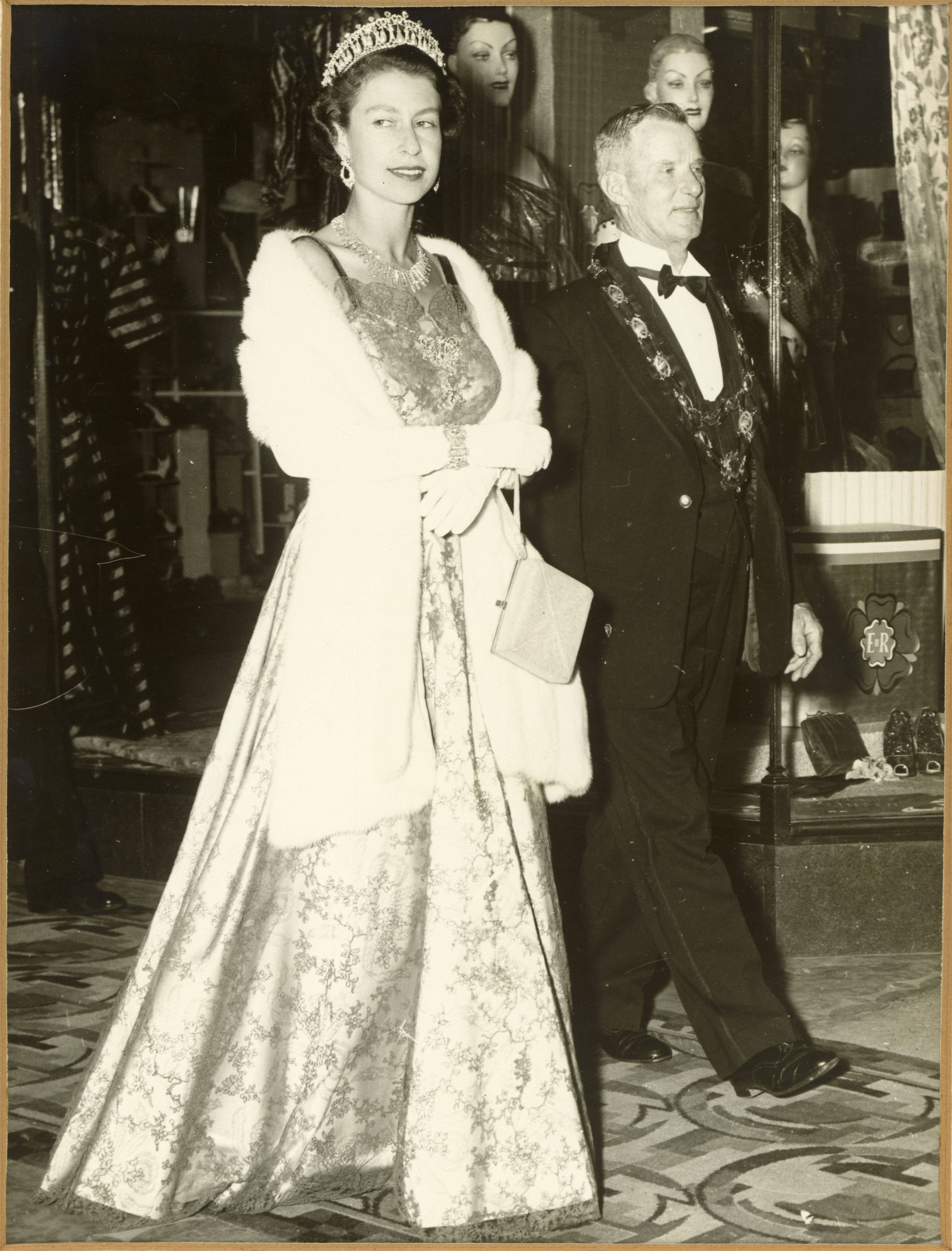
While the evasive testimony of the Railway Department’s engineers contrasted the criticisms of independent engineers, the Tangiwai Railway Disaster Inquiry Board did not excoriate anyone for wrong doing. Yet, Pier 4 was badly damaged by a lahar in 1925 and was not properly repaired, nor replaced. Despite engine crews reporting a slight ‘sideways kick’ as they passed over the bridge — due to Pier 4 being shoved a half inch off center by the 1925 lahar event — no criminal prosecutions followed. The scouring of Pier 4 between 1925 and 1953 was played down by the Board of Inquiry.
The Inquiry hearings, which commenced on January 26 1954, pinned the cause of the ‘accident’ on the failure of the natural tephra dam surrounding the Crater Lake at the summit of Mount Ruapehu. However, casting a finger of blame as an ‘Act of God’, is filthier than the volcanic silt in the turbulent torrent that Christmas Eve in 1953.
Judge W. F. Stilwell, who had presided as chairman over the Inquiry into the tragedy at Tangiwai, or the place of weeping waters, claimed no one was to blame.
And, those officials who were culpable, in essence, had to sit still at the ‘Well’ Hazard Square, like in a Royal Game of the Goose for Judge Stilwell’s Inquiry to rescue them.
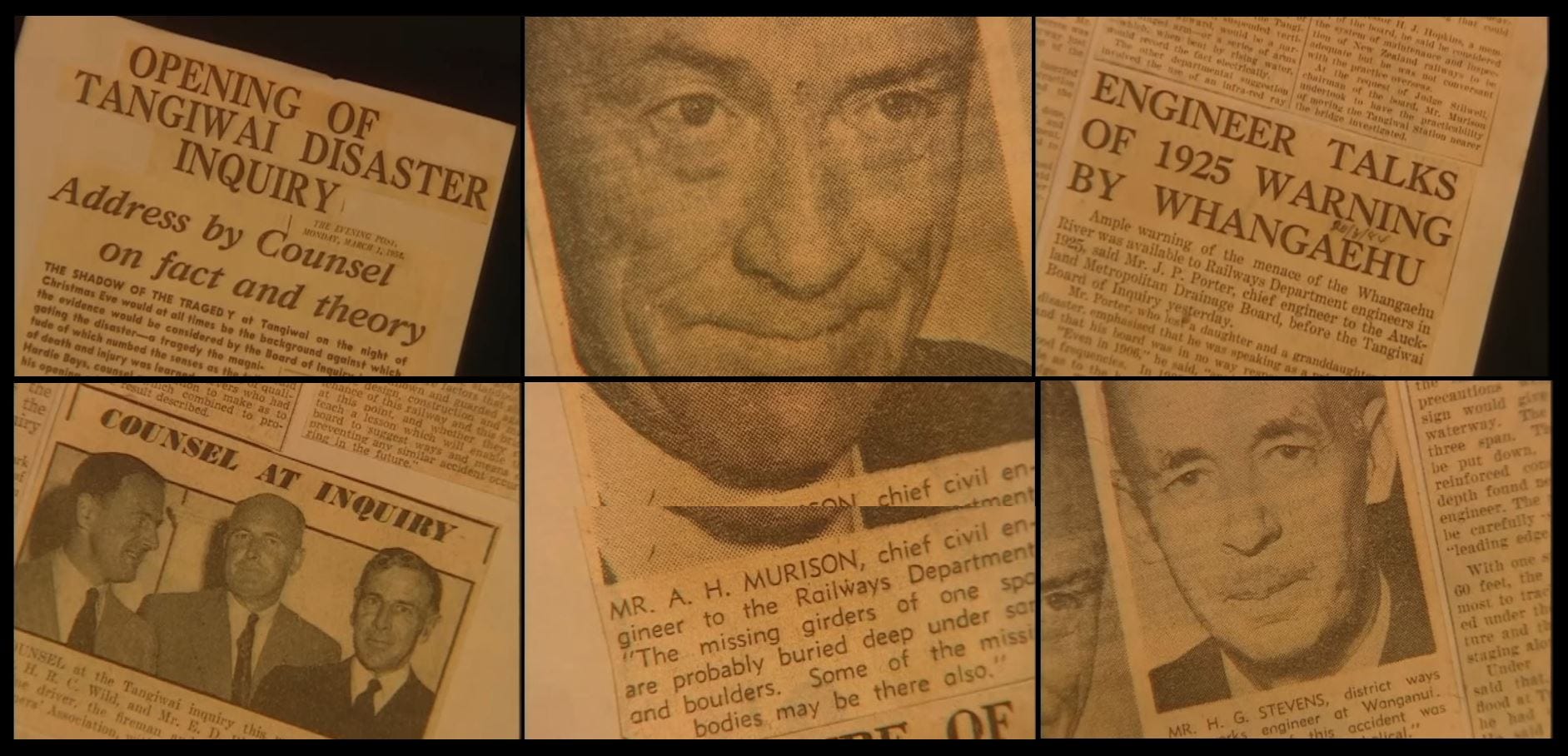
Not only had the dangers of the Whangaehu River featured in Willis’ Guide Book and the Government Year Book from 1899, noting the waters from the Crater Lake flow through underground channels into the river laden with ice and debri. Strangely, Professor Cotton’s widely shown film about the 1945 Ruapehu eruption, downplayed his warning of a lahar event that could flood the surrounding countryside. Yet, a report in 1951 was produced by Lewis Vause and Jim Mason, who measured the Crater Lake’s depth, estimated its volume and tracked the rate of the lake’s rise. They observed the Crater Lake’s hot muddy water rising above the hard rock perimeter and undercutting the surrounding glacier, which accelerated the rise. The soft ash wall was the only embankment holding the huge volume of water together as a lake. Vause mailed his 1951 report to the DSIR’s Branch of Geological Survey, raising concerns about what would happen in two to three years’ time. He received no response.
In 1952, a fire destroyed archived records for the departments of Public Works and the DSIR’s Geographical Survey Branch, housed in Wellington on Dixon Street.
The dates meta-data related to the official inquiry reveal a cover-up operation.
Prime Minister Sidney Holland authorized a warrant dated 18th day of January 1954. On January 18th 1840, Captain William Hobson left Sydney for New Zealand aboard the HMS Herald, on his mission to swindle paper sovereignty from ‘the natives’.
The Inquiry Board’s hearings began on January 26 1954. This date was packed with symbolic potency, given the matters at hand. On January 26 1815, Reverend Samuel Marsden departed the Bay of Islands at the conclusion of his first stint in New Zealand. And on January 26th 1883, the first direct steam communication between England and New Zealand was inaugurated by the New Zealand Shipping Company.
Ergo, the sovereignty, protestant and steam transport theming continued while the Royal Visit was drawing to a close. The cryptocracy were in charge of the inquiry.
The Inquiry’s original deadline to report was on February 27th 1954, but the Inquiry recommenced on March 1st. As if to note the complicity of the Railways and the DSIR’s Geological Survey Branch, it was on February 27 1890 that William Fox climbed Mount Egmont/Taranaki at age 78. If an energetic 78 year-old — who was a New Zealand Company agent, who had served as premiere four times and who had confiscated Māori lands — could climb Egmont at 78, then what was stopping ‘All of the King’s Horses and Men’ at the Department of Railways, the Department of Scientific and Industrial Research, and for that matter, the Rangitikei Catchment Board, from journeying to the volcanic plateau in ’51, for the fittest men to climb Mount Ruapehu? After all, a beekeeper and a sherpa had cracked Everest in ’53.
The Inquiry’s recommencement date on March 1 just happened to coincide with the historical date March 1st 1865 when Reverend Carl Sylvius Völkner was arrested at Ōpōtiki. He was confronted with intercepted letters showing he had been passing information to soldiers about Whakatōhea, as former Radio NZ producer Tony Simpson retold in his 1979 book, Te Riki Pakeha/The White Man’s Anger. Völkner was hung the next day as a traitor, as Executed Today records, after a brief trial in a runanga house where it was laid bear that he had betrayed the tribe’s trust, who had adopted him as a spiritual teacher. The resumption of the Inquiry codified the need to control the presented evidence. So, the Inquiry’s new deadline was extended to the 14th day of April, and later to the 30th day of April 1954. The signals intelligence continued.
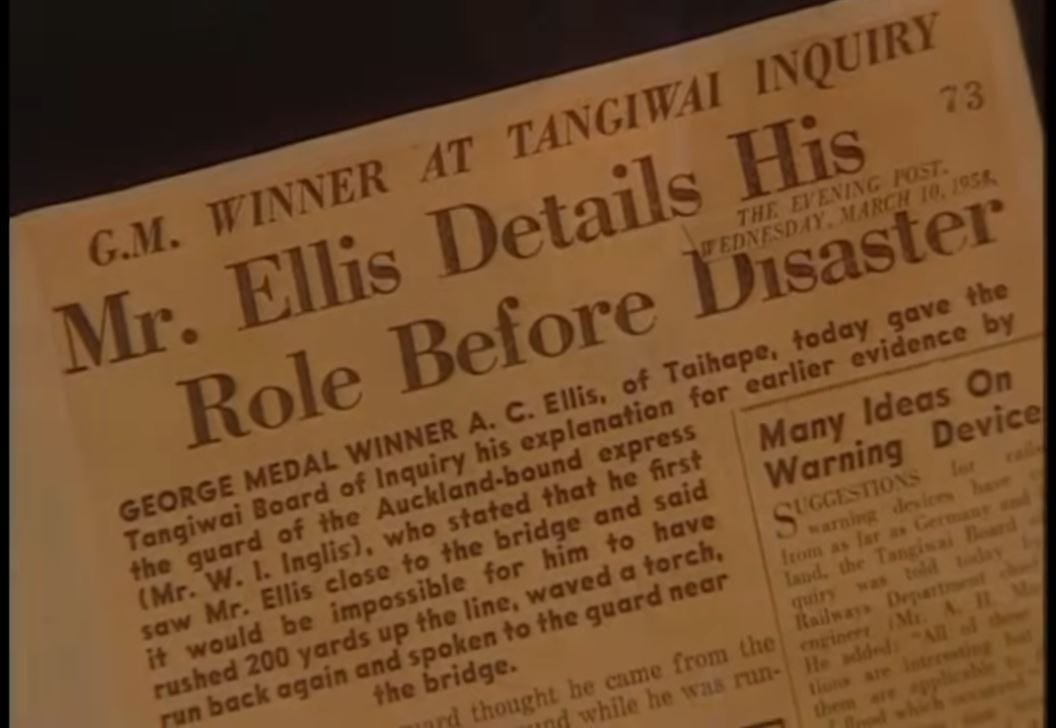
What are the odds that a reference to Robert Henry Wynyard would make a reappearance, as well as an Anglican missionary reference? On April 14th 1851, Lt-Col R.H. Wynyard was appointed as Lieutenant-Governor of New Ulster, or the North Island (while the South Island was named as New Munster). The Board of Inquiry’s findings were reported on 23 April 1954, and the report was published on April 30 1954, according to the National Library’s Digital New Zealand. On April 23rd 1851, the Trinity Church at Pakaraka opened. Significantly, it was founded by Rev. Henry Williams after his dismissal from the Church Missionary Society. And, on April 23 1840, Rev Richard Taylor, Willoughby Shortland, Dr John Johnson and Lieutenant Smart were sent to Kaitaia to obtain signatures for the Treaty of Waitangi. And on April 30th 1851, Archdeacon William Williams arrived in England to defend his brother after his dismissal from the Anglican Church Missionary Society.
And since the Wellington to Auckland steam-express was also a mail train, what are the odds this deadline riffed off the historical date of April 30 1940, when the first regular Auckland to Sydney flying boat service commenced, which resulted in an airmail run to the United Kingdom? So, sovereignty, protestant missionary and transport references were codified into the Commission of Inquiry’s key dates to communicate the ‘fix was in’ about an ‘disaster’ featuring a ‘night terrors’ theme.
Given the public inquiry commenced 33 days after the train disaster — that occurred on the eve of Christmas, which commemorates the alleged virgin birth of a tax-endorsing carpenter-turned itinerant preacher, who was allegedly crucified at the age of 33 years — Snoopman wasn’t surprised to find this sneaky number 33 appearing in the Inquiry’s meta-data. Especially, since the tragedy featured a driver with 33 years service, who wasn’t allowed to swap shifts that fateful Christmas Eve, and who would go down with a train weighing in at roughly 33 tonnes shy of 500 tonnes.
Before the deadline was pushed out, the Inquiry’s duration was supposed to be 32 days, meaning that 33 days later, the public officials under scrutiny might relax. But, the deadline was pushed out, and were restarted on Monday March 1st. The public sessions ended on April 2nd, meaning that after having to face scrutiny once the Inquiry recommenced, the officials were in the clear on April 3rd, or 33 days later.
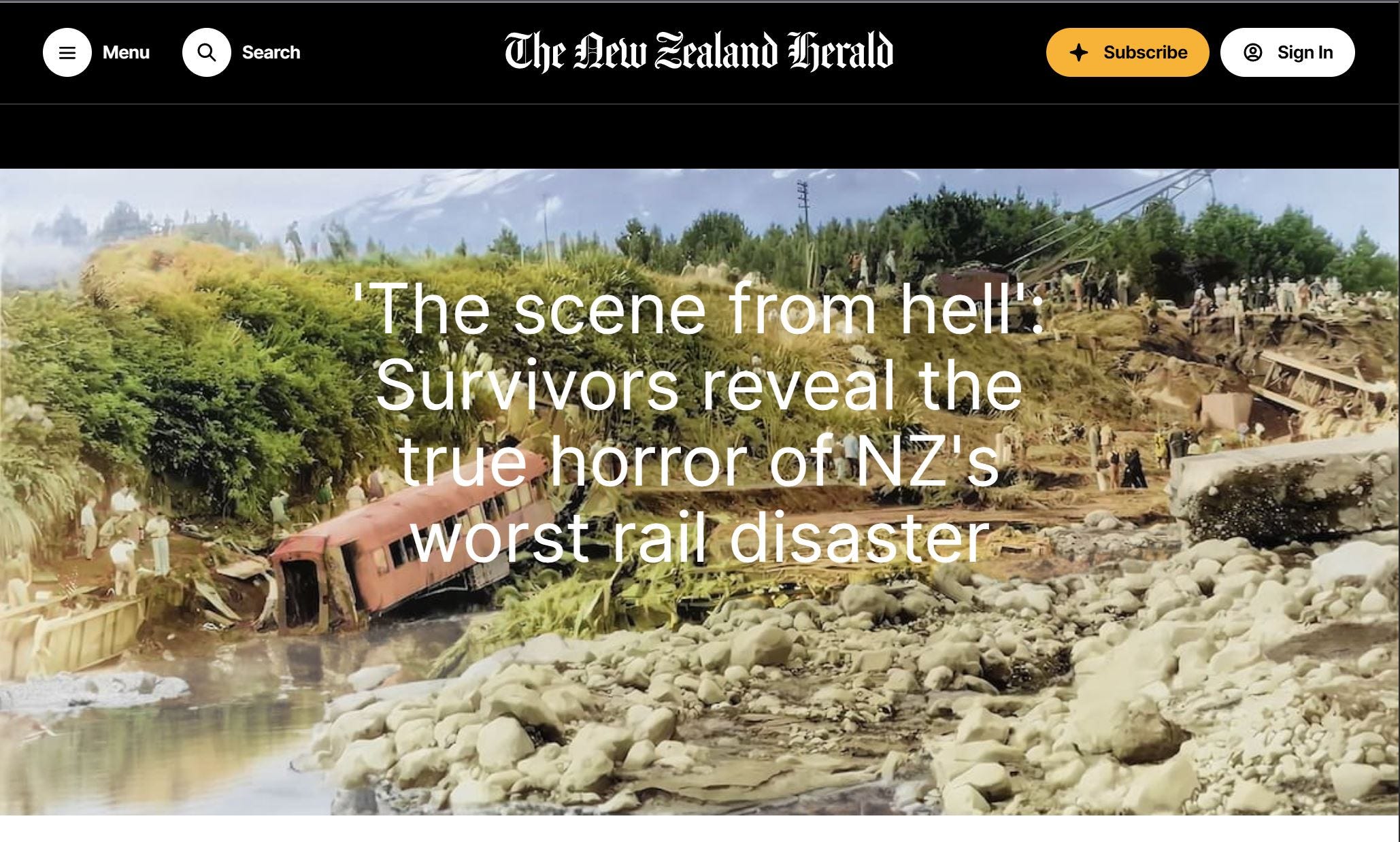
The Inquiry timings signalled the formality of a cover-up. While Jim Healy of the Geological Survey Branch of the Department of Scientific and Industrial Research produced the letter written up by Lewis Vause in 1951, as Exhibit 28 — Vause and Mason were not called to give testimony. The thorough work of Vause and Mason would have shown up what All of the King’s Men at the Geological Survey Branch of Department of Scientific and Industrial Research, the Ministry of Works, the Department of Railways, the Lands and Survey Department, and Rangitikei Catchment Board could have done in ’51: monitoring, mindfulness, mitigation.
According to the documentary, The Truth about Tangiwai, Exhibit 28 lay unread. Vause found only three of the four documents that he had sent to the Geological Survey Department, were produced as exhibits to the inquiry. Yet, the fourth document described a method for the controlled release of the crater lake’s waters. The Inquiry suppressed this inconvenient truth, along with looming danger presented by Vause and Mason — lest the Inquiry led by Judge W. F. Stilwell was backed into a corner.
Jim McAloon, a Professor of History at Victoria University of Wellington, who featured as an expert guest in the 2023 podcast series Tangiwai: A Forgotten History , said the Inquiry ‘found’ that little could have done to prevent the build up in the crater lake and the subsequent deluge couldn’t have been foreseen. The Inquiry ascertained the Tangiwai Railway Disaster was just a horrible accident and no one was at fault.
The police found no evidence that legal blame could be attached to any party, and there were no prosecutions. Police Commissioner Eric Henry Compton was awarded the Queen Elizabeth II Coronation Medal, on June 2 1953, and in the 1954 Royal Visit Honours he was appointed a Commander of the Royal Victorian Order.
In episode 3 “Legacy”, McAloon said given the nature of the accident, he didn’t think much could have been done to prevent the tragedy. He mentioned the warning monitors that were subsequently placed further up the river. McAloon seemed unaware of the Vause’s 1951 report suggesting a controlled release of the crater lake.
During the course of 15 years research, author of Weeping Waters: When Train Meets Volcano, Benedict Le Vay found that driver Charles Parker had engaged the emergency brakes and Lance Redman had turned off the oil. Le Vay believed Parker and Redman should have been awarded the George Medal, as Ellis and Holman had, for bravery; their actions saved lives when they could have jumped to save their skin.
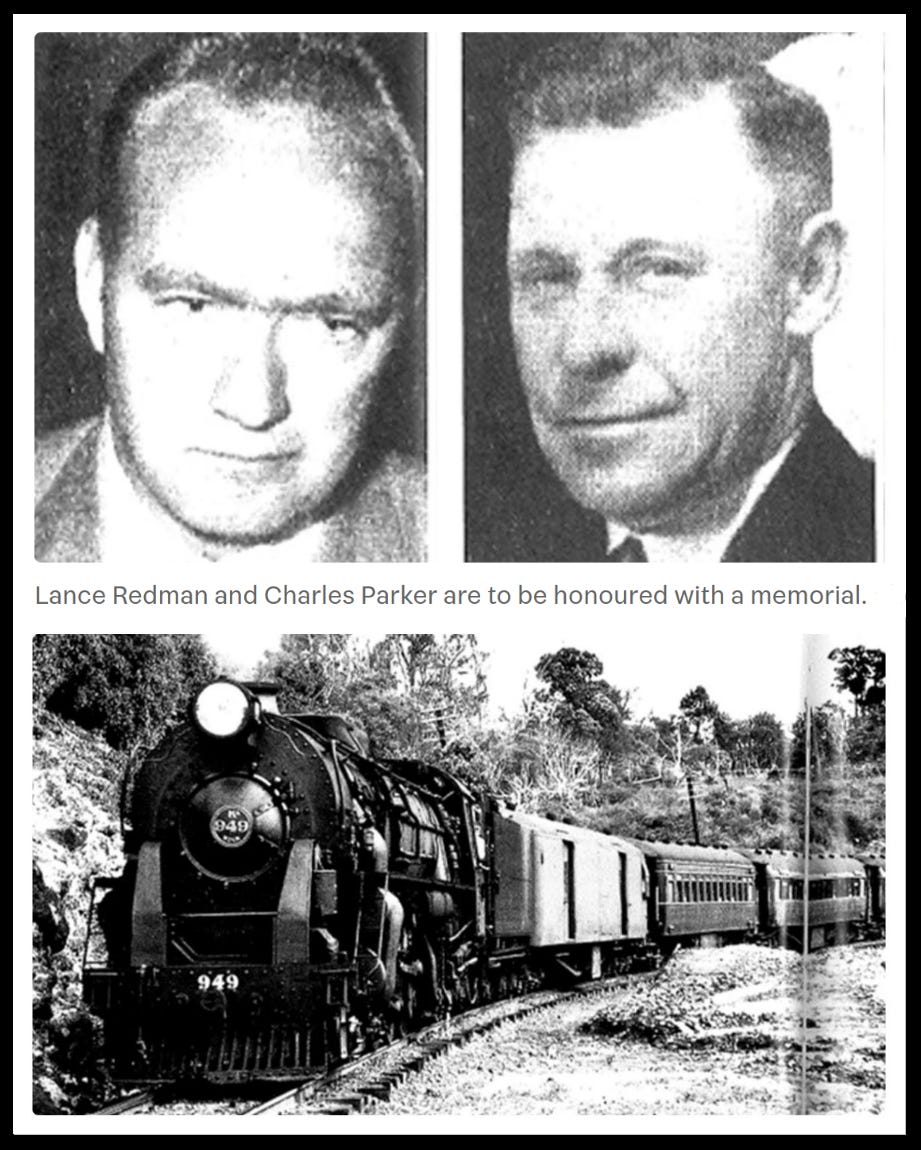
The Inquiry report quoted Superintending Geologist, James Healy, at the Geological Survey Branch of the Department of Scientific and Industrial Research, who studied photographs taken on the crater lake on the very morning of December 24 1953.
Healy stated a Mr and Mrs T. Wood, of Auckland, visited the lake, and took the photographs at the south end of the lake to show the cave occupying the lowest notch in the volcanic rim, with outcrops of volcanic rock shown on each side. Healy wrote:
“The condition of the lake as shown in the photograph does not indicate to me the imminence of any break in the crater wall. I found no evidence that volcanic activity had played any part in causing the sudden collapse of the ash barrier, but this cannot be definitely ruled out. Mr G. Eiby, of the Seismological Observatory, reported that the seismograph at the Chateau did not record any earthquake or volcanic disturbance, but it recorded vibration, presumably caused by the rush of water, commencing two or three minutes after 8 p.m. on 24 December 1953. It is suggested, therefore, that as a result of crevassing movements in the ice the ash barrier alongside of the existing cave suddenly collapsed about 8 p.m. on that date and precipitated a solid mass of water down the channel to the Whangaehu River beneath the ice.” — Tangiwai Inquiry Report, p.6-7
In other words, the photographs and observations of Mr and Mrs T. Wood, of Auckland, who visited the lake on the day of the disaster, were presented by Superintending Geologist, James Healy, at the Geological Survey Branch of the Department of Scientific and Industrial Research, to the Inquiry Board, who in turn emphasized this account as evidence for fixing the narrative. This official narrative would have it that although the crater lake was filled pretty much to the brim, there was no sign of eminent collapse even on the morning of the day of the disaster. Yet, for this narrative to fly, the preferencing of the photographs by the Woods, over the photos, diagrams and graphs tabled by Mason and Vause as a result of their repeated expeditions to Ruapehu, was endorsed by the Inquiry to get officials ‘out of the woods’.
Lahars had occurred in the Whangaehu in 1861, 1889, 1895, 1925, and 1953. The floods of 1861, 1925, and 1953 appeared to be cold lahars due to release of lake water below the glacier. Those of 1889 and 1895 resulted from eruptions in the crater lake.
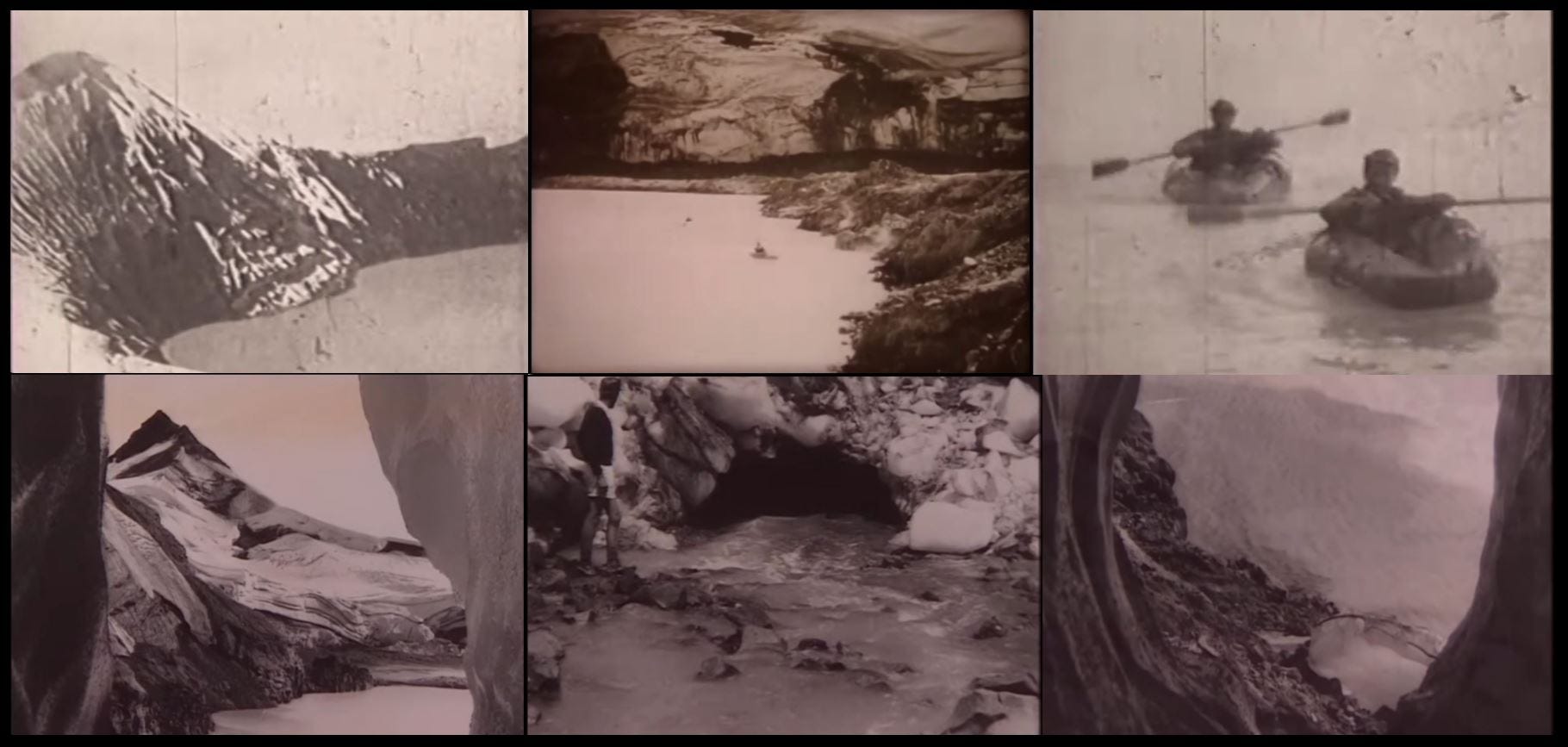
According to the documentary, The Truth about Tangiwai, mountain guide Eric Fetzer alerted authorities to a collapse of the ice cave on Ruapehu and they laughed at him. Soon after, the crater lake burst and the ‘1925 Lahar’ damaged the Tangiwai Bridge.
In 1951, Vause wrote that a lahar would likely occur in the next two or three years.
Given the thematic historical date riffing traced by Snoopman, it would appear that the 1951 report written by Lewis Vause as both a warning and a solution, was instead taken as material for the architect of Tangiwai Railway Disaster to glean its data.
The Inquiry Board instead preferenced Healey’s assessment, “The lahar’s destructive power was determined by the size of the Crater Lake outlet, which created a flow rate beyond any measure of past lahars. There was no lack of reasonable care by engineers”.
The Tangiwai Disaster report stated inquiries for plans and records of the original bridge were started immediately after the ‘accident’. But, the Wellington archives were lost in the Hope Gibbons Building Fire on July 29 1952. The Inquiry Board stated:
“These files would contain letters of instruction regarding the construction of the bridge, instructions relating to standards of workmanship, and reports from the construction works and descriptions of the foundations as opened up at the site.”
The original bridge design data pertaining to flood fitness were destroyed in the fire.
Naturally, a search in Taranaki and Wanganui district and sub-offices was fruitless.
The Hope Gibbons Building Fire in Dixon Street, Wellington — which was reported by the Evening Post and the Dominion at the time — was recounted by Stuff in 2015:
“Charred pages of New Zealand’s history fluttered through Wellington’s streets in 1952, as a treasure trove of government archives burned.”
There was much destruction of valuable documents in the top storeys of the building, which housed records from government departments including public works, Māori affairs, geographical survey, immigration, labour, broadcasting, and agriculture.
The eight-storey office block, became a blaze after a vat of industrial thinners caught alight in a smaller rear building, around 3pm on July 29, 1952. Given the loss to a treasure trove of historical documents, what are the odds that on the same date, July 29 in 1897, a steamer called the Tasmania struck rocks in a gale, and sank off Table Cape, Māhia Peninsula, in the Hawke’s Bay region, and a treasure trove of jewells belonging to a merchant, Isador Jonah Rothschild — was lost?
Historian J.C. Beaglehole scathingly remarked upon the precarity of the archives:
“Till we convert our scattered, rat-ravaged records into a proper system of archives, our claim to civilisation is so much more the slender. We have hacked at the tree of our tradition with the murderous inconsequence of adolescent vandals in a public park.”
But, the historian didn’t comprehend the evil at work. If Dante Alighieri had been alive to witness the signals of a looming catastrophe, he might’ve fitfully alternated between the black and red ribbons, while belting the keys of an Imperial typewriter.
The Post newspaper typed descriptively about the Hope Gibbons Building Fire:
“Walking up the stairs to the top floor at 11pm last night was like walking through the Waitomo Caves. Glow worms were replaced by firemen’s lanterns, but the water was realistic — up to ankle height in places. Typewriters and adding machines were drenched and covered with rubbish. Files lay charred on the floor. Fire alarms were still ringing in some places at this hour. The noise was faintly mocking.” — The Post, 30 July 1952
And so, the Tangiwai Disaster Inquiry Board’s report noted missing records this way:
“There appears to be no Public Works Department plan in existence showing the bridge as actually constructed. No record has been found as to the depth to which the foundations were carried, and the details of some of the foundation depths shown on Plan No. 68100/1, Exhibit No. 1, have been obtained subsequent to the accident.” — Tangiwai Inquiry Report, p.12
Evidently, the practice of deciding the depth of the foundations was decided by the engineer in charge of construction. And so, the fire created ‘gaps’ in the records.
Noting the bridge was inspected following the lahar of 1925, the Inquiry Board said:
“The first indication on the Railways Department’s files of damage to the bridge is on 23 January 1925 (see District Engineer’s file 2443/8, Exhibit No. 31). A note on file CE. 19592/11, Exhibit No. 39, shows that the Public Works records disclosed no information concerning the depths of foundations; this is dated 30 January 1925.”
These dates seem to have inspired the mayhem makers behind the ‘Tangiwai Disaster’ to mimic escapees from hell, and who might have been tracked down by Dante Alighieri, if he had taken to time-travelling. According to A.W. Reed’s It happened Today in New Zealand, on 23 January 1882, a disastrous fire occurred in the business district of Queenstown, which was deliberately started by a grocer. And, on January 30 1853, Sir Grey and Rev. Richard Taylor explored the eastern slopes of Mount Ruapehau and the summit ice-field. Ergo, it’s like the mayhem makers telegraphed how a staged collapse of the rail bridge at Tangiwai would follow a lahar triggered by deliberately set explosives. But, first it would be necessary to destroy records pertaining to the bridge’s construction, lest an inquiry was compelled to find fault.
And, to all but ignore the work of Vause and Mason, and avoid booking them to testify.
After all, one purpose of this regulatory capture was to compromise officials so they bend to the will of a hidden cryptocratic dark state, and serve its totalitarian aims.
At intervals, remedial work to the bridge occurred, with concrete blocks, bags of cement and rocks, to buttress the columns from scouring by the periodically turbulent river, the report recounted. The remedial jobs didn’t account for Pier 4 standing like a rotten tooth that should’ve had the equivalent of a dentist’s ‘pull’, instead of patch-ups.
The last inspection of Bridge No. 136 by the Inspecting Engineer, was made on 21 February 1953, with comments only of a “minor nature”. What are the odds that on February 21 1879, the death of thirty four miners occurred during the Kaitangata Mine Disaster? This early industrial catastrophe resulted in stricter mining oversight.
Given the apparent telegraphing of the looming train derailment as a rite of passage terror theater, Snoopman isn’t surprised to find the Anglican theming continued. On February 21 1853, a protestant meeting took place in Wellington, where the basis for a Constitution for the Church of England in New Zealand was tabled. Was a cryptocratic conclave being signalled for examining the technical details to successfully inflict this ritual techno-sorcery? After all, the last personal examination of Bridge No. 136 was made by the Wanganui District’s Civil Engineer on October 29 1953. Mr H. G. Stevens was evidently satisfied with the Tangawai Railway Bridge’s condition. Given the required techno-sorcery to pull off such a sinister operation, what are the odds that on October 29 1894, the Wairarapa was shipwrecked at Great Barrier Island, with the loss of 121 lives? If the inspection had taken place the day before, it would have riffed off the wreck of the SS Ventor on 28 October 1902, off Ōmāpere. While the Ventor was transporting 499 coffins containing the exhumed remains of Chinese gold-miners for repatriation back to Guangdong, there was only a loss of 13 lives. N.Z.’s emergent cryptocracy needed to riff off a larger death toll if they were to strike the right chord to conjure a truly newsworthy terror sacrifice ritual.
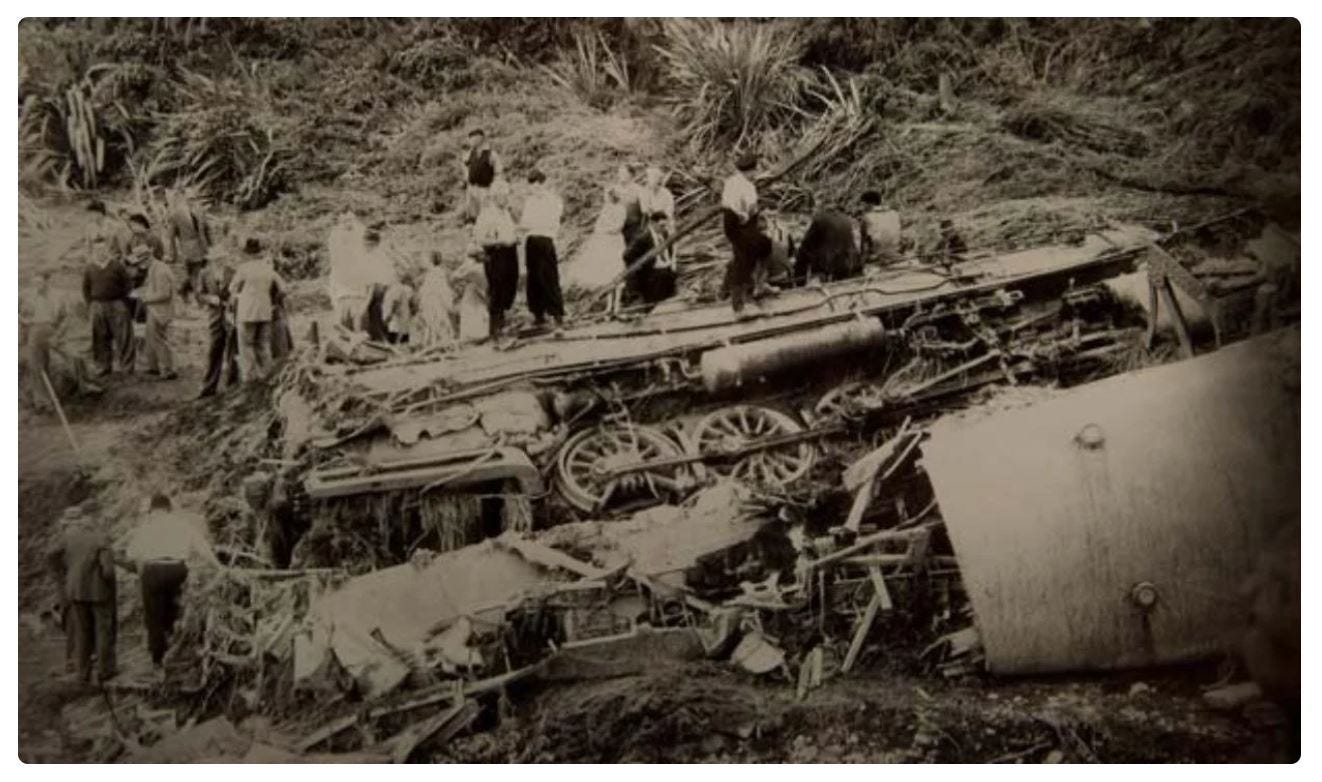
Numerous inspections were carried out that referenced milestones in transport, mountaineering, faith footholds, militarism, shipping calamities, and also pre-colonial era massacres. The Tangiwai Inquiry Board's report noted that the Inspector Permanent Way, Ohakune (Mr F. W. Beccard), carried out the following inspections: (a) By motor trolley on 26 November 1953, 3 December 1953, 16 December 1953. (b) Walked the length and inspected it in company with the Ganger on 17 November 1953. (c) Travelled from Waiouru to Ohakune on engine of Daylight Limited Express on 24 December 1953, passing over Bridge No. 136 at about 2.15 p.m. On none of these occasions did he observe anything unusual at the bridge. These dates find thematic correspondence with historical events.

On November 17 1902, Sir John Logan Campbell opened the electric tram service in Auckland. And on November 17 1840, Bishop arrived at Waikouaiti aboard the Sancta Maria. On the night of November 26-27 1941, the New Zealand Division reached Tobruk, port city of Libya, as part of the potently titled Operation Crusader, in the North Africa campaign and formed the Tobruk Corridor to assist with ending of the Siege of Tobruk, by German and Italian forces. On 27 November, the New Zealander Division reached the Tobruk garrison and ended the siege. And on December 3 1865, the Enterprise became the first ferry on the Waitemata Harbour, and later, on December 3 1881 the world's most southerly horse-tram service opened in Invercargill. And on December 3 1910, Freda du Faur became the first woman to set foot at the summit of Mount Cook. And on December 16 1850, the first immigrant vessels, the Charlotte Jane and the Randolph, arrived at Lyttelton, to people the New Zealand's Anglican-only settlement at Canterbury. Not surprisingly then, the Anglican Cathedral at Christchurch was opened for worship on the same date, December 16 in 1904. And the transport milestone theming continued with the first official airmail flight by George Bolt and Leo Walsh between Auckland and Dargaville on December 16 1919. On December 24th 1909, N.Z. commenced compulsory military training.

The last daily inspection of the length by the line gang was made on the afternoon of 24 December 1953, and the last weekly inspection by the Ganger was made on 19 December 1953. On December 19 1642, four of Abel Tasman's crew were murdered at Golden Bay. On December 19 1938, the first trolley bus service took place in Auckland. And on December 19 1915, the withdrawal from Gallipoli commenced after a massacre of 2500 New Zealand Soldiers, and 5000 wounded.

A Hallade device was run northwards over the Main Trunk on the Limited Express on 3 November 1953, and southward by the corresponding express on 11 November 1953. A Hallade instrument is mounted in a special car and is hauled at the rear of the fastest train over the section being tested. Briefly, it consists of a series of pendulums and records separately the vertical, lateral, and
rolling movements of the car. The record is produced on a continuous chart and provides a reliable indication of track irregularities by recording their effect on the movements of the car, the Board of Inquiry report stated.

The dates of these measurements find correspondence with NZ’s railway history, and a pre-colonial era massacre. On November 3 1886 the last spike of the Manawatu Railway Line was driven at Otaihanga. On November 11 1830, Chief te Rauparaha returned to Kapiti Island on the brig Elizabeth after the massacre at Akaroa, with the captured chief Tamaiharanui and his daughter.

The signals intelligence telegraphed a looming Trojan Train Horse atrocity.
A headquarters organisation was set up at Waiouru Military Camp, to include the police, railways, works, army, navy and many others, to deal with the calamity.
The great forces in play during the lahar were visible in the aftermath: The main frame of ‘Car A. 1920’ was found one and a half miles downstream, its body was likely torn off early in its passage; span 3, consisting of two steel girders connected by open bracing was carried 100 yards downstream and left on the bank almost completely out of the water; the base portion of Pier 4, weighing 125 tons, was carried 70 yards downstream and left with its center of gravity six feet higher than it was originally.
The column, Pier No. 4, was carried away by the lahar, taking spans 2, 3 and 4 with it, before the engine reached the bridge and plummeted into the lahar-swollen river.
Pier No. 5 was removed bodily and broke into at least two pieces immediately after.
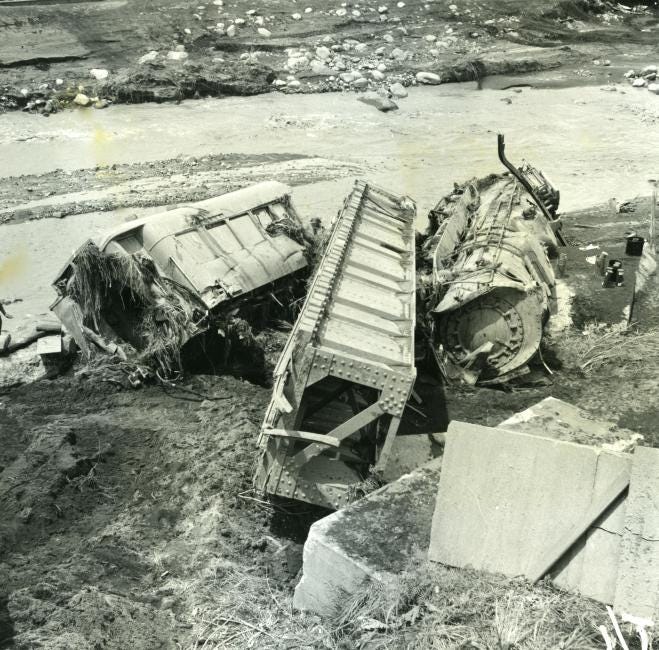
In Tangiwai: A Forgotten History, Bob Norling, President of the Main Trunk Railway Ohakune, said a seismograph at the Chateau picked up vibrations. Following the Tangiwai Disaster, a river alarm system was installed and was checked three times a day at the beginning of each eight hour shift, and included duties to measure the sulphur content daily, and recording the river levels. Norling, who trained as an engineer, was hired to maintain, check and develop the technology, started at the railways in 1963 with a job manning a hut at the north end of the Tangiwai Bridge.
Every week, he tested the sulphur content of the sulphur stream fed by Ruapehu.
However, it took 51 years after Tangiwai for a truly proper warning system to be installed around Ruapehu, in spite of two years of seismic unrest in the mid-1990s.
Despite the belated improvements, the podcast “Tangiwai: A Forgotten History — Never Again”, still advanced the myth that no one in 1953 knew what a lahar was, and therefore, it wasn’t possible to anticipate the dangers, let alone the solutions. And thus, the Herald’s news audience was sold a 70 year-old myth that had hardened like a granite plaque. This mythology was fashioned, fitted, figured, forged and fixed to an ‘unforeseen, unstoppable and unimaginable form of the N.Z. environmental tragedy’.
Analysis and Conclusions to the ‘Tangiwai Railway Disaster’
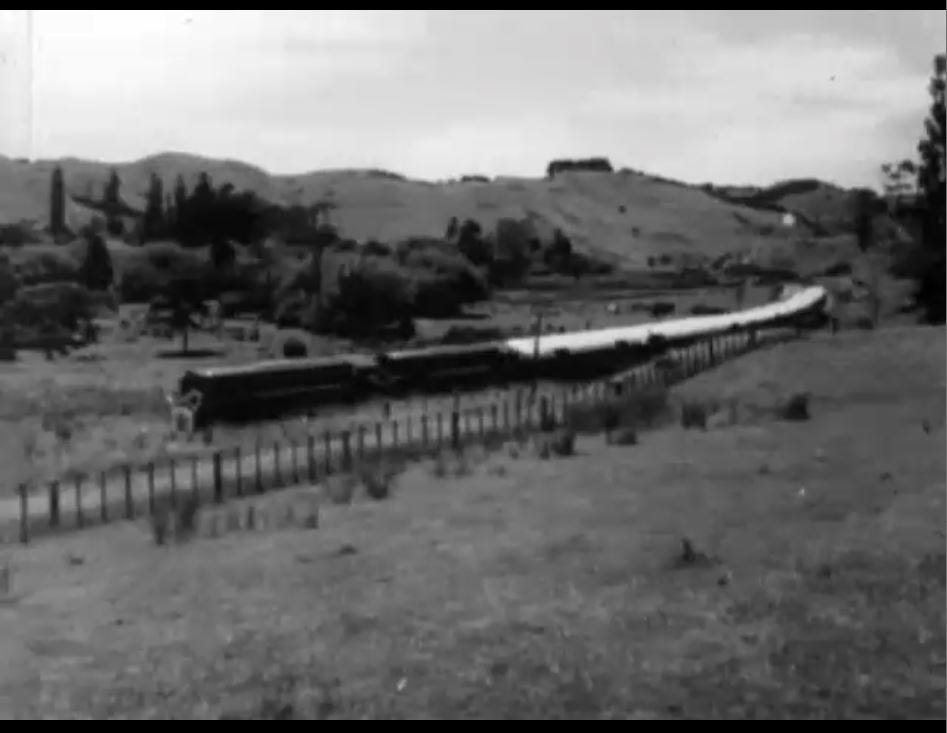
The ‘Tangiwai Railway Disaster’ was an exhibition of spectacular techno-sorcery.
Any one of the four express trains scheduled for late travel that evening could have been the one that plunged into the Whangaehu River. At 9pm, a policeman at Waiōuru heard the sound of a roar coming from the direction of the mountain. At 10.09pm, steam locomotive, KA 949, departed Waiōuru Station towing the Express carriages.
Meanwhile, the late-running freight train travelling from the north, that had stopped at Karioi Station to shunt wagons, was made to wait for Locomotive KA 949 to pass.
With portable radio sets, it would be easy for field operatives to clock the lahar’s progress as it coursed its meandering way down the Whangaehu, and relay those times, to an operations unit to calculate an estimated time of arrival at Tangiwai.
In the year prior, a comprehensive appraisal of New Zealand Railways’ efficiency occurred by the mechanism of a Royal Commission. This study not only was an accounting of the Railways capacity, staffing, and financials, but it also heard evidence from freight customers, commercial chambers, and councils regarding transportation.
What are the odds the first sitting of this Royal Commission took place on March 24th 1952, which thematically riffed off the deliberate scuttling of the schooner yacht Ariadne, wrecked at the Waitaki River’s mouth on 24.03.1901? And, what are the odds that the report’s deadline was June 30th 1952, since this date riffed off the opening of the electric tram service in Wellington on June 30th in 1904. Ergo, under the cover of an urgent Royal Commission, an exercise to glean data, profile people, and carry out reconnaisance was thematically ‘bookended’ with a historical scuttling crime, and a technological development of transportation history riff. The brotherhood is stealthy.
One month later, the Hope Gibbons Building Fire destroyed the Government’s archived records of the Department of Public Works and DSIR’s Geographical Survey.
How ironic that the Queen would travel by train to arrive at the City of Palmerston North on January 7 1954, following a train tragedy that occurred on the same day she had presented the Queen’s Colours flag to the Royal New Zealand Navy, on the same date in 1814, that Chief Ruatara erected the British Union Jack flag at Rangihouia Pā.
Little did the Chief know that the act of assisting to plant a flag of a European Cannon power peopled with civilized Christians, was construed as voluntary consent.
The Dutch United East India Company’s instructed Captain Abel Tasman to plant symbols of “actual occupation”, which were either a memorial stone or the Netherland’s prince flag, and were meant to be erected or hoisted as possession rituals to lay claim to any lands that the Dutch explorer discovered, touched and set foot on.
One of the few historians who actually printed the revealing last paragraph of Captain Abel Tasman’s instructions is a deceased barrister and solicitor of the New Zealand Supreme Court. From N.A. Foden (1965). New Zealand Legal History (1642-1842)]. Captain James Cook had two flags raised at Queen Charlotte Sound in the company of the "old Indian man", as a discovery ritual, upon realizing that there was a strait between the two main islands, which he named Cook Strait, to demonstrate his 'discovery' was superior to that of Tasman's scrawl. Potently, the state dinner in Palmerston North at a department store served as an inversion of the mad afternoon tea party held at the Ballantyne’s Department Store when a fire broke out in 1947 (two days before the Royal Wedding), where a beauty queen, Miss Mary Wootton, was due to parade a three-piece ensemble for a booked clientele, supposedly as part of the luxury retailer’s pre-Christmas season marketing.
Especially, since this state dinner occurred on the same date, January 7 in 1910, that the administration of the Order of St. John in New Zealand was undertaken by a Dominion executive. A remarkable pattern of proximate timings corresponds in an increasing ‘independence’ of the governance between the New Zealand Order of St. John, the New Zealand Government and N.Z.’s staged disasters down under.
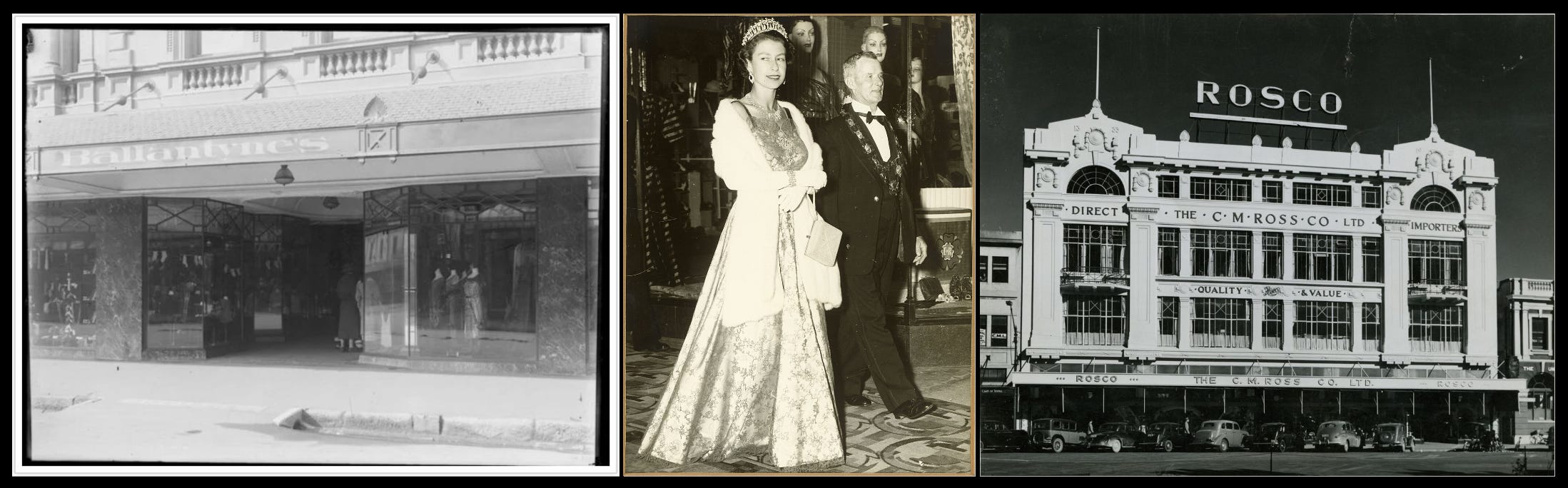
Given that the British Monarch is the Sovereign Head of Order of St. John, let Snoopman briefly trace the entwined machinations underpinning these staged disasters, with their reference to the colonial-settler project, that featured its protestant mission stations, battles for conquest, and developments in rail, roads and ports connecting the archipelago, and their temporal correspondence to royal events.
If we view the Ballantynes’ Fire of November 18 1947 as a ritualized baptism of fire, and if we view the Tangiwai Railway Disaster as a night terror featuring symbol sorcery, it appears a ‘rite of passage’ was being exhibited to the key insiders of the ‘Commonwealth and Empire’. Evidently, membership of a secret élite required mayhem for full entry to a new kind of empire. In this ‘Royal Game of the Goose’, the staged bridge collapse at Tangiwai symbolised the price of the rite of passage, where inflicting a massacre on one’s own people while it masqueraded as a natural disaster, was the equivalent of ‘Crossing the Rubicon’. The expression ‘Crossing the Rubicon’ has its origins when Julius Caesar crossed the Rubicon River in 49 B.C. with his army; an act that broke the law and was a provocation for war with Pompey the Great, the leader of Rome. The expression is commonly used to mean that the ‘point of no return’ has been passed. But, since this mayhem is part of an undeclared war to forge a totalitarian world empire by stealth, the practice of codifying chess moves prior to, at the time, and after the staged events performs the function of tickets stamped with dates, clicked with holes, or marked with pens. Traitors who traded on treason, invest, spend or speculate in a cryptic currency detectable to those attuned to reading runes.
As the supreme head of several important civil, religious, and military orders, the Queen as the British Monarch could wield power by stealth, the Snoopman contends.
Once such chivalrous feudal institution is the Sovereign Military Hospitaller Order of St. John of Jerusalem, of Rhodes and of Malta, as he mentioned in the introduction. To wield power on behalf of the British Oligarchy, the British Monarchy could get around the problem that Elizabeth II had made the error of failing to be born a man, and as such she could not be the Grand Master of English Freemasonry, and therefore could not authorize ‘off with their heads’ orders via the subversive Masonic Orders.
And, so a sketch of the entwined incremental advancement in New Zealand’s ‘independence’, between the New Zealand Order of St. John and the New Zealand Government reveals an uncanny correspondence with the staged disasters down under.
On paper, New Zealand became a fledgling Dominion in 1907 when it officially cracked out of the colony cacoon shell. On 26 September 1907, Prime Minister Joseph Ward read a proclamation to a gathered crowd from the steps of the General Assembly Library in Wellington. Ward announced N.Z.’s Dominion status, which just happened to coincide with the first edition of the Dominion newspaper.
Two and a half months later, on 11 December 1907, this Parliamentary Library narrowly escaped fire that swept through the wooden Parliament Buildings. The brick walls and metal door of the de facto national library saved the 80,000 volumes and other treasures inside. However, a considerable quantity of documents belonging to the Native Department perished, which meant many records on how native lands were lost, ‘were lost’. The fire was thought to have started with faulty electrical wiring in the ceiling of the Interpreter’s Room. This fire was a stark contrast to the reading of a proclamation, two and a half months prior, announcing N.Z.’s Dominion status outside the Library. Reading the ‘Interpreter’s Room’ in these dates correspondences, the records of who gained native lands in the colonial era, were the rulers’ vulnerability.
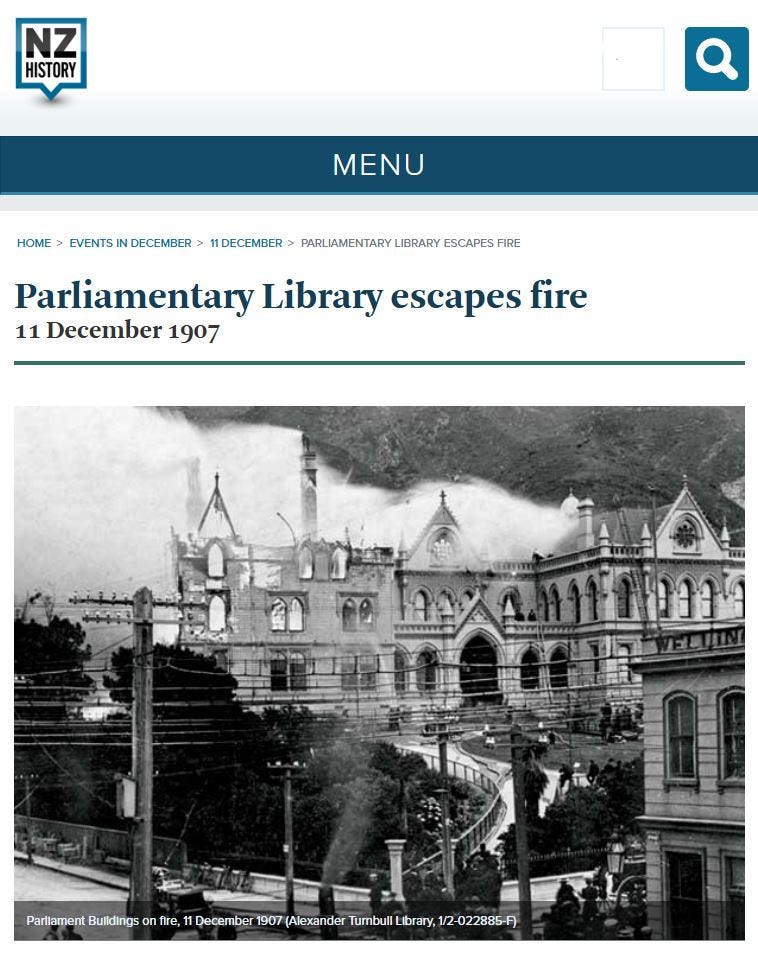
Two years and one month later, on January 7 in 1910, New Zealand’s Order of St. John acquired a Dominion Executive administration status. It is critical to recall that the history of the Knights of the Order of St. John intersects with the costly bloody Crusades. Particularly, since the brotherhoods of the British Empire in 1910, were preparing for another ‘crusade’ that would be marketed as the ‘war to end all wars’.
It’s often said by veterans that New Zealand paid the price of nationhood in the first and second world wars. Even Māori public figures repeat this claim like a cult mantra.
This expression refers to the immense human cost and sacrifice that fostered a unique sense of national identity and secured international recognition for New Zealand as an independent nation separate from Britain, yet paradoxically within its Empire.
It is a view that forms the witless core meta-idea of the Waitangi War Museum.
It seems the sacrifice of during World War I, including the ANZACs, in assisting with the ‘last crusade’ to smash the Ottoman Empire, was a sufficient price to further integrate the Sovereign Military Hospitaller Order of St. John of Jersulem, of Rhodes and of Malta, with the Dominion of New Zealand in 1920. The Dominion Executive made the decision for the governor general to be patron, head of the order in New Zealand and their ex-offixio member, as Gavin McLean wrote in The Governors.
On 11 December 1931, the Statute of Westminster was enacted in the British Parliament, which formally removed London’s right to legislate for the dominions unless they asked it to do so. Officially, New Zealand refused to ratify this law until 25 November 1947. Yet, there’s a trace of brotherhood winking in the reading rooms.
’Cause, if we trace New Zealand’s belated adoption of the Statute of Westminster of 1931, which occurred after every other Commonwealth State, and observe that its royal ascent bears a date, November 25th 1947, some seven days after the Ballantynes’ Fire, one can trace a narrative arc running through these staged disasters, subsequent episodes of crisis management and crisis engineering, and the coincidental developments of increasing status conferred to the New Zealand Order of St. John.
In 1931, the Grand Priory in England approved setting up a Commandery in New Zealand in recognition of the work of the Order of St. John under a Dominion Executive, as any newsroom possessing a copy of The Order of St. John in New Zealand would know. It states that the Grand Priory’s approval provided:
“the Dominion with a greater measure of autonomy under government by a Knight Commander and Commandery Chapter, and allowed the Order in this country (New Zealand) to draw more directly on guidance offered in London.”
At face value, this autonomy and guidance rhetoric refers to the governance over the Order of St. John as a community-spirited organization merely operating ambulances.
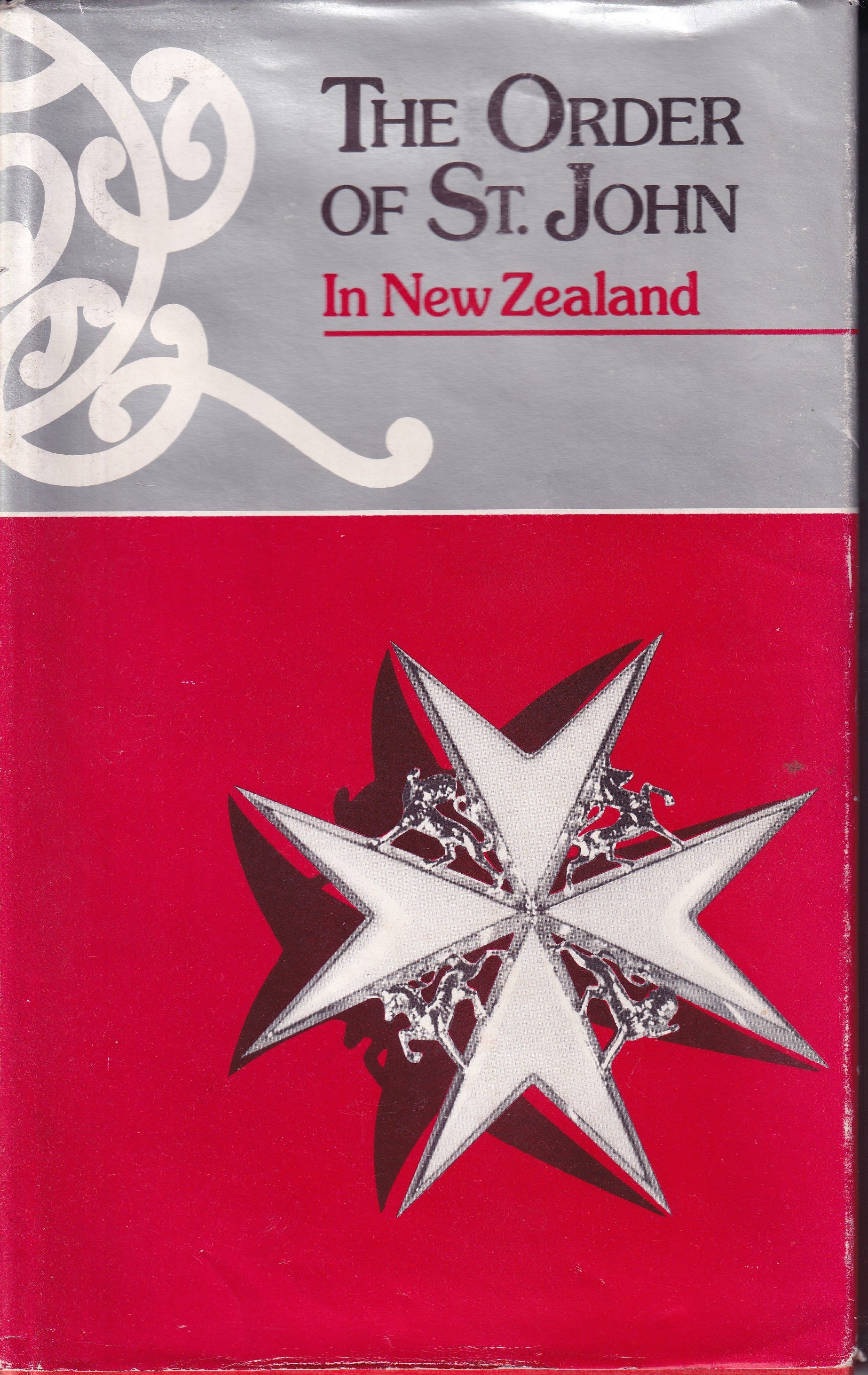
Let’s recap the loaded history of the British Monarchy, since the Knights of the Order of St. John intersects with the costly bloody Crusades. The Order of the Garter was founded in 1348, by King Edward III, who was allied with the Venetians, who in turn had encouraged the English King to pick a fight with Philip VI of France, that turned into the Hundred Years’ War of 1339 to 1453 CE. The core of Western Civilization was conquered by England as an imperialist state, around 1420, but later repelled resulting in chivalry being circumvented with commercial capitalism. England’s loss led to the ‘War of the Roses’ (1455-1487), that was a dynastic conflict between the English nobility and monarchy which led to four decades of intermittent battles, executions, and murder plots and 50,000 dead. The English elite was split into two camps, each centred around a branch of the descendants of Edward III of England (r. 1327-1377): the Yorks and Lancasters. Although the war known as the Cousins’ War, the association of the roses was popularized by famous peddlers of fiction, such as William Shakespeare and Sir Walter Scott. The counties of Lancashire and Yorkshire, have a red rose and a white rose respectively as their emblem. The Lancastrian Henry Tudor took the throne, commencing the Tudor Dynasty; the Plantagenets ended.
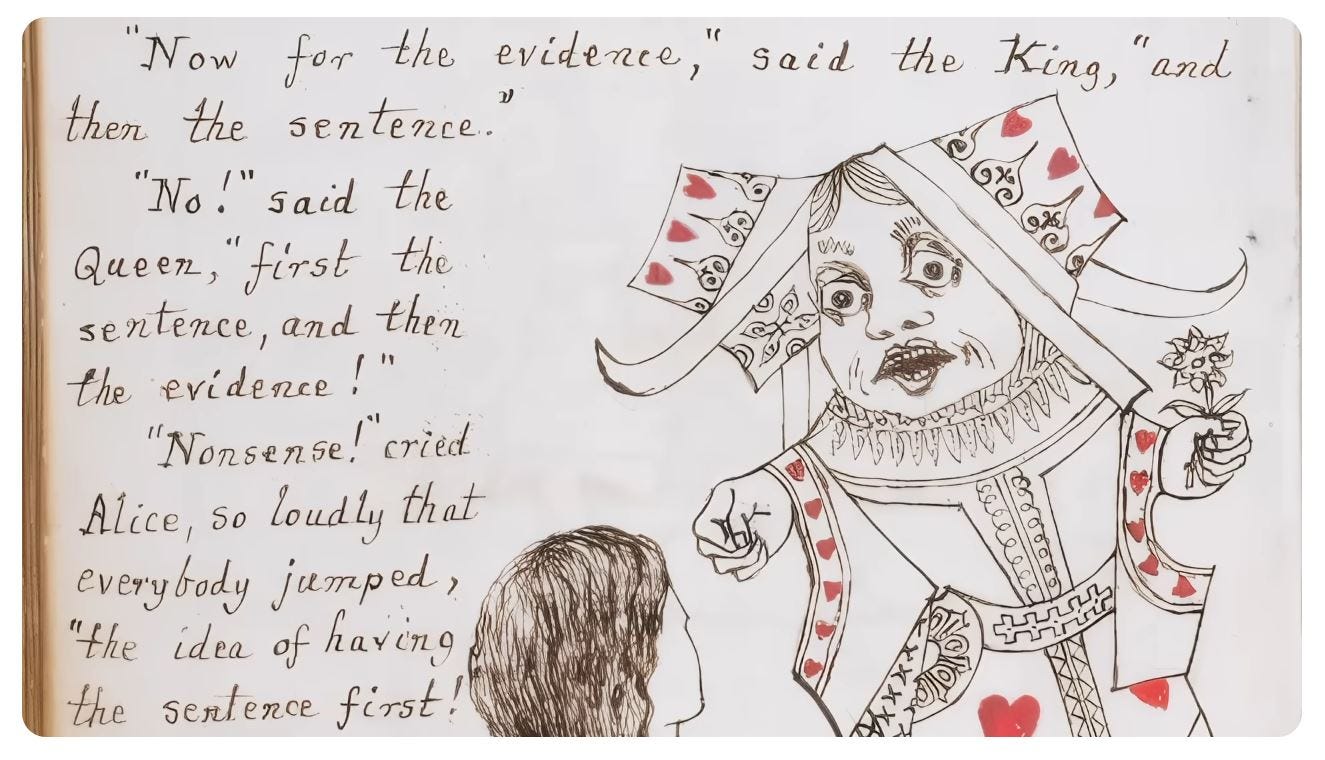
A reluctant Anglican deacon, Charles Lutwidge Dodgson, referenced the War of the Roses to mock the British Monarchy and the mad power structure arranged around it. As ‘Lewis Carroll’, he likened Victorian England to an illogical Wonderland burrowed deep in a rabbit warren by a bank on the River Thames at Godstow four miles upstream from Oxford. In the garden scene of Alice's Adventures in Wonderland, the gardeners Two, Five and Seven from the House of Hearts, paint white roses red to cover up their mistake of planting the wrong coloured rose bush. The tyrannical Queen of Hearts orders the soldiers to execute the gardeners by chopping off their heads. Alice saves the cards from peril by stashing them in a flower pot and the soldiers give up. The red rose was associated with Queen Margaret of the House of Lancaster. And also Queen Victoria was deeply in love with Albert, her husband, who could maintain control of the monarch. Therefore, the angry Queen of Hearts in the garden scene riffed off the War of the Roses, while her desire to execute Alice and the king's rational point that she was only a child, references Victoria. Therefore, the First Hundred Years’ War was ostensibly fought over the Kingdom of France, and marked the decline of feudalism, the rise of nationalism and the commercial revolution which was enabled by the credit revolution innovated by the Knights Templars. This credit revolution would fund the European colonial empires.
Ironically, the Protestant Reformation was a Venetian intelligence operation to divide Europe in one to two centuries in religious wars, and to end Rome’s Christian monopoly by forging Anglocized Catholicism through the Church of England.
According to Webster Griffin Tarpley, Venice’s cardinal Gaspara Contarini encouraged and protected Martin Luther, who famously nailed 95 theses to the door of All Saints Church, in Wittenberg in 1517, challenging Catholic Doctrine and exposing the Indulgences as a fundraising fraud to build St Peter’s Basilica. Venice had all but temporarily lost its empire in April 1509, when the League of Cambrai comprising France, Spain, Germany, the Papacy, Milan, Florence, Savoy, Mantua, Ferrara and others, defeated the Venetian mercenaries at the Battle of Agnadello.
The Venetian oligarchs — who Dante Alighieri had first exposed in part one of his satirical Divine Comedy Inferno, and had long hated the idea of nation states that Dante had proposed — had brazenly tried to manipulate France and other nation states to smash Milan, to pave the way for Venetian expansionism. But, the bond that glued the League of Cambrai was mutual animosity toward the Venetian Oligarchy.
Venice saved itself by mobilizing its formiddible intelligence network and diplomats. The Geneoese Pope Julius II della Roverie was bribed to break up the League.
So began a two-century project to take-over of Britain, forging the British Empire.
But, the Venetian Cardinal Gasparo Contarini also led the Catholic Counter-Reformation, by sponsoring St Ignatius of Loyola, and by securing papal approval to establish the Society of Jesus, more commonly known as the Jesuit Order. The Jesuits, along with Rome’s Knights of Malta, became the two militant arms of the Vatican for plotting intrigues, including assassinations, coups and triggering wars, as readings of The Secret History of the Jesuits by Edmund Paris, and Richard Cottrell’s chapter “St. Petersgate” in Gladio: NATO’s Dagger at the Heart of Europe — make all too clear.
And so, the Order of the Garter — which was founded by Edward III, who was an ally of Venice, and who picked a fight with France — was wielded by King Edward VII, the great-grandfather of Queen Elizabeth II, to bring the monarchies of Europe and Japan into a vast alliance in preparation for World War I to bleed Europe, and was one of the key chivalrous orders used to plot a “world-wide conspiracy for the overthrow of civilisation”, that Winston Churchill brazenly deflected blame onto the Bolsheviks.
Recall that Winston Churchill downplayed the calculated sacrifice of the ANZACS in the Dardenelles as part of “our last and finest crusade”? And that the military disaster at Gallipolli was staged to keep the Russians in the war on the Eastern Front. Russia’s Tsar, Nicholas II, was promised the port city of Constantinople as a ruse. The game plan was to decapitate the Russian Monarchy, purge the engineering class and to pursue a cold strategy to reduce Russia to the status of a captive technical colony.
Russia became communist because American, British and German bankers bankrolled the masonic Bolshevik Revolution of 1917, to decapitate the Russian Monarchy. The Romonovs were targetted for execution because Czar Alexander I would not support the proposal of Prince Klemens Furst von Metternich, a Rothschild agent, at the Congress of Vienna in 1815, to establish a Monarchical Federation of Europe, or independent kingdoms with a governing body in Vienna — a forerunner to the European Union, as Nicholas Hagger mentions in The Secret History of the West, David Rivera asserts in Final Warning: A History of the New World Order, and John Daniel recounts in Scarlet and the Beast: A History of the War Between English and French Freemasonry. A vengeful Nathan Rothschild vowed his family would destroy the Czar’s family for his defiance. Eventually, the Soviet Red Army ground down the Nazis.
The Second Hundred Years’ War (1690-1815), in-which France under Napoleon conquered the core area in 1810 establishing mercantilism, that was later circumvented with industrial capitalism, as it became clear from reading Professor Quigley’s 1961 book, The Evolution of Civilization — An Introduction to Historical Analysis. The subtext that underpinned the rivalry between the British Empire and French Empire were their competing utopian visions. The British Masonic Empire — which embodied Sionist Rosicrucian Freemasonry, was a revolutionary force committed to forging a universal empire under the rule of one monarch. French Templar Freemasonry, on the other hand, developed into a revolutionary republican force committed to forge a universal empire under the rule of one federal republic.

According to historian Anthony Chaitkin in his epic tome, Treason in America (1984), an Anglo-Swiss Banking Alliance was reached in 1815 at this Sionist Congress of Vienna at the end of the Second Hundred Years War, after the fall of Napoleon I. It was at the Congress of Vienna, that Switzerland was established as a neutral state under the protection other European countries, and Zurich was established as a Sionist financial headquarters, to oversee mercantilism, which had displaced commercial capitalism. British Masonic bankers agreed on the condition that they’d gain control of Swiss banking.The world had been dragged into its Third Hundred Years’ War, which began around 1900 over a struggle to control the territories, treasures and technologies to exploit oil.
Every empire needs an instrument of expansion. The technologies, institutions, and oil resources comprised the instrument of expansion that was fought over in WWI and WWII. What happens to the instrument of expansion, determines the arc of history. By imperialist logic, control over the instrument of expansion equals world dominion.
The core of a British ‘Secret Élite’ had met on February 15 1890 at Lord Nathaniel Rothschild’s country estate to discuss a world domination plan hatched by Cecil John Rhodes. This megalomaniacal British ‘Secret Élite’ plotted World War I and then with some new blood, three factions worked monolithically to bamboozle the Nazis.
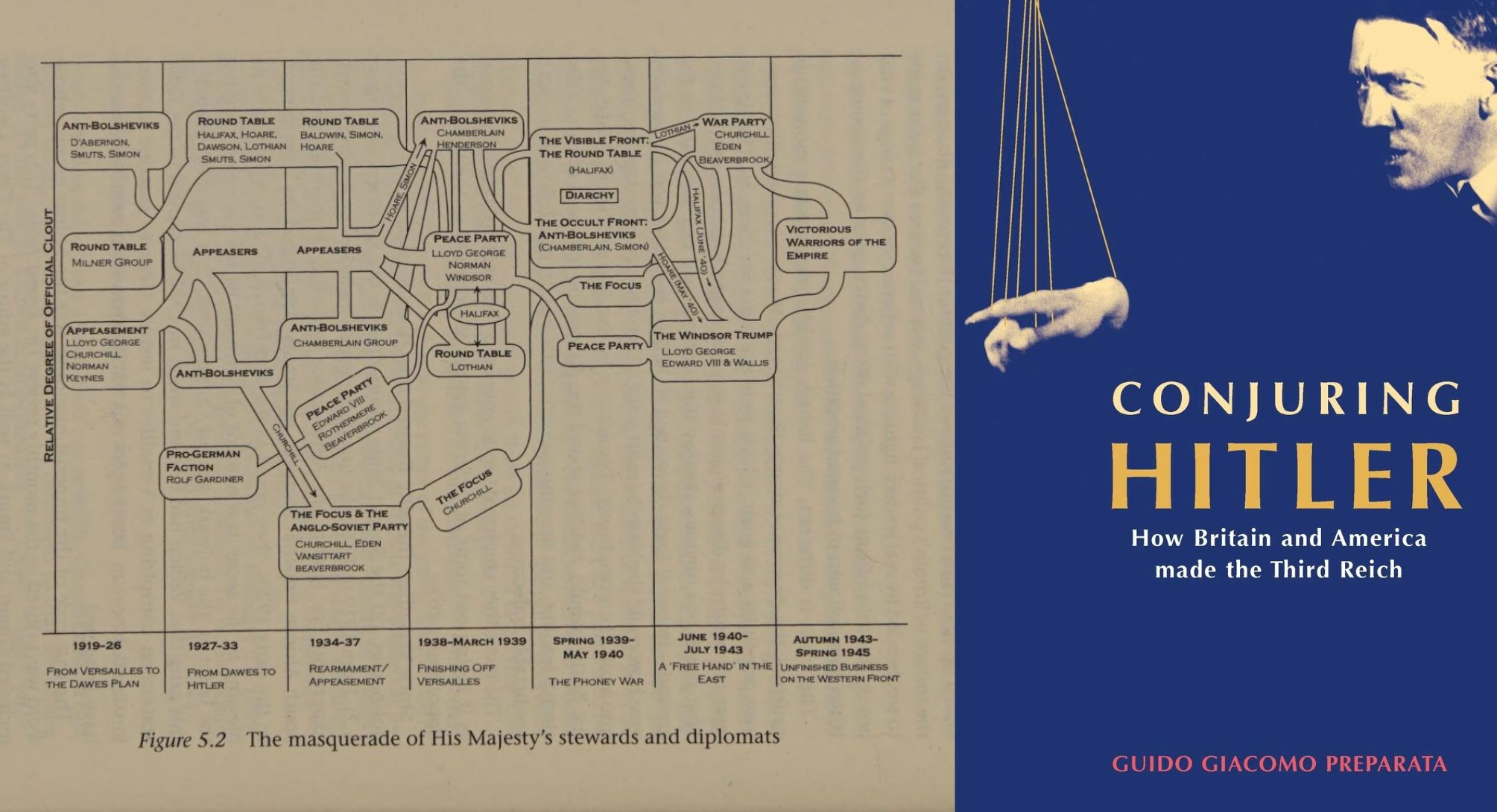
Given the forgoing diabolical machinations, Snoopman views the British Monarchy’s civil, religious and military orders as subversive revolutionary institutions.
The English Grand Priory was so satisfied with the New Zealand Commandery’s progress, that “in 1946 it was raised to the dignity of a Priory”. What progress, exactly?
Are there codified governance arrangements in the organization that operates ambulances, which act as a transmission mechanism for subversive plots? To wit:
“Government by His Excellency the Governor General as Prior and a Prior Chapter followed and it has been continuing policy that the Vice-regal representative graciously accepts the office of Prior.” — The Order of St. John in New Zealand (1977), p. 93
The first Prior was Lieutenant General Lord Bro. Bernard Freyberg (1946-1952), and was Deputy Constable and Lt-Governor of Windsor Castle until his death in 1963, as well as a Freemason with the Household Brigade Lodge No. 2614. The British Prime Minister Winston Churchill, a 33° Freemason, called him ‘The Salamander of the British Empire’, due to his ability to pass through enemy fire unharmed.
What are the odds that New Zealand’s Order of St. John gained the status of Priory on September 16 1946, given that it was on the same date, September 16 in 1840 that the location for Auckland was determined by the ‘Surveyor-General’ Felton Mathew?
This decision was recorded by Felton’s cousin, Sarah, who was also his wife and diarist. The official ceremony took place two days later on September 18 1840.With this chess move, Governor Hobson could establish the rudimentary apparatus of a Government in cahoots with pioneering capitalists away from the cesspool of Kororāreka, where settlers would slow down the Masonic take-over underway.
The Statute of Westminster Adoption Act 1947 was a constitutional act of the New Zealand Parliament that formally accepted the full external autonomy offered by the British Parliament. By passing the Act, New Zealand adopted the Statute of Westminster 1931, an act of the British Parliament evidently granting full sovereign status and Commonwealth membership to the Dominions ratifying the statute.
And so, the English Grand Priory approved in 1931 setting up a New Zealand Commandery, supposedly out of recognition of the work of the Order of St. John under a Dominion Executive. This approval came the same year that the British Parliament passed the Statute of Westminster. New Zealand was the last ‘Commonwealth’ territory to ratify this Statute of Westminster, and that royal ascent was granted by N.Z.’s Governor-General some seven days after the Ballantynes’ Fire.
Also in 1947, a secret war began in Italy called Operation Gladio, that was later copied across Western Europe, to shift the political center of gravity to the right, by inciting division with agent provocateurs, psychological operations, and tactics of terrorism.
At the time of the Tangiwai Disaster, the top position as Prior of the New Zealand Order of St. John was held by Lieutenant-General Charles Willoughby Moke Norrie, 1st Baron Norrie, from 1952 to 1957. Nicknamed Baron Norrie of Wellington, he was educated at Eton College and at the Royal Military College, Sandhurst, and he was also the eighth Governor-General and Commander-in-Chief of N.Z.’s Defence Forces from December 2 1952 to July 5 1957. Norrie was awarded a Royal Victorian Order on 15 January 1954. This date riffed off the historically the date of January 15 1821, when timber was cut for the Kerikeri Mission House, for Church Missionary Society.
The Royal Victorian Orders recognises distinguished personal service to the monarch, members of the royal family, or to any viceroy or senior representative of the monarch. This award meant Baron Norrie of Wellington occupied the highest position of Royal Victorian Order for New Zealand just ahead of an Inquiry Board being appointed.
Yet, despite the huge loss of life, the Inquiry did not bear the prestigious status of a Royal Commission getting underway while the Queen was in the country. However, Lizzy did avail herself to be the first monarch to open Parliament on January 12 1954.
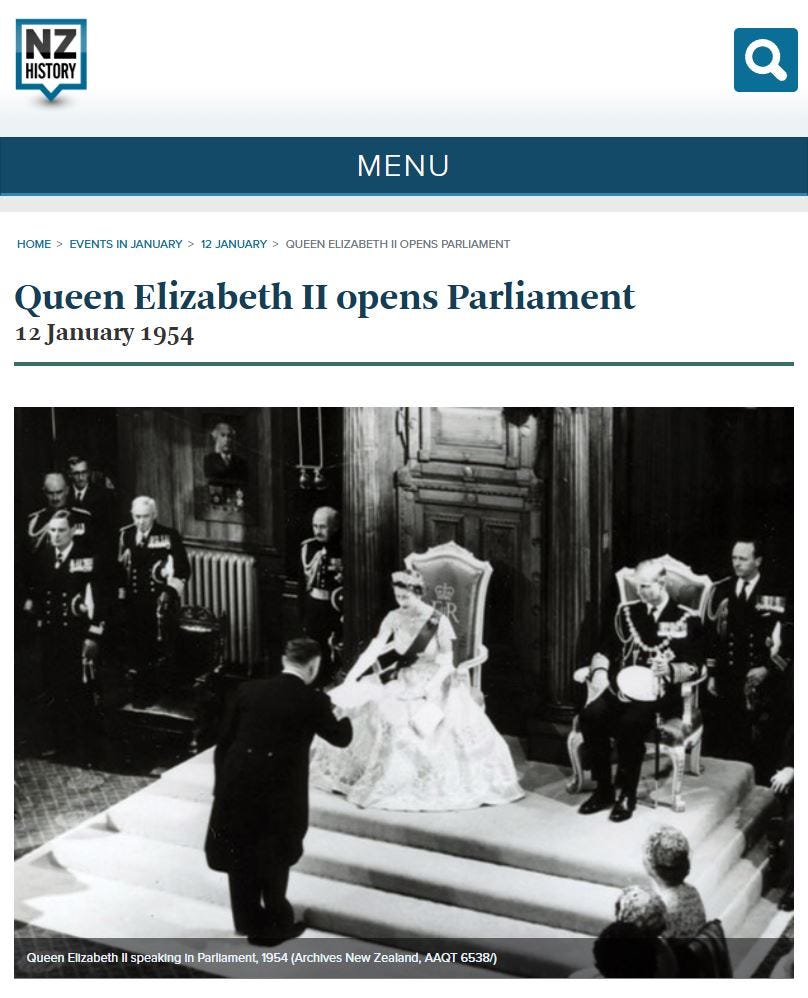
Also in the 1954 New Zealand Royal Visit Honours, other key ‘cards’ were awarded medals in the Royal Victorian Orders. Among them was William Alexander Bodkin, who was made a Knight Commander. In the Holland Ministry of the First National Government, Bodkin was a member of the executive council, and also the Minister of Internal Affairs (1949–1954), which oversaw public inquiries. Bodkin specialised in mining and irrigation law and had been minister of civil defence within the short-lived bi-partisan War Administration in 1942. When National won the treasury benches in 1949, he served as minister of internal affairs and minister of social security and, from 1951, minister in charge of tourist and health resorts. Bodkin proved an able administrator and earned a reputation as an expert in parliamentary procedure. Ergo, Bodkin had a head for matters of governance, state finances, civil defence, welfare, and public inquiries. In this Royal Game of the Goose, on his watch as the Minister of Internal Affairs charged with oversight of public inquiries, and as a newly minted Knight Commander of the Royal Victorian Order, William A. Bodkin ‘failed’ to make himself familiar with the ley of the land for a black operation involving detonating a crater lake on a volcano, that was also as a tourist destination, requiring a mobilization of civil defence, the military and welfare. If a staged disaster never occurred to him, the psycho-dramatists had managed his ignorance splendidly.
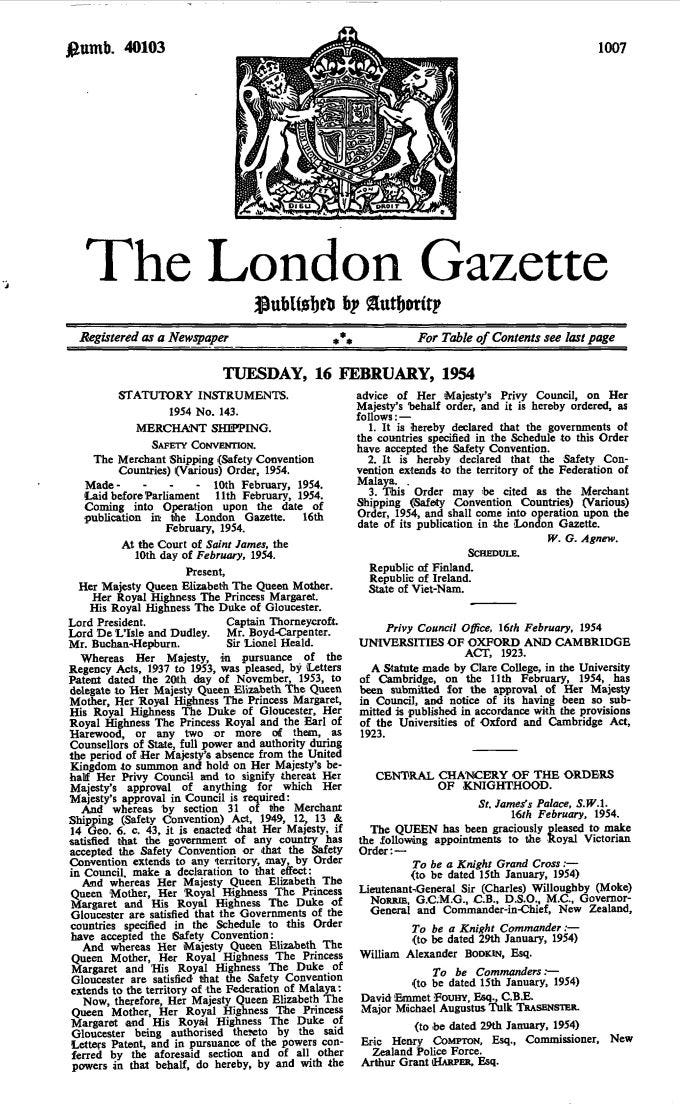
The new Commanders of the Royal Victorian Orders, were: the Police Commissioner Eric Comptom; David Emmet Fouhy, the Official Secretary on the Governor-General’s Staff, 1936-1961; and Arthur Grant Harper, Director of Royal Tour; Major Michael Augustus Tulk Trasenster of the 4th-7th Royal Dragoon Guards, of Wellington. The Royal Victorian Orders were gazetted on 16 February 1954, which riffed off the discovery themed date of February 16 1770, when Captain James Cook sighted Banks Peninsula. Officially, Cook is said to concluded the next day that it was an island. But, according to the book Lying for the Admiralty, Cook changed his maps, journals and diaries in Batavia after hearing of a French vessel heading south. Captain Cook hid harbors to buy time for Britain to establish settler colonies in New Zealand, with ports for trade. Ergo, Cook created the fiction of a potentially hazardous passage to pass through, to hide both harbours that were located at Banks Peninsula; one to the north, where the entrance to Lyttleton Port is now located, and the other on the southern coastal point, at Akaroa — where the French would formed a settlement.
The Monarch and All The Queen’s Men were something more than a pack of cards, Alice might have said, if Lewis Carroll had time travelled ninety years into the future.
Since the Ballantynes’ Fire occurred two days before the Royal Wedding in 1947, and the Tangiwai Railway Disaster occurred the day after a reigning monarch arrived in New Zealand for the first time, what are the odds that the royal ratification of New Zealand’s Dominion status, which occurred on November 25th 1947, riffed off the historical date of November 25 1862 when the General Assembly of the Presbyterian Church of New Zealand was constituted? The Statute of Westminster Adoption Act 1947, which was passed by Parliament on November 21st 1947, also riffed off the historical date, November 21 1863, that General Duncan Cameron’s forces were said to have stormed the defences of Rangiriri Pā. General Cameron was later awarded a Knight Grand Cross of the Order of the Bath for this military encounter.
The British and Colonial forces were able to cut deep into the Waikato region. The Kingitanga’s loss of control over the fertile Waikato lands, were followed by further confiscations in the Bay of Plenty, Taranaki, the East Coast of the North Island, which in effect were the conquest element of the Doctrine of Discovery practiced by the European Cannon Powers to gain territories off peoples’ who were deemed to have less political rights because they lacked the Christianity. Since there were two layers to the British Empire, comprising the visible pious Christian faith edifice, and the hidden subversive Masonic revolutionary force, the brutal truth was that ‘the natives’ possessed less political rights than Europeans because ‘savages’ lacked cannons.
After all, ‘Christianity’ was forged with the sword, the lance and the arts of terror.
It appears New Zealand had earned its stripes to establish an intelligence agency.
On 11 December 1956, the Duke of Edinburgh arrived by air at Ohakea Air Force Base and travelled to Wellington on a flying visit during the course of his world tour. The same year 1956, the NZ S.I.S. was established at the instigation, and with the assistance of British intelligence. The replacement bridge opened in September 1957.
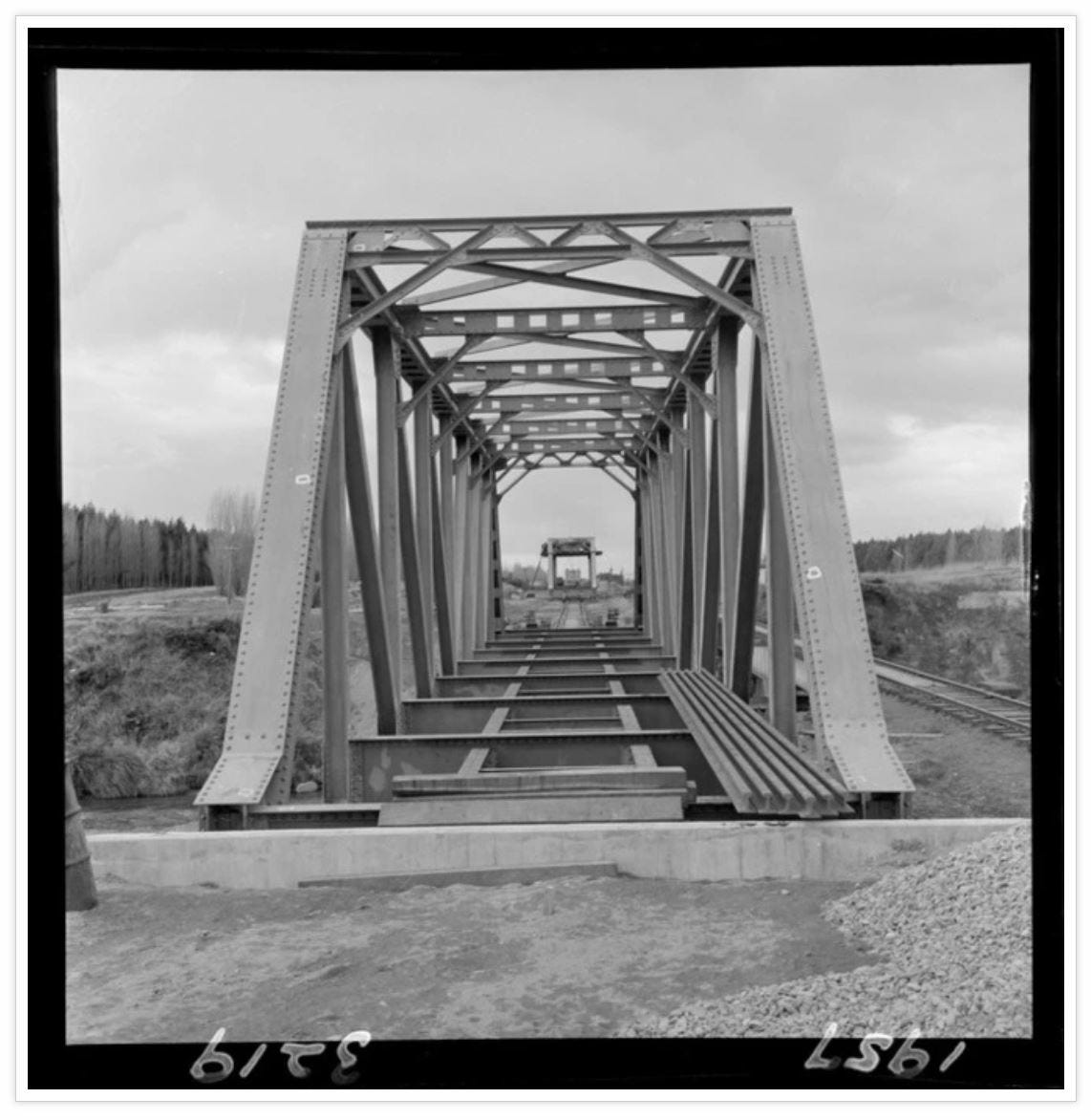
The Constitution Act of 1986 finally removed the last faint provision for the British Parliament to make laws for New Zealand. It established supposed independent roles of the Legislature (Parliament), Executive (Cabinet/Ministers), and Judiciary, recognizing the Monarch (King/Queen) as Head of State, and consolidating scattered constitutional rules into one document, replacing the 1852 Act and removing UK Parliament’s power to legislate for NZ. Prompted by a 1984 crisis, it brought clarity to NZ’s parliamentary democracy, outlining powers, roles, and the separation of powers.
That’s the sanitized narrative of the Constitutional Crisis of mid-1984, as laid down by the Realm’s Officials of Crisis Past, such as Muldoon’s Attorney General, Jim McClay, on whose watch the Erebus cover-up occurred. The Mount Erebus Disaster of November 28 1979, was an air terrorism operation inflicted to coerce New Zealand’s establishment to move bureaucratic mountains for the envisaged trans-corporate heist of the economy, lest more mountains were moved in front of flight crews.
The way had been prepared while Muldoon was in power, who could only do so much.
The Currency Crisis was staged theater to create the spectacle of a crisis to justify the need for the planned restructuring of the economy, from a centrally planned welfare state to a centrally planned corporatist state, to facilitate an asset stripping operation.
Among the currency speculators was the Bank of New Zealand, which was state-owned and was subsquently bailed out twice to the tune of $1300 millions before it was sold off, as part of a sweep of state assets sales orchestrated by the cryptocracy.
As Snoopman demonstrated in part 4 of his Darkest Days by Dates Down Under series, entitled “Kiwi Dollar Weaponized as Ransom Notes — ‘Bastille Day’ Currency Crisis”, this staged crisis was rife with French Revolution historical riffing.
A decade after Tangiwai, the Queen would express sympathy to the bereaved after the Brynderyn Bus Tragedy of February 7th 1963, which had been at Waitangi, where Elizabeth performed a speech on the marae. ‘The Maoris’ on the bus were sacrificed.
What are the odds that New Zealand’s worst road accident occurred on the same date, as New Zealand worst maritime disaster, February 7 1863, when HMS Orpheus sank. The sail and steam corvette lost 189 navy men bound for fighting in the Waikato War.
Ergo, New Zealand was cast as a staging ground for sinister novel Trojan Horse black operations, to incrementally reconquer the land district by district, city by city and administration by administration. The themed date meta-data reveals an over-arching meta-narrative, or conflict, and its diabolical hidden objectives. By embroiling officials across the land in cover-ups, such ‘worst of type disasters’, or the attempts to make them so, was embarked upon as a totalitarian strategy to forge a police state.
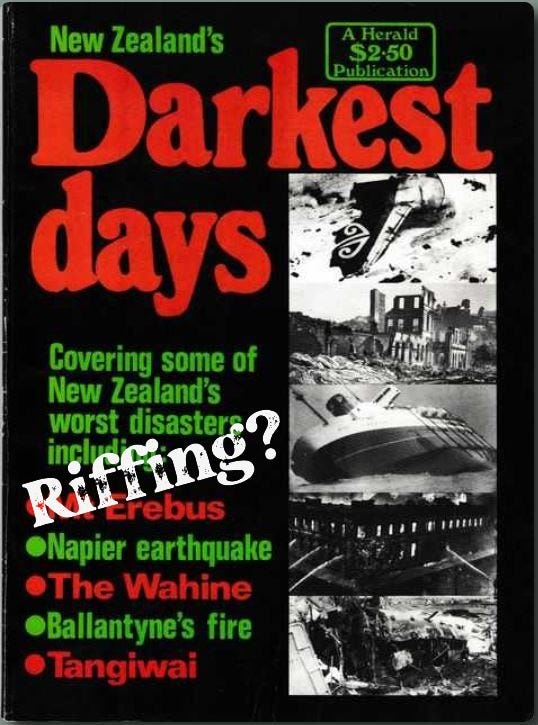
How ironic that two days into Her Majesty’s New Zealand tour during a six month trip around the “countries of the Commonwealth and Empire”, Queen Elizabeth would speak of how the British Commonwealth was a new conception of empire.
And in the Christmas day heart-warmingly-toned address, designed as it was to brainwash the Commonwealth’s masses with a sense of optimism with a friendly face, the female monarch stated how in the past half a century, a peace-loving brotherhood of man had invented a progressive association of peoples which history had yet seen.
Without blushing about the opulence she had grown up in, while the degenerate British Oligarchy played geopolitical chess with the globe in cahoots with their sociopathic counterparts on the Eastern Seaboard of the United States, Elizabeth II omitted to say that Great Britain was broke after engineering two global wars. And, that instead of her wretched family bowing their heads for being co-conspirators, and selling off their assets to pay reparations, the privately-owned Bank of England had been ‘nationalized’, which was a euphemism for socializing the debt to taxpayers.
This is why the sacrificed lives were treated with all the concern of a Wall Street accountant when confronted with a rounding era, by the Board of Inquiry into the train derailment on Bridge No. 136 at Tangiwai, at 10.21pm on December 24 1953.
Ergo, the ‘Public Inquiry’ performs as an obituary of the public as a decisive agent.
The secrecy inherent to the operation requires a Public Inquiry as an experiential spectacle, which draws newsroom resources away from autonomous investigations.
Newsrooms reported on a stage-managed contest where participants were filtered, flak was restricted and vertical clarity was dispersed with red herring arguments such as over a reasonable standard of care to do with engineering, inspections and maintenance of Bridge 136. The ‘Elephant in the Inquiry Room’ was that this discourse acknowledged lahars ‘were a thing’, as a millennial psychology student might have said if she had time-travelled to drop in at Judge Stilwell’s theater. But, site inspections of the Crater Lake weren’t a thing. It was ‘beyond imagination’ that nature would do such a thing, and with such cruel timing a day before the Queen’s Christmas Day broadcast. Yet, if the Queen was to have travelled on that train, No. 626, lahars would’ve have entered the imagination of every Freemason official, including Holland, because the ‘brotherhood of man’ was a Masonic enterprise.
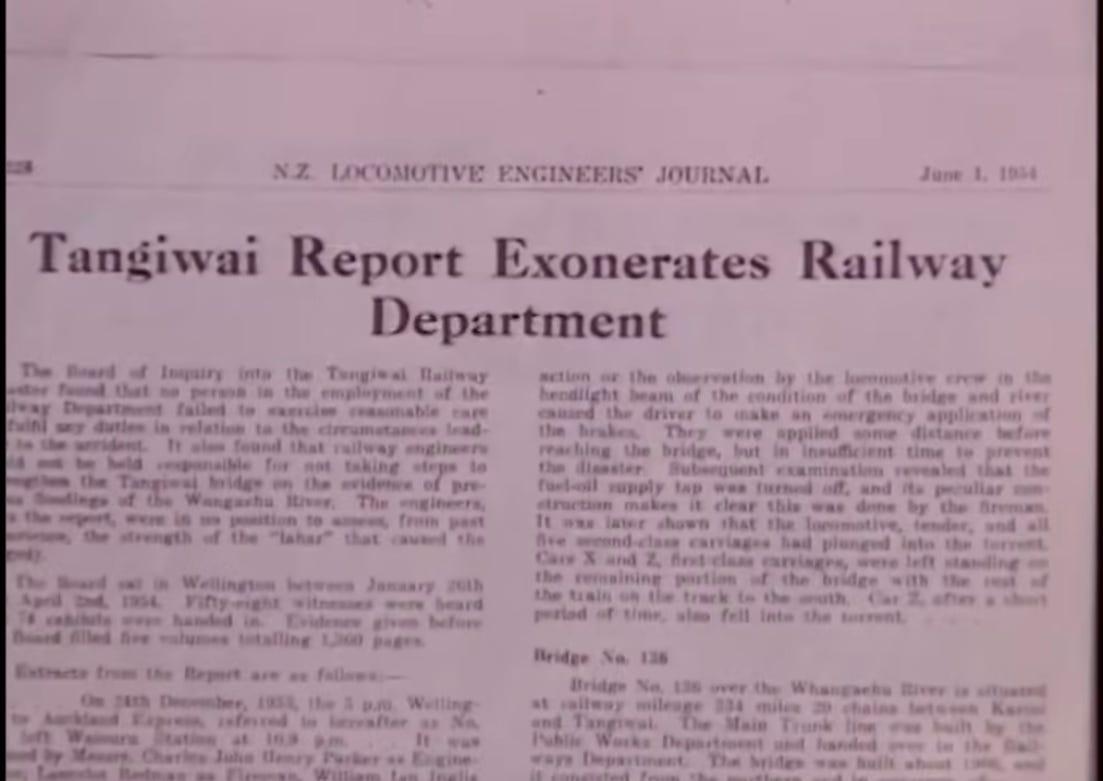
And so, the Public Inquiry itself is an agent of the cryptocracy, performing as a vector for horizontalization by chopping the facts, evidence and frameworks for ‘analysis’, like slaughtered carcasses at a butchery owned by the Mayor — to create clashing camps.
The purpose is to split public opinion by feeding them the equivalent of meat cuts via news reports, so that they will create incomplete mind-maps like a poster of a steer, or a sheep, depicting its cuts on a wall in a butchery to be perused in a queue.
The poster doesn’t depict the political economy of a declining empire reinventing itself as a junior partner with the new hegemonic power, the United States, to inform the butcher’s customers about how All Wars are Bankers Wars, lest they learn to evolve.
Since the Mayor owns the butchery it is ‘available for hire’ for disposing of bodies, when it is closed on Sundays. The cryptocracy’s nationwide criminal network greases its economic dynamism with shell companies, drug trafficking and pimping hookers.
The pongy abbatoir by a river where the carcasses are slaughtered comprises a node of the vertical pyramid power structure that is networked into the cryptocratic dark state.
The real evidence of slaughter is symbolized by the blood washed away into the river at night. The town gets a whiff that something is awry like on a low cloud day when the slaughterhouse’s stench reminds everyone ‘the Boss and the Mayor are Lodge’.
Disputes about blame versus an unforeseen ‘Act of God’ are intentional horizontal conflicts to derail a backlash that would threaten an architecture of impunity.
A ‘Public Inquiry’ is rigged as critical componentry to this horizontalization protocol, for an emergent cryptocracy who plot Trojan Horse catalytic events as rituals.
The ‘Public Inquiry’ exists to ensure there is no verticle glitch, where the underlying class and power structure becomes too visible to be rotated away, and regular people spot the matrix code. The Tangiwai Railway Disaster Inquiry managed this threat and turned it into a horizontal fight between the railways engineers and the independent engineers. This horizontal fight performed as a red herring argument that deflected attention from the scent of a black operation to trigger the lahar on Christmas Eve.
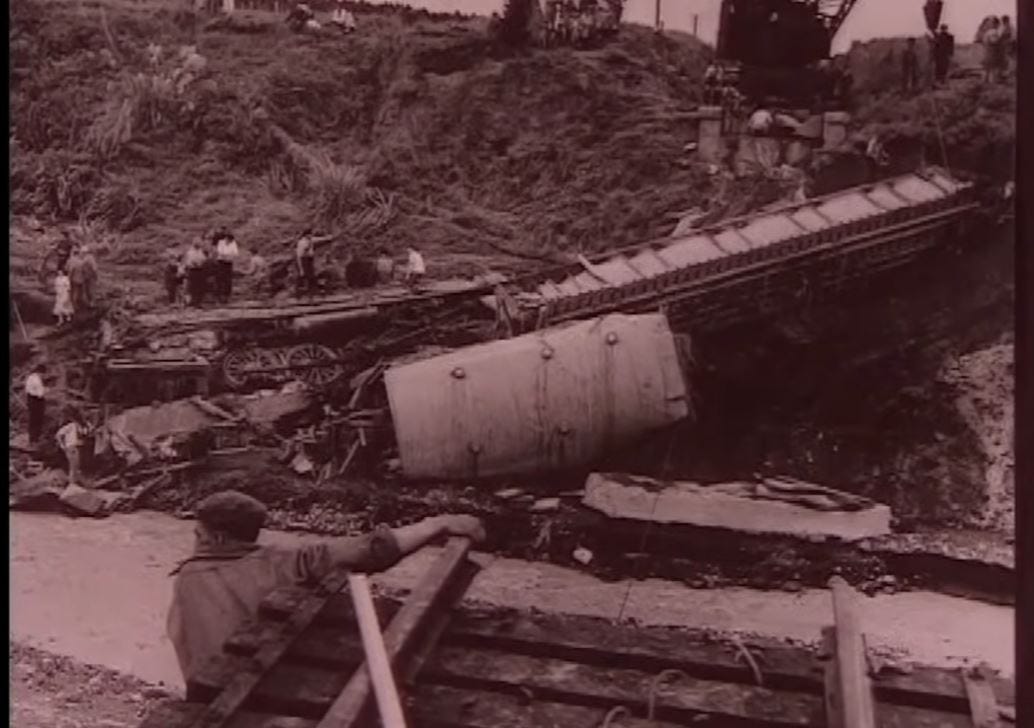
But, secrecy wasn’t the emergent cryptocracy’s only weapon. The cryptocracy also operated in the light, supplying an abundance of distractions including the organized religions of Christianity. These mask the personification of celestial objects that had been deified in myths by city state cults for their life-sustaining nature, and others, cast as threatening to codify the periodic threats of asteroids that cause cataclysms.
Ironically, the distractions extended to sport to keep the monkeys focussed on the ritualized competition, while a cryptocracy remade the world fit for permanent totalitarian rule. The British Empire spread cricket and rugby as a form of unifying power between the classes. So, when the filmmakers retold the tragedy through the lense of Tangiwai: A Love Story, which depicted the snuffed out life of Nerissa Love, the love interest of the fast bowler Bob Blair, their film fed the myth most splendidly.
The Tangiwai Railway Disaster Board of Inquiry practiced the structure of contrived ignorance with professionalism. The February 5 1951 letter by Lewis Vause was filed as Exhibit No. 28 by the Inquiry upon submission by Jim Healy, the Superintending Geologist at the Geological Survey Branch of the Department of Scientific and Industrial Research. But, the index to the Tangiwai Report excluded reference to his 1951 report. Vause said he was troubled to find that only the first three sections of his report were archived with the records of the Inquiry Board. The crucial fourth section was missing. It contained methods for opening the crater lake for a controlled release.
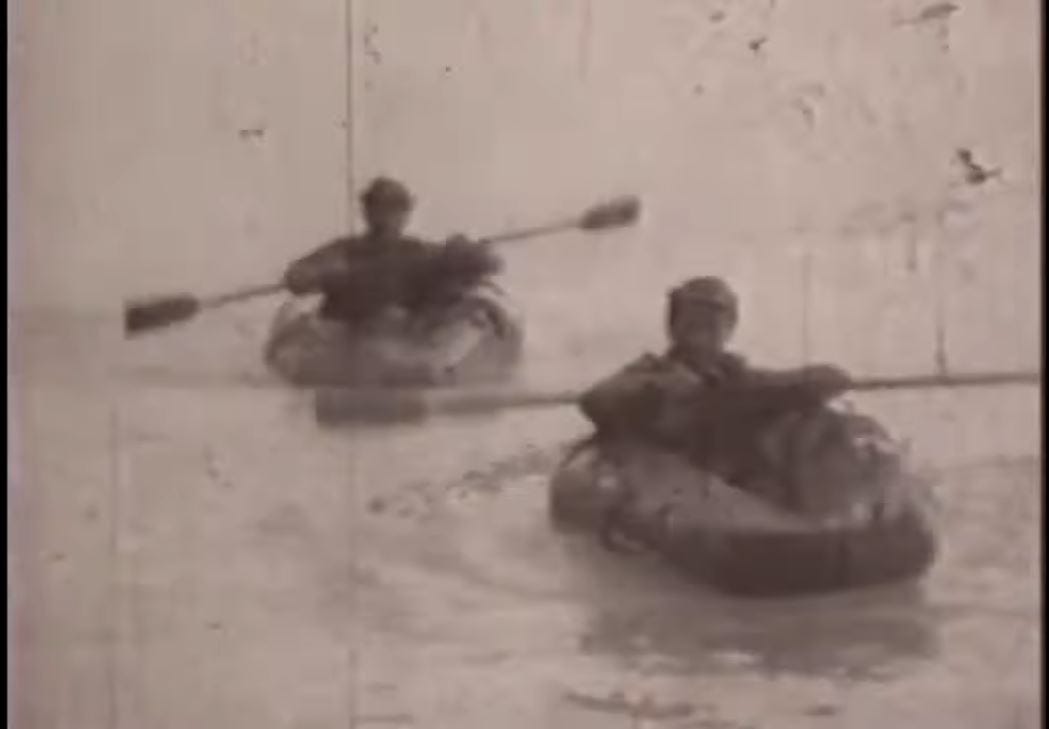
And so, the methodical expeditions of Lewis Vause and Jim Mason to the crater lake in 1950, which were reported at the time in the Wanganui Herald, were inconvenient.
A structure of contrived ignorance works with screening actions and unwitting misdeeds ‘acting in cahoots’ to successfully maintain a syndicate’s conspiracy.
In his paper, “Contrived ignorance”, published in The Georgetown Law Journal in 1999, David Luban argued the case for modeling the “Structure of Contrived Ignorance” by viewing screening actions and so-called unwitting misdeeds as a unitary whole rather than separated by time-frames. Luban proposed viewing the version of the self that wittingly performed screening actions to preserve his own oblivion as the principle actor, while the agent is the later self at the time of the unwitting misdeed, who effectively ratifies the earlier self’s choice to compartmentalize or screen off potential knowledge of wrongdoing. A quote Luban draws from a U.S. trial seems apt for this example of crisis engineering, and its cover-up by the cryptocracy, “Ostriches … are not merely careless birds.” In making his point that “in criminal law, willful ignorance is grounds for conviction, rather than acquittal,” Luban was in essence, laying out the gaps in catching and convicting group enterprises that contrive ignorance.
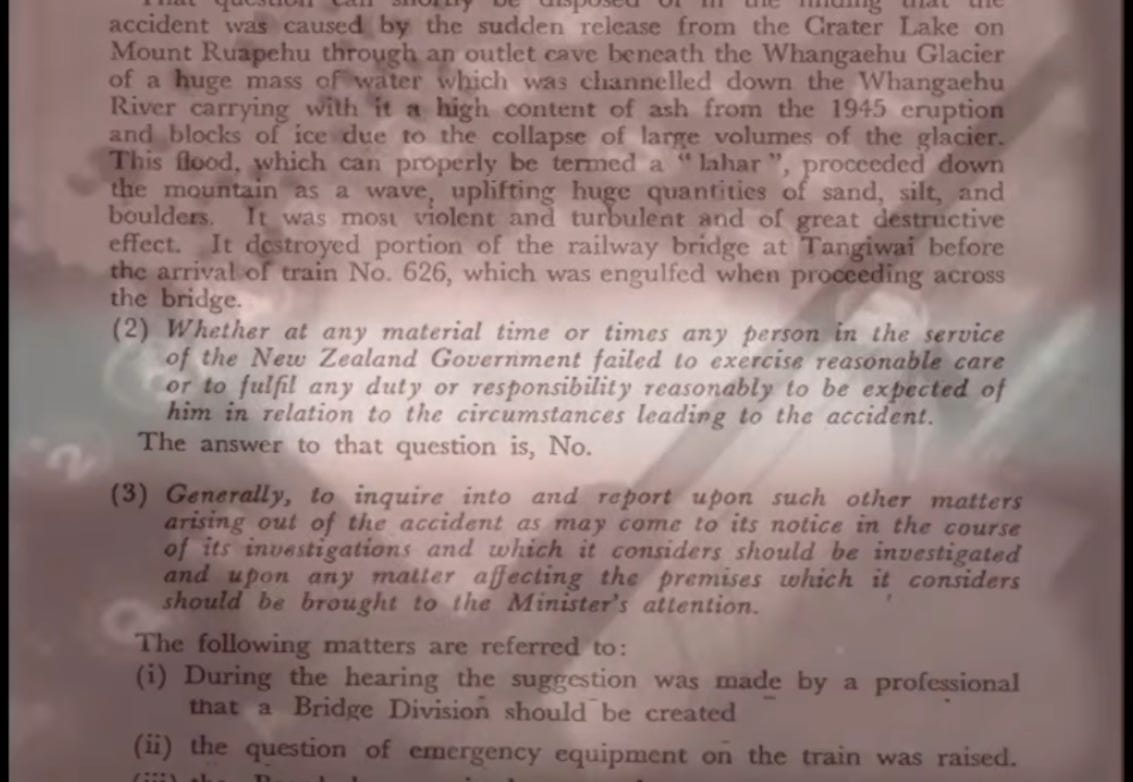
The apparent avoidance of the DSIR’s Geological Survey Branch to acknowledge Vause’s letter of February 5 1951 would qualify as a screening action. As an institution, such an avoidance would screen off officials from knowledge of credible data showing threats posing an impending likeliness of danger, damage and death.
By ignoring Vause, the DSIR’s Geological Survey Branch performed a screening action and in so doing, an official (or officials) at the Geological Survey Branch cast himself (or themselves) as the principle actor(s) who wittingly preserved his (their) own oblivion, while the agent(s) as the later self (or selves), effectively ratified the earlier self’s (or selves) choice(s) to compartmentalize or screen off potential knowledge of wrongdoing, once the unwitting misdeed of the Tangiwai Disaster eventuated.
And so, the Tangiwai Railway Disaster Board of Inquiry accepted the account about the cause and nature of the flood tabled by Jim Healy, the Superintending Geologist at the Geological Survey Branch of the Department of Scientific and Industrial Research.
The Board of Inquiry noted that Healy made observations of the Tangiwai area, the Whangaehu River and Mount Ruapehu, including the Crater Lake and the head of the Whangaehu Glacier in the aftermath. Jim Healy’s decision to preference the observations and photographs of the Wood’s from the morning of Christmas Eve 1953 were in effect a ratification of the decision to preserve the oblivion of the Geological Survey Branch, if not himself directly, from knowledge of the looming danger.
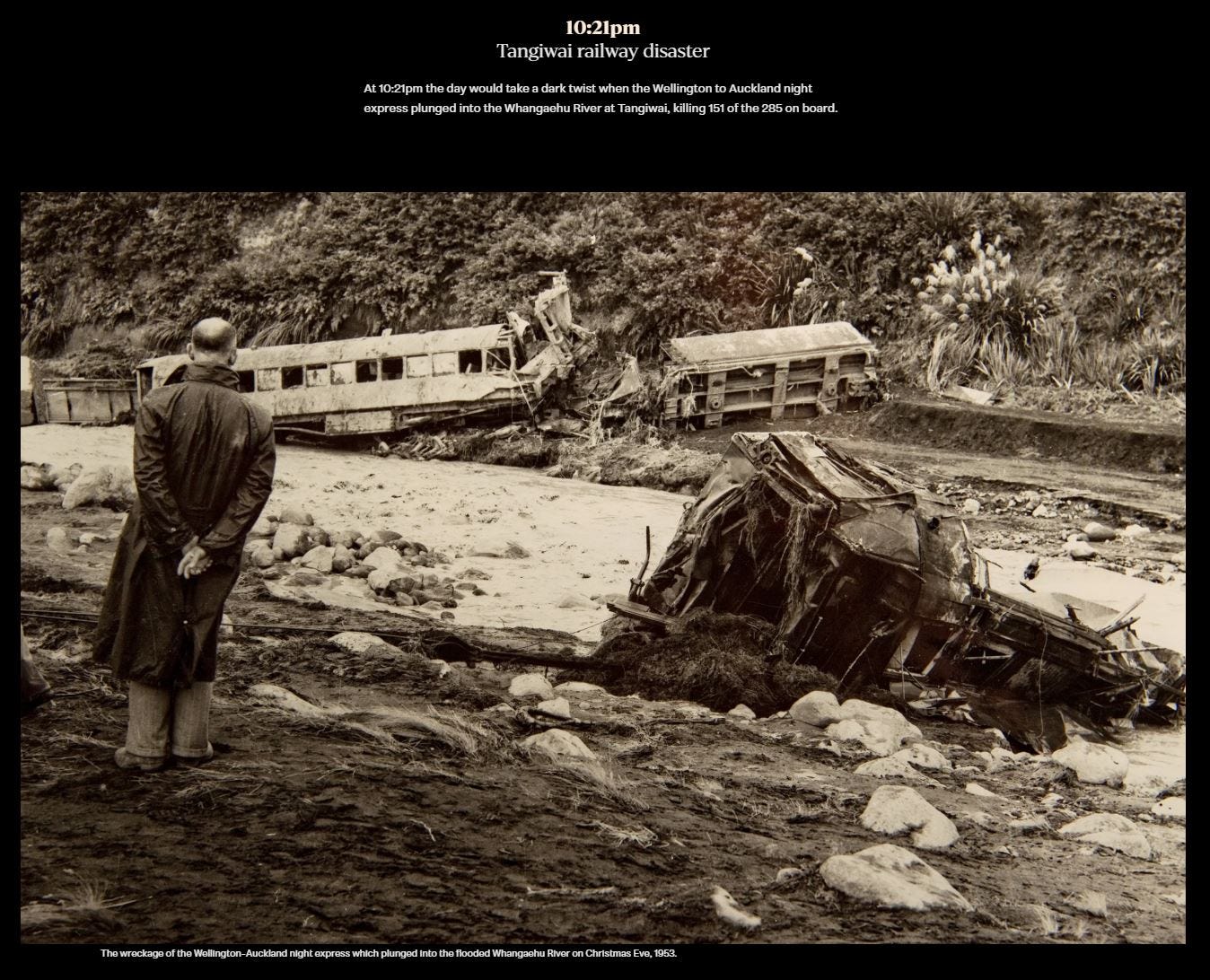
Because, in discounting the value of the observations, measurements and calculations made by Vause and Mason to essentially a worthless exhibit letter, and by avoiding to emphasize Vause had written to the Geological Survey Branch in early February of 1951 warning of lahar event two or three years down the track, and how the mountaineer, who was also an engineer, had described methods for controlled releases of the Crater Lake water — Healy had wittingly obfuscated the dangers were known, or should have been known, to the DSIR and its Geological Survey Branch.
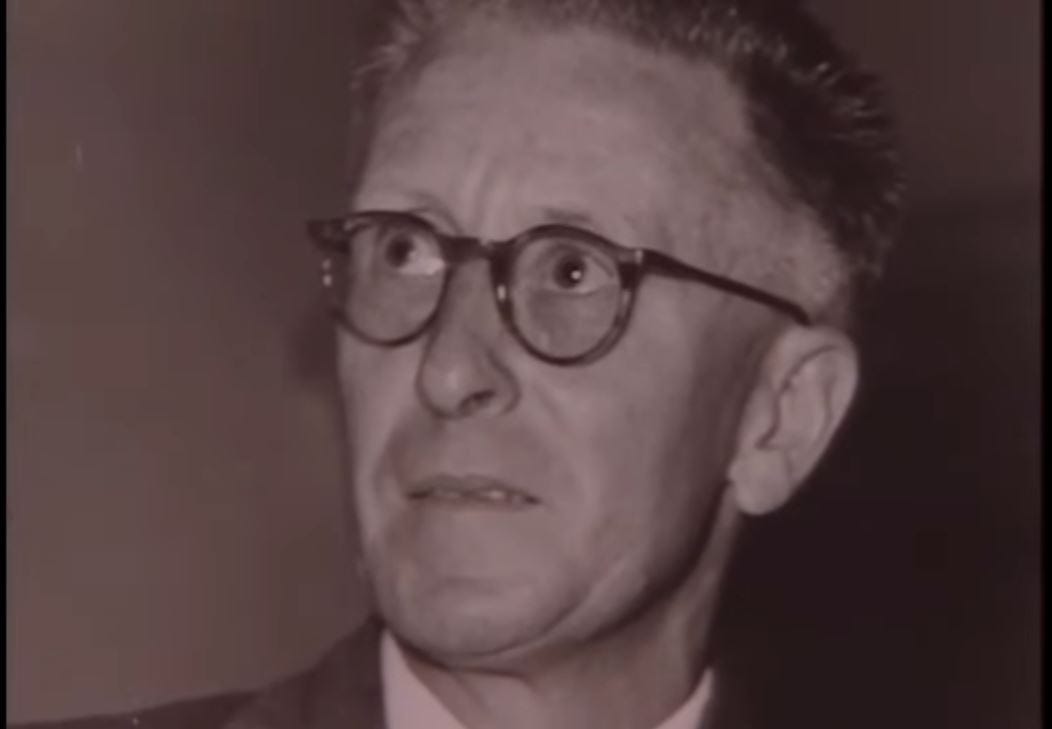
How ironic that the only trace of Vause’s 1951 letter in the Inquiry Report appears as an exhibit entry, No. 28, in the index titled, “Schedule B”, tabled by Healy, rather like a rescued survivor. Meanwhile, the first three sections of his 1951 report was buried in the archives, like a dug up body found in the silt of the Whangaehu River’s bed. And meanwhile, the critical section four, which would have been the most damning if the Inquiry Board’s staff found it, could not be sighted by Vause when he searched. So, section 4 of Vause’s 1951 report could not be found just like 21 bodies never recovered.
How uncanny, the No. 626 Limited Express train plunged into the Tangiwai River on December 24th 1953, which just happened to be on the same date, December 24th in 1814, that the Anglican Reverend Samuel Marsden slept restlessly at Rangihoua, in the Bay of Islands, where he would establish a mission station. Particularly, because it meant the Queen performed ‘breaking news’ to the world in her first ever radio broadcast on Christmas Day 1953 about the “most grievous railway accident” at a place called Tangiwai. The narrative of an accident was set in the minds of millions. How uncanny, since this historic first radio broadcast riffed off Reverend Marsden’s performance of the first Christian service in New Zealand on December 25th 1814. Recall, the monarch is the Supreme Governor of the Anglican Church of England?
What better way to fix a sacrificial rite of passage staged as train terror theater, than to time its occurrence to riff off the same day that the Church of England’s trail-blazing missionary slept restlessly in the Bay of Islands in 1814? And, what better way for this train terror theater to happen, than the day after the landfall of the first reigning British Monarch to visit New Zealand? And, that the Tangiwai Train Tragedy would feature a pier that lost its footing in a lahar like a loose tooth knocked free from the bridge of the mouth by a thumping fist in an explosive playground fight.
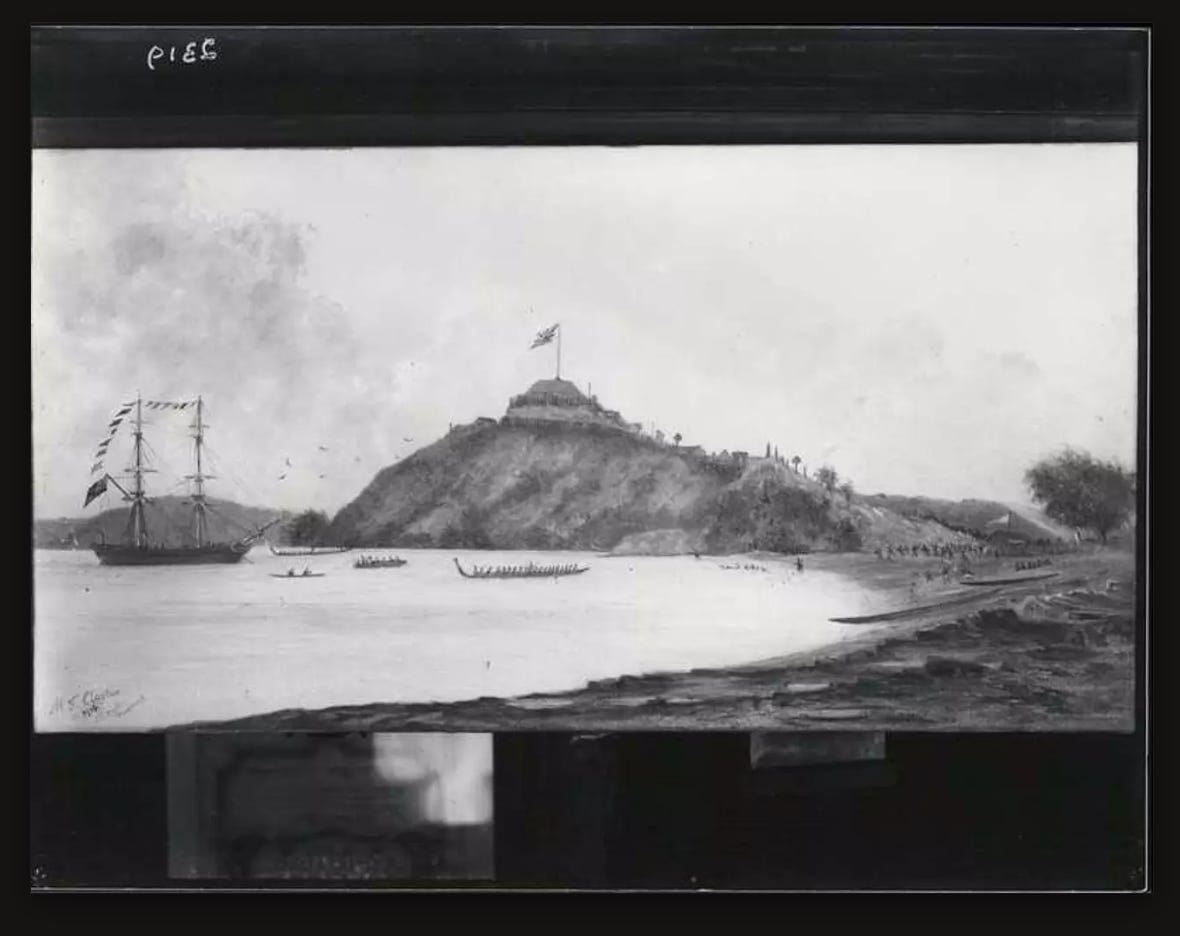
And was it not uncanny that the new Queen would travel by train to Palmerston North on January 7 1954, after a trip to the Watties Cannery Factory at Hastings.
After all, it was on January 7th 1910, the administration of the Order of St John in New Zealand was undertaken by a Dominion executive. With this trip, the Queen expressed confidence in New Zealand’s Railways Department. It appeared to subtly signal simultaneously the asymmetric diligence in care afforded to the monarch, following a disregard for the safety of the Express passengers and crew.
Recall how the British Monarch is the Sovereign Head of the Order of St. John? And that the Order of St. John is a descendant militant religious order that was first established in the ‘Holy Land’ and expanded to Cyprus, Rhodes and Malta as a “bulwark of Christendom against the onslaught of the Saracens”, as Denis Blundell framed the history in his preface to the 1977 book, The Order of St. John in New Zealand? Denis Blundell, who had served in the New Zealand Expeditionary Force, was one of the Tangiwai Inquiry Board’s counsel. He would later become a Governor General. He was the grandson of Henry Blundell, who was a scion of the ancient Lancashire family, and who founded the Wellington newspaper, the Evening Post in 1865. Denis Blundell was made knighted in 1944, and was awarded the Queen Elizabeth II Coronation Medal in 1953, which was instituted on June 2 of that year.
In effect, the monarch’s train trip was a ratification of a successful rite of passage ritual, whether Elizabeth II knew it or not. During her 70-year reign as a ‘world’s greatest character actor’, Britain was America’s most constant companion in military interventions to overthrow governments that didn’t serve the Empire’s expansionism.
In Lewis Carroll’s Wonderland, Alice saw through the chaos disguised as logic.
During Elizabeth II’s 70 year reign, the Alices and Alans were duped into believing the logic that the staged chaos wasn’t the result of a grand conspiracy. The Alices and the Alans can’t see the horizontal spectacle has everyone blaming the marionettes in the opposing suits in every card game, or the competing pieces in every board game. They fail to discern that vertical conflicts are dangerous for the rulers, who learned from Wonderland too. The ultra-rich lurk in shadows while billionaires get the limelight.
At first, ‘the Royals’ presented a sane ‘common touch’ that made it seem the chaos was of an origin among the ‘numbered cards’ or ‘the pawns’, consumed in their madness.
But, over the eternal tea-time at six, the British Monarchy itself was drawn into maelstrom of chaos, as their scandals became fodder for royal beat reporters.
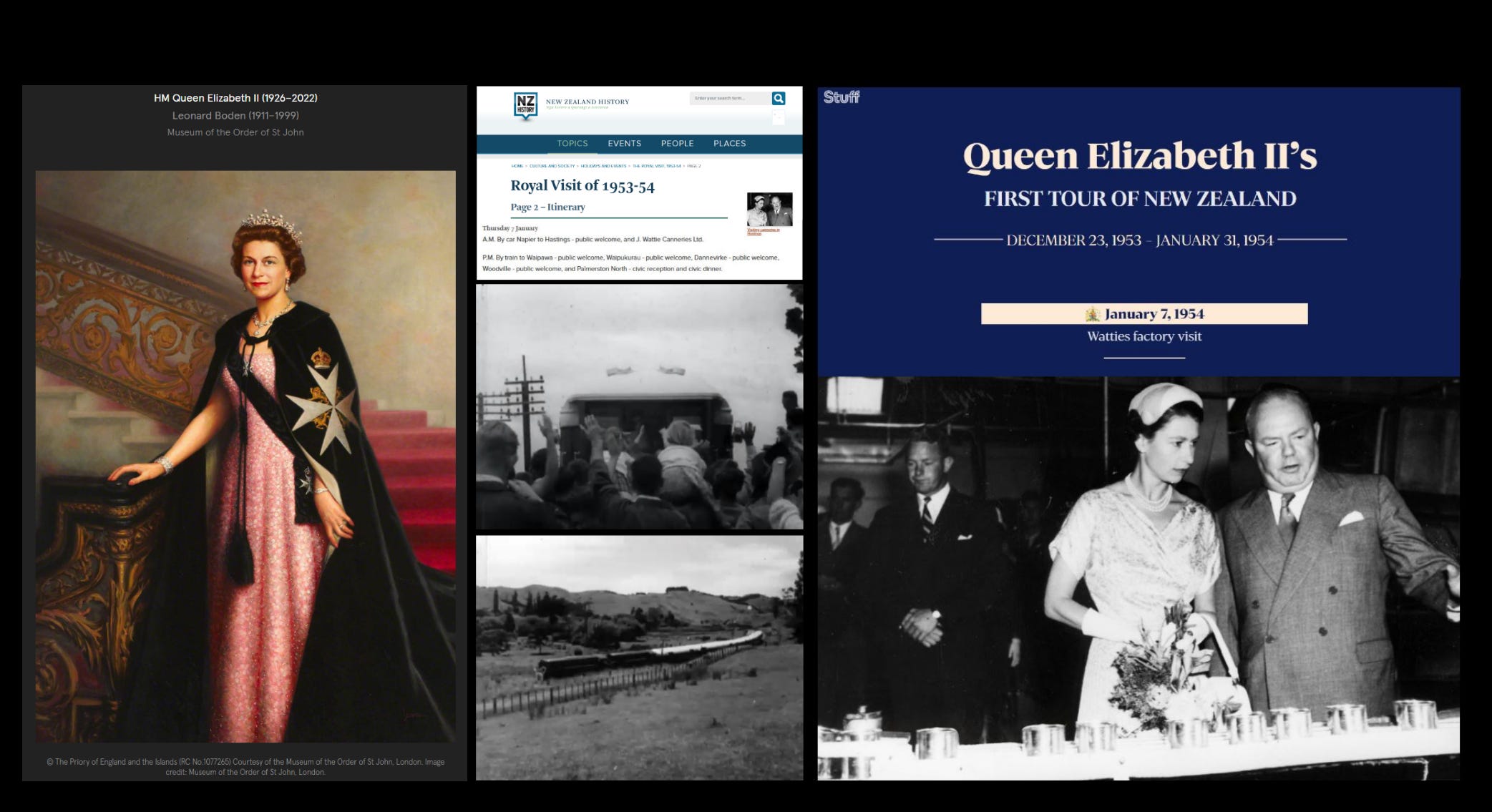
A secret war was inflicted in Europe from 1947. In his book, NATO’s Secret Armies: Operation GLADIO and Terrorism in Western Europe, Dr. Ganser showed the security services, intelligence agents or special force units, or ex-personnel from such units, from all 16 NATO countries had inflicted state-sponsored terrorist attacks on their own citizens. In these black operations, the bombings of train stations, buses, and airports, as well as assassinations and coups d’état, would be blamed on a communist group or commie patsies. The CIA, MI6 and the Coordination and Planning Committee (CPC) of NATO’s Supreme Headquarters Allied Powers Europe (SHAPE) were key culprits. QEII was the Commander-in-Chief of the British Armed Forces.
Such false flag attacks were a low grade war inflicted to achieve a ‘strategy of tension’ to shift the political ‘center of gravity’ of Western Europe away from socialist governments, by blaming the terrorism on communist groups. by associating peace, freedom and democracy with right wing governments. Operation Gladio was exposed in 1990, but soon forgotten. By showing the subversion of Western Europe, Ganser’s groundbreaking book proved NATO’s fascist Gladio network drove a radical shift in warfare. And, Paul L. Williams traced the history of Vatican-CIA-sponsored terrorism, drug-running and arms trafficking since World War II, in his 2015 book, Operation Gladio: The Unholy Alliance between the Vatican, the CIA, and the Mafia.
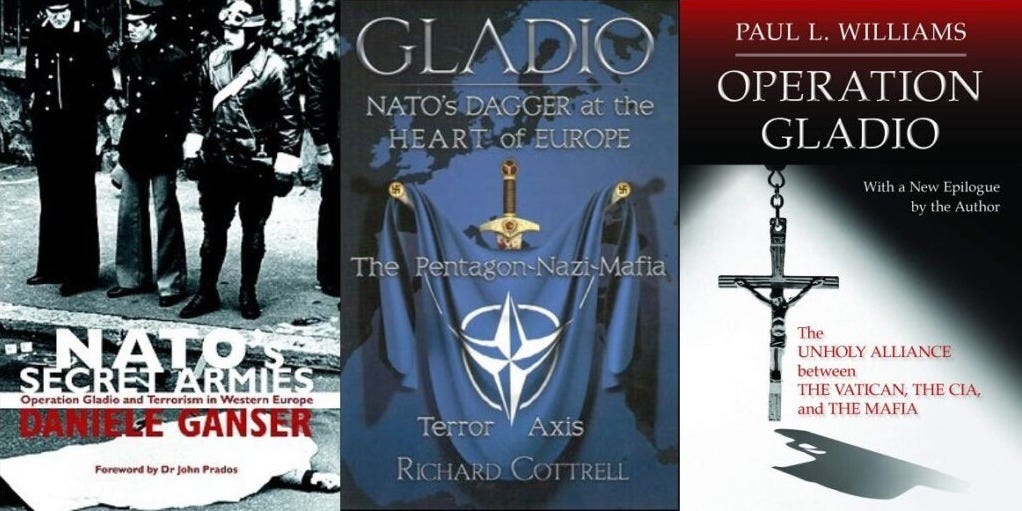
It turns out that Pope Pius VII worked piously with his Under Secretary of State, Monsignor Giovanni Battista Montini (the future Pope John VI), to assist 33rd Degree Freemason Allen Dulles, the Swiss Director of the Office of Strategic Services (OSS), in constructing the ‘Vatican Ratlines’ through which top Nazis could escape Europe. And it was Pius VII, who, rather symbolically, made James Jesus Angleton a Knight of the Sovereign Order of Malta. Symbolic, because Angleton was a CIA spook.
The Office of Strategic Services began life as a World War II-era foetal monster that was returned to a ‘laboratory’ at the war’s end, only to be reborn in 1947 with a ‘birth certificate’ known as the National Security Act — along with its nosy twin sibling, the N.S.A. The born-again foetal monster became infamously known by its initials: ‘C.I.A’.
Angleton, along with former OSS Executive Director William Donovan, negotiated in 1947 for CIA black funds from heroin to be funnelled through the Vatican Bank to bankroll the resurrected Christian Democrats into the Italian Parliament. At that time, Donovan headed World Commerce Corporation (WCC), which was an enterprise registered in Panama and initially bankrolled by Nelson Rockefeller, Alfred DuPont, Joseph C. Grew (nephew of J.P. Morgan), and Charles Jocelyn Hambro of Hambro Bank, with the purpose to supply arms to subversive underworld groups in exchange for drugs. A Miami-based shell company General Development Corporation, ran the first Gladio-funding drug-running test, Operation X, toward the end of 1947, which involved the Sicilian mafia shipping pure heroin in crates of oranges containing wax replicas, wheels of cheese, cans of sardines and barrels of olive oil from the Italian pharmaceutical giant Schiaparelli to Cuba for cutting in laboratories controlled by the Trafficante clan and shipped to Gotham for distribution to the jazz clubs of Harlem.
And it was Pope Pius VII who had made the Executive Director of OSS, William ‘Wild Bill’ Donovan a Knight of Malta. ‘Wild Bill’ negotiated the Vatican’s support for the establishment of the Gladio network of ‘stay-behind-units’, which was the brainchild of Nazi intelligence chief, General Reinhard Gehlen, who was also made a Knight of Malta. As with Gehlen’s Organization of ‘werewolves’, the stay-behind-units would eventually be transformed into the Soviet-spying German Bundesnachrichtendiesnt (BND). Under Conrad Adenauer in 1956, the Gladiators of Western Europe would be absorbed into the secret units within the militaries, intelligence agencies or secret services of all NATO states. And, while every European country’s parliament or judicial system investigated Gladio after its exposure in 1990, NATO and Washington refused to talk about the terrorism these clandestine power structures had inflicted on the watching naïve news audiences: European citizens, as well as politicians.
But, as Paul Williams stated in his book Operation Gladio: The Unholy Alliance between the Vatican, the CIA and the Mafia, it is the Holy See in Vatican City — which is headed by the Sovereign Pontiff — that is the real linchpin of the Western Empire’s global terrorism operations. At the inception of the CIA in 1947, the intelligence agency was tasked with covert operations targetting hostile foreign states or groups. While the administration of the CIA could be funded by U.S. Congress, such black operations required a black budget, to be funded by forging an international drug syndicate.
Because the Vatican needed the CIA’s help to ensure the Italian Communist Party (Partito Comunita Italiano, or PCI) did not win the 1948 Italian election, William Donovan and former OSS officer James Angleton cut a deal with Pope Pius VII. The black funds from heroin, totaling $65 million for the 1948 election operation, would be laundered through the Vatican Bank. This was the beginning of the CIA supplying black funds in return for the Holy See protecting the CIA’s most sensitive documents, since the CIA had one potentially fatal ‘Achilles Heel’ flaw. If the political winds ever shifted beyond the American Deep State’s control, Congress could order the CIA to turn over its most sensitive records, while the Department of Treasury could, in theory, raid its Langley Headquarters and CIA officials could be indicted for war crimes, conspiracy and mass murder. Whereas, the Papal State within a State with a bank that also has a sovereign entity status, seemed like a more secure bet.
From that deal onward, the Vatican and CIA became bonded as Fraternal Brotherhoods in their evil intrigues to accumulate more wealth, power and control, even as they inflicted a collective mental degeneration over Western Civilization to distract, divide and defeat. After World War II, the Atlantic Alliance covertly formed this secret ‘stay behind’ army by recruiting fascists, including former Nazis, to conduct terrorism operations now generally referred to, by the Italian pogrom, code-name ‘Gladio’, which was Latin for Roman sword. Operation Gladio is the umbrella name for a hidden low-grade war that embroiled every NATO state who used either their intelligence services, military forces, or paramilitary squads to inflict terrorism against their own citizens to shift the political gravity to the ‘right’, and away from socialism by blaming left-wing communist groups for the carnage. The bombings of trains, planes, automobiles, buses, and buildings conducted under Operation ‘Gladio’ were, in fact, ‘false flag’ operations. MI6’s complicity occurred on Elizabeth II’s watch.
Ergo, even when an epic multi-decade transnational terrorism conspiracy was proven, no officials were ever held to account, despite judicial and parliamentary inquiries.
And so, the irony of Queen Elizabeth II presenting her Queen’s Colour to the Royal New Zealand Navy at the Devonport Naval Base, on 24 December 1953, was that it not only riffed off the historical hoisting of the Union Jack atop the Rangihouia Pā, where the first Anglican Mission Station would be built. But, also because the monarch’s presentation of a new Royal New Zealand Navy Flag, occurred hours before the ‘false flag’ terrorism at Tangiwai. The opening of the Royal Visit was riffing off the historical record of the trail-blazing Church of England missionary Reverend Samuel Marsden. And in turn, the mayhem-makers behind the ‘Tangiwai Railway Disaster’ would overlay their own brand onto the Coronation Tour, with symbol sorcery gleefully hacking reality by riffing off the same historical moments and some others.
And, what are the odds that two Royal New Zealand Air Force pilots flying Mustang fighters would crash in fog on December 22nd 1953 while en route to Whenuapai Air Base in West Auckland, on the same date, December 22nd in 1814, that Reverend Samuel Marsden landed three horses at the site of Rangihoua Mission Station? What psychotic humour packed into this terrorism that the squadron of Mustang fighters set out flying below minimum safe altitude following the coastline, given that the name Mustang derives from the free-roaming wild horse of the Western United States, descended from horses brought to the Americas by the Spanish conquistadors.
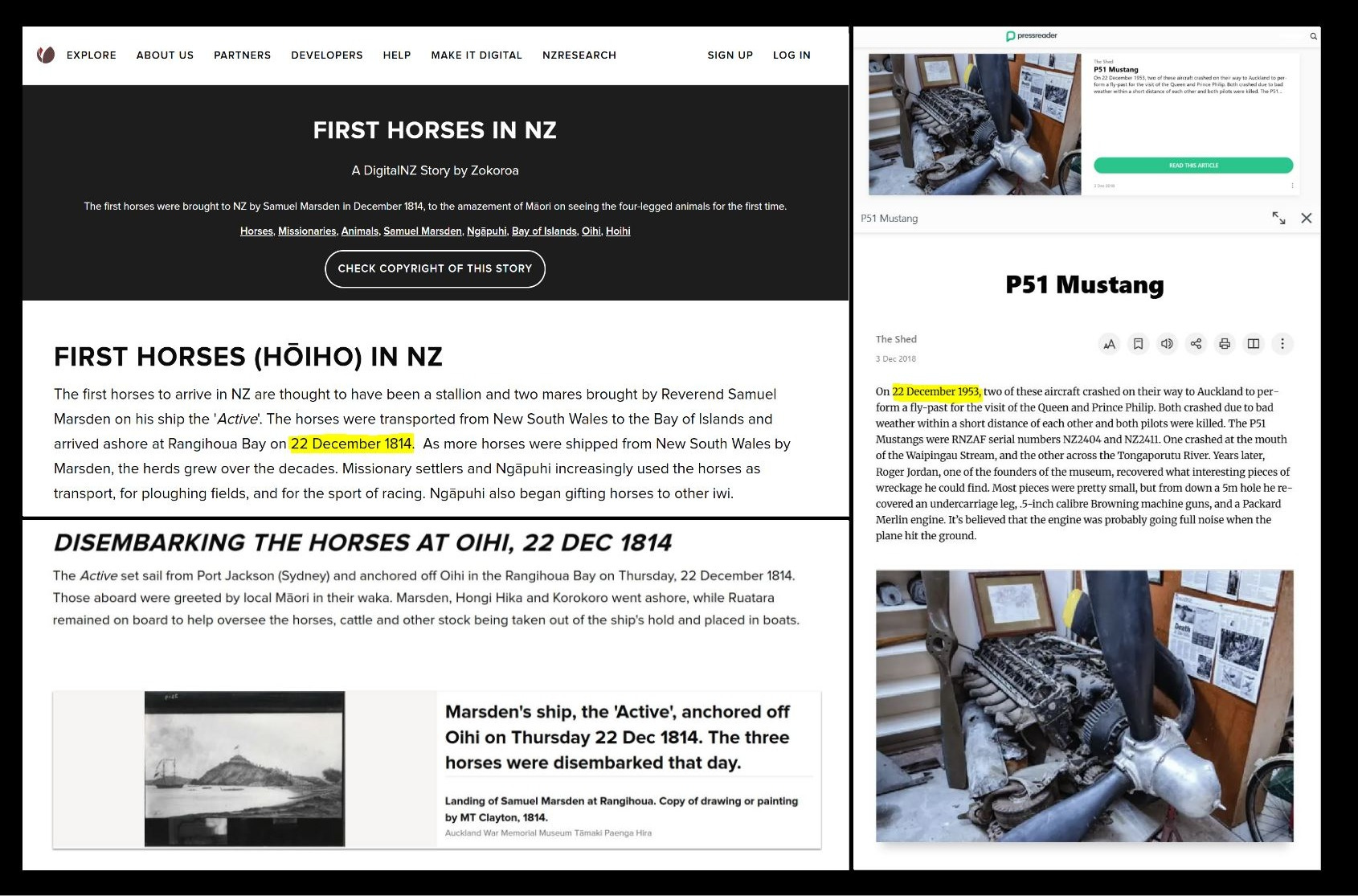
Since New Zealand took delivery of 30 Mustangs once World War II was over, they were put into storage at RNZAF Station Ardmore in south Auckland. It was not until 1951 that they were brought out of storage and activated for service, mostly for the Territorial Squadrons of the RNZAF. These squadrons were No. 1 (TAF) Squadron based at RNZAF Station Whenuapai; No. 2 (TAF) Squadron based at RNZAF Station Ohakea; No. 3 (TAF) Squadron based at RNZAF Station Wigram and No. 4 (TAF) Squadron which was based at RNZAF Station Taieri. Additionally a small number of Mustangs served as target tugs with No. 42 Squadron at Ohakea, and as reserve aircraft, according to Dave Homewood's Unofficial Guide of the Royal New Zealand Air Force Museum, a former RNZAF Air Vice Marshall. The news of the two Mustang crashes, featuring the two pilots who were meant to partake chosen to in a flypast for the arrival of the royal yacht SS Gothic as it approached Auckland, in fact, telegraphed a looming black operation.
This date-riffing is a dead give-away that the Mustang crashes were the ‘go-signal’.
The SS Gothic was escorted by HMNZS Black Prince, a World War II era battle cruiser acquired off the Royal Navy in 1945 by the Royal New Zealand Navy. The name is believed to have been derived from King Edward III’s eldest son, Edward the Black Prince (1330-1376 CE), who was known as the Black Prince owing to the dark colour of his armour and for his martial reputation as an experienced military commander. The Black Prince nickname, may have been given to him by the French, for his martial reputation extended to a terrible scorched-earth strategy he repeatedly used against them during the First Hundred Years’ War. Potently, the Third Hundred Years’ War, began around 1900 while the world system was dramatically changing to control the territories, technologies and treasures of oil and transformed into a struggle to dominate the development of the computing chip. This present ‘Age of Conflict’ is ongoing. When civilizations turn expansionist, they become imperialist empires.
However, every empire needs an instrument of expansion. The invention of new technologies drives a combination of structural forces to gain the resources and territories to sustain the innovations in administrative systems that can give an empire the edge over rivals. Ergo, what happens to the instrument of expansion determines the arc of history. Since computing chips have the capacity to collectivize all previous instruments of expansion, the race to dominate computing power is inherently totalitarian because all previous instruments of expansion have entailed social control over populations. These prior instruments of expansion include: slavery, feudalism, the credit revolution, and mechanization. The accumulation of power upward while faking a pivot to decentralization, masks a dangerous theater as powerful factions, rivals and alliances play with creating virtual machine gods, who may ultimately win this ongoing Third Hundred Years’ War, and enslave a culled humanity.
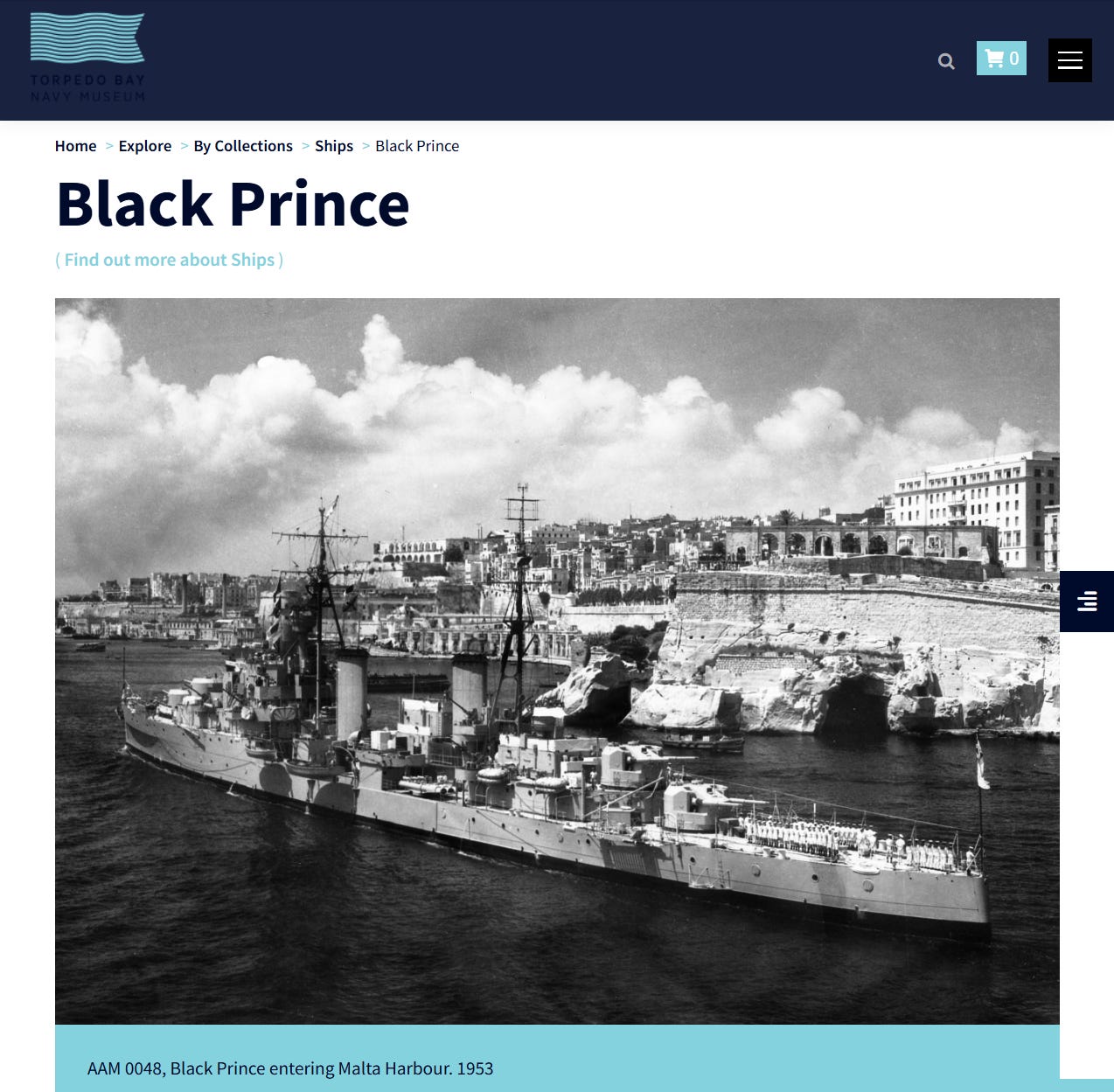
This Hundred Years’ War between France and England said to have began in 1337 CE was actually a 19th-century CE label for a conflict which rumbled on intermittently for well over a century and finally ended in 1453 CE). The English Order of the Garter, which is England’s most prestigious order, and features St George and the Dragon, was founded in 1348, by King Edward the Third during this Hundred Years' War. Queen Elizabeth was Soveriegn Head of this Order. Crucially, as King, Edward VII played an instrumental role in enticing France and Russia into secret alliances with Britain in a long game against Continental Europe’s leading industrial powerhouse: Germany.

As the sovereign head of the occult Order of the Garter, Edward VII drew the royalty of Spain, Portugal, Russia, Italy, Sweden, Persia and Japan closer by investing them as ‘stranger’ Garter Knights. In this way, King Edward VII used the Order of the Garter as a secret mechanism for hidden world domination objectives. As Grand Master of English Freemasonry, he was positioned at the centre of an epic gambit of a British ‘Secret Elite’ to construct a universal empire that involved laying siege to Germany, which was in the midst of constructing the Berlin to Baghdad Railroad to transport oil.
Given the Duke of Edinburgh was linked to the premier Navy Lodge, it’s important to recall that Sidney Holland was a Freemason with the St Johns Lodge No. 37. English Rosicrucian Freemasonry had merged with the British Monarchy long before Queen Victoria, the sovereign head over the House of Lords, the Church of England and the most prestigious imperial Order of the Garter, became their Patroness.
In 1951, on Holland’s watch, the CIA’s ‘Air America’ made 1300 cargo flight crossings between the North and South Islands to undermine the 1951 Waterfront Strike. It was chartered to ensure that goods could still be shipped around New Zealand during the waterfront dispute of 1951. The dispute was the largest industrial confrontation in New Zealand history bringing the nation’s ports to a standstill and, at its peak, taking 22,000 workers off the job from February to July 1951. The scope of the CIA contract with the New Zealand Government, code-named Operation Railhead, involved over 150,000 kilometres of flying in around 1,300 crossings between May and June 1951.
The U.S. provided four Curtiss C-46 Commando planes and crew to fly cargo between Paraparaumu Airport near Wellington to Woodbourne in Blenheim on the South Island. Although the flights were reported in local media at the time, the public was unaware that the airline, Civilian Air Transport (CAT), was secretly owned by the CIA. Although author Dick Scott noted the US flights in his book 151 Days, the disclosure about the CIA’s ownership only came when the Central Intelligence Agency released “almost 13 million documents” in July 2017. The CIA was established on September 18th 1947 by Wall Street lawyers, including the Dulles brothers, John Foster and Allen, along with a young George Herbert Walker Bush, after having organized terrorist groups in Europe following World War II. Allen Dulles became CIA Director in 1953, and after he was fired by President John F. Kennedy, he would reappear in the public role as a member of the Warren Commission to signal a cover-up was in hand.
The Waterfront Strike commenced on 13 February and ended on 15 July 1951 halting port activity across the country. Sidney Holland brought in the navy and army to work the wharves and also de-registered the Waterside Workers’ Union under the Industrial Conciliation and Arbitration Act. Under the emergency regulations Holland’s government censored the press, made striking illegal, and even made it illegal to give money or food to either strikers or their families. The proclamations have been described as “the most illiberal legislation ever enacted in New Zealand”
Holland authorized emergency regulations to overcome the 1951 Watersiders Strike and revoked them on July 25 1951. The dispute that led to the strike had been brewing for more than year. It was over working hours, as well as a refusal to upgrade ports with new technologies and techniques that watersiders had encountered in the U.S.
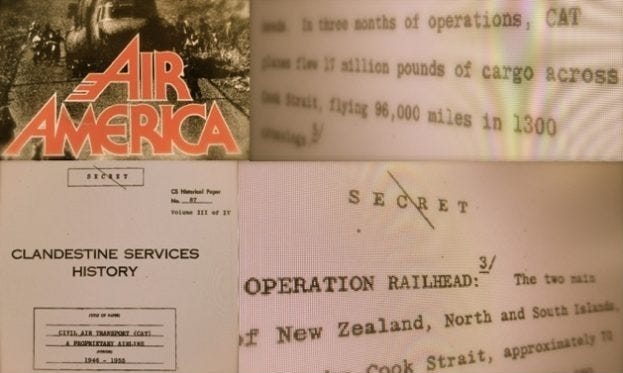
It just happened that the U.S. Secretary John Foster Dulles met with Deputy Prime Minister Keith Holyoake in New Zealand around 22 February 1951, ostensibly to negotiate a military alliance between Australia, New Zealand and the United States, or ANZUS, which was formally signed on September 1 1951. The spectacle of an industrial strike added to the propaganda of communism spreading to New Zealand.
Holland used the clash with the watersiders to call an early election in 1951, instead of 1952. Ergo, Queen Elizabeth’s “brotherhood of man” rhetoric carried rich potency.
And so, the date meta-data was thematically encoded to riff off historical events in order to construct a subtextual layer of meaning to the narrative arc that skimmed across the surface. When combined with the devilish details of a cover-up to protect institutions, individuals and interests who were careless, reckless, and callous, the thematically encoded date meta-data reveals a staged rite of passage featuring terror.
How horrendous that the locomotive driver was cast for the role because he had been in the job for 33 years, and his participation would mock the sincerity of Christians, who have been hoodwinked by robed men and women who retell the tales conjured by myth-makers from dusty antiquity. How depraved that the Inquiry would sit for two stretches of 32 days, creating each time a 33rd day; the first, a Resurrection of the Inquiry and the second time, a mocking Salvation, given that fooled Christians who believed they were journeying to see family at a time supposedly celebrating the birth of the saviour, the ‘son of God’. How horrendous that such pawns didn’t know the Christian religions were derived from a conspiracy to create a state-sponsored unified church in 325 A.D. at Nicaea. How wretched a Council, who plagiarised mythological elements from the franchised city-state cults to forge a new meta-character to weld the cracking seams of the Roman Empire, would mislead so many. And, for so long, that such pawns could be relied upon to travel through the night over a usually calm stinky river nicknamed the ‘Sulphur Stream’, for a ‘Locomotive Meets Lahar’ climax.
Recall that Charles Parker had arranged to swap shifts with a colleague, but he was told at the last minute by management to adhere to the original duty roster? And so, the popular driver of 33 years service is sent to travel on his last train assignment, for which there will commence an inquiry 33 days later into the ‘rail disaster’ that occurred on the eve of Christmas, which commemorates the alleged virgin birth of a cultural meta-character, who was allegedly crucified 33 years later to save a species of jumped-up monkeys from their sins, on a far-flung planet that lacks adult supervision.
The enduring mystery of the Tangiwai Disaster can be unbraided with snoop-logic.
Would the Railways Department, the Department of Science and Industrial Research, and the Rangitikei Catchment Board all fail to coordinate their efforts to monitor the crater lake at Mount Ruapehau and draw upon the solution of a controlled release — as suggested by Lewis Vause — if the Queen were travelling on the Wellington to Auckland Express? Ergo, Snoopman has exposed the Royal Game of the Goose in play.
The brutal naked truth is the Tangiwai Plot was a masonic offering to the monarchy.
The Tangiwai Plot belies the pure logic of covert terrorism as theater staged to invert the joy of Christmas into mass tragedy, as the perpetrators enjoy the psycho-drama.
In this death cult sacrifice, the dead 151 crew and passengers of the Wellington to Auckland Express, No. 626, were not only stripped of their lives. They were stripped of their dignity, flung violently and smashed, drowned and shredded, in a chaos of steel girders, chassis, and rails carried in a zooming slurry of the moonlit lahar. And, many of them were stripped of their clothes by the lahar, like in a lurid laundromat.
Collin Morgan of Lower Hutt, woke in the top of a tree on the river-bank, and had been stripped naked by the lahar’s torrent, such that he only had his underpants on.
And so, this despicable rite of passage terrorism was dressed up as a natural disaster, when in fact it was a Trojan Horse attack, staged by traitors within, as a cult offering.
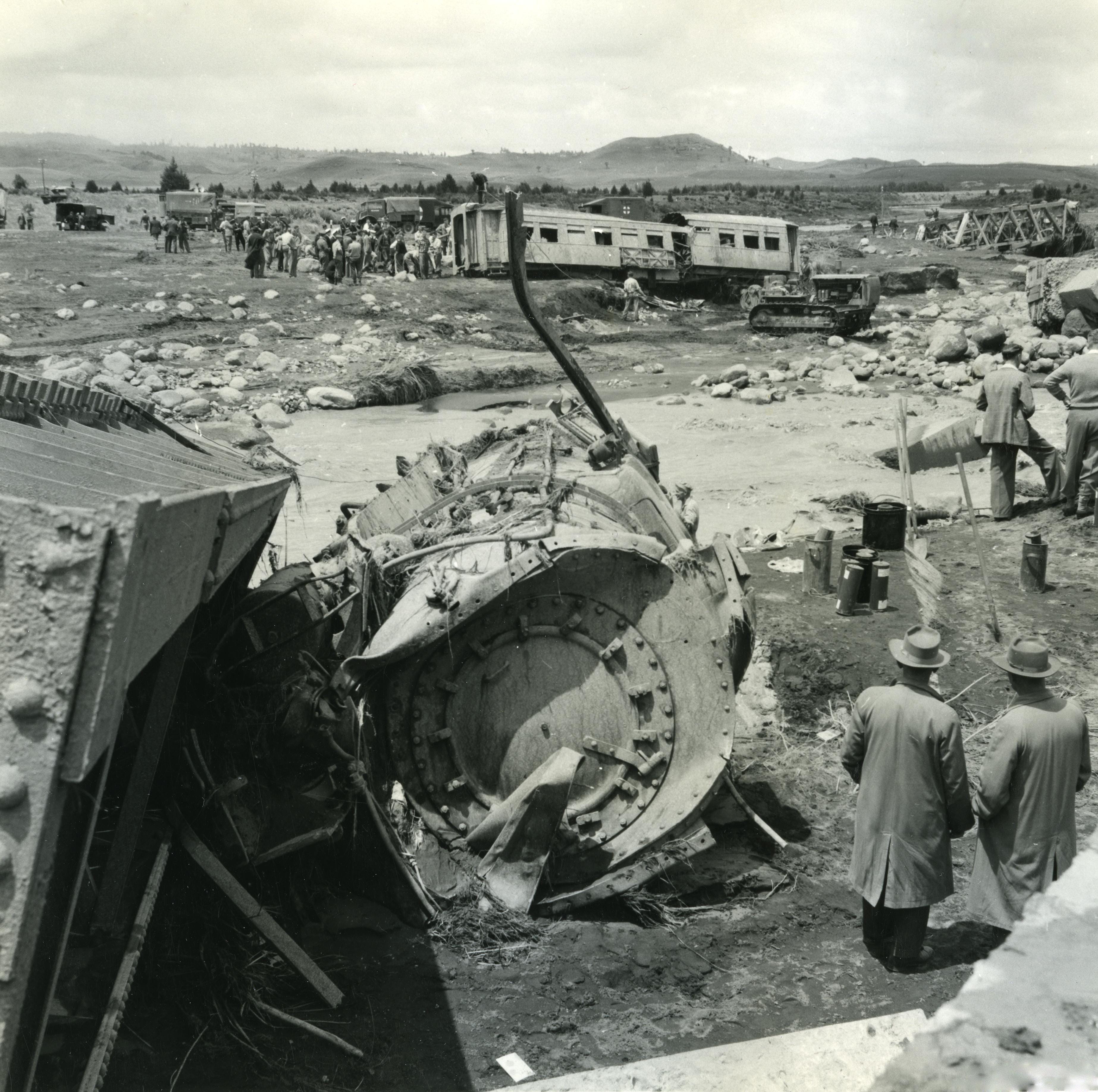
The Queen’s first Christmas Broadcast was signals intelligence that New Zealand’s cryptocracy had performed a cruel ‘Cross the Rubicon’ rite of passage ritual.
The symbol sorcerers inflicted their voodoo, signalling the theater of war had altered.
History had become sheet music to play like riffs, and each staged production featured its very own theme. Woven into this terrific night terror was a mocking of an ancient tension. At a time when the pain of two global wars was still raw for so many, those who could see the truth of the empire’s propaganda beneath the polite surface, they faced a tough choice between risking ostracisation and walking with authenicity.
The mocking was obvious only to those privy to the dark brotherhood, who could know that a staged disaster operation had been taken ‘live’ and warfare had changed.
The theatrical release of the Tangiwai Disaster on Christmas Eve 1953 was an ‘Orwellian–Carrollian’ wet dream gleefully themed as a terror nightmare, to telegraph new institutional bridges to ensure the succession of the dark brotherhoods’ empire.
A masonic cryptocracy rules from the shadows, metting-out a horrific alchemical programming upon the population, who have been cast as monkeys to play like viewers, extras and stock characters in multi-season news psy-ops. The meta-data of metaphor-laden historical date riffing codified into the events sketched in this heretical dispatch, has revealed an underground amoral ‘funhouse’ that get their kicks designing, scripting and constructing crises that become multi-season news psy-ops.
The news events feature a kinetic jump-cut ‘speed politics’ element. The fast-paced developments are used to justify government by emergency that overtake slower deliberative processes. The crisis actors, including those wearing suits, or emergency cos-play garb, are deployed on the scene to manage the optics of the crisis rituals.
This crisis engineering is the unholy voodoo of a criminal network fused with the post-war state, whose stage productions are ritualized terrorism theater, performed to inflict psycho-dramas on the naked brains of a geographically-isolated naïve population. The aim is to demoralize, dehumanize and despirit the N.Z. monkey with open-air masonic ceremonies, while the land is remade with a techno-feudalist architecture, featuring police state gadgets. The historical riffs are like glyphs that act as motiffs, as if they’ve been inspired from an underground death cult book titled, The Terror Archipelago: A Grimiore of New Zealand Political Witchcraft and Wizardry.
For the second time in six years, New Zealanders were being taunted, toyed and traumatized while a transnational cryptocratic dark state signalled building new institutional bridges across the British Empire, at a time when the base of the Roman Empire moved, once again. The new Rome set up shop in the District of Columbia.
The Tangiwai Bridge No. 136, at the place of the weeping waters became a talisman.
The Princess who became Queen on Waitangi Day in the 52nd year of the 20th century and won the hearts of the naïve, broadcast the tragic news of the train accident at Tangiwai. This broadcast followed the breaking news of Freemason prime minister Sidney Holland, of the horrendous railway disaster. The shock news was an esoteric ritualized trial signalling a rite of passage to a dark world, and telegraphing the need for building institutional bridges to psychically traumatize the world.
The radio news pointed the way to exploit the new broadcast mediums, especially television to develop the six o’clock news bulletin concept to construct eternal trauma time loops. By creating a world of staged crises, populations could be trapped psychically in endless repetition of a mad chaotic illogical world where a tyrant Queen’s ‘pack of cards’ creates contradictions, wields power arbitrarily and imposes a labyrinth of trials to breakdown the identity of the ‘Alices’. In our Carrollian World, the six o’clock television and radio news epitomizes the Mad Hatter’s Tea Party — at 6pm.
Just as the Mad Hatter’s Tea Party was stuck in an eternal time-loop of occurring everyday at 6pm, the flagship bulletins of various media brands broadcast ‘the news’ at six o’clock. It is a perpetual daily show of grimly reaped terrorism as theater.
Like the confusing world of Wonderland, these alchemical crises fragment the psyche, traumatize nervous systems and re-programme societies with new illusions.
Each character subjects Alice to absurd logic, games, mental challenges, and contradictions. The journey, which changes scenes like in a dream melding with a nightmare, mimics the esoteric rituals of occult societies that test the initiate’s comprehension of reality, and transforms their identity into a more suggestive form.
Poignantly, the hacking of minds became a systematic study funded by the Central Intelligence Agency in the year 1953. The deep purpose of the muliti-institutional, transnational, multi-year program in mind control, codenamed MK-ULTRA, was to figure out how to scientifically direct societies. The technological know-how about manipulating whole societies with fear, hope and rewards was literally mapped by the CIA in the mind-control, brainwashing and behavioural modifications experiments conducted from 1953 to 1964. The program was renamed MK-SEARCH, until it was shutdown in 1972, as The Minds of Men documentary compellingly shows.
Under the rubric of cybernetics, MK-ULTRA technocratic planners, scientists, and psychiatrists worked to develop technical systems that would merge the control of humans with machines via the creation of communications networks, dubbed ‘the matrix’. The horrific, cruel and illegal MK-ULTRA mind control experiments, which involved at least 149 sub-projects, were conducted on vulnerable humans, monkeys and rats, at over 130 institutions including hospitals, medical schools, universities, mental asylums, military facilities, and prisons across the United States, Canada and the UK. The experiments included sensory torture, deprivation in isolation and re-programming of the mind, experimental psychotropic drugs, allergens and electric shock treatments, as well as mapping the human bio-electric circuitry, behavioral studies with remote control devices, and social conditioning with applied game theory.
Crucially, one of the far-reaching consequences of the top secret MK-ULTRA experiments was the finding that the subjects in a closed system could only exert feedback ‘responses’ and were powerless to change the design, one the system was set.
Ergo, the liberal democracies of the so-called ‘West’ are the track-laying vehicles for monkeys cast as ‘tax-payers’ and ‘consumers’, to fund the construction of ‘the Matrix’.
Thus, the symbol sorcery inherent to the selection of the Tangiwai Rail Bridge as the technical mechanism for this staged disaster in 1953, worked as the tactic of inversion.
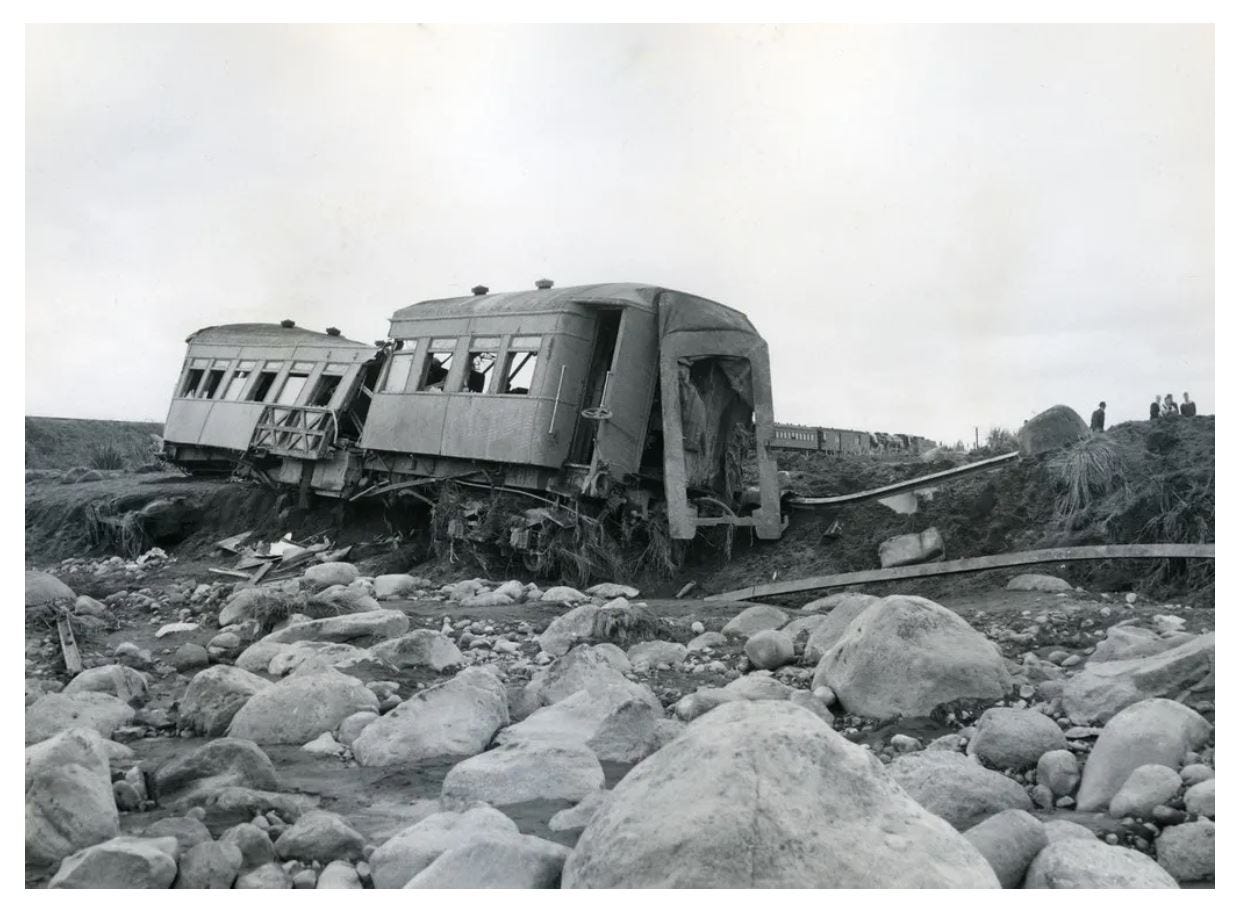
As with all of these staged disasters, their cover stories play on an apparent individual, institutional or ideological ‘failure’ to identify and avoid pitfalls, blind spots, and common mistakes, that practically guarantee the odds of a catastrophic crisis.
These staged disasters play with the tactic of inversion, where naïveté is cultured into the gentile peasant monkeys, such that they plan for success without asking the critical counter-question: what would guarantee failure? Yet, initiates of secret orders also learn about inversions in metaphorical ceremonial stages, journeys, and trials with symbol-laden allegorical tales performed as rituals to achieved degrees of a craft.
Like the White Rabbit in Wonderland, William A. Bodkin on his watch as the Minister of Internal Affairs — which is charged with oversight of public inquiries — performed the role of the psychopomp, whether he was aware of his casting or not. The psychopomp is a conductor of souls, who escorts the newly deceased souls from Earth to the afterlife. Bodkin was made a Knight Commander of the Royal Victorian Order by Elizabeth II on January 29th 1954. With uncanny timing, this date riffed off the historical date of January 29 1840, when Captain William Hobson arrived at the Bay of Islands to commence the operation to swindle sovereignty for Queen Victoria.
The lodges, like the Lions and Rotary clubs, work as friendly societies while operating as cover operations for profiling members, to function like a great sorting machine.
Lewis Carroll, a mathematician, used inversions as paradoxes of logic to create the distorting dream world of Wonderland, which had an internal consistency of madness.
For example, the Queen of Hearts insisted a trial should start with the sentence, followed by the evidence. Alice called out the monarch’s “nonsense”. Elizabeth II — the Queen, who’d won everyone’s hearts on her worldwide Coronation Tour — called the Tangiwai Disaster a “most grievous railway accident”. And with that appraisal, none of Queen’s Pack of Cards, who’d been brought into the Royal Victorian Order, were going to argue with the Commander-in-Chief of the British Armed Forces.
An accident, by definition, means there is no foul play. That is to say, any sentence is nullified before the evidence of a public inquiry had been presented for scrutiny.
Newsrooms miss the point of the adventures under ground, which occurred as a result of Alice falling down the rabbit hole. Alice woke up, and emerged — changed.
The apprentice perpetrators, or catechumen, had undergone a rite of passage ritual that played out like a Royal Game of the Goose to symbolically signal a new ‘institutional bridge’ was planned. A rail bridge was destroyed to gain a commitment.
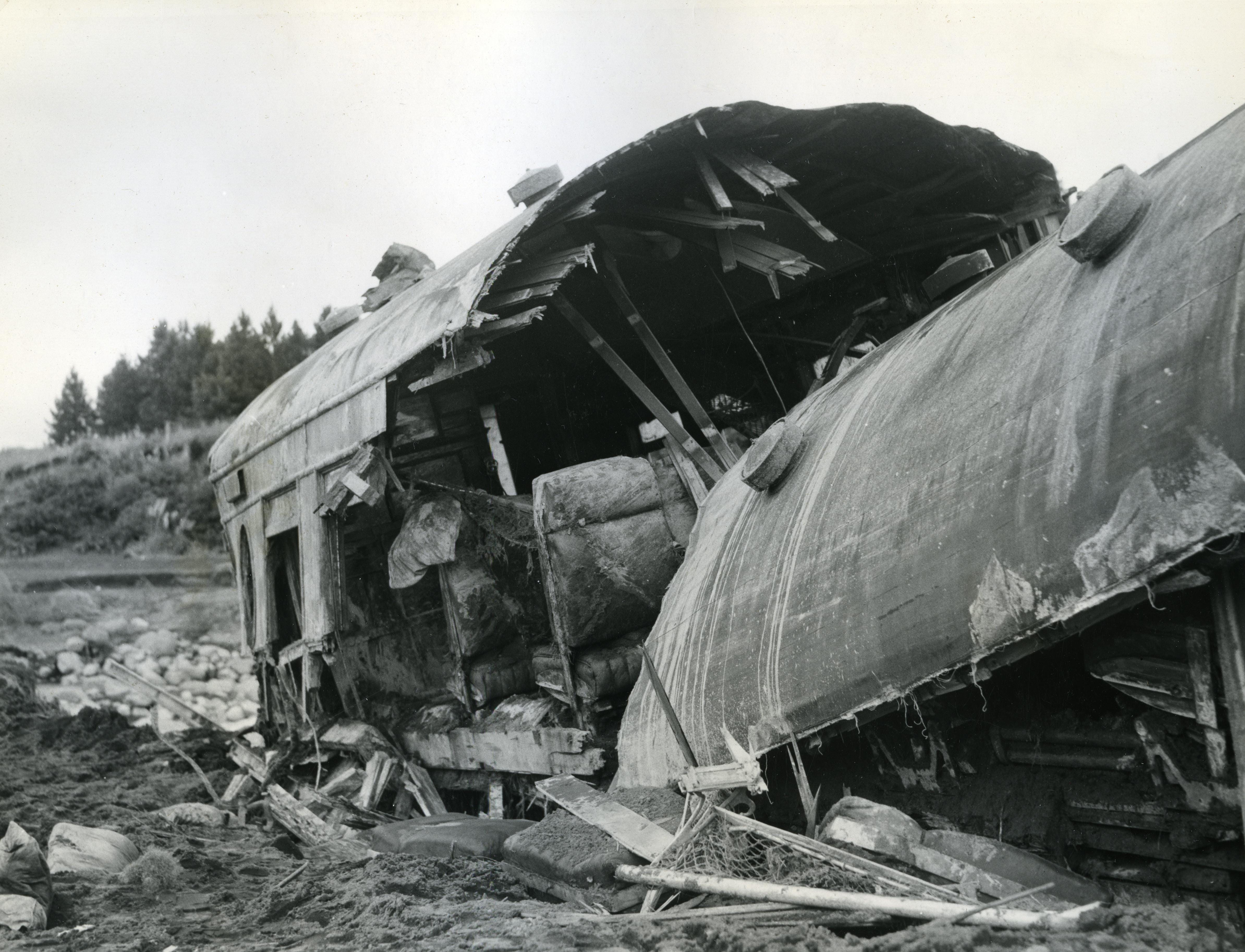
The apprentices had, in effect, ‘Crossed the Rubicon’, in preparation for their baptism as members of the ‘New Zealand Militant Order of the Cryptocratic Dark State’.
The start of the Queen’s reign on Waitangi Day in 1952, became the fulcrum upon which to spin an inversion, where the logic of inactions, errors and omissions could result in catastrophic failure to become a catalytic alchemical night terror at Tangiwai.
At the place of the weeping waters, the broken Tangiwai Bridge became a talisman that taunted, while the train’s physics bled into the maelstrom of an engineered lahar that arrived with precision timing to maximize the mayhem, and to add potency to the historic Christmas broadcast of a monarch whose reign started on Waitangi Day in 1952. The taunting creepiness behind selecting a place called ‘Tangiwai’ to stage a rite of passage ritual, given that it is an anagram of the place-name, ‘Waitangi’ — reveals the gleeful dark humour of the transnational and domestic cryptocratic alchemists.
For 72 years, the Tangiwai Rail Bridge ‘accident’ has stood up as an unplanned crisis.
Brazen lies spread quicker than the naked truth has the chance to stick on underwear.
Propaganda always deflects attention away from the naked truth, lest everyone sees the Queen and all of her important Cards don’t have a heart between them. And, they have cornered the underwear market to control the transparency, which can’t be found in public inquiries. Only a facsimile of transparency can be tracked down to the lingerie sections of department stores. But, the mannequins don’t know anything.
Ergo, vertical conflicts are dangerous, because they scale and unify by exposing the architecture. So, the system rotates them sideways and the vertical threat is turned into a horizontal spectacle. A horizontal protocol splits clashing monkeys into camps.
Like the other militarized staged crises, monkeys argue over who is to blame, never imagining how deeply dreadful New Zealand’s darkest days have been since WWII.
The Tangiwai Railway Disaster remains New Zealand’s worst rail catastrophe. At the time, it was ranked at number eight on the charts of the world’s deadliest rail ‘disasters’. The cryptic Anglican night terror-theming is the dead giveaway of staging.

N.B. The ‘New Zealand Militant Order of the Cryptocratic Dark State’ is a merely a descriptor for the criminal network that runs the archipelago from the shadows. See Terror Archipelago Down Under: Part 1 for more detailed context. This dispatch was originally posted on The Snoopman Files (December 24 2025).
Post-Script: Snoopboy’s mother told him that he was wasting his brains watching Scooby Doo instead of doing his homework. Who would have thought being a student of Scooby Doo would lead him to figure out who made an economic depression happen in the mid-1970s, that had been foreshadowed in the first season of Scooby Doo, which aired in 1969. And, that revelation would lead Snoopman to learn that the 9/11 Coup d’État occurred on the 60th anniversary of the masonic foundation stone-laying ritual at the start of building the Pentagon. And eventually, Snoopman came to decipher the cryptic matrix code of thematic historical riffs lurking in newsmaking crisis events that have been stealthily inflicted to forge a cryptocratic dark state in New Zealand.

Back when Snoopman was ‘Snoopboy’, he delivered the Auckland Star during the exciting days when Pope John Paul II and President Ronald Reagan survived assassination attempts. There was also a cervical cancer scare linked to tampons. The lead story didn’t state the tampons’ intentions. No one on his paper-round would say. Ever since, Snoopman notices when context in news is missing in action.
Editor’s Note: If we have made any errors, please contact Steve Snoopman with your counter-evidence. Or, if you wish to share information related to these dispatches, by email, also briefly state the topic in the subject line, using relevant noun words, so that your email is searchable for following up later. For example, if it’s revealing how the suppressed police investigation into the Mount Erebus Crash happened, perhaps make the subject line: Erebus Police Coverup. Three to five (pro)nouns work well.
e: snoopman72@proton.me