

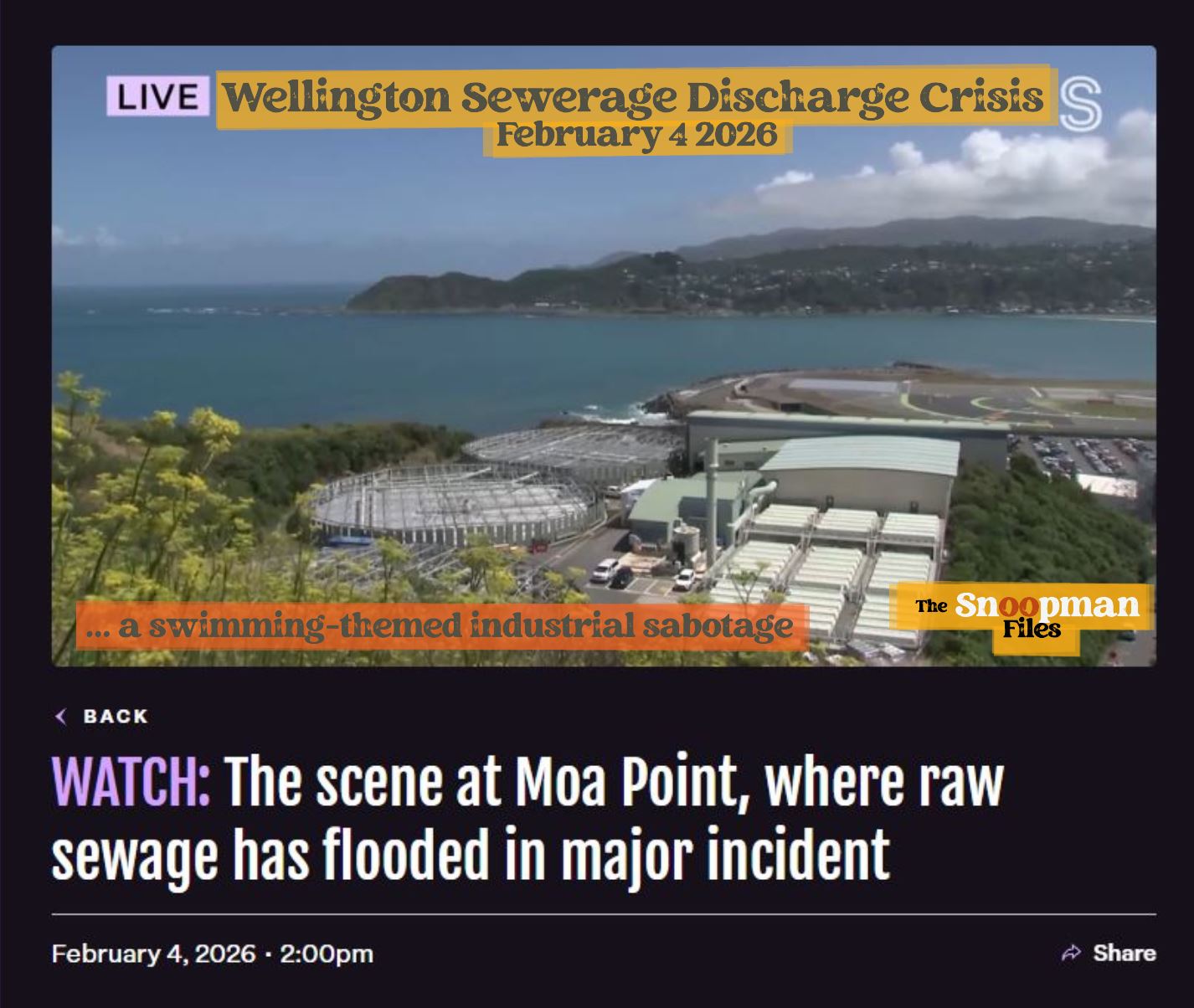

Wellington Sewerage Discharge Crisis, February 4 2026
This Dirty Deeds by Dates Down Under series reveals how New Zealand’s issues, scandals and crises are thematically encoded with historical riffs to signal authorship, unity, scapegoats and caution — while telegraphing hidden aims — in plain sight. New Zealand's staged crises occur with spooky precision timing to riff off historical events so that the newsmaking psycho-dramatic terror theater, simultaneously performs as cryptic signals intelligence, boasts its ritualized spectacular power and functions to maintain discipline among a cryptocracy.This ground-breaking series cites the NZ History website, administered by the Department of Internal Affairs, as well as A.W.Reed's 1973 compedium of significant events entitled, It Happened Today in New Zealand, and A.W. Reed's 1979 chronology, Two Hundred Years of New Zealand History. News headlines are reworked into collages, with graphical colouring-in by Snoopman. 
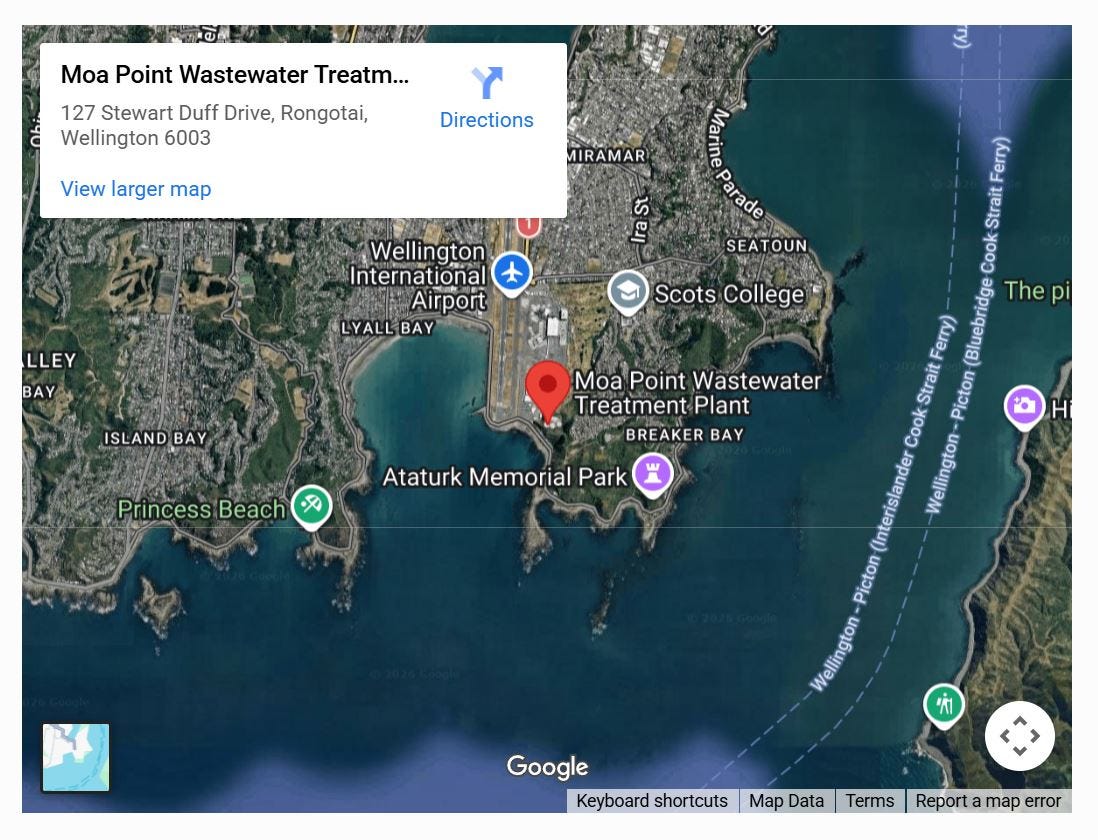
➳ Sewerage Discharge at Wellington’s Moa Point Wastewater Treatment Plant
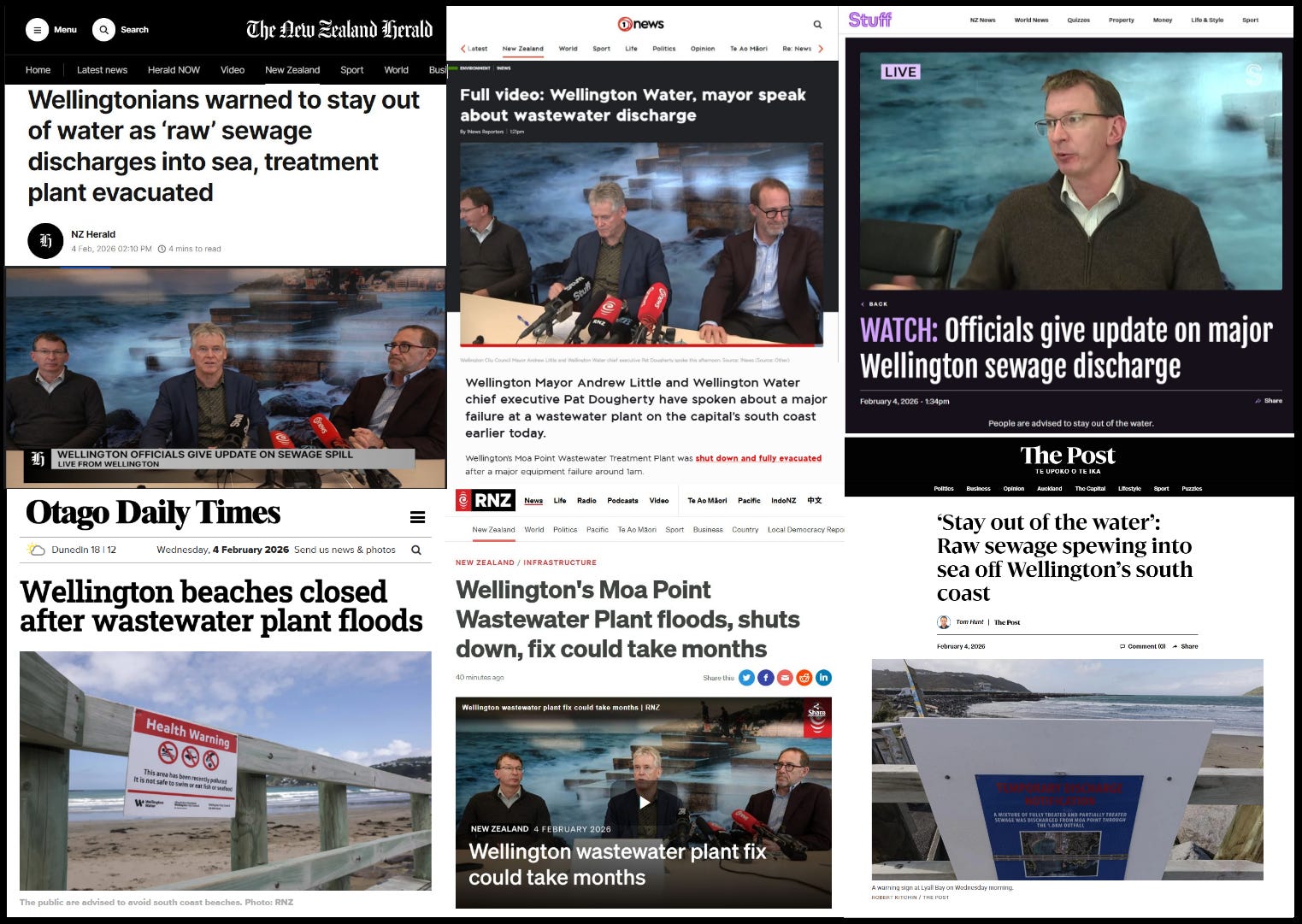
At 1am, on February 4th 2026, Wellington’s Moa Point Wastewater Treatment Plant malfunctioned when sewage backed-up and flooded multiple floors and caused an ongoing raw sewage discharge that has closed beaches off the capital’s south coast.
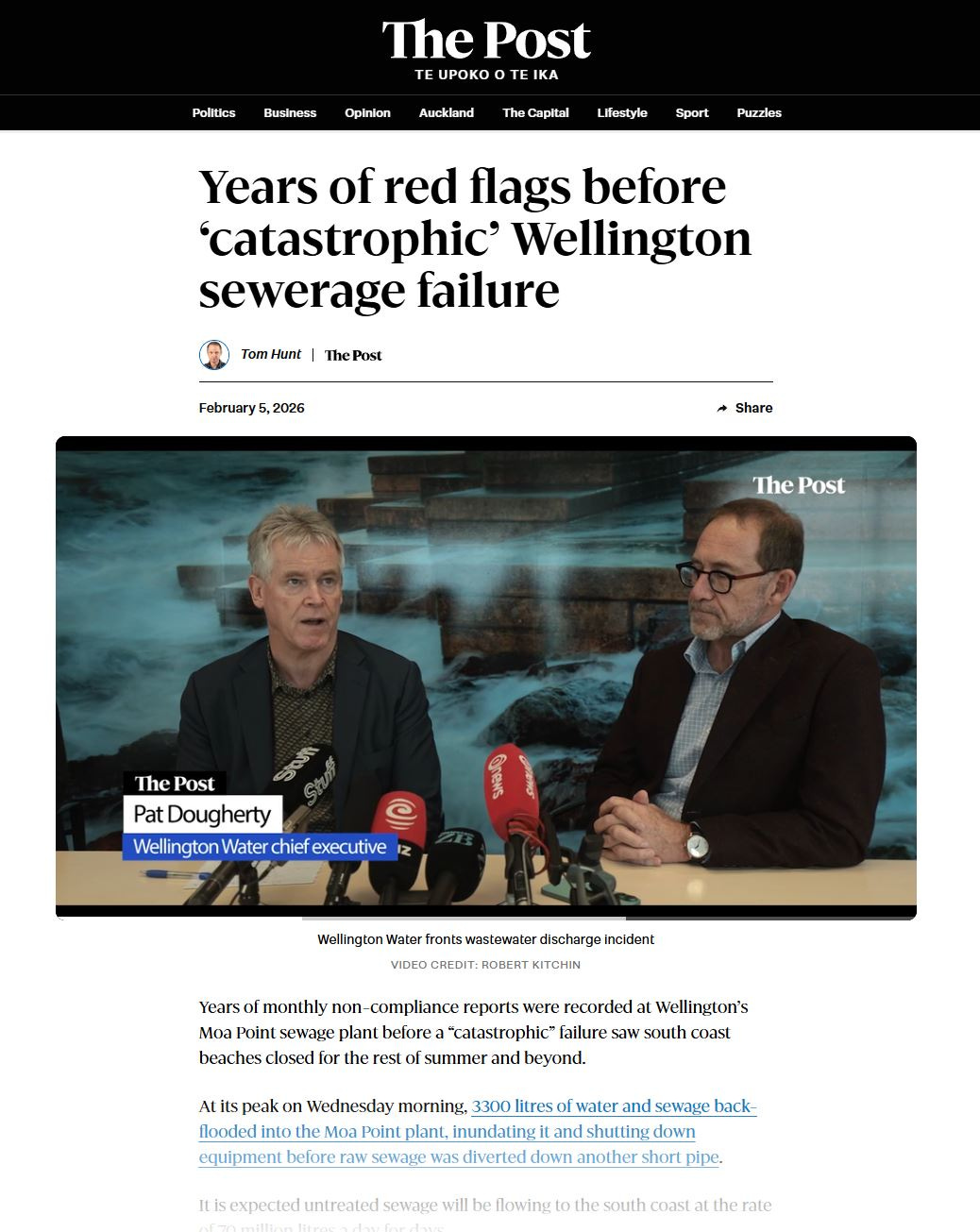
Wellington Water chief executive Pat Dougherty said heavy rain had caused wastewater to back up into a maintenance area and flood multiple lower floors of the facility, tripping power fuses, damaging control equipment and forcing power to be switched off. Wellington’s south coast wastewater discharge had polluted the coastal waters, and Wellingtonians have been advised not to swim, fish or collect shellfish.
Approximately 70 million litres of raw sewage is now flowing into the sea each day.
Dougherty said he was “at a loss” to understand why the long outflow pipe backed up.
“The outfall pipeline has more capacity than the treatment plant itself, it’s designed to to be the one thing that works whatever happens,” the water chief executive said.
The cryptocracy exploits individual, institutional and ideological vulnerabilities.
Mr Dougherty explained maintenance of the treatment plant had been underway, but during the heavy rain in the night, wastewater backed-up, found its way into a worksite and flooded the lower floor of the facility causing a “catastrophic failure”.
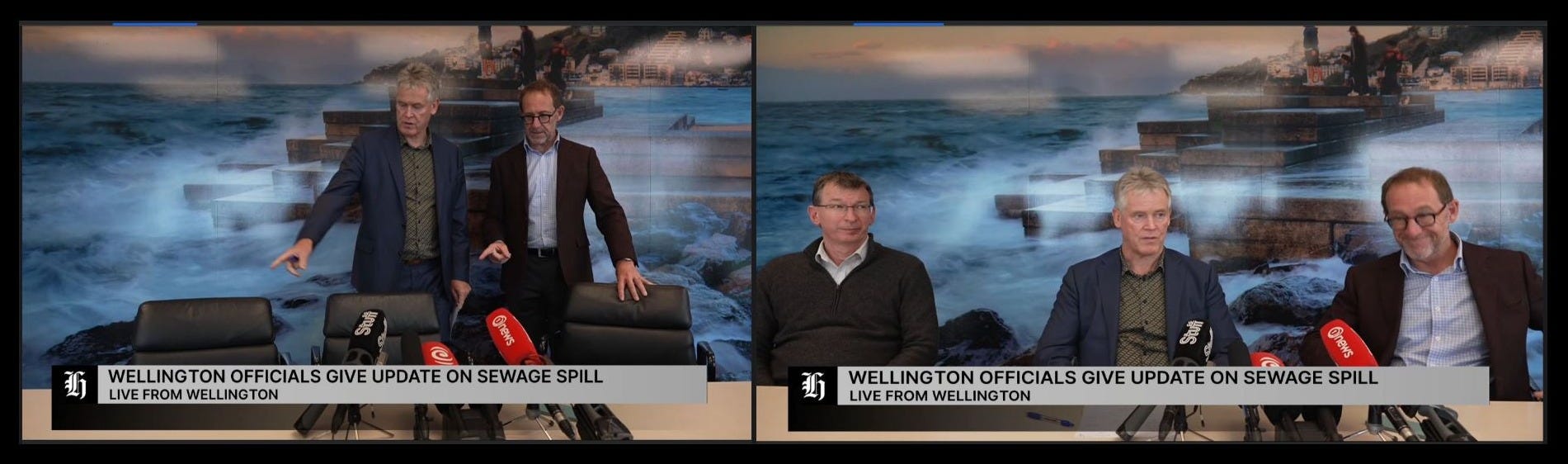
A scrubber room “the size of an Olympic swimming pool” was now three metres deep in wastewater, Mr Dougherty said with a marine-themed wall panel as a backdrop.
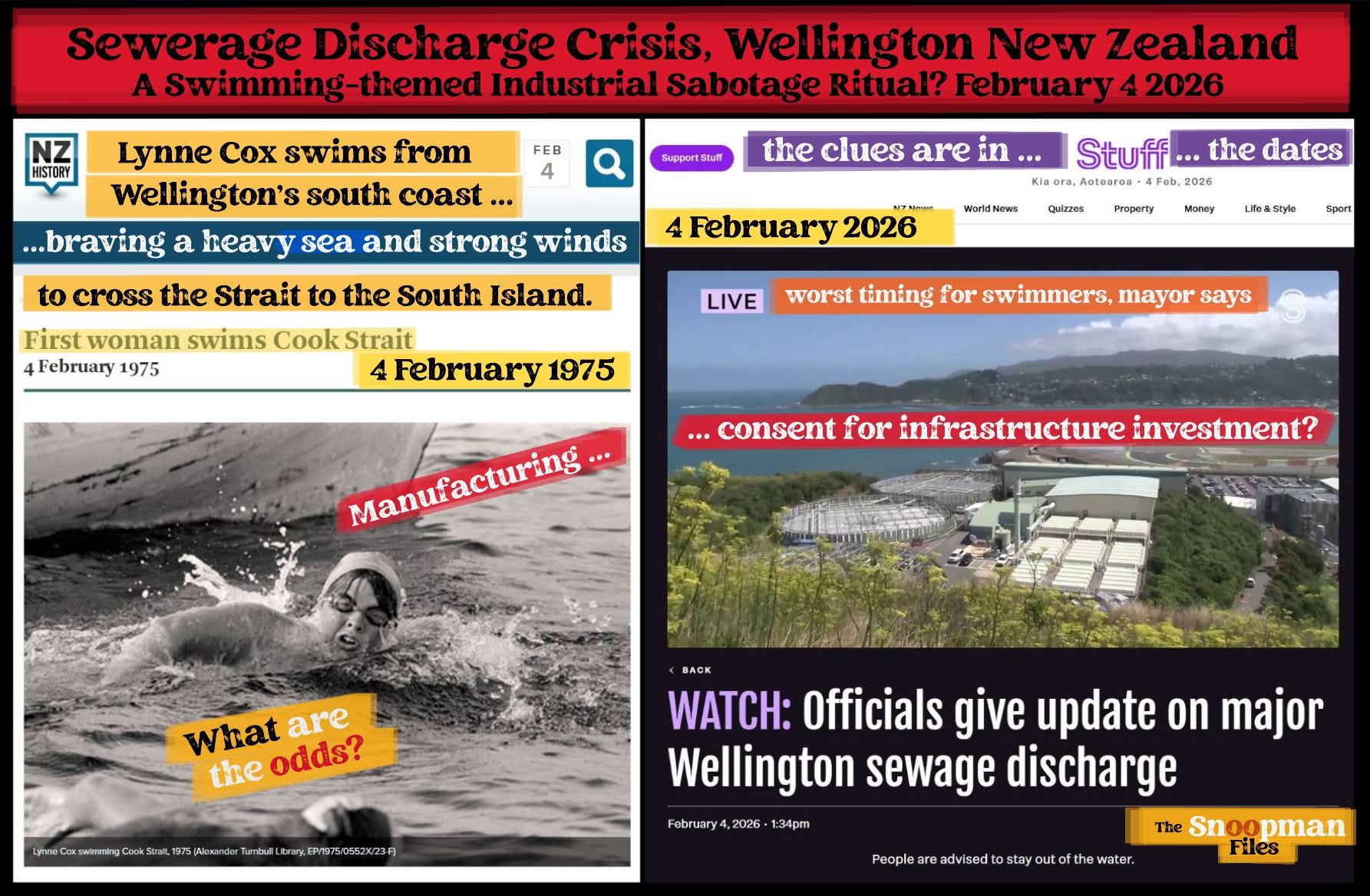
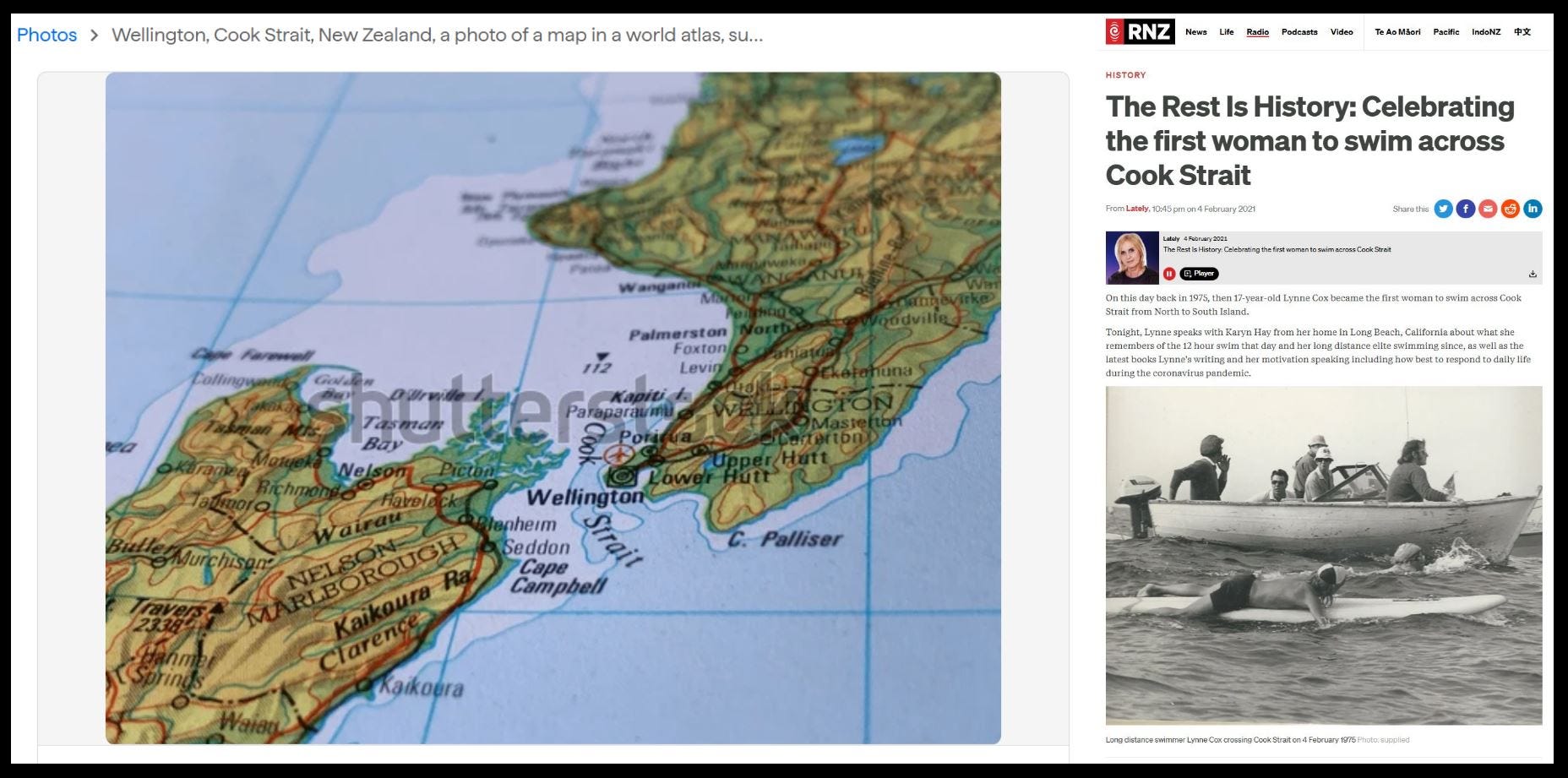
What are the odds that this headline-grabbing waste-water crisis would occur on the same day, February 4 in 1975, that Lynne Cox became the first woman to swim the Cook Strait? After all, Cox swam from Wellington’s south coast braving a heavy sea and strong winds to cross the Strait to the South Island in 12 hours and 7 minutes.
Ergo, a Cook Strait swimmers-theming was baked into the Moa Plant sewerage leak.
Wellington Mayor Andrew Little looked crest-fallen as he repeated what sounded like the day’s supplied line, saying the sewerage crisis was “incredibly disappointing”.
Little, who is no stranger to crisis rituals, since he fronted many as the Minister responsible for the Pike River Mine Recovery Agency, added the crisis came at the “worst time” for Wellingtonians wanting to swim, walk dogs and enjoy the seaside.
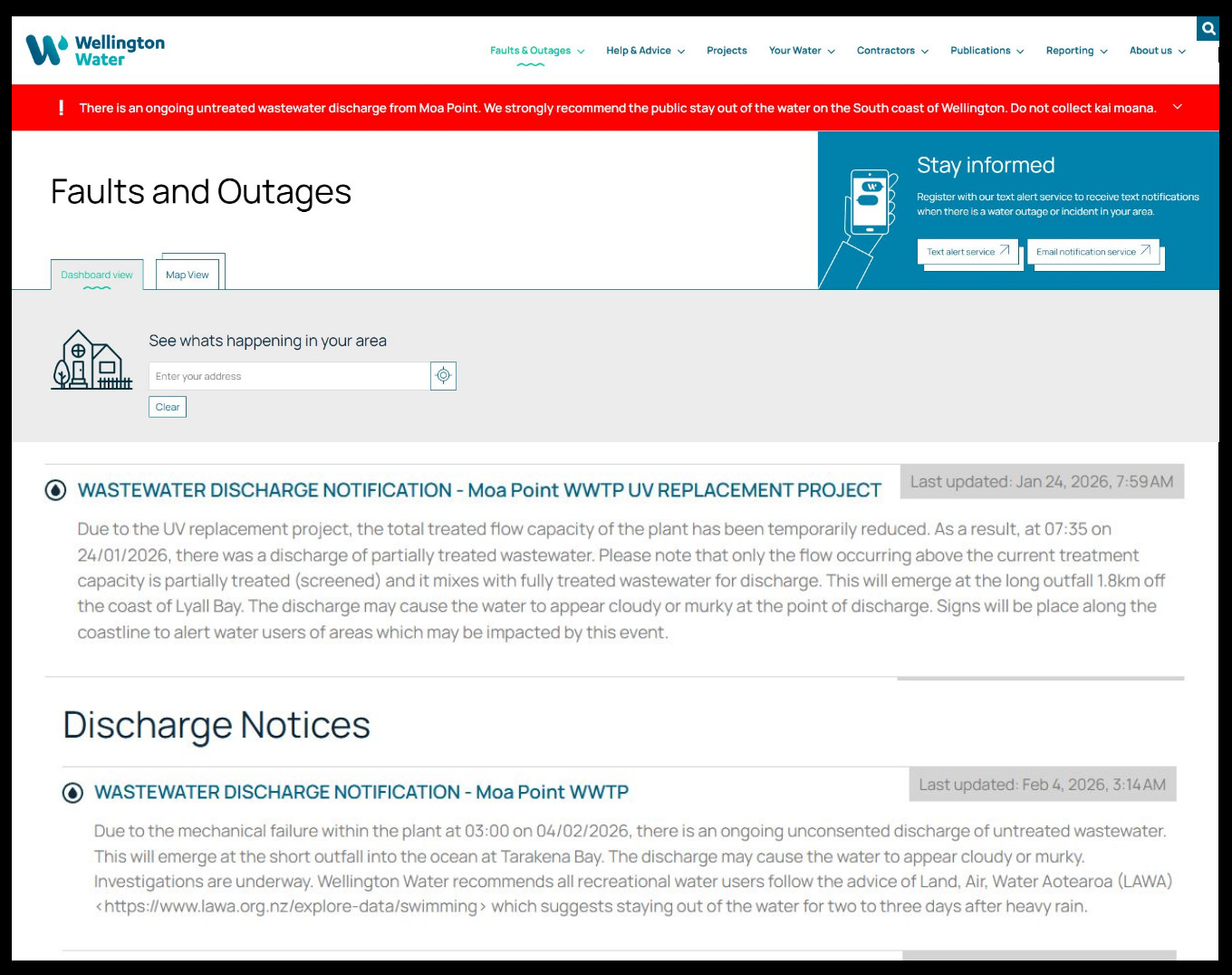
Wellington Water said it would be prioritising diverting discharge to a 1.8km long outfall into Cook Strait in the coming days once power could be restored, removing sludge to prevent odours, and assessing the extent of equipment damage — which could take months to repair, Dougherty said. Wellington Water’s Faults and Outages website page said, “Due to the mechanical failure within the plant at 03:00 on 04/02/2026, there is an ongoing unconsented discharge of untreated wastewater.”
Doherty said it was 3am when the contractors were first aware of the plant failure adding this was when the alarm was first sounded. There’s a discrepancy in the times.
Indeed, Mayor Little said the plant failure occurred at 1am, and the alert was sent to Fire and Emergency New Zealand (FENZ), instead of Veolia, the French transnational water maintenance company contracted to maintain the wastewater treatment plant.
Dougherty said the remedial work was happening when heavy rain began to fall.
“We had planned for that, so about half the flow was going through the plant and half was going through a bypass and then out the outfall,” Doherty told the NZ Herald.
“The outfall wasn’t able to cope with that volume and backed up into our worksite.”
As a result, Dougherty estimated about “60-70% of the plant was inundated” with wastewater, including control and electrical equipment.
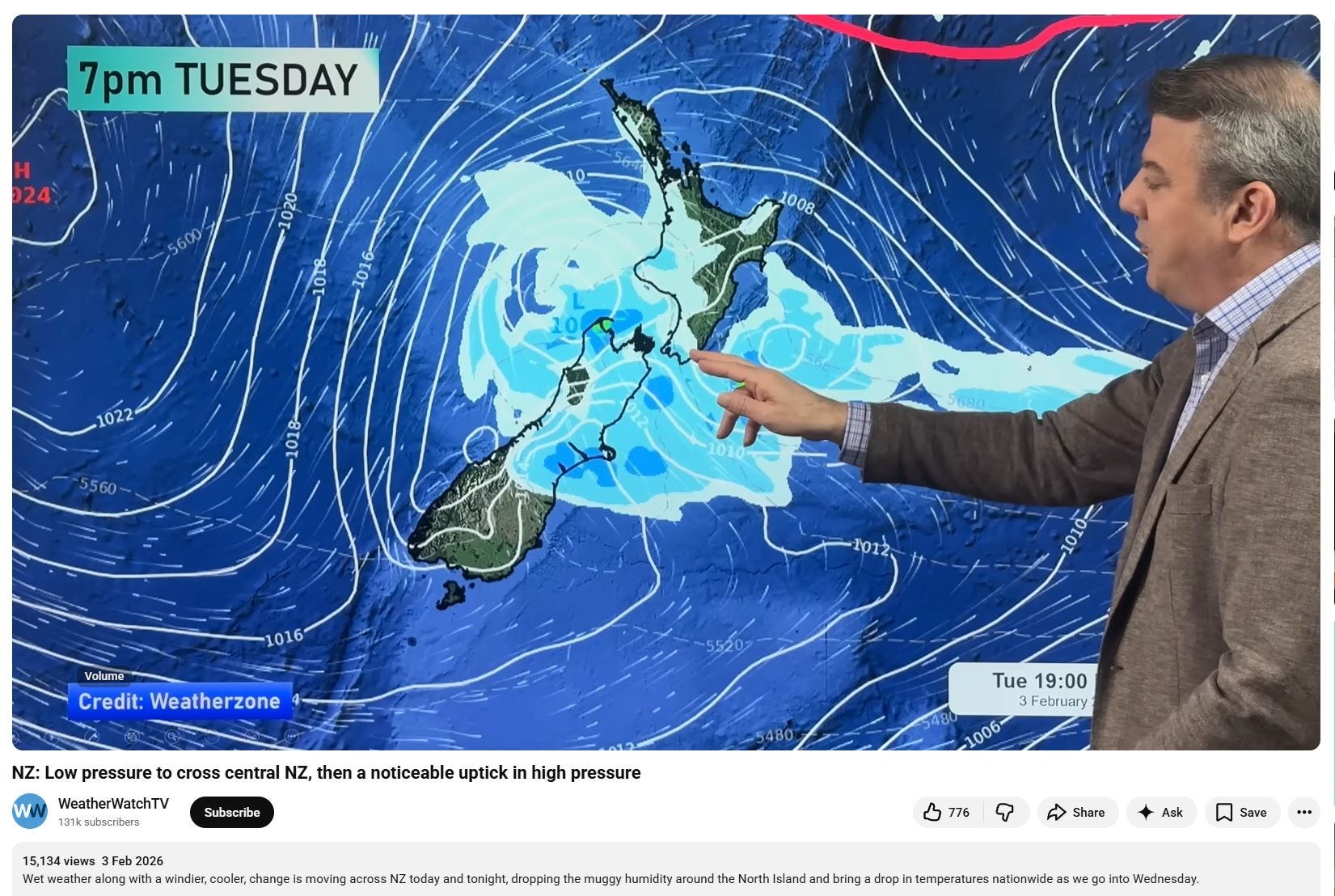
In his morning WeatherWatchTV forecast for Tuesday evening of February 3, and overnight, Philip Duncan stated that the Cook Strait area and the lower tip of the North Island around the Wellington Region, could be in for heavy down-pours.
It would appear the treatment plant was unattended, and there was no night vigil.
The Faults and Outages page also noted that the treated flow capacity was reduced on January 24, due to a UV replacement project. Consequently, there’d been a discharge of partially treated water at the long outfall located 1.8kms off the coast of Lyall Bay.
And a week prior to that notice, on 17 January 2026, the Seaview treatment Plant leaked into the Wellington Harbour, and made headlines across New Zealand.
Almost 22 months ago, the Wellington Water Committee met on Friday 15 March 2024 to discuss the city’s water infrastructure capacity for the next decade, and the associated funding gaps. RNZ reported that Wellington Water had said the budget allocation was less than half of what they were seeking for new water pipes. What are the odds that this water committee budget allocation meeting took place on the same day, March 15 in 1965, that the Benmore hydro-electric power station opened.
Ergo, a water-themed capital investment metaphor was codified into the hui date.
Doherty said the first priority was to divert the discharge into the Cook Strait, followed by removing the sludge out of the treatment plant before it turns anaerobic. The third prioity was to get the waste water out of the plant to assess the damage.
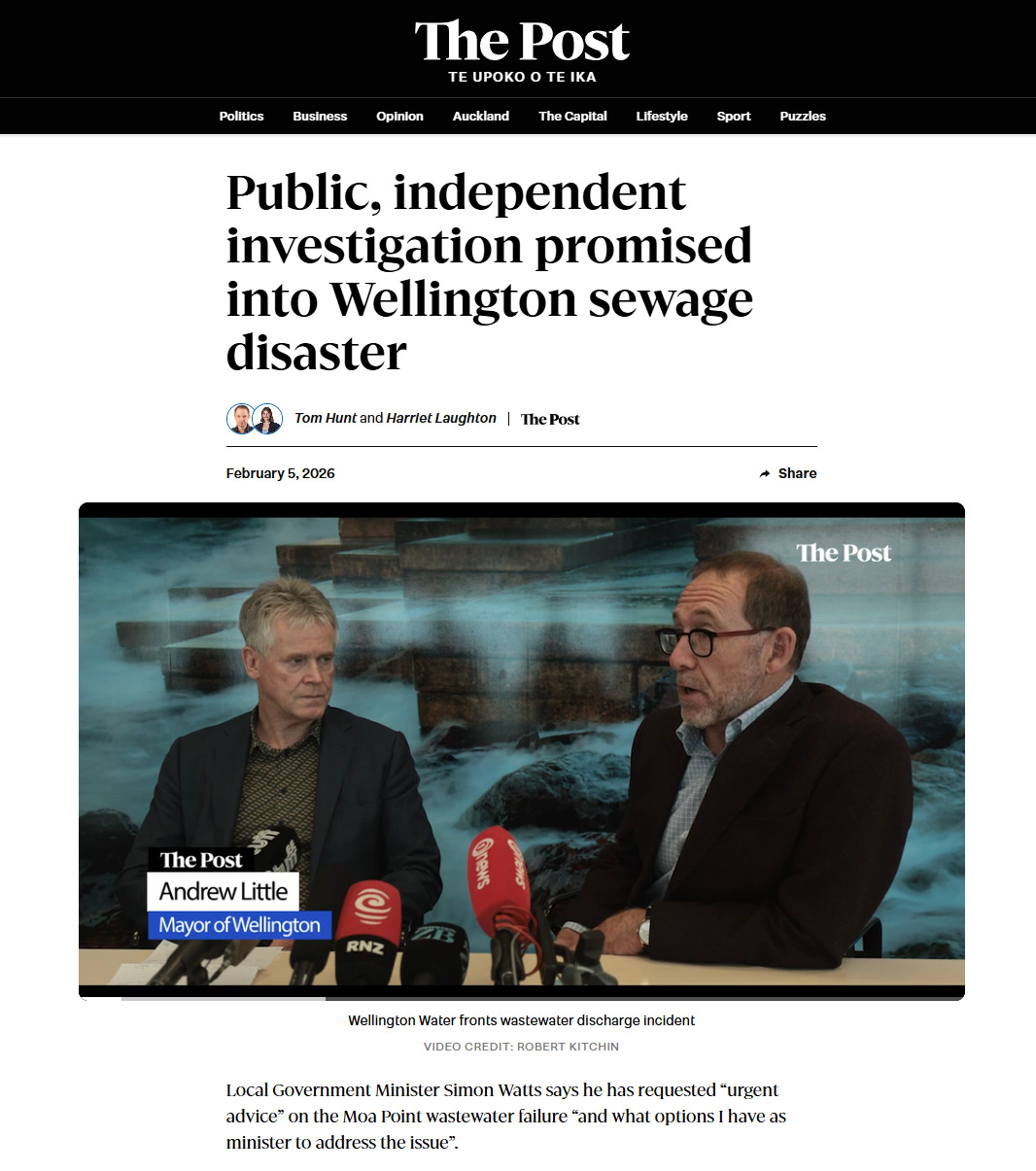
Andrew Little said there would need to be an independent inquiry with the three parties associated with the waste water treatment plant. They are “Wellington City Council as the owner of the plant, Wellington Water as the operator of the plant, and Veolia is the organisation responsible for maintenance of the plant”, he said.
Veolia’s maintenance contract is due to run out soon, and Tiaki Wai, a council-owned organisation established by five councils in partnership with mana whenua iwi, is due to be up and running from July 1 2026. This shift has followed a strained relationship between Veolia and the operator of the plant, Wellington Water, amid frequent faults, outages and spills to the drinking water, stormwater and wastwater networks. In 2022, Radio NZ reported that an independent review had found the French-owned multinational Veolia failed to carry out basic asset management, including regular maintenance. Veolia’s performance has “adversely affected the trust and confidence of client Councils, iwi, stakeholders and community groups in Wellington Water”. There was now a lack of trust between key personnel from both sides, RNZ reported in 2022.
For Veolia’s part, its staff “viewed their treatment by Wellington Water as that of a ‘master-slave relationship’ and felt that client power dynamics may have impacted adversely on Veolia’s performance”. Veolia staff felt there have been too many reviews, taking them away from their operational delivery functions. “Wellington Water has at times exhibited a blame approach rather than jointly problem-solving.” The French-owned company, which has operated Moa Point and Western wastewater treatments plants since 2004, was awarded a 10-year contract to run all four plants in 2019.
Since Tiaki Wai is due to take over the delivery of drinking water, wastewater and piped stormwater services to people in the metropolitan Wellington area and absorb a the current provider, Wellington Water, on July 1 2026, it is noteworthy that this date thematically riffs off the date, July 1 1988 when the Government announced it would return ownership of the land at Bastion Point (Takaparawhā), on the southern shore of Auckland’s Waitematā Harbour, to local iwi Ngāti Whātua. What are the odds that Moa Point Waste Water Treatment Plant, on the southern shore of Wellington Harbour, would make national news with a swimming-themed metaphor?
The dead give-away that the Wellington Sewerage Discharge Crisis is a staged industrial sabotage is in the date meta-data. How uncanny that Wellingtonians would be told not to swim on Wellington’s south coast on the very same day that Lynne Cox swam from the south coast of Wellington to the South Island, becoming the first woman to swim the Cook Strait, on February 4 1975. What are the odds?
➳ Analysis and Conclusions: Straight from the 1998 Auckland Power Crisis Playbook
This Wellington Sewerage Discharge Crisis is like a rinse and rhyme off the Auckland Power Crisis in 1998. On Thursday February 19th 1998, Mercury Energy, a power company supplying New Zealand’s largest city, Auckland, requested its central business district customers to conserve use to avoid “drastic measures”, and so began a five-week power crisis. The start of the Auckland Power Crisis riffed off the date February 19 1970 when oil and gas strikes in the Maui wells off the Taranaki Coast were confirmed. Ergo, an energy sector-themed crisis was manufactured to obtain buy-in from ratepayers, taxpayers and consumers to fund a power infrastructure overhaul. The Power Crisis ended on March 27 1998, as a riff off the opening of the first National Industrial Conference on March 27th 1928. What are the odds?
Since the end date for the Auckland Power Crisis riffed off the opening of the first National Industrial Conference, it signalled key players would forge the funding for plans to upgrade the electricity grid for Auckland City, and carve up the ‘power cake’.
Ergo, the end date of the Wellington Sewerage Discharge Crisis will likely riff off a major historical infrastructure project, or some other such industrially-themed event.
As a modus operandi, such historical riffing signals authorship, cooperation, caution and it telegraphs objectives. The signals indicate players are communicating their cooperation to take a plot ‘live’, convey hidden objectives, and to broadcast psychotic humour, thereby posting themselves like hostages — as applied game theory predicts.
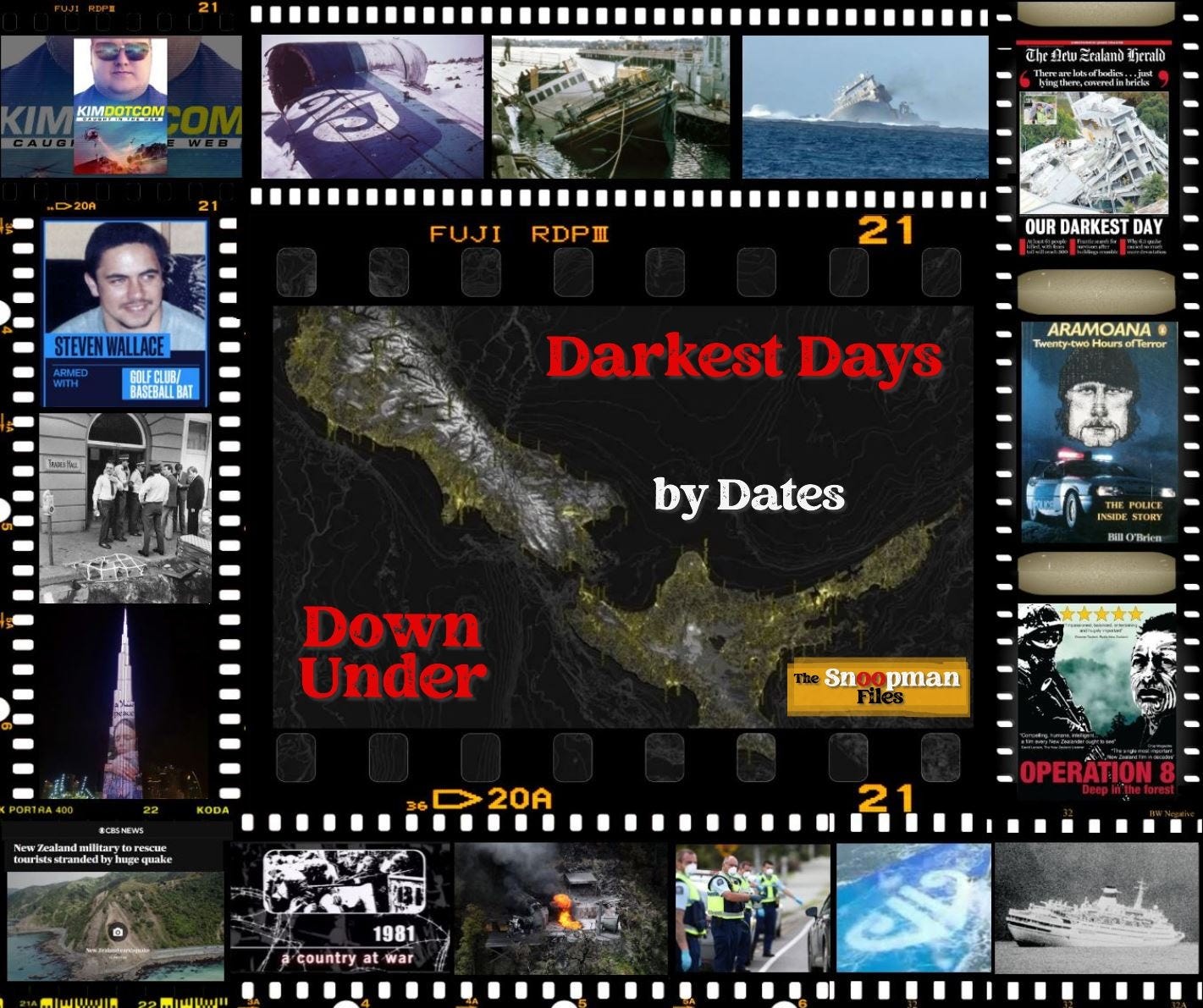
In his “Darkest Days by Dates Down Under” series, Snoopman surveys the curious coincidences of calamities, catastrophes, or crises that jolted the nation while power, wealth and control were accumulated. In his disturbing multi-decade sketch, Snoopman traces the creepy trail of spooky minds, who he believes plot machinations with an eye on the past and a dark vision of the future. The circumstantial evidence reveals an awful picture of each new administration becoming embroiled in a cover-up of a staged event made to appear as an accident, a natural disaster, or a crisis caused by an unhinged man, or an ‘unsolved’ crime. The modus operandi of metaphor laden-historical riffing continues, because most monkeys suffer from symbol illiteracy.
Ergo, the criminal network that runs New Zealand from the shadows are signalling authorship, threats, promises, caution, and scapegoats as they telegraph their chess moves. Their gambit is that their power, influence and control over strategic resources— with the penetration of every major and significant institution — will continue and with impunity. This network runs in tandem with similar transnational clandestine operations across the world, destabilizing societies to inflict totalitarian tyranny.
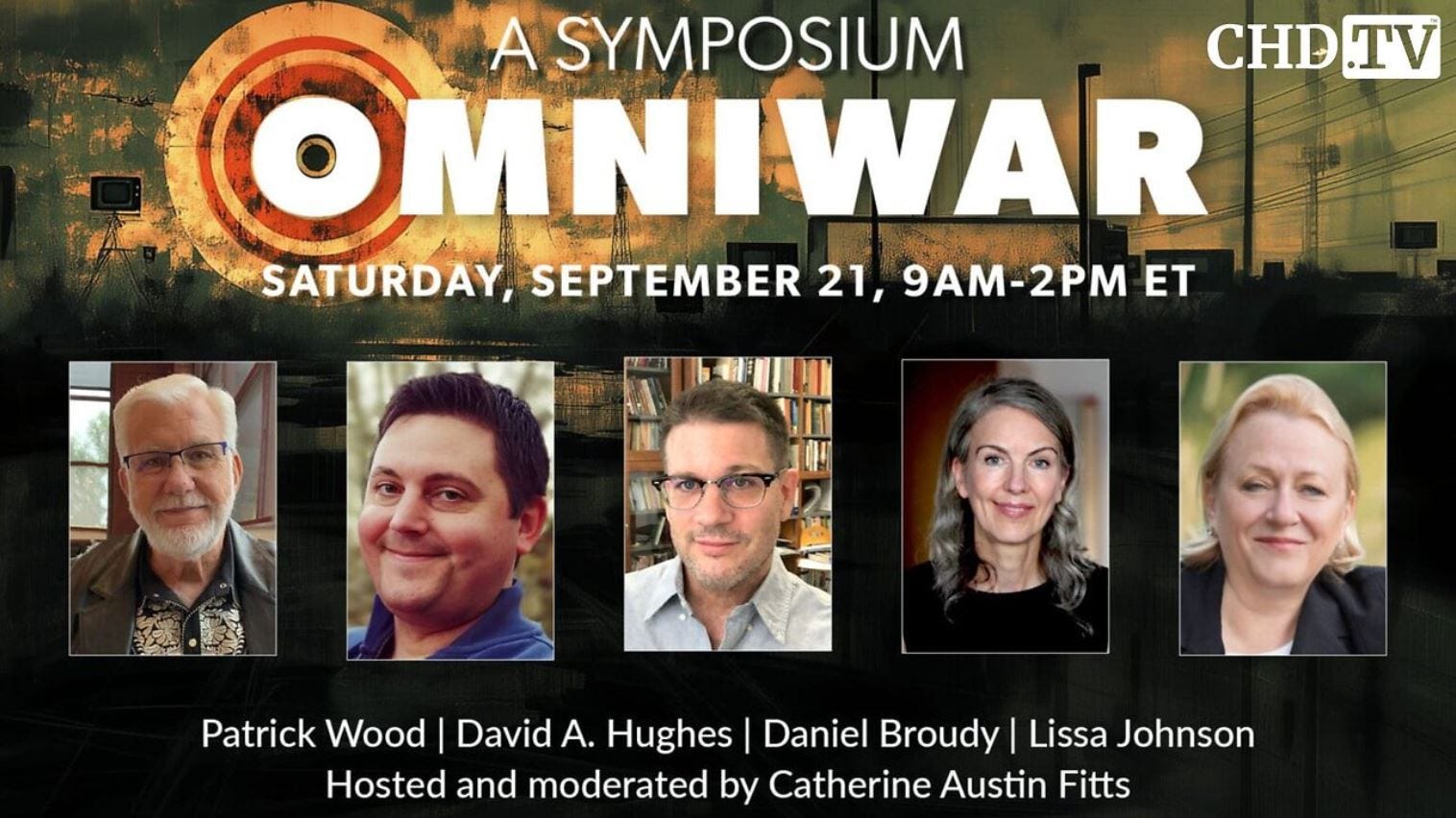
In a recent ‘symposium’ hosted by a former banker, Catherine Austin-Fitts, of the Solari Report, and three academics — David Hughes, Lissa Johnson, and Daniel Broudy — presented a picture of a full spectrum dominance war, waged by the transnational deep state, whose objective is to enslave humanity via total control of territories, treasures and technologies. This symposium was also presented with the leading author on technocracy, Patrick Wood, whose book Technocracy Rising: The Trojan Horse of Globalization, laid out the origins and rise of a technocracy movement in the 1930s.
And, they sketched the tactics, technologies and the tricksters of technofeudalism.
They also made the case that a dystopian totalitarian technocratic system is being constructed before our very eyes, while technology upgrades get boosted amid periodic resets, and are actually the componentry of a global control grid designed to eventually fully integrate humans with biodigital nano-tech police surveillance states.
The present geopolitical tectonic shifts are an epic struggle between powerful factions competing to control the territories, treasures and technologies for dominance over the development of the computing chip. New Zealand has untapped minerals in the Conservation Estate, the coastal environs and under the seabeds.
Many shock news events are staged in this low-grade war of trauma programming, economic warfare and ritual terrorism fitting within a ‘strategy of tension’ paradigm to forge a police state. A police state describes a government that exercises power arbitrarily through the wielding of law enforcement against the citizenry, rather than upholding the Rule of Law Doctrine to restrain abuses of power. If unchecked, police state formation can manifest into a totalitarian state controlled by a politicized police force that secretly supervises the citizens’ activities, inflicts punishments and controls the captured citizenry through fear and tightly regulated hope, for sinister ends.
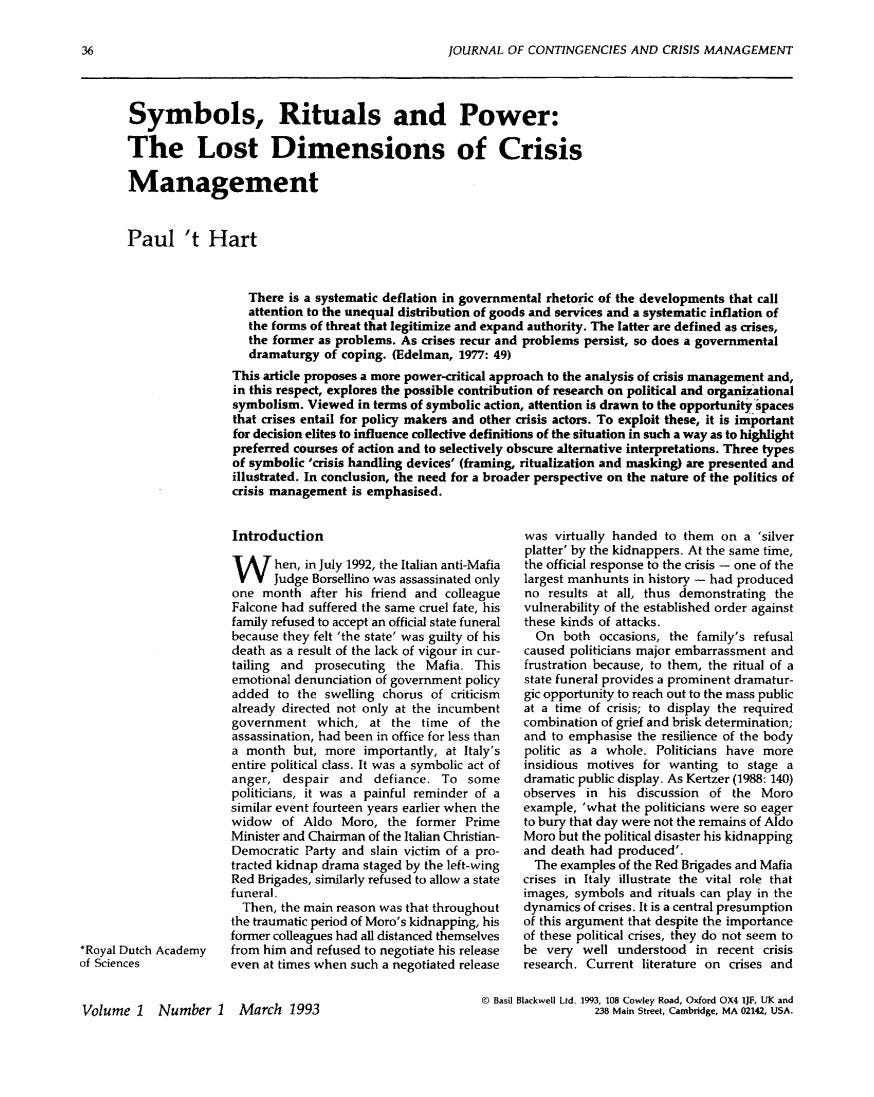
As crisis management expert Paul ’t Hart observed, crises can be contrived and manoeuvred by actors within and external to the state apparatus and provided they can control the ritualized symbolic actions, they can also constrain the meanings. In an atmosphere of calamity and urgency, those who control perceptions about what caused the crisis and what might resolve it, will tend to gain politically, wrote ’t Hart in his 1993 paper “Symbols, rituals and power: The lost dimensions of crisis management” and published in the Journal of Contingencies and Crisis Management.
Political actors, whether they work in government institutions or in private enterprises, have incentives to smooth over concerns during crises, either because they do not want to make them worse, or because they are acting collusively to set a course toward a climax, from which they expect to gain in its resolution. Powerful groups use the media to relay information to ‘crisis stakeholders’. Ergo, newsrooms become vectors for perception management in the absence of vigilant filtering.
By controlling the dates of crises inflicted upon public and private institutions, and across the country and over time, the network is performing ritualized displays of power. This spectacular exhibition enforces discipline among the network, as well as serving to manufacture the consent of the public, and state managers, and competing vested interest groups, to agree to the ‘desired solutions’ without necessarily being aware that a sinister, stealthy form of the ‘Shock Doctrine’ has been perpetrated.
This pattern hidden in plain sight isn’t merely coincidence, synchronicity, or chance.
Nor, can it be explained away by Oscillation Law, which describes the rhythm behind cosmically woven fabric of reality, as an infinite flow like a river and its crystalization, performing as ‘frozen forms’ holding shapes. Snoopman has cracked the cypher that lurks behind the headlines. A cryptocracy that rules New Zealand from the shadows hacks the national mind, tomb-raids cultural memory and hijacks our aspirations with broad daylight robberies and witching-hour hold-ups, staged to appear as banal endings due to illnesses of the infirmed, or as accidents, or occasionally, as murders blamed on a patsy, or as shootings by police acting ‘self-defensively’. These crises are codified calamities, and therefore they are ransom notes to the Establishment’s insiders.
And so, where Scooby Doo’s friends would unmask the villains at the end of each of their investigations, but fail to nail who tanked America’s economy at least half a decade prior to the engineered Oil Price Shocks of 1973-74 — Snoopman’s snoopy-dooing has unmasked the existence of a cryptocratic deep state network timing the crises of New Zealand’s history for the best part of 80 years. The early Scooby Doo series, the 1969 and 1970 episodes, featured obvious signs of an economic depression.
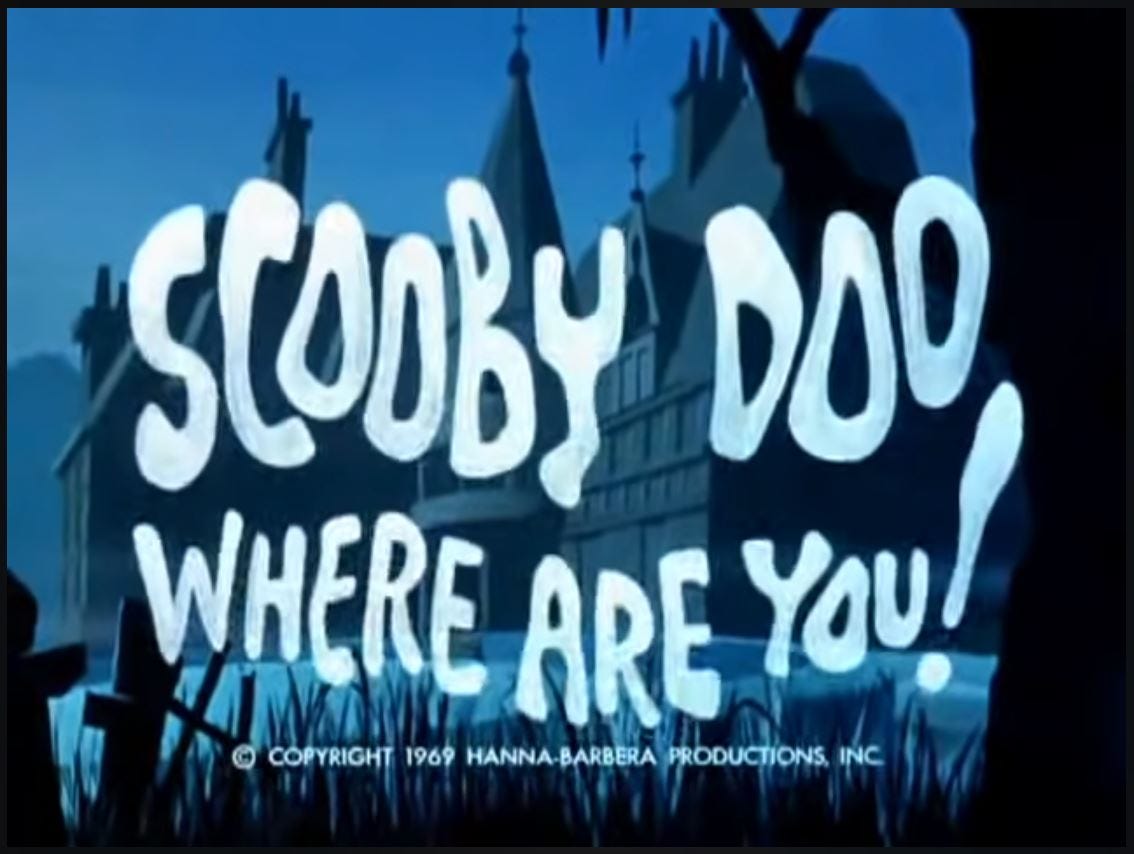
Students of Scooby Doo will recall ‘out of work’ scientists, professors and the like, who resorted to schemes of scaring people off the abandoned theme parks, haunted mansions and run-down museums, to make their fantasized fortunes. On their early vacation trips, Scooby Doo and Friends unmasked the villains in front of them, but they failed to nail who made the depression happen, and why. CrimeReads missed the mystery of the mysterious motifs. And Cartoon Conspiracy presenter Emily Carson failed to consider the entrainment of the population with predictive programming. Hanna Barbera's early Scooby Doo series uncannily ‘predicted’ the stagnation that followed the engineered 1973-74 Oil Shocks, as well as the 1978-1979 Oil Shocks triggered by the US-UK intelligence-engineered Iranian Revolution (SEE: William Engdahl's 2004 book, A Century of War). The first oil shock was inflicted to reinvigorate the US FED dollar as the world’s reserve currency, while the Iranian Revolution of 1979 was engineered by British and American intelligence to set off an ‘Arc of Crisis’ across the Near East. It was designed to spill-over into Muslim regions of the Soviet Russian Empire. And that stirring, occurred merely three years after the Saudi Royals had been brought into a subversive intelligence, paramilitary and narcotics network called the Safari Club, by George H.W. Bush to bankroll the chaos featuring Islamic terrorism. And so, the meddling of Scooby Doo's friends reflected Hollywood's tendency to shift focus away from the real supervillains, whose scheming in mansions is seldom depicted.So, the newswires spread the sewerage discharge story and the crisis is taken at face-value. Yet, the pattern reveals a sinister cryptocracy practising symbol sorcery.
The pertinent details and issues in the events, as they relate to the dates, unveils the thematic metaphors encoded into the timings to stage crises and produce headlines.
A key feature of propaganda is the mass production of a narrative that performs to a hymn sheet, whereby news anchors, reporters and publishing editors essentially sing from one script. Meanwhile, the omissions of key evidence hide the underlying goals.
And so, when a New Zealand crisis breaks on a historical date that thematically riffs off details of the crisis itself, you can bet all of the world’s debt the deep state network had scheduled precursor events to signal a looming staged event. And that cryptocracy’s professionals, officials and trademen have moved like synchoronized swimmers as an army of ‘soldiers’, to make a crisis scenario ‘go live’ on the specified date. And, that others may have performed roles as unwitting assets or agents.
This isn’t to say that the news media are ‘all in’ on the rort. Most would be appalled.
Brazen lies spread quicker than the naked truth has the chance to stick on underwear.
This heretical dispatch, Dirty Deeds by Dates Down Under 003, was last updated on February 5th 2026 and was originally posted on The Snoopman Files on February 4 2026. See also: Dirty Deeds by Dates Down Under: Dispatch 001: Sexual Predation Police Review Codified with Internal Self Government Theme [The Snoopman Files]
Dirty Deeds by Dates Down Under: Dispatch 002 ‘No Show’ Breaking News of Former Ministers at Covid Inquiry, 13 August 2025 [The Snoopman Files]
Thanks for reading Snoopman News! Subscribe for free to receive new posts and support my work.

Back when Steve Snoopman was ‘Snoopboy’, he delivered the Auckland Star during the dark days of the Reagan White House. He forged his superpower to ‘Thunk Evil Without Being Evil’ while writing a thesis on the Global Financial Crisis. Upon quipping Batman had failed to bust any Gotham banker’s balls — since his ass is owned by DC Comics — he consequently realised New Zealand needed a Snoopman.
Editor’s Note: If we have made any errors, please contact Steve Snoopman with your counter-evidence. Or, if you wish to share information related to these dispatches, by email, please also state the topic in the subject line, using relevant noun words, so that your email is searchable for following up later …
e: snoopman72@proton.me
SEE related: Darkest Days by Dates Down Under series introduction
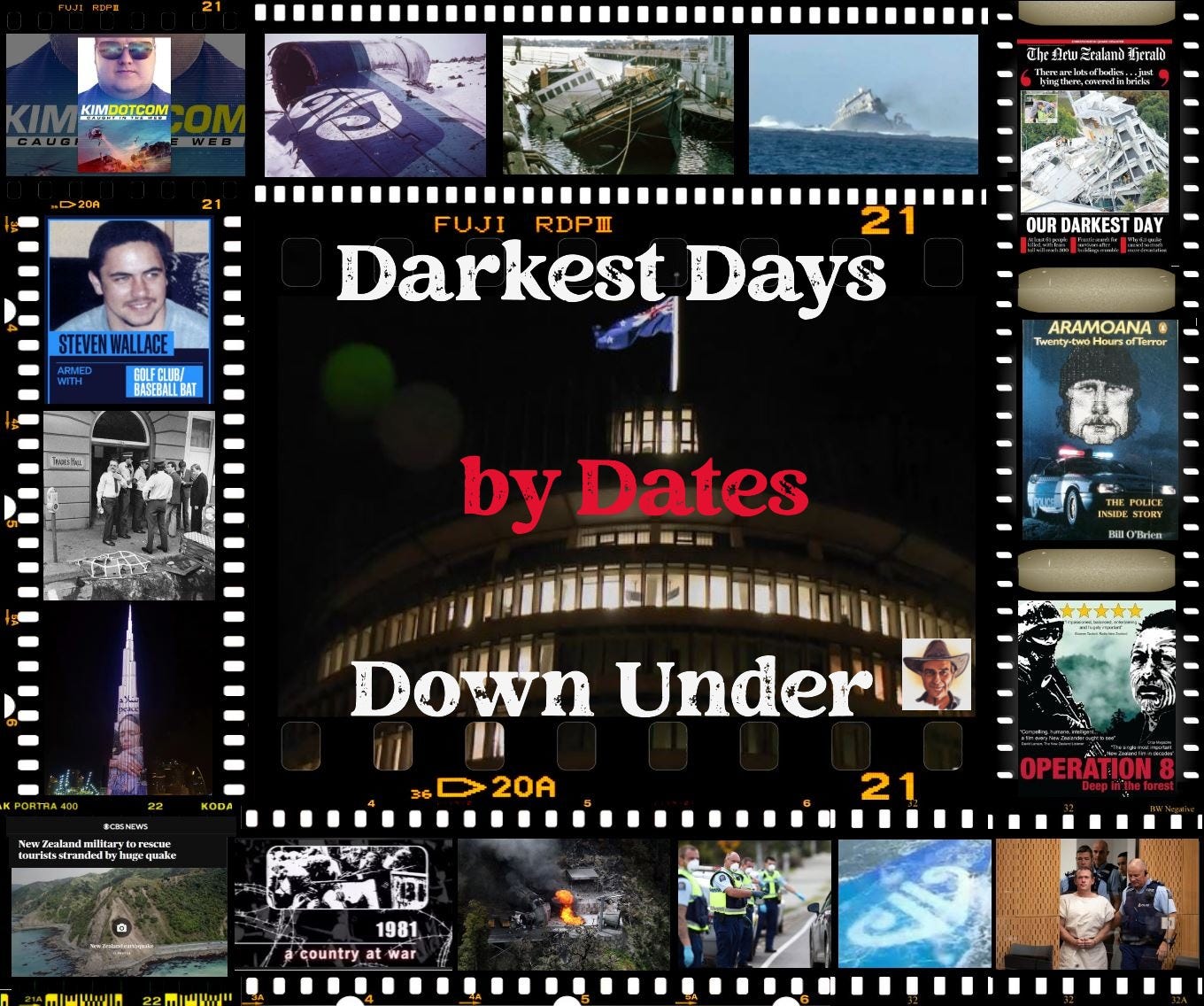
Moving a Mountain — The Crash of Flight TE901: November 28 1979
Darkest Days by Dates Down Under: Part 1 [The Snoopman Files]
The Great Divide — 1981 Springbok Rugby Tour, New Zealand
Darkest Days by Dates Down Under: Part 2 [The Snoopman Files]
Transport Themed Terrorism — Wellington Trades Hall Bombing, March 27 1984
Darkest Days by Dates Down Under: Part 3 [The Snoopman Files]
Kiwi Dollar Weaponized as Ransom Notes — ‘Bastille Day’ Currency Crisis, 1984 Darkest Days by Dates Down Under: Part 4 [The Snoopman Files]
Accommodating France — Rainbow Warrior Bombing, 10 July 1985
Darkest Days by Dates Down Under: Part 5 [The Snoopman Files]
The Russians are Coming! The Mikhail Lermontov Sinking, 16 February 1986 Darkest Days by Dates Down Under: Part 6 [The Snoopman Files]
Ballantynes’ Fire, 18 November 1947 — Death Toll: 41 Staged Disasters Down Under: Part 1 [The Snoopman Files]
Tangiwai Railway Disaster, 24 December 1953 — Death Toll: 151 Staged Disasters Down Under: Part 2 [The Snoopman Files]
The Brynderwyn Bus Buskin, 7 February 1963 — Death Toll: 15 Staged Disasters Down Under: Part 3 [The Snoopman Files]
“Terror Archipelago Down Under? Pt 1 Industrial Sabotage, Ritual Terrorism, and Police State Formation in New Zealand” [The Snoopman Files]
“Into the Erebus Abyss — Air New Zealand Flight TE901 Rabbit Hole Redux” “Terror Archipelago Down Under?” Part 2 [The Snoopman Files]