

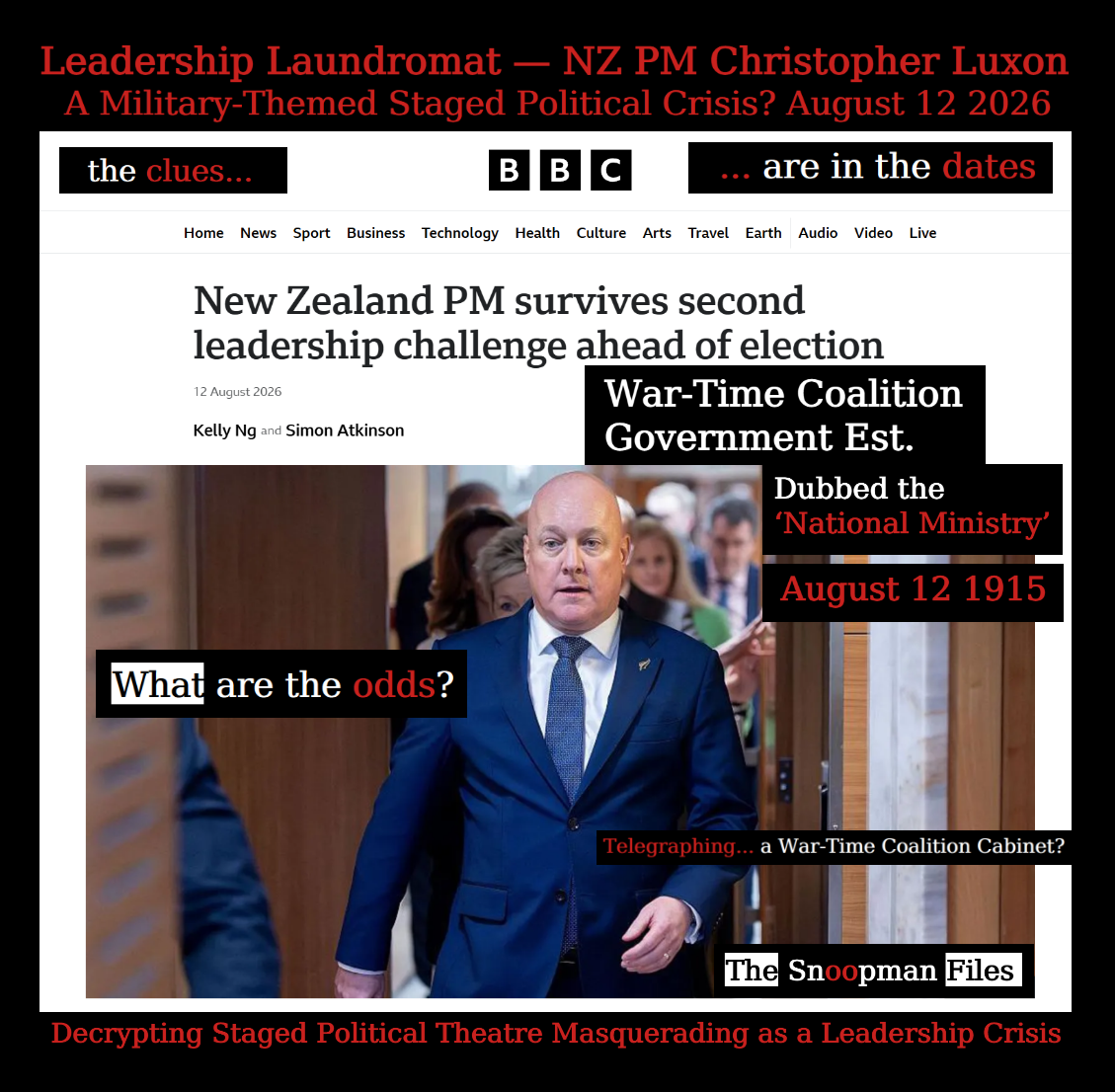

How the Luxon Leadership Challenge Telegraphed a ‘National Ministry’

Click the link to read The Snoopman Files in black, or listen to this code-cracking dispatch via the reader app,. “Control +” to expand the text, and click the images to enlarge their size.
Theme: This summary dispatch is one of numerous probes about how New Zealand’s issues, scandals and crises are thematically encoded with historical riffs to signal authorship, unity, damage control and scapegoats — while telegraphing hidden aims — in plain sight. New Zealand’s staged events occur with spooky precision timing to riff off historical events so that the newsmaking psycho-dramatic terror theater, simultaneously performs as cryptic signals intelligence, boasts its ritualized spectacular power and functions to maintain discipline among a cryptocracy. The cryptologists’ modus operandi is to encode events with metaphors to telegraph ruptures with the past, that go live as the syndicate’s chess pieces perform their scripted and improvised moves, to transform populations through entrainment, trauma, and terror on a theatrical trajectory. The metaphor-laden matrix code tabulated into staged events, whether they be trumped-up battles during the hustings, milestones in reforms, or catalytic stage disasters to jolt the mandated political trajectory of councils, corporations, churches, clubs, communities, cities and the country — works as magical physics by secretly wielding history to shape a totalitarian future. Backdrop: This dispatch locates the present great power competition as staged theater, where the ‘American Empire’ is said to be in decline, amid a rise of the ‘multi-polar world order’. While this re-orientation has devastating real world consequences, borne mostly by regular people, the tectonic geopolitical shifts are the culmination of accelerated technological innovation, new administrative systems and the expanded capacity for resource exploitation amidst the cauldron of an Age of Conflict that began before 1900. Over the course of this ongoing Third Hundred Years’ War, the great powers also became vassal colonies of an invisible global empire. The ‘multi-polar world order’ is essentially a global theater production with masquerade costumes, masks and bling, to distract, divide and defeat the mass populaces while a totalitarian super-structure is built-out before our very eyes. This super-structure is techno-feudalism. It is the new instrument of expansion that collectivizes all previous imperial instruments of expansion including slavery, franchised city state cults, monotheism, monasiticism, feudalism, and merging communism with capitalism. Snoopman calls this global power the Cryptocratic Invisible Empire.
Snapshot: A leadership challenge to the Catholic Prime Minister of New Zealand, Chris Luxon, that culminated in a party caucus vote on August 12 2026, landed with uncanny timing. What are the odds that the emergency meeting at the Beehive, took place on the same day when a war-time coalition government was formed on August 12 1915, dubbed the National Ministry? The meta-data of metaphor-laden dates associated with this staged leadership crisis reveal a clockwork manipulation of politicians, journalists and citizens, while signalling to key insiders to corrall the centrist-right coalition to polish its shining liberal western democracy image. The parallel take-down of the online newspaper, the New Zealand Daily Telegraph, by the Government’s Domain Name Commission, indicates interference was run to censor inconvenient coverage.

This ‘leadership challenge’ was the second inside four months, in an election year, after all.

In the full version of this war-themed dispatch about a show-down allegedly launched by the Defence Minister, Chris Penk, former Māori TV news and current affairs editor, Steve Snoopman, shows how three recent deaths of men whose careers were associated with that of Muldoon’s, together reveal entwined-themed meta-data in their timings. The first to die was the most famous Hollywood actor New Zealand has produced, whose debut feature film role was a man who became a fugitive of the state, back when Muldoon became a show pony for the U.S. military. In real life, the actor recently drew the ire of NZ First’s Resources Minister, Shane Jones, for opposing a proposed gold mine. The second to die was the energy minister responsible for the expansion of the now-defunct Marsden Point Oil Refinery. And, the third to die, as if on a synchronized spooky schedule, was Muldoon’s point-man for the currency switch-over to the dollar in 1967.

Due to widespread symbol illiteracy, New Zealand’s newsrooms missed the irony of the Defence Minister appearing to fall on his sword in a ‘war-time’ metaphor-laden ‘National Ministry’ beat-up, staged to perform like a climax in the first act in the classic three-act story structure.

Mr Penk was cast out as the ‘agitator’ like a lone, hoofed, horny foraging vegan (genus capra hircus) in an ancient scapegoat ritual. Ten days earlier, news surfaced at a NZ First Party public meeting on August 2 2026, that a former Defence Minister, Ron Mark, was returning to the political ring. What are the odds that on August 2 1940, the New Zealand Home Guard was officially established during the early stages of World War II to bolster domestic defense against potential invasion. Ergo, the voting public doesn’t comprehend that Gulf War III is about disrupting the agitators to the American Empire’s plans to dominate the energy-based tokenization of the global economy, which is set to displace the world currencies system.

Following a post-leadership crisis ‘breather’ at the beginning of Act II, the Tauranga City Council reported the findings of the inquiry into the Mount Maunganui Beachside Holiday Park landslide, on August 19th, that in effect performed the role of the first focus point. And, the news emphasized how the damning findings would cause councils to review their own emergency evacuation procedures, as well as do appraisals of slip-prone areas, flood hazards and storm-damage mitigation measures. And on cue the very next day, August 20th, the NZ Herald published an ‘Infrastructure Reality Check’ 36-page sponsored supplement, representation from the New Zealand Initiative, which is the ‘New Zealand Business Roundtable’ Pig wearing Mammon’s Lipstick and carrying a New Zealand Institute ‘Handbag’ slinked over its right shoulder. Naturally, this NZME ‘Reality Check’ sponsored supplement omitted any iwi representation, least Hobson’s Pledge and Corporate New Zealand had conniptions about ‘Co-Governance’ in a land down-under. After all, NZ was forged as a Masonic State by swindle, stealth and struggle in Co-Governance partnerships with English and New Zealand Freemasonry, Buckingham Palace, and the Bank of the New Zealand.

How uncanny that when the Tauranga City Council reported the findings of the inquiry into the Mount Maunganui Beachside Holiday Park landslide on August 19, this date would correspond with the time when Edward Gibbon Wakefield, the 19th century architect of organized colonialization in New Zealand, was elected to the Colonial Parliament on August 19 1853.  His election — after promising land grants to workers who had migrated under his land settlement scheme — was a significant governance milestone since the colonial theorist, and New Zealand Company architect, Edward Gibbon Wakefield, occurred during the first general and provincial elections enabled by the British-passed New Zealand Constitution Act of 1852. Key dates associated with the storm’s formation and progression corresponded thematically with NZ’s military history. Ergo, in the future, engineered storms are to trigger ‘managed retreats’ or the re-settlement of the colonists, who are in effect cast as ‘insurgents’ to be corralled into 15-minute zones.

What are the odds that when a subtropical cyclone transitioned into an extra-tropical cyclone on January 21, and this date thematically riffed off the date, when the ‘Tauranga Campaign’ of the New Zealand Wars, commenced on January 21st 1864. Although no fighting occurred on January 21 1864, it marks the official military operational timeline designation for the deployment of forces into the Bay of Plenty region. Since a landslide occurred January 22 2026, how uncanny was it that on 22 January 1864, Colonel George Carey landed at Te Papa with about 600 men?

Like all hardball military strategies, that give rise to risk game plans to increase the probabilities of the chosen tactics working as desired, this cruel grimoire politics entailed wetting the land like a soggy sand-pit, so slips would ensue district-wide. A pernicious cryptocratic system weaponizes “science” (or materialist physics) and “democracy” (or managed choice) to maintain the illusion that human populations are meat operating in a dead universe, rather than consciousness entrapped in a probability farm called nations. The idea is to manufacture consent with engineered crises, and in this secret warfare alter the probability field by jolting the probability farm known as New Zealand, with periodic catalytic events.

Ergo, the military-themed extra-tropical storm would trigger a re-settlement of the colonists, who had been designated as ‘insurgents’ requiring managed retreats to 15-minute zones.

A Government Inquiry into the Fatal Landslides in Tauranga was set up to establish how the landslides occurred. Applications for a senior comms and engagement lead position closed on June 21 2026. What are the odds this date thematically corresponded with the same day, June 21 1864, that the ‘Tauranga Campaign’ ended? Since the New Zealand’s Herald “Infrastructure Reality Check” special landed on August 20th, how uncanny was it that the S.S. Golden Age sailed its first trip between Port Chalmers to Dunedin on August 20th 1863? After all, the Minister for Resources as well as Regional Development, and who was featured in the Herald’s "Infrastructure" supplement, had talked about a “resources golden era” and a “resources renaissance” in 2025.

Ergo, a golden era in resources extraction ‘requires’ a coordinated stealthy Military Campaign, to ‘democracy’ a majority of monkey minds to think on the same techno-feudalist wave-length.

As such, this exposé explores the ‘Luxon Leadership Laundromat’ as a staged alchemical theatre to forge a ‘National Ministry’ to fast-track New Zealand’s trajectory as a techno-feudalist colony of an invisible empire. The tectonic geo-political tensions are about staging catalytic crises to forge rival super-states with regional trade blocs appearing to be enemies, to justify perpetual war, like that portrayed in George Orwell’s dystopian novel, Nineteen Eighty-Four.

Key Finding: Reading the runes, the Luxo leadership challenge behaved like a mafia front-company masquerading as a laundromat shop, cleaning the party’s livery set to ‘election cycle’. The wash cycle featured a laundering of the living, while the Luxo Suds™ were war-themed to telegraph a war-time National Ministry, and the spin cycle manufactured consent to stay calm and carry-on.

All the grubby marks were erased from suits, skirts and silks with the defence force’s preferred dry cleaning solvent, Home Guard Marks™, while a hot dryer tossed all of the National Ministry’s smalls together and the Defence Minister was hung out to dry after a wash in an old agitator.

In plain English, this military-themed Beehive soft-coup behaved as intended, to unseat the Defence Minister, and with this Penkian Slip, the way has been paved for Mr Marks to take-up the ministerial posts overseeing the national security state, should a National Ministry be formed.

Moreover, it has set-up a dynamic where it’s coalition’s composition would see a strengthening of NZ First and the ACT Party, and National gaining enough seats, but having to make major concessions, that accelerate the policy trajectory established in Luxon’s first term. It suggests big money will be stumped up to fund campaign coffers and to bankroll public events.

After all, a faux soft coup attempt climaxed on the same day as the historical formation of a war-time coalition occurred on April 12 1915. Out of all of the days in the year, LuxoMan was forced to emerge from a tense three-hour caucus meeting with eight of his cabinet members to put on a united front on a day when the ‘National Ministry’ was formed in the cauldron of WWI. Such  formations occurred three other times prior to MPP; once during the Depression, twice in WWII.
Theory: The supposition presented here is that following World War II, a kind of warfare was imported into New Zealand that was so novel in its nature, that neither its immigrant or native populations would suspect they were being subjected to a psychic-voodoo. This kind of low-grade war featuring covert terrorism is described as Fifth Generation Warfare. The foundational event was a staged department store inferno called the Ballantynes’ Fire on November 18 1947, that just happened to occur on the same day when the Stte Fire Insurance Act was passed in N.Z. Parliament on November 18 1903. The Ballantynes’ Fire was the first of numerous staged ‘worst of type’ disasters inflicted to capture state, city and provincial officials, corporate executives and management to create permanent severances by place, by time and by generation between the visible public state and what Snoopman calls the cryptocratic dark state. Over the course of hacked time, new district, city and government officials become embroiled in a reset that alters the mandated political trajectory of towns, distrcists, cities and the entire archipelago.
In the aftermath of the Second World War, there were two imperialist superpowers organized around two competing instruments of expansion: communism and capitalism. The war planners of the ‘American Empire’ faced a competitor whose totalitarian system was not constrained by the opinions of the citizenries of Western Civilization, who were agitating for democratic systems of government. Many nations took the rhetoric of freedom and democracy seriously, overthrowing the colonial masters. This dispatch detects a stealthy system of codifying events with metaphor laden date riffs specific to New Zealand’s history, in a broader blueprint logging milestones in the distortion of reality while the ‘American Empire’ pursues a totalitarian pivot.
Ergo, there lurks another layer to New Zealand’s recent past and the trail of meta-data reveals encrypted ‘glyphs’ or ‘runes’ of a network who ‘hex’ targets in terrible tricks. This cruel, brutal, evil, novel clandestine warfare has featured a general trend in increasing its techno-prowess, while a ‘cryptocratic dark state’ network grew in size, sway and sophistication. But always, one characteristic has remained a brazen and unwavering constant; a thematic riffing off historical events to signify a cryptographic disaster, where the worst types of tragedy out-do the previous ‘bests’ in natural disasters, or unintended human-made crises. Or, where a calamity is staged to look like an outbreak, a lone wolf, or unforeseen and beyond New Zealand’s control.
This hidden terrorism is aimed at the Establishment who become embroiled in the cover-ups. It is the most dangerous type of warfare, because it remains invisible. Since the targetted population does not know the signs, they don’t recognize they are even in a war and they are loosing it.
The selection of dates can codify the tactic of inversion, to inflict a wicked symbol sorcery that flies over the public’s heads, and thus, adds to the authored psychopathic humour in play.
We are living in a Baconian wet-dream, perhaps the most influential man of the last 500 years.
Francis Bacon spearheaded three institutions that would together work like covert turbo-boosters to support the re-invigoration of commercial capitalism as the de jure instrument of imperial expansion. Bacon spearheaded the Freemasonry Cult to operate as an unifying imperial institution and as an intelligence arm to what became ‘British Intelligence’. He gave intellectual shape to the scientific method, emphasizing repeatable experiments, data collection, and harnessing nature supposedly to serve humanity. Since England would become an inventive wheel-house, and its economic dynamism would require a structured exploitation of slaves, natives and commoners — backed with war arms, it would require image management that projected Engand’s prestige. Bacon was the driving force of an alchemical theatre that would not only work as Tudor propaganda masking over the regime’s crimes of power. But also, plays that would shape the world culturally, and promote a language invented by merchants in London — English — to be a global language to ease the flow of commerce, which funds the military dominance, and wins over allies.
As Solicitor General, in 1606, Bacon prepared the royal charter for the Virginia Company of London. He was also a shareholder and a board director, as Nicholas Hagger stated in The Secret Founding of America: The Real Story of Freemasons, Puritans and the Battle for the New World.
His utopian novel, New Atlantis, portrays the mythical island of Bensalem as a society directed by a centralized scientific institution called Salomon’s House, whose work is hierarchically controlled, while the public are cast as admiring spectators. Bacon had described a proto-technocracy. In his life-time, he lobbied for a scientific hub to make discoveries available, and eventually the Royal Society of London was founded in 1660, 34 years after he died. Bacon claimed science should serve humanity. But, Bacon was an elitist imperialist, who had a gnostic worldview, that knowledge of the code behind the cosmos was power to be ‘shared’ — among the adepts of science. This way, knowledge could be wielded by an elite to dominate nature, overcome mortality, and to bend science into scientism, and render the public as doting spectators, while new species are created, and liquids make men strong, and the weather is controlled.
Yet, his work leading the Elizabethan scriptorium to co-write the Shakespeare plays as Tudor Propaganda, fitted into the Venetians long-game to takeover Britain to counter Rome, and forge a transmarine world empire. Thus, the Globe Theatre would became an alchemical venue to entrain the establishment to transform the world into a stage to play the commoners as puppets.
Where Freemason Captain James Cook said New Zealand would make “an ideal base for the Empire in that quarter of the world”, the commoners of the South Pacific archipelago are now living in the wet-dream of Bacon, the primary genius behind the world’s most famous playwright: ‘Shakespeare’. Disclaimer: This dispatch isn’t claiming that the likes of Chris Luxon, Erica Stanford, Winston Peters, Shane Jones, Ron Mark, Thomas Coughlan, Jenna Lynch, Duncan Garner, Jo Moir, or Jim Grenon act as witting players for the cryptocracy. Individual, institutional and ideological vulnerabilities can be weaponized. Snoopman’s sarcastic satirical swipes emphasize the absurd arrangements on a planet that lacks adult supervision, and that is inhabited by jumped-up monkeys, who as a species appear to be determined to evolve slower than geological processes make mountains “happen”.
This ground-breaking dispatch cites the New Zealand Government websites, NZ History, and Te Ara: The Encyclopedia of New Zealand, and the Dictionary of New Zealand Biography. Sources also include publisher A.W.Reed’s 1973 compendium of significant events entitled, It Happened Today in New Zealand, and A.W. Reed’s 1979 chronology, Two Hundred Years of New Zealand History. And also a 1932 book, Datus: A Chronology of New Zealand from the Time of the Moa, by George Finn. News and editorial headlines are reworked into collages with graphical colouring-in by Snoopman. Setting the Scene
“The Cryptocracy is not a myth. It seeks to transform humanity through an alchemical processing of the mass consciousness or Group Mind, which involves various tests and corresponding responses through channels linked to secret societies. The result is both psychological and cultural control; but more importantly, transformation. The Cryptocracy has essentially kept the minds of the masses in a cauldron, like a Renaissance alchemist, and occassionally tastes, adds ingredients, and stirs. — Craig Heimbichner (2005). Blood on the Altar: The Secret History of the World’s Most Dangerous Secret Society: USA.
The Luxo Leadership Laundromat
➳ Act I Climax: The Coalition Cabinet Sing ‘The Happy Family’
ON AUGUST 12 2026, New Zealand’s Prime Minister Chris Luxon faced a caucus vote, during a specially convened Beehive meeting called during a recess week.
This was the second challenge to his position as leader of the National Party this year, after controversy errupted last week, and speculation escalated on the Monday night.
Luxon emerged from the three-hour meeting and delivered a tersely-toned 72 second talk claiming at the Podium of Struth, the National Party’s caucus fully supported him.
Yet, the significance of the date, August 12, was missed in the extensive coverage of this ‘leadership coup’, like a child shrugs off why the parents play tents on weekends.
The date had everything to do with telegraphing a coalition between the right-bloc.
What are the odds that this apparent leadership coup vote occurred on the same date that the ‘National Ministry’ was formed on August 12 1915, one year into the First World War? The two major parties, the Reform Party and the Liberal Party, formed a coalition government. N.Z.’s first wartime coalition government emerged as a stability solution, presenting a unified political front to serve the British Empire’s imperialism.
Neither party had a clear majority in the December 1914 general election. Massey gained 40 seats in Parliament — exactly half — but was in a minority after the appointment of a speaker. With a Parliamentary deadlock, amid growing ‘public agitation’ for a coalition government, Prime Minister William Massey invited Joseph Ward’s Liberals. Massey’s standing was weakened by a harsh crackdown on the wharfies and miners, after Police ‘Specials’ bludgeoned stubborn strikers. And, also the imprisonment of the Maorilander newspaper editor, Harry Holland, for sedition, in Wellington in November 1913, for rhetoric deemed inflammatory, inciting crowds during the bitter strike. Ironically, with the looming passage of the Military Service Act on August 1st 1916, became the primary catalyst that forced the rival moderate and militant socialist factions to finally unite to form the New Zealand Labour Party on July 7 1916. This law empowered the government to introduce conscription ballots.
Ergo, a staged leadership crisis telegraphed manufacturing consent for a war-time ‘National Ministry’, amid escalating tectonic geo-political and geo-economic tensions.
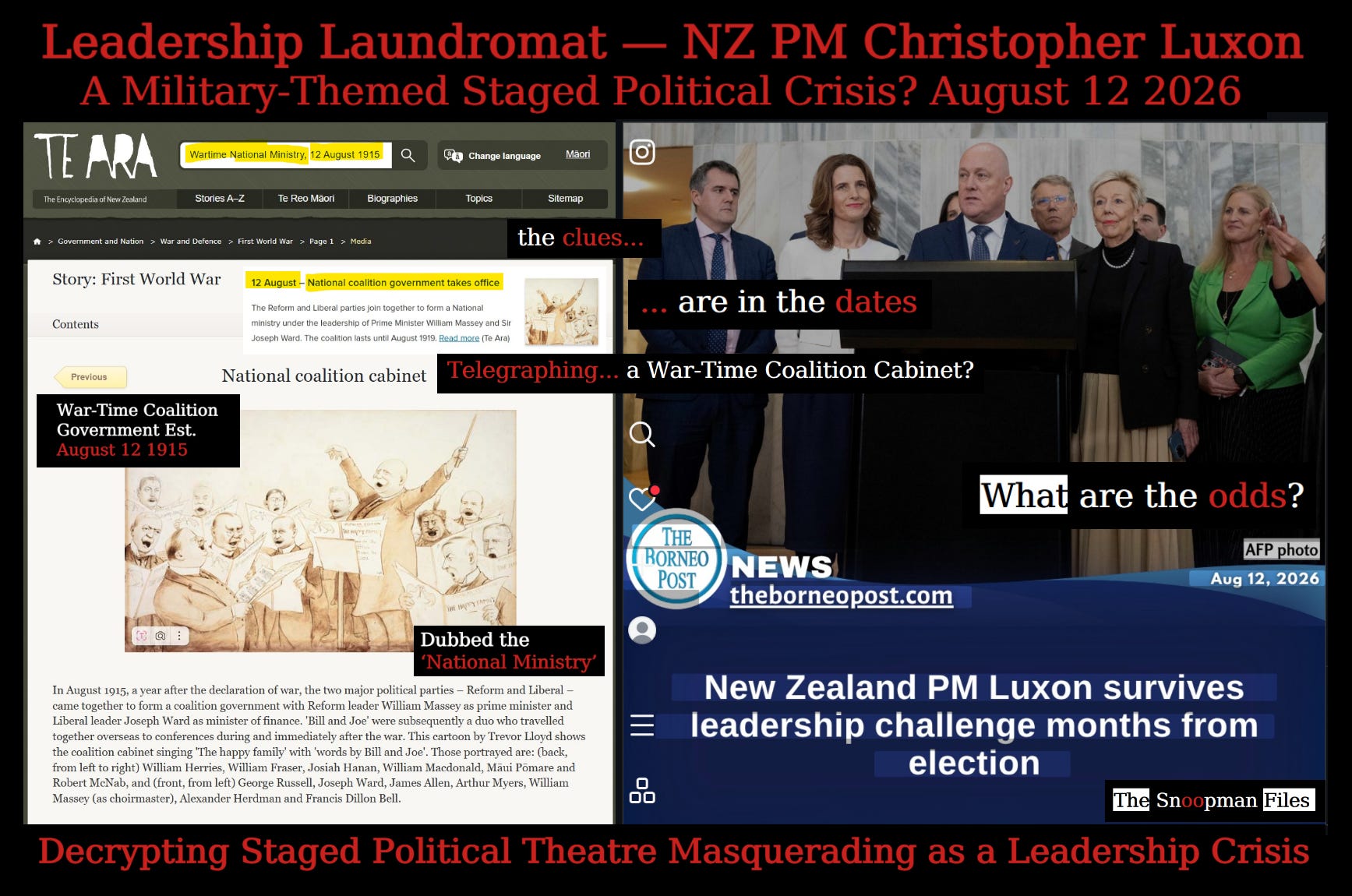
Since the date meta-data has the hallmarks of the staged leadership fiasco, it would appear the cryptocracy inflicted a ‘signals intelligence’ drop, to conjure a ‘National Ministry’ from ‘behind the curtain’. But, if so, what composition would that take?
Prior to the 2017 election, the idea of a Grand Coalition between Labour and National was briefly proposed from the political commentariat and think-tankerati corners.
On March 15, the Ides of March in 2026, Auckland Mayor Wayne’s opinion piece appeared in the Sunday Star-Times, rallying for ‘Grand Coalition Movement’. Brown argued that a grand coalition bypasses the outsized influence of minor “radical”, or fringe parties, under the Mixed Member Proportional (MMP) voting system. The controversy about a grand coalition became a brief media blip in mid-May, with a substack by political commentator Dr Grant Duncan, and with Dr Oliver Hartwich of the think-tank New Zealand Initiative (the revamped NZ Business Roundtable). And with the NZ Herald and Stuff reporting that Luxon and Hipkins wouldn’t jump under the same political bed-sheets, so to speak. The media can be relied upon to stir drama.
The rhetoric for a Grand Coalition is about sidelining the ‘minor parties’ to forge the bonds between two big parties to ram through legislation that’d otherwise get nixed.
Yet, the date riffing meta-data indicates a different picture. The faux leadership coup’s intention was to jolt the campaign trajectory to favour a right bloc coalition, such that with time, New Zealand First and the ACT Party would gain in strength. It’s a gambit.
National Party Minister Mark Mitchell said the National would take a hit in the polls over the highly public leadership vote. He added that whoever shared numbers about April’s confidence vote “doesn’t have a clue what’s going on”. Ergo, this staged Luxo Leadership Laundromat™ creates the conditions for a ‘National Ministry’, where National and Labour are so awkwardly matched, to justify a ‘pragmatic coalition’.
The financial newswire, Interest.co.nz, detailed a 1News poll (as at Tuesday evening Aug. 11), showing that Labour had 30% support, while National polled at 29%, Green Party was on 12%, ACT on 9%, NZ First on 8%, and the Opportunity Party rose to 8%.
This 1News Verian Poll was stopped amidst the rising controversy at 847 respondents out of the usual 1000 sample size, due to Luxon summoning his caucus to Wellington.
There are only four polling companies tracked by Party Pulse: Curia Market Research, Roy Morgan, 1News/Verian and RNZ/Reid Research. KiwiPolls counts those, as well as two others: Talbot Mills, and Freshwater. However, these polls only display the names of seven parties, which creates a cartel-type political market that casts new entrants with a ‘fringe’ tinge, and is akin to the faith business, where the major religions feature common mythological elements, and maintain market share with childhood indoctrination. The situation is asking for a satirical gameboard, Monopoly: The New Zealand Techno-Feudal Edition, where the media, TVNZ, RNZ, NZME, Stuff-Three, Māori TV, Allied Media, The Spinoff, and Newsroom dominate the news-scape shaping perceptions. At elections, this restricted market normalcy bias creates a ‘wasted vote’ mentality in the cheap cardboard booths, where the bewitching androgenous orange clone, suckers the commoners with the illusion of choice. It’s like dropping by the dairy and there’s only seven fizzy drink brands stocked for the election party, or like panicking on your death bed and making a call to a local agent of one of the big faiths.
During a talkback segment on Newstalk ZB (Aug. 6 2026), Luxon indicated his support for a referendum on MMP, adding it would be better to have National ministers at the cabinet table than “some yahoo or numpty from some other party”. His remarks were widely interpreted as a criticism of coalition partners NZ First and Act. Two days prior, on August 4, Labour’s leader Chris Hipkins ruled out working with Mr Peters as a foreign minister, if the Labour Party was in a position to lead a government.
Predictably, Winston Peters posted a memo on ‘boastful feedea’ referencing the previous referendums in 1993 and 2011. The New Zealand First leader said people wanted different representation in Parliament than what Labour and National could provide, remarking, “Now that the two old parties are losing their grip on power, they want to change the electoral system to favour their falling fortunes.” Six days later, on August 10, Chris Hipkins officially ruled out forming a coalition with NZ First.
While hustling by the two big parties to dominate the party votes in a Mixed-Member Proportional (MMP) voting system amid an election campaign is nothing new, the timing of the shambolic second leadership challenge fiasco, carried symbolic potency.
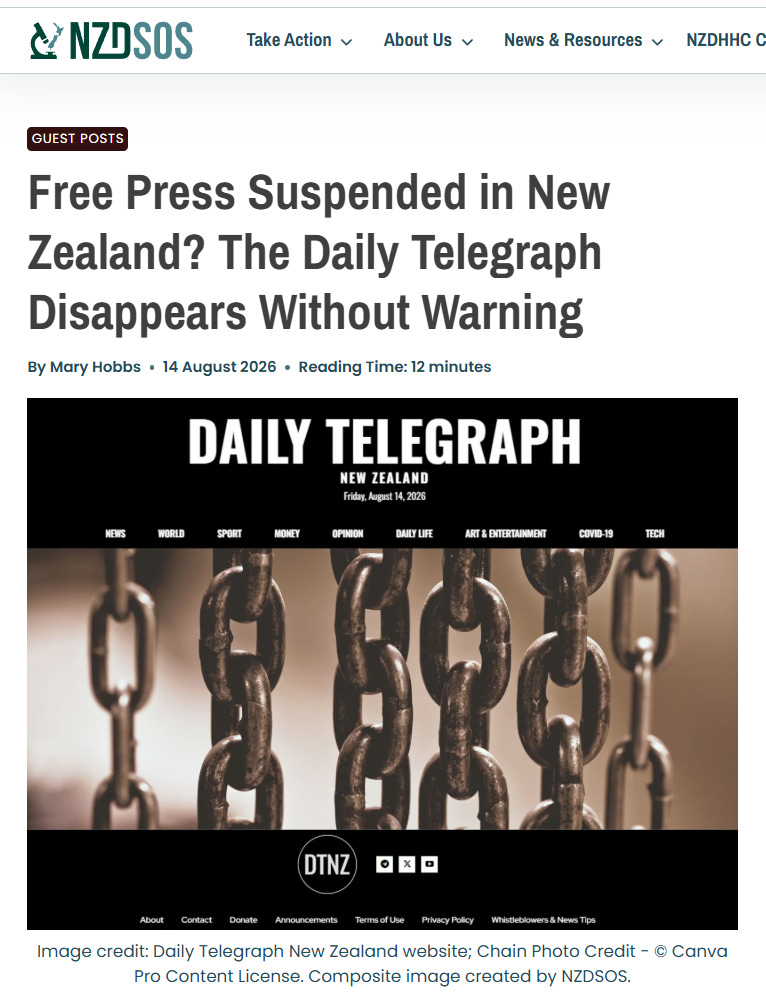
Lost also in the transmission of this ‘Luxon Leadership Laundromat’ was the temporary takedown of the Daily Telegraph New Zealand, an independent online newspaper that was established in October 2021 to fill a gap in media coverage amid the hysteria of lockdowns, the coercion to get a jab, and the societal division inflicted.
This dispatch locates the DTNZ take-down as a small part of the broader operation.
And, as such, this dispatch explores why it is (and was) an error of freedom-oriented people — who were rightly appalled at the two Ardern Coaliton Administrations during the scamdemic, and/or with the wokeness of left-leaning politics — to back NZ First for a right bloc coalition. And, why it’s the logical fallacy of wishful thinking to believe the freedom-oriented minor parties can shift the needle of totalitarianism.
Yet, this dispatch isn’t arguing the efforts of such freedom-oriented minor parties is a waste of energy, time and resources. Nor, are the efforts to agitate for resistance, or to teach on, or work at, re-orienting households, workplaces, clubs, churches, or councils.
The efforts that agitate for a reset of government raises awareness of dark realities, occurring, just as radioing ideas do, to reboot communities with local food security, wise health choices and achievable steps to rebuild household economic resilience.
This dispatch isn’t claiming the current arrangements are the pinnacle of human evolution. Or, that Snoopman has the final read on what’s occurring, or the solutions.
To be super-clear, this snoop-missive is not a sales pitch for a left-bloc either. Lefties often think they have a monopoly on truth, and think their outlook is the correct path.
This mindset is as nauseating as right-wingers, who believe they have a monopoly on truth and also think their worldview is the one right way to live. The subtle trick to divide communities, societies and civilizations with a left-and-right political spectrum, works to operationalize a horizontal protocol. Humans are conditioned to blame the Camp Left or the Camp Right, rather than focus on the vertical protocol.
Hierarchical civilizations rely on poverty and ignorance. The super-rich oligarchs thrive in crisis-ridden societies, while their loyal servants protect them from scrutiny.

The brutal truth is either seen by being open-minded, curious and developing a willingness to de-condition the mind of the sanitized news and current affairs stories.
Like a rude awakening in The Truman Show, when Jim Carrey’s character, Truman Burbank, notices daily patterns. Amidst his growing suspicions that the town in his life has a fakeness, he sees the ground floor lobby elevator he is about to step into, has no back wall. People sitting around on a break like they’re extras, and in a corner, there’s a film light. The building is Omnicam Industries, which is a telling clue, since he lives in a giant studio dome equipped with 5,000 cameras to broadcast his life.
Or, the ruder awakening occurs when the brutal truth whomps people after a crisis hits a community, and later some of the inhabitants slowly realize the inquiry was part of the cover-up. When the facts are laid bare, the performative Sincerity Rituals still don’t explain why exactly the dung-pile of ‘failures’ feel ‘too stupid to be stupid’.
This dispatch in effect peels back the ‘newspapers’ that metaphorically lines the interior walls of ‘Government House’, as if its decorating had been contracted to the Wombles, who’d recycled New Zealand’s ‘papers past’ collection, and pasted them up.
Where The Truman Show is a long-running high-grade American reality television programme capturing the life of a man who has been filmed since he was born, and its serves as a soap opera back-drop to a nation’s mundane daily life, this dispatch reveals an extraordinary thread linking the nation’s daily life to its past, and is written by a man who delivered newspapers when he was a whipper-snapper. On the surface, the second leadership challenge for the top political position of the National Party looked like another party fight, blown out of proportion to stir up website hits, and ratings on the hustings. However, this faux leadership coup occurred against the backdrop of a long-running low-grade civil war featuring the same codified modus operandi, as that present in the so-called leadership challenge of August 12 2026. Some of the nation’s most dramatic news events were staged, and their timing’s were selected to occur on dates that thematically riff off historical events, to signal its secret sponsorship.
This is a unique critique showing why the Luxon Leadership Caucus Vote occurred.
And in doing so, Snoopman makes the case that it is merely one jigsaw puzzle piece in a broader sinister war, that has been stealthily waged on New Zealanders since 1947.
Let Snoopman lay out the elemental parts of this election campaign reset event.
➳ Act I Rising Tension: Performing Democracy in a Cryptocracy
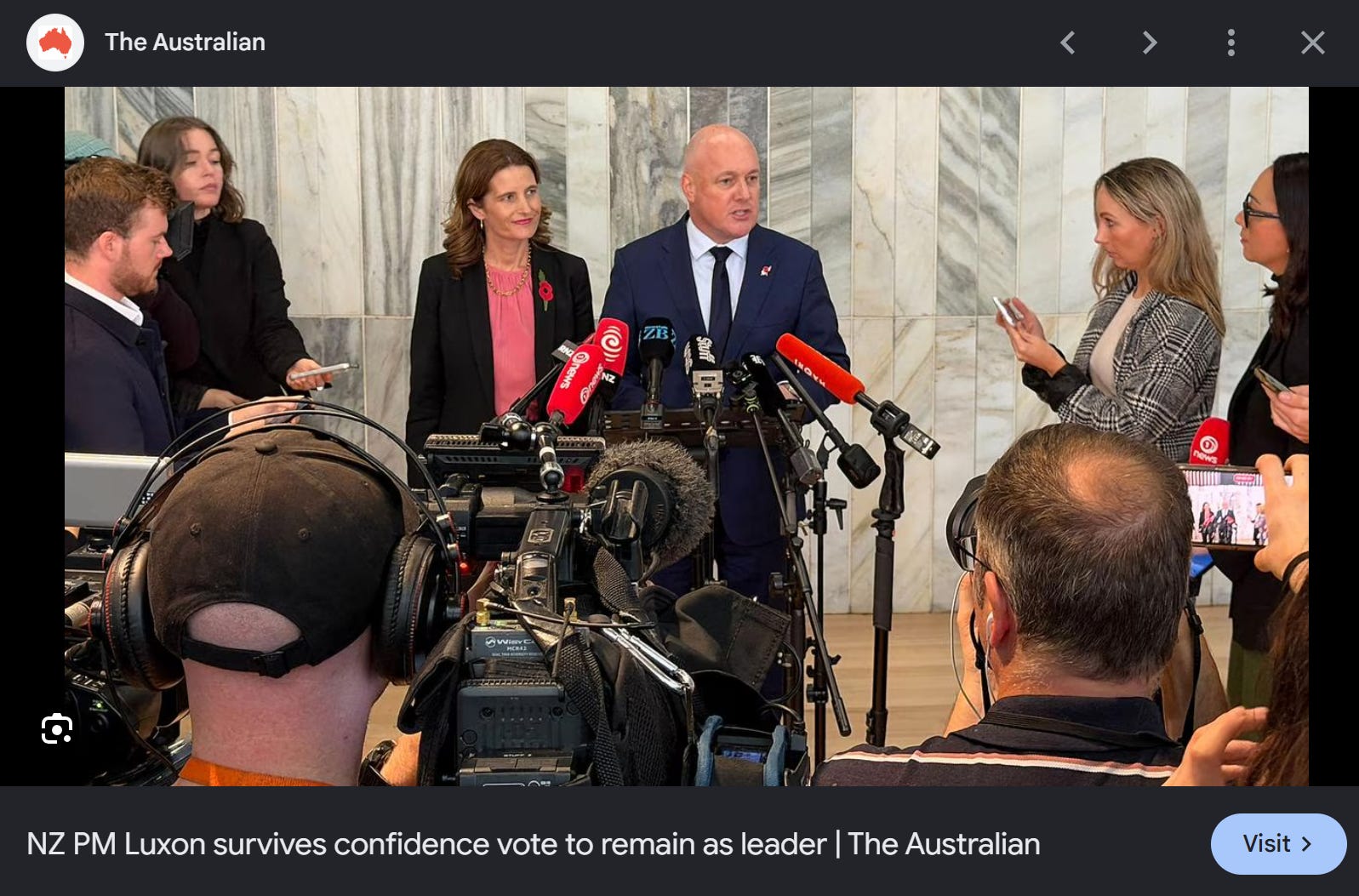
Former Parliament Gallery reporter, Toby Manhire, pointed out this leadership hooplah sequence was like a weird facsimile of the April leadership challenge. Both originated with NZ Herald political reporter, Thomas Coughlan, filing a story about plotters plotting, and triggering a caucus vote, said Manhire on Gone by Lunchtime.
How uncanny that on Friday April 17, the New Zealand Herald’s Thomas Coughlan reported that Luxon faced challenges to his leadership amid flagging caucus support.
What are the odds that this news article landed on same day when the first inter-city brass band contest took place on April 17 1880? From the 1840s the bands of the imperial regiments based in New Zealand’s colonial era provided music for state and civic occasions, vice-regal balls and public concerts. The traditions established by these imperial bands were continued by their Militia and Volunteer counterparts during the N.Z. Masonic Revolutionary War and in the decades that followed, when many military bands were replaced by community bands associated with the fire brigades, trade unions or factories. The military traditions of brass bands in New Zealand are continued today by the popular and versatile Royal New Zealand Air Force Band, New Zealand Army Band, and Royal New Zealand Navy Band.
Ergo, unwitting reporters were recruited into the first inter-city news band contest.
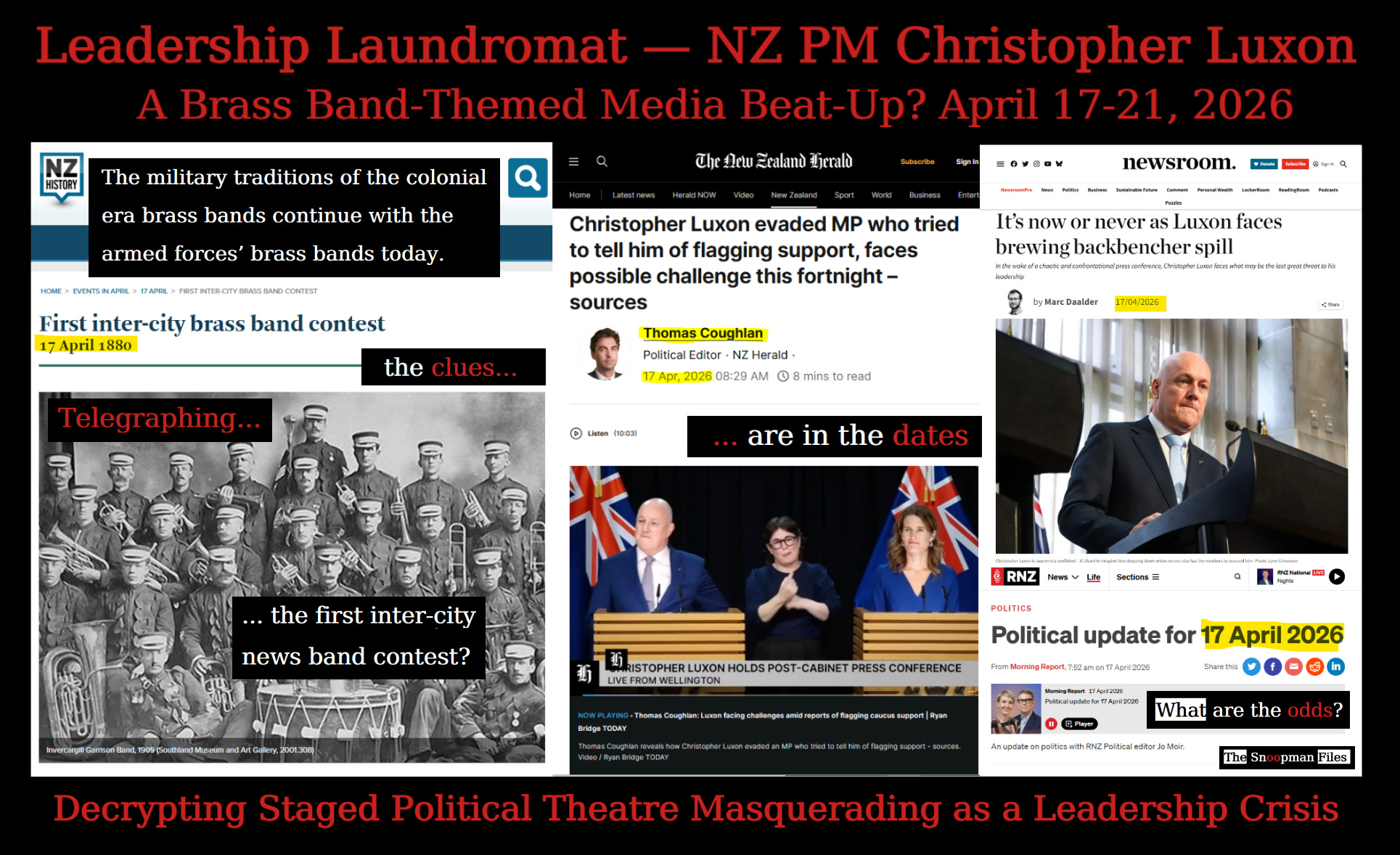
Four days later, Tuesday April 21, Luxon faced off this challenge, in a 27 to 22 vote of National’s MPs. Given this entire Luxon ‘coup’ fiasco was military-themed theater, should we be surprised this caucus confidence vote thematically riffed off the opening of the Court Theatre in Christchurch’s Provincial Council Buildings on April 21 1971?
Potently, as a chess piece the Prime Minister is equivalent to the Queen who directs the whole chess game. The PM-as-Queen comparison highlights the practical political power. The queen is the most mobile and powerful chess piece; similarly, the Prime Minister is head of government, chairs Cabinet, coordinates the government as a whole, and has particular authority over appointment and dismissal of ministers. The Governor-General as the King piece holds supreme authority, performs as head of state on behalf of the reigning monarch, since the English version of the Waitangi Treaty construed the monarch, Victoria, and all her heirs, gained paper sovereignty.
Elizabeth II was born on April 21 1926, and reigned for 70 wrinkle-making years.
How uncanny that during the New Zealand Masonic War of 1860 to 1872, British Lieutenant-General Duncan Cameron arrived in Tauranga with reinforcements on April 21, 1864. This build-up led directly to the brutal Battle of Gate Pā a week later, where a heavily outnumbered Māori force decisively defeated 1,700 British troops despite surviving the heaviest artillery bombardment of the entire colonial war.
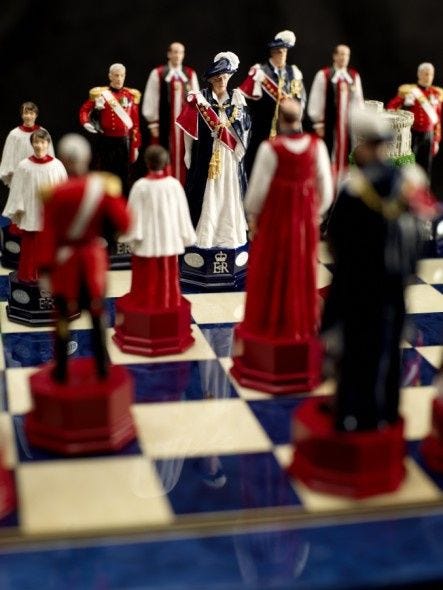
And during the First World War, a domestic war-time crisis peaked on April 21, 1917, when striking West Coast coal miners actively resisted the military conscription laws passed by the government. Prominent national newspapers like the New Zealand Times published fiery propagandist editorials condemning the anti-conscription strikes as unpatriotic, framing the stand-off as a threat to national war-time security. Ahead of an impending workers’ vote the NZ Times editor whined that with jingoist rhetoric:
“Like the Government, every loyal man and woman in the Dominion will be delighted if the miners, by their secret ballot, go back to work. By so doing, they will withdraw their mandate and will demonstrate that they acted without reflection, on bad advice, not realising the gravity of thou offence against the State. Democracy cannot submit to the dictatorship of minorities. Patriotism cannot permit national dishonour.”
And, on April 21 1943, during World War II, the Industrial Manpower Minister announced a targeted financial relief plan to reduce hardship on workers who had been directed to quit unessential jobs and relocate to vital war-production industries.
This news arrived by special cable to the New York Times, printed April 22 1943, on page 9, above a large advertisement for ‘Macy’s — America’s Largest Men’s Store’.
How uncanny that the former Unilever brand manager for men’s grooming products, would — as the metaphorical Queen piece of New Zealand’s political chess board — survive a leadership challenge on such a potent historical-charged day. After all, April 21 1864 was the date when General Cameron arrived at Tauranga with reinforcements during the ‘Tauranga Campaign’, with the mission to defeat the Bay of Plenty Maoris.
And, it was on April 21 1917 that the New Zealand Times reported on the impending secret ballot to be held by striking West Coast miners on the mandated conscriptions.
And it was on April 21 1971, when the Court Theatre opened in Christchurch, the hometown of Chris Luxon, who was born into a Catholic family in Bishopdale.
Ergo, this April 21 theatrical challenge to the Queen chess piece was war-themed. It telegraphed that MMP-style democracy posed threats to the oligarchy, that required coordinated management. Public perceptions had to be curated by limiting the field to a choice of ‘seven fizzy drink’ brand parties, consumable to left or right formations.
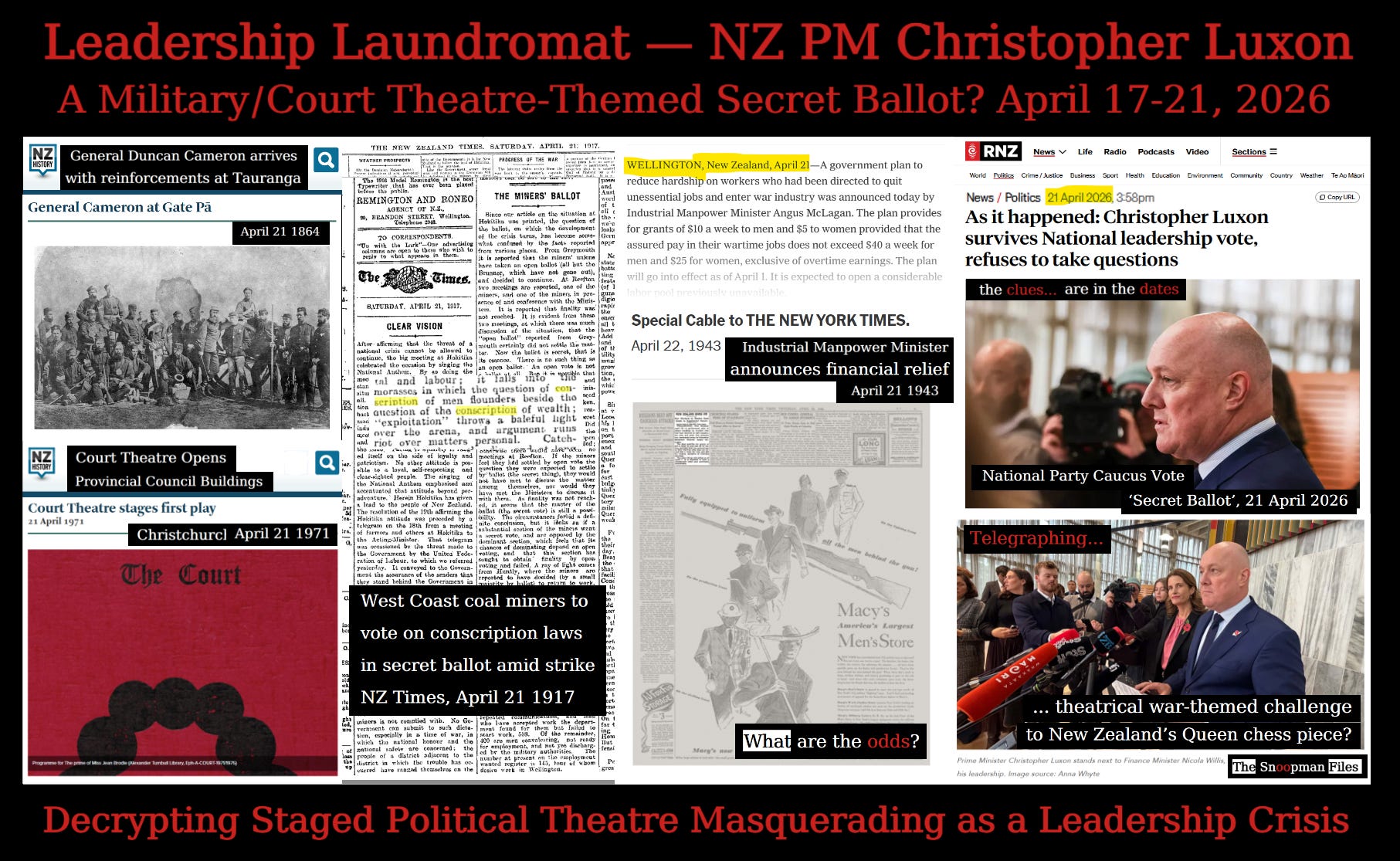
A ‘major trigger’ for the August ‘leadership challenge’ was the controversy stirred by Luxon flying from Whanganui to Auckland on a Royal NZ Air Force plane on the evening of 23 July, after attending a National Party fundraising dinner. But, this use of the eight-seater King Air model NZDF plane was not reported by the news media until August 5. This reportage followed Stuff detailing Luxon’s Air Force ‘frequent flyer’ status. Luxon had also told the Rotorua Business Chamber the Government’s job was to “create the operating system” and “be adult, adult, adult”, while businesses’ job was to “go out there and smack it”. These condescending remarks didn’t land well. Failing to read the room, Luxon said a “parent-child mentality” existed in the board-rooms of New Zealand, where businesses people wondered what the government was going to do, or is thinking, wanting “grant money” from the state. Yet peasants can’t txt him.
The PM also floated the idea of a MMP referendum on radio, which ‘blind-sided’ his caucus. But, because the public doesn’t comprehend that controversy is conjured to manufacture consent of the governed, such subversive penetration rituals work to entrain mass consciousness, as Spinfluence: The Hardcore Propaganda Manual, details.
On July 27, Luxon ruled out Opportunities Party as a coalition contender, posturing that he doesn’t want to prime minister with people who seek to increase taxes.
What are the odds that an Armistice Treaty ended the Korean War on 27 July 1953? The Chinese launched a massive offensive to save the North Koreans from defeat.
The New Zealand Army and Royal New Zealand Navy were heavily involved in both combat and logistics during the Korean War, while the Royal New Zealand Air Force had individual personnel integrated into allied air forces. No peace treaty has been signed and the two Koreas are technically still at war — seventy-three years later.
Ergo, the division between communism and capitalism echoes even as democracies are being stealthily displaced by technocracies, while elections manufacture consent.
On July 29, Don Brash posted a thunk-piece, “My advice for Christopher Luxon: Stand for something” in which he argued that Luxon’s National has created uncertainty over racial division and co-governance. Brash’s think-piece stirred for abolishing Māori electorate seats, and diminishing the Waitangi Treaty in school curricula, how National’s candidates feel free to contradict the party’s ‘supposed policies’. He blamed the Labour Party for its relentless attempts to divide New Zealanders by ancestry.
While Brash said the 2023 vote delivered a mandate to address issues such as inflation, state spending and administrative competence, he didn’t type about how the ‘RichWhites’, as an oligarchy, pull on their co-governance strings from the rafters.
How uncanny that Brash’s Māori-bashing opinion piece would land on the same day July 29, that the Police Red Squad would bash anti-apartheid protesters with brain-banging batons on Molesworth Street, outside Parliament, on July 29 1981, to change their minds about demonstrating outside the home of the South African Consulate. Police were looking to re-assert dominance after protesters had occupied the pitch at Rugby Park, Hamilton on July 25, causing a match against Waikato to be cancelled.
Conveniently, the incumbent National Party Prime Minister Robert Muldoon allowed the South African Springbok Rugby Tour to go ahead, despite the Human Rights Commission pointing out that New Zealand’s hosting of national rugby team from Afrikaner Broederbond’s regime, was a breach of the 1977 Gleneagle’s Agreement, a Commonwealth pact, to which NZ was a signatory. The Old Boys’ Network of the NZ Rugby Football Union, the NZ Police, the National Party and the Beehive closed ranks.
While anti-tour protesters were ‘getting the bash’, New Zealand-born opera star Kiri Te Kanawa sang in St Paul’s Cathedral, London, while Prince Charles and Lady Diana Spencer signed official marriage documents. Muldoon attended the wedding.
The degenerate British Monarchy hasn’t stumped up for redress to Māori. Instead, the Royals have let resentment fester among those New Zealanders, who resent footing the bill for ‘Waitangi Treaty’ settlements, in Crown-controlled drawn-out processes.
Brash’s lobby, ‘Hobson’s Pledge’, opposes legals for schools and boards that teach the Treaty of Waitangi and implement specific Māori worldviews. Hobson’s Pledge wants a cleansed Treaty history to reflect a RichWhite-driven naïve skew that every smurf is treated equally with one rule for all. Yet, the former Reserve Bank Governor — who could be fairly likened to Golem — never says the quiet part out loud about “my precious” in public. The ‘RichWhites’ want to possess ‘one ring to rule them all’.
The Hobson’s Pledge Train hates the New Zealand Wars being taught in schools.
The quiet part is: Māori seats counter the co-governance of the Old Boys’ Network.
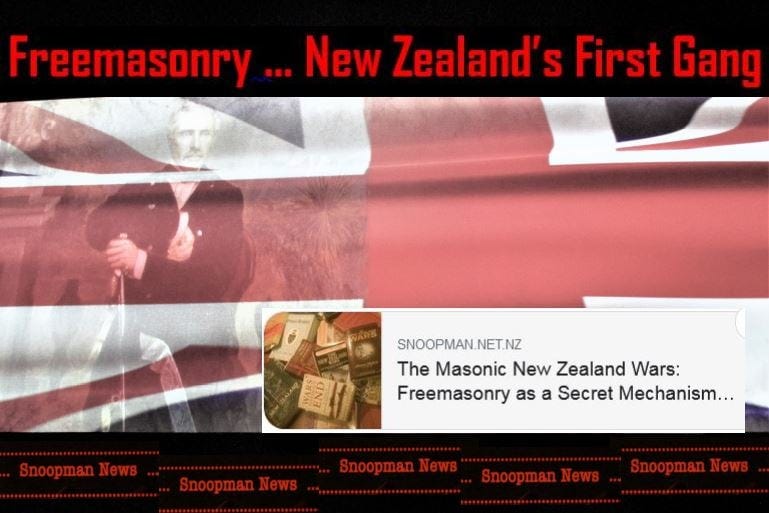
Brash continues to stir about separatism, while deflecting attention from the debt enslavement system that became entrenched during the colonial era once the “hostile Natives” lost the New Zealand Masonic Revolutionary War of 1860 to 1872, thanks in no small part to the Bank of New Zealand raising loans to finance the consolidation.
Given that Brash established the inflation-targetting regime in 1989 during his 14-year tenure as Governor of New Zealand’s Reserve Bank, it’s a bit rich for the former Freidmanite World Bank economist to dogwhistle about separatism. After all, the inflation-targetting regime works as a stealthy mechanism to regulate economic activity by altering the wholesale interest rates (dubbed the official cash rate), which flow onto commercial and retail interest rates. The fluctuating cost of credit determines whether or not businesses, or households or councils will qualify for new loans, or can maintain interest payments on existing ‘loans’. The official cash rate hikes cause job losses, credit crunches for businesses and trigger mortgage defaults.
In other words, Brash assisted the ‘RichWhites’ to re-forge the banking cartel.
Brash blew on his separatist dogwhistle that he’s had since 2004, to signal it was time for another open season of Māori-Bashing, to manipulate the population with the horizontal protocol. With a home-guard of podcasters, the commentariat this election season will mostly steer clear of the vertical protocol, lest the public see the game.
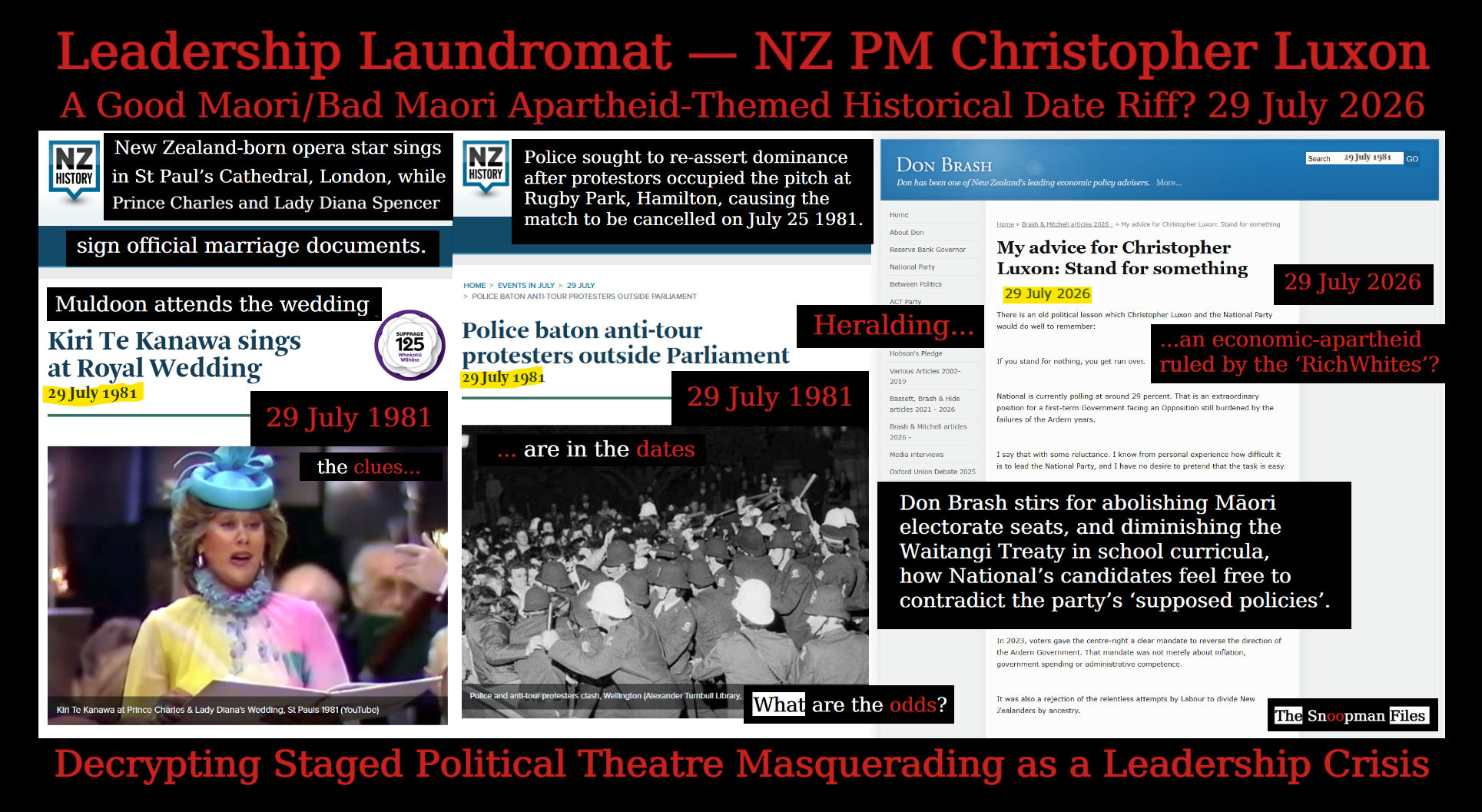
Ergo, with this apartheid-themed riff, this subtextual inversion was a wink to Brash’s dog-whistling about Labour encouraging ‘separatism’, as he would have it, even though he’d assisted to install an economic-apartheid system of the RichWhites. They not only maintain strategic control over NZ’s resources via corporate cartels that dominate every industry. But also through the cryptocracy’s connections that maintain ‘the fix’ across institutions. Brash had, after all, been one of two people, who had invited invited Milton Friedman, who was a co-founder of the Mont Pèlerin Society, for a brief tour to New Zealand in 1981. Bureaucratic mountains could be moved by inflicting ‘shock therapies’ of the kind prescribed by Milton Friedman. The currency trading forged by Alan Gibbs and Don Brash in the early 1970s became the financial warfare mechanism deployed the currency crisis of mid-1984, to stage a political-financial-bureaucratic coup to establishment an ‘elected dictactorship’.
Friedman — who was an economics professor from the Rockefeller founded-University of Chicago — met with Argentina’s dictator, Augusto Pinochet, during a six day visit in 1975. He claimed around the time he was awarded the Nobel Prize in Economics in 1976, that his economics advice was not of a political nature. Friedman neglected to mention that the economic indices measuring high inflation and stagnant activity resulted from the engineered oil price shock that was triggered by the Kissinger-Rockefeller-Bilderberger Nexus to reinvigorate the US currency, with Petro Dollars. Kissinger gamed the Syrians, Egyptians and Israelis into a war.
He engineered the Yom Kippur War of October 1973 knowing the Arab members of OPEC would retaliate, with an embargo, for the United States supporting Israel. This reset in the 1970s was the set-up to drive a world debt crisis to weaken governments, to coerce them to inflict economic treatments to forge a global market super-economy.
Friedman taught his students, dubbed the ‘Chicago Boys’, how to inflict economic warfare and emphasized a concept of ‘speed, suddenness and scope’. His ‘Chicago Boys’, were among the many economic missionaries who spread ‘free market’ shock policies around the world. These economic shock therapies were field-tested on countries such as: Brazil in 1963, Indonesia in 1965, Chile and Uruguay in 1973 and Argentina 1976 using US-backed military violence to destroy the Developmentalist Movement, as Klein described in her book (and later reworked as a documentary).
The perniciousness of the inflation targetting regime is to maintain the economic, political and cultural supremacy of the ‘RichWhites’, who appear bragging in the NBR’s New Zealand Rich List chronicle, and its wealth-porn magazine/newspaper.
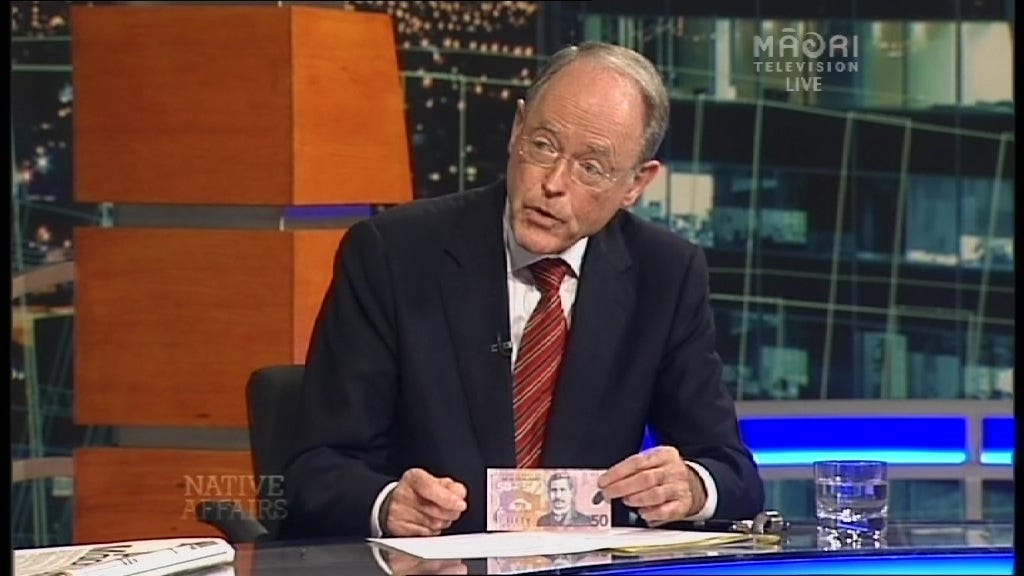
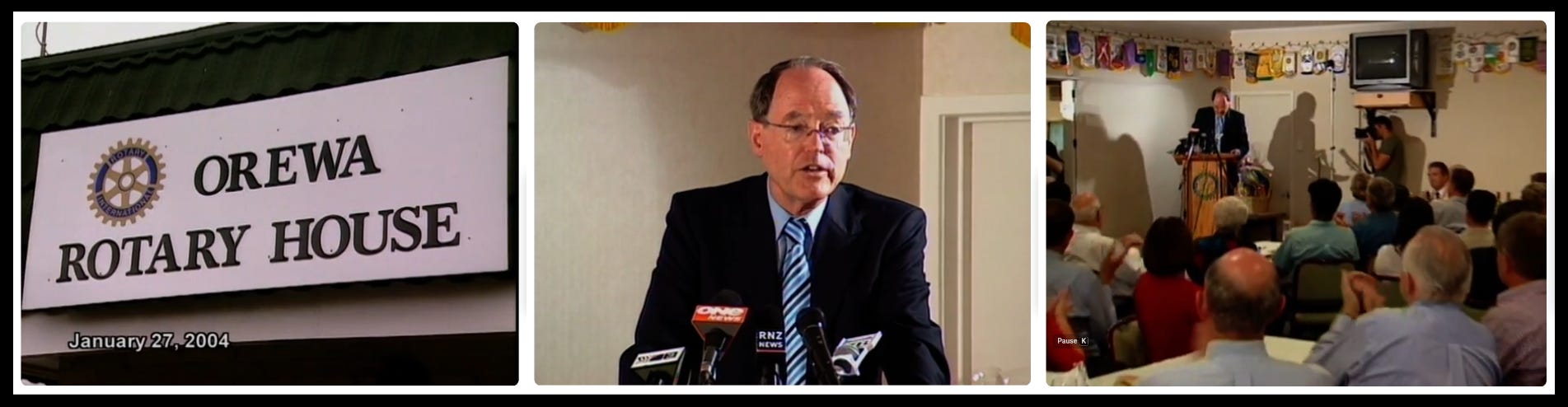
➳ Seguey to Brash’s Orewa Rotary Club Speech, January 27 2004
Brash’s opinion piece echoed the infamous Orewa Rotary Club Speech, performed on January 27 2004, that was primarily written by Peter Keenan, his chief strategist. The speech had Brash claim New Zealand was in a “dangerous drift towards racial separatism”, and an “entrenched Treaty grievance industry” had been constructed. It followed the Clark Government’s move in late 2003 to counter the June 2003 decision of the New Zealand Court of Appeal regarding customary rights to the foreshore and seabed. Delivered on June 19 2003, in Attorney-General v Ngāti Apa [2003] 3 NZLR 643, this landmark ruling over-turned decades of precedent and held that the Māori Land Court had jurisdiction to determine whether areas of the foreshore and seabed had the status of Māori customary land. Consequently, no petroleum block permits were granted in 2004, according to the Goverment’s Petroleum and Minerals agency.
If Māori gained co-governance over the foreshore and seabed, the Crown’s sole sovereign power would be in peril. The issue wasn’t about sun-bathing and swims.
The date June 19 riffed off the sinking of the RMS Niagara off the coast from Breamhead near Whangarei, when the passenger and mail ship struck two German mines on June 19 1940. The sinking of the vessel, which was also carrying gold bound for London, was rude a awakening. The Dominion’s limited sovereignty was in peril. It was also the date when Muldoon released Ron Chippendale’s air accident report on June 19 1980, into the crash of Air New Zealand Flight TE901 on Mount Erebus, Antarctica in 1979. The timing of this report’s release indicated the crash was a takedown by German intelligence, the Deutsche Verteidigungs Dienst (DVD).
In Spyhunter: The Secret History of German Intelligence, Michael Shrimpton stated a small German intelligence ring stationed in Wellington had penetrated N.Z’.s state bureaucracy. The date of the fatal flight carried historic potency for NZ’s flagship air carrier, whose flight crew were not told that Air New Zealand’s navigation section had changed the flight coordinates hours before the fatal flight, on November 28 1979. The crash riffed of the fateful Antarctic expedition of Captain Robert F. Scott to locate the South Pole. One year into their journey, Captain Scott’s team first sighted the Trans-Antarctic Mountain Range last thing at night on 28 November 1911. Where Captain Collins did not sight the mountain looming in front of him due to white-out conditions, Captain Scott, sighted one of the Trans-Antarctic range’s highest peaks.
Reading the runes, the Erebus Crash communicated to Establishment insiders to move bureaucratic mountains for the envisaged trans-corporate heist of the economy, or more mountains could be moved in front of flight crews — any time, any place. The loss of Air NZ’s DC-10 was air terrorism, and served as the catalytic event to jolt the political trajectory of New Zealand onto an accelerated path of techno-feudalism. This techno-feudalist path was part of broader plan hatched by a New York-based think-tank, Council on Foreign Relations. The Rockefeller-dominated policy-shapers produced a blueprint called the ‘1980s Project’, to forge a global super-economy.
Ergo, NZ’s cryptocracy forged a co-governance alliance with the ‘American Empire’.
What d’ya know? There’s themed date-riffing in the Orewa Speech of January 27 2004.
Given that the springboard for Brash’s 2004 speech was the Foreshore and Seabed issue, what are the odds that it was on January 27 1969 when the Maui-l platform, located about 51 km from the Taranaki coast, was spudded in, at a depth of 363 ft (111 m) of seawater? The Maui-l site was found to be a gas condensate- and oil-bearing field. This issue arose after the Court of Appeal’s finding that the Māori Land Court had jurisdiction to hear customary title claims to New Zealand’s coasts and seabed.
And, how uncanny was it that Brash’s 2004 Orewa Rotary Club Speech would also thematically riff off a Pai Mārire ceremony at Tataroa on 27 January 1865? A famous watercolour by Lieutenant Herbert Meade (1842-1868) depicted a Pai Mārire (Hauhau) ritual to decide the fate of Meade and his guide Hemipo during the Second Taranaki War. The movement became a core vehicle for Māori military resistance and political conflict against the British Crown. The ceremonies recorded on this date involved distinct rituals around a niu (pole), symbolizing an intense period of spiritual and armed resistance as Māori sought to reclaim sovereignty and stop colonial expansion.
The ‘Hauhaus’ as they were more commonly known, marched clockwise around the pole while chanting and praying, and as the ritual continued, the pace of the marching increased, and some became dizzy, fell over the ceremony ended. The relative positions of the flags determined whether there would peace or conflict. How uncanny that the Rotary International symbol is a mechanical gear wheel that explicitly represents active industry, continuous effort, and the practical application of service in daily life. With 24 cogs representing the 24 hours in a day, Rotarians are encouraged to daily adhere to the core institutional values, including family, action, friendship, professional ethics, freedom of worship, and the organization itself, that are symbolized by the six spokes. The Center Keyway symbolizes that a gear needs a slot to lock onto a power shaft. To a Rotarian, this central notch signifies they are worker and not an idler, with individual members acting as the driving force that puts the club in motion. The Rotary Club members take turns hosting dinners in their homes, and the members rotate’ around the town, city or district discussing topics.
The location potently played a supporting role the dog-whistling tactic, since it inferred Maori idling, while the ‘Kiwi battlers’ were being taxed to pay for Treaty settlements.
So, Brash seeded hot button topics for Rotary dinner conversations. Where Brash had preached to the Rotary Club members about thresholds of ‘Maori blood’ to diminish a culture’s claims to ethnic-based ‘special priviliges’, the son of Presbytarian minister avoided discussing the NBR’s $50 million threshold to make its Rich List. Māori don’t have engineering consortia interests to be players in oil and gas drilling ventures.
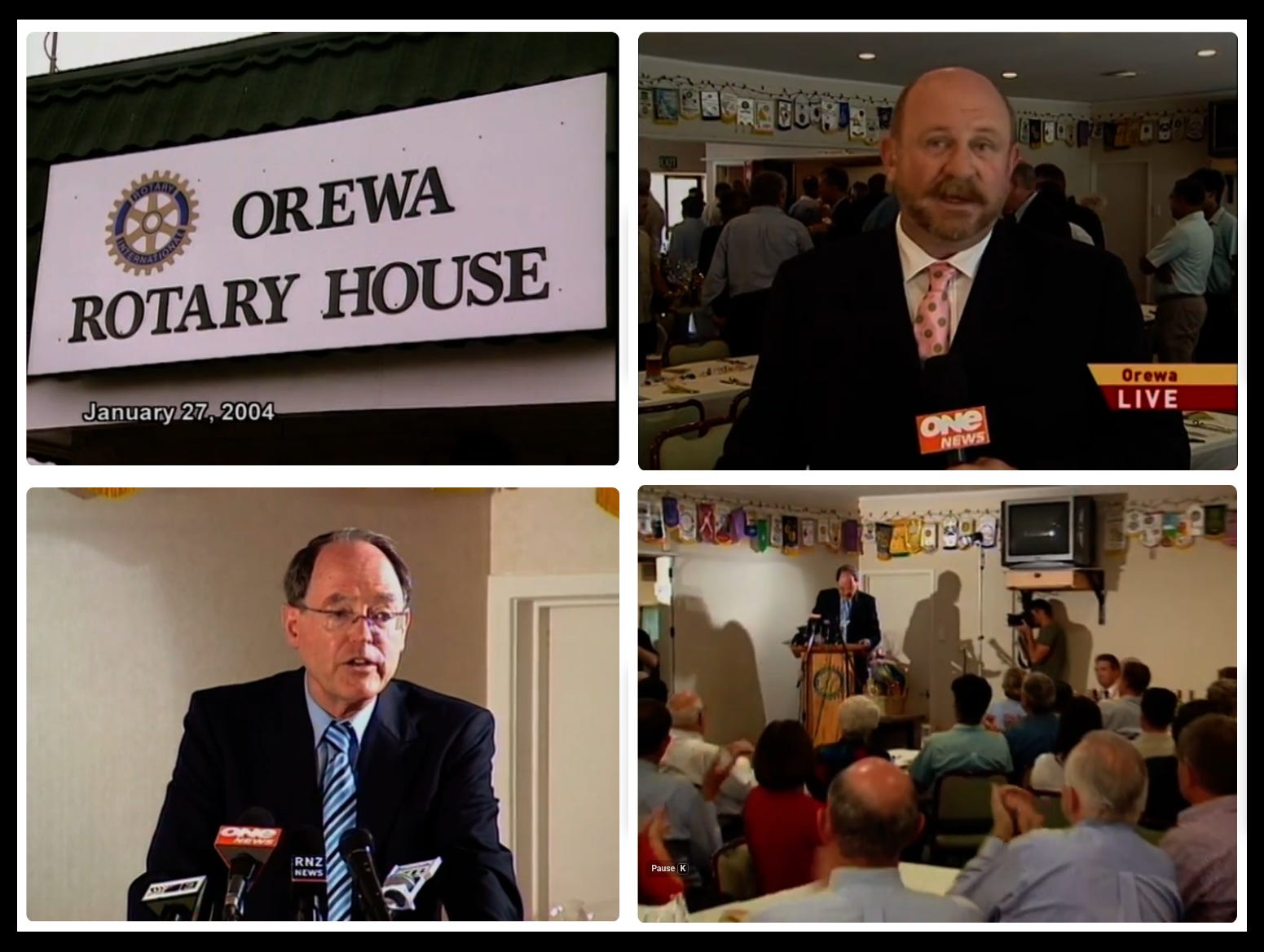
Ergo, Brash’s 2004 Orewa Speech telegraphed that the cogs in Rotary Club members’ brains could be harvested as votes in the conservative membership base of the National Party, with a turn of the center key, as each gear locked onto the power shaft.
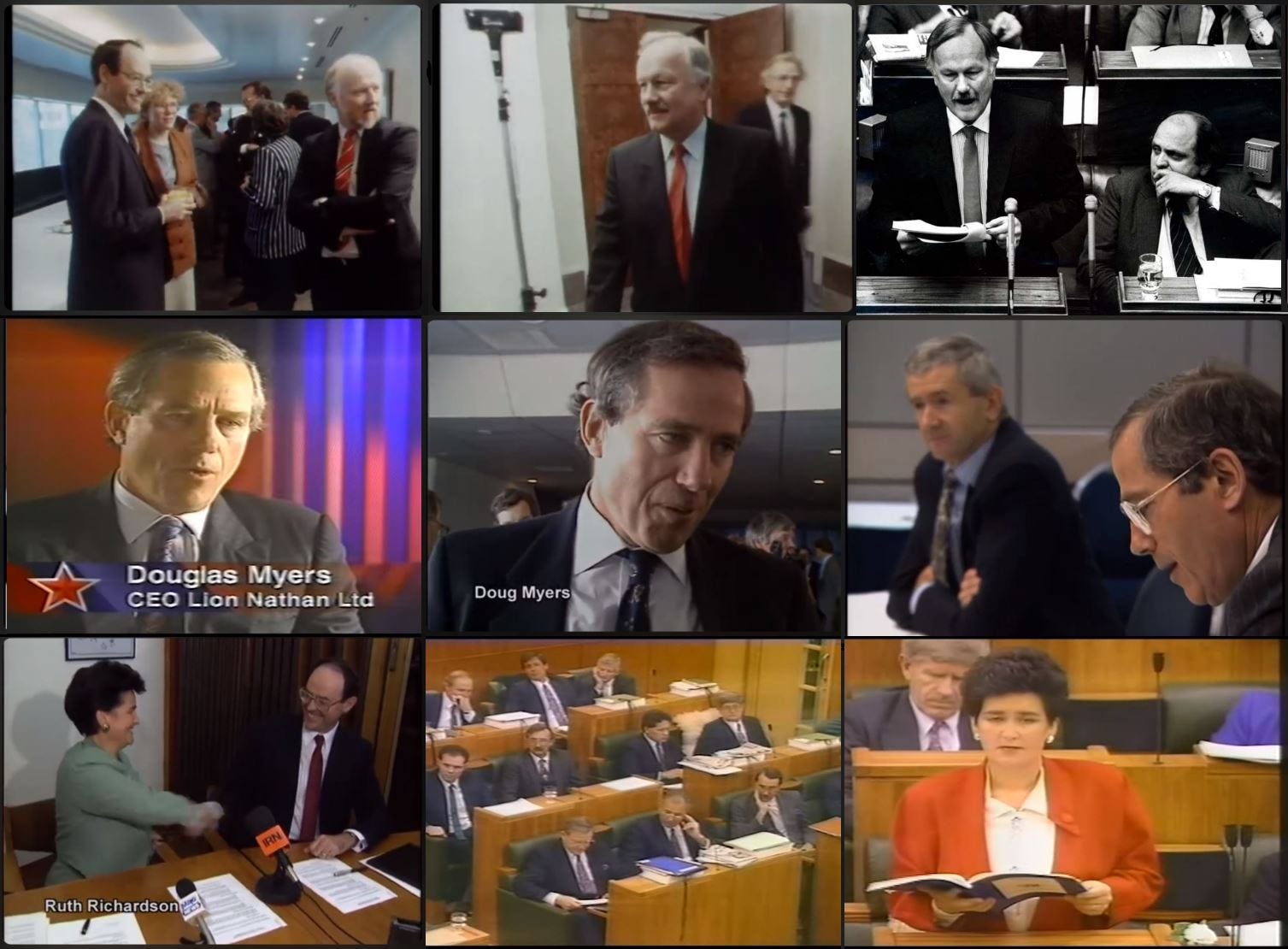
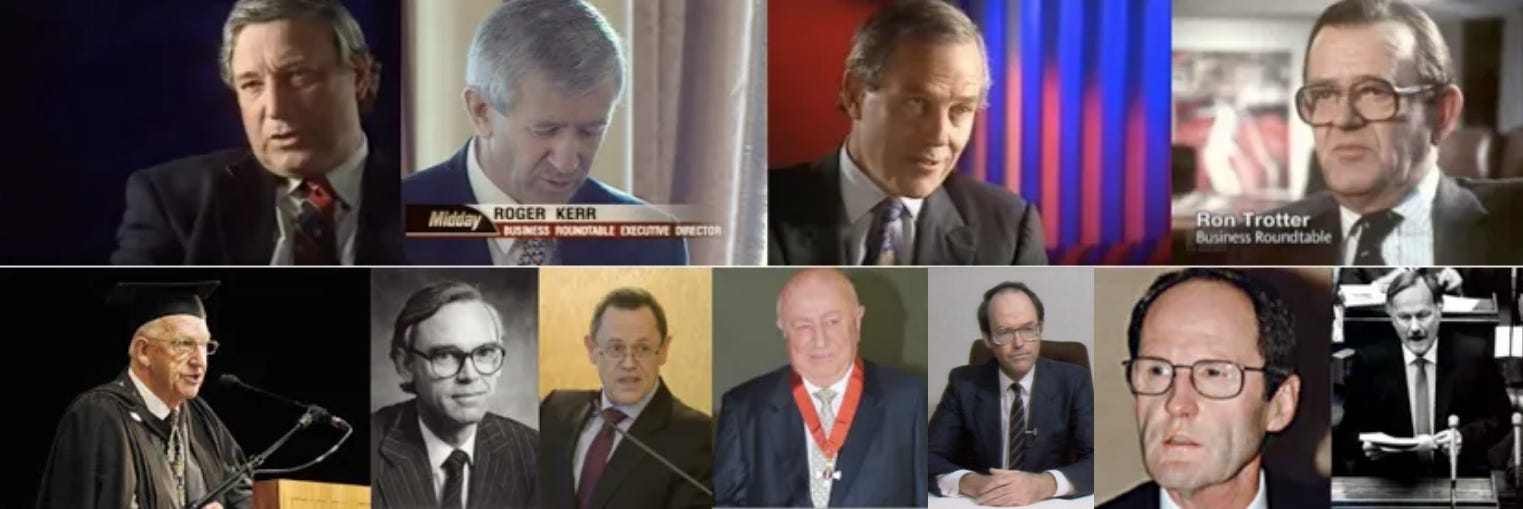
Back when Brash was National’s leader, and his finance spokeman was John Key, their prospective financial backers for the 2005 election were Alan Gibbs, Rich Lister, former chairman of ForestCorp and Electricorp; Douglas Myers, Rich Lister and former Business Roundtable Chairman (1990-1997), Roderick Deane, former Reserve Bank Deputy Governor, former Chief Executive of Electricorp and Telecom; and Diane Foreman, Rich Lister, who owns private hospitals with Healthcare Holdings.
Before Don Brash was appointed as Reserve Bank Governor (1988-2002), he was one of Roger Douglas’s advisors on free market ‘reform’, or policy shocks. As such, in 2004, as the Leader of National Party, Dr Brash underwent a RichWhite’s transition therapy to become the nation’s leading brash Māori-basher. Since then, Māori-bashing has been a regular feature of electioneering campaign politics for right-wing parties, lobby groups and their astro-turfed networks, that had receded to the margins when Robert Muldoon lost power in 1984. Yet, Māori have been a perennial scapegoat since 1840.
➳ Back to Act I Rising Tension: Performing Democracy in a Cryptocracy
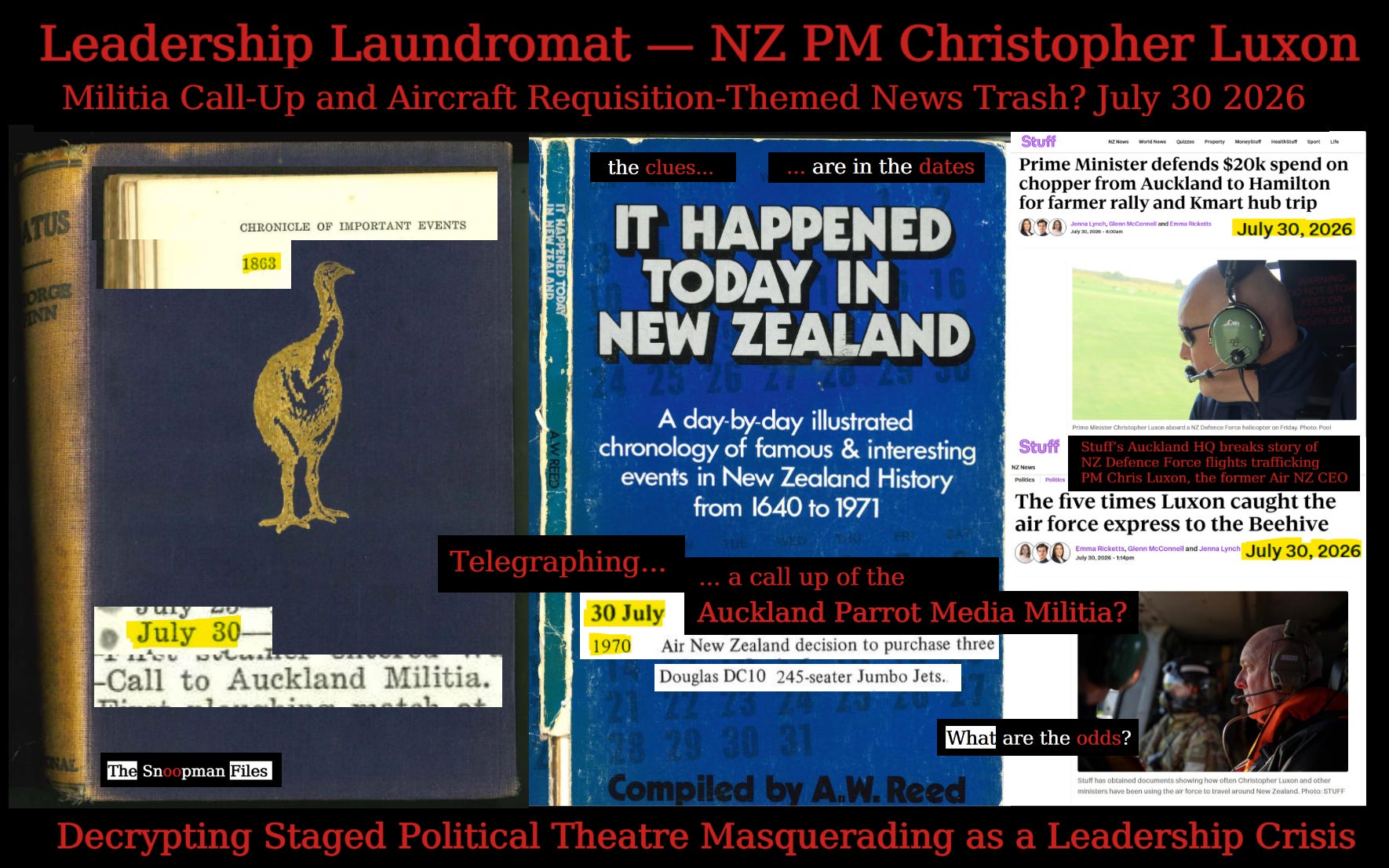
On July 30 2026, a newspaper pimping wares called Stuff, reported on numerous flights that Luxo had taken on the Royal New Zealand Air Force’s planes and choppers.
Amid the Luxon-led austerity measures, Luxon’s Air Force flights on the tax-dime are an easy target for reporters, who know politicians have become poll-driven reef fish.
Initially, Luxon had said on radio that he had a tight schedule following ‘a meeting’, and so he took a flight from Whanganui to Auckland on an Air Force plane. It turned out the Luxon attended a National Party fund-raiser at the Whanganui Golf Club. Reporters claimed they noticed Golf Club paperwork, applying for a special liquor license for July 23, and a big booze order. Hardly Hardy Boys, or Nancy Drew stuff.
How uncanny that on July 23 1847, the Imperial Government passed the Colonization Act that endorsed the New Zealand Company’s settlement plans with a loan. Ergo, this fundraiser riffed off the history of the colonization company that forced the Imperial Government’s hand to go-around Parliament and get Buckingham Palace to authorize an usurpation of sovereignty by multiple pieces of paper, while the Waitangi Treaty would be construed as the proof that ‘the natives’ signed away chieftainship.
And, that a Colonization Company needed a state-backed loan to back its operations.
The New Zealand Herald reported the same morning, July 30, that the Prime Minister defended two defence force flights between Auckland and Hamilton that cost $20,000.
How uncanny that the former Air New Zealand CEO would be publicly embarrassed on July 30 2026, for being a frequent flyer on the ‘Air Force Express’, given it was on July 30 1974 when Air NZ’s board decided to buy three Douglas DC-10 ‘Jumbo Jets’.
And, what are the odds that the Auckland Militia was called up on July 30th 1863, to serve in the Waikato War, following a skirmish on July 17 at Koheroa Ridge, east of modern day Mercer, between British troops and Māori who were regarded as “insurgent Natives” for failing to pledge allegiance to a Hanoverian Queen: Victoria.
Ergo, the Stuff News headquarters on Williamson Ave, in Ponsonby, Auckland, in effect, called up the Auckland Parrot Media Militia where NewtalkZB, the NZ Herald, RadioNZ, TVNZ, Māori Television, the Newsroom, and the Spinoff, all have newsrooms.
Luxon said he had to get back to Auckland because he was attending Bill Birch’s funeral the following day. This meant the Prime Minister’s scheduled breakfast and Q&A hosted by a Tier-1 law firm, Simpson Grierson, was pushed forward to 7:30am.
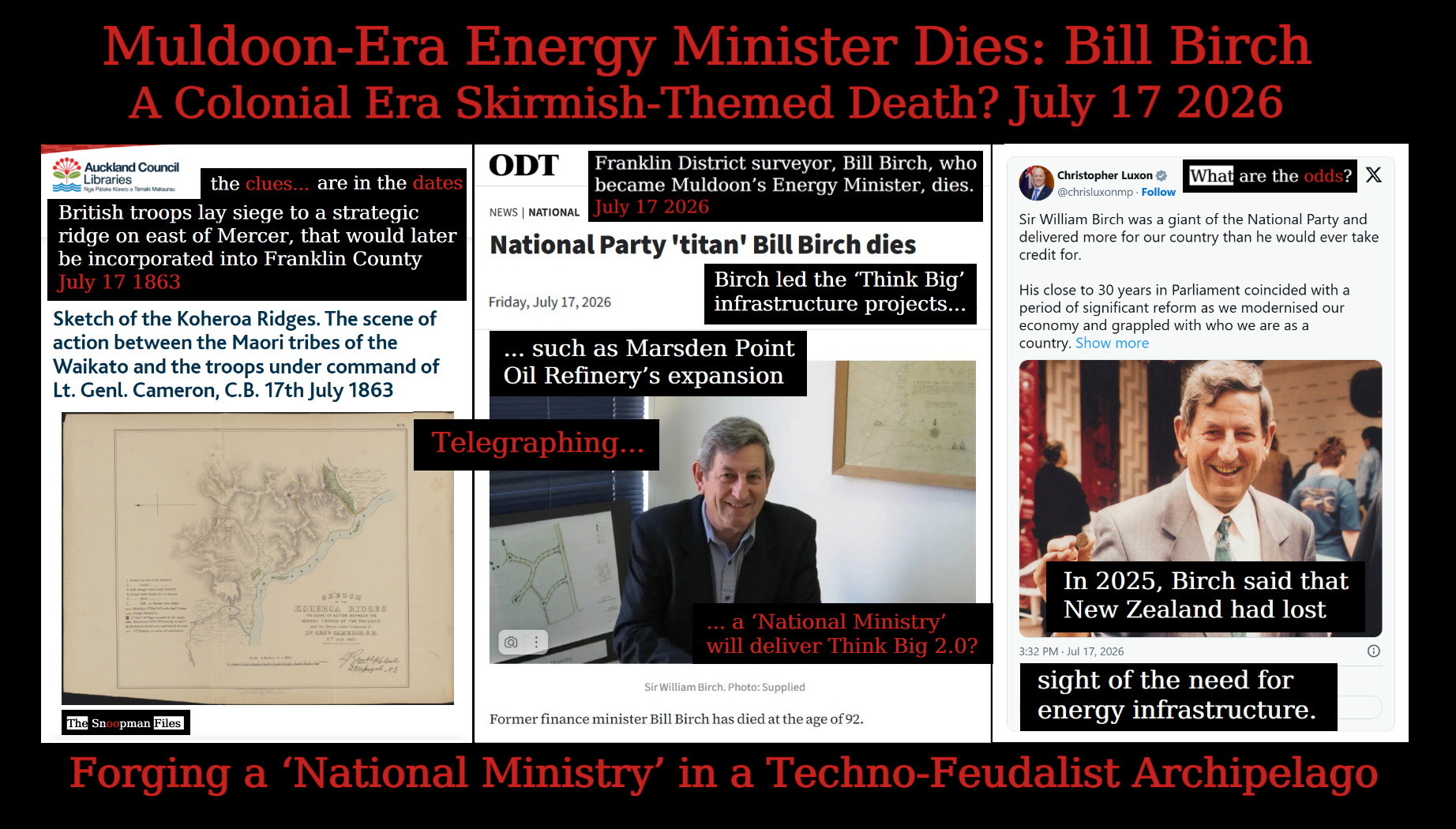
The funeral took place in Pukekohe at 11am, July 24. Birch had been deputy prime minister to Jim Bolger, for whom he had organized the rolling of Jim McClay, in order to clear the way for Bolger to become Prime Minister in 1990. When Jenny Shipley rolled Bolger in late 1997, she kept Birch as Finance Minister to calm the markets, but soon fired Treasurer Peters. Birch said in an interview in 2025 that New Zealand had lost sight of the need for energy infrastructure. He died on July 17 2026, aged 92.
What are the odds that the MP for the Franklin Electorate Seat would die on the same day, when British troops laid siege to a strategic ridge on July 17 1863, east of Mercer, that would later be incorporated into Franklin County? A bayonnet charge ensued, causing 15 Māori deaths, including Chief Te Huiranga, in what were the first engagements in the invasion of the Waikato. Koheroa Ridge became part of Koheroa Parish, and eventually Franklin Country, in turn, Franklin District, where a young Bill Birch was running a successful surveying business, when he was talked into politics.
Amidst the present geopolitical shifts, its potent he was appointed as energy minister in 1978, and soon after the Iranian Revolution erupted leading to an oil price crisis.
Ergo, this ritualized political theater was about valuing human bonds, against the backdrop of geopolitical shocks featuring high fuel prices, debt stress, and war drums.
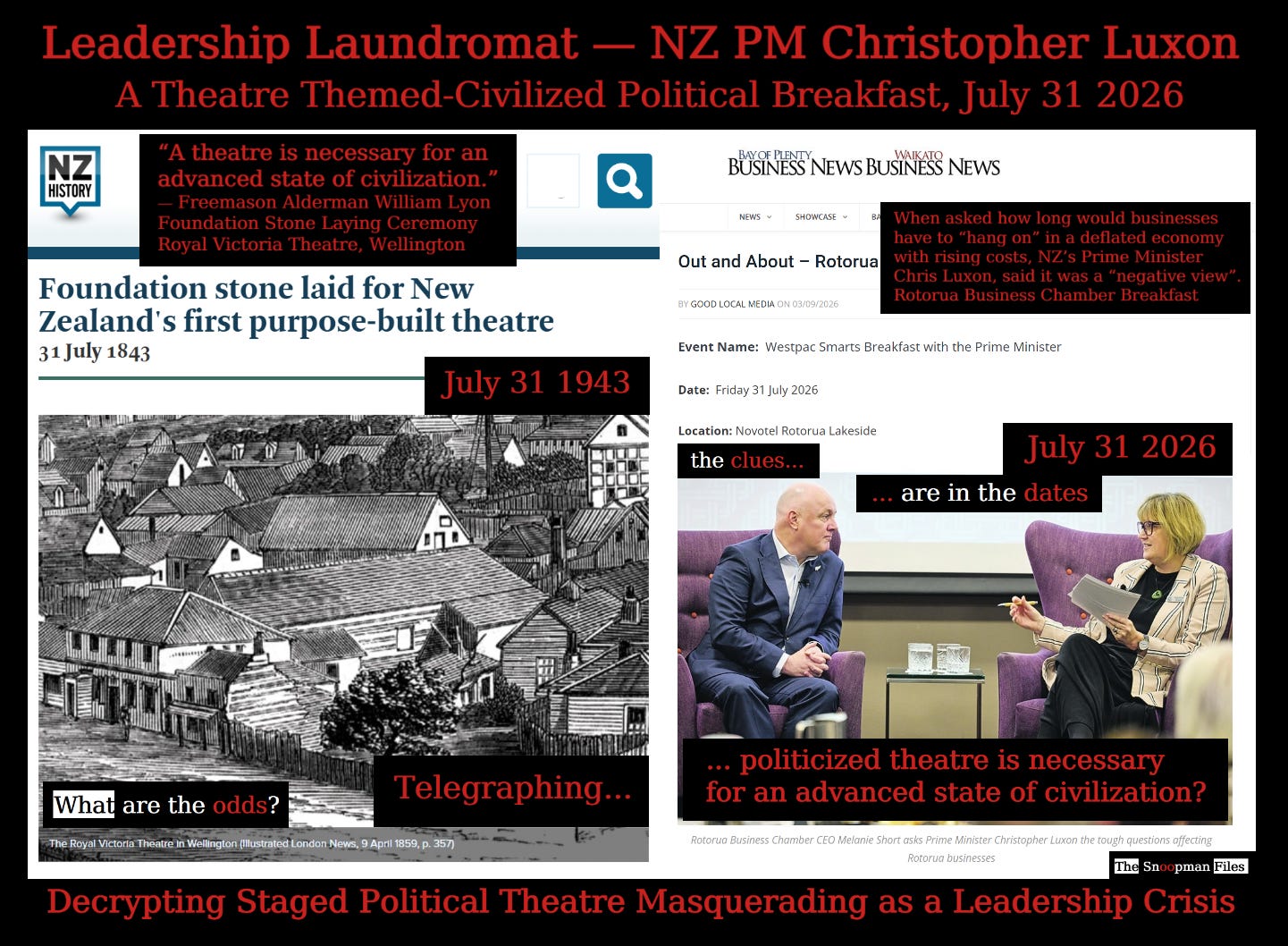
On July 31, Luxon remarks to members of the Rotorua Business Chamber Government’s did not land well. The Prime Minister had said there’s a “parent-child mentality” in New Zealand where businesses were looking for Wellington’s hand-outs.
Luxon was asked how long businesses would have to “hang on” in a deflated economy.
Given the fact that everyone with an IQ above 20 except PM Chris Luxon, can see that New Zealand is in a deep economic crisis, no thanks due in no small part to two-and-a-half years of Ardern’s medical martial law, and then his Conveyor Belt Coalition inflicting the banksters’ rinse and riff austerity, LuxoMan was viewed as ill-mannered.
What amazing synchronicity that the leading politician from Wellington would gaff his lines with an ill-mannered tone deafness, given that it was on July 31 1843, that the foundation stone was laid for New Zealand’s first purpose-built theatre on Manners St, Wellington. When Freemason Alderman Bro. William Lyon laid the foundation stone for the Royal Victoria Theatre, he welcomed the new amenity saying “a theatre [was] a necessary concomitant of an advanced state of civilization.”
Ergo, the ongoing staged theatrics were necessary to advance the state of civilization.
Naturally, the media fed on the controversy over the Rotorua Business Chamber event.
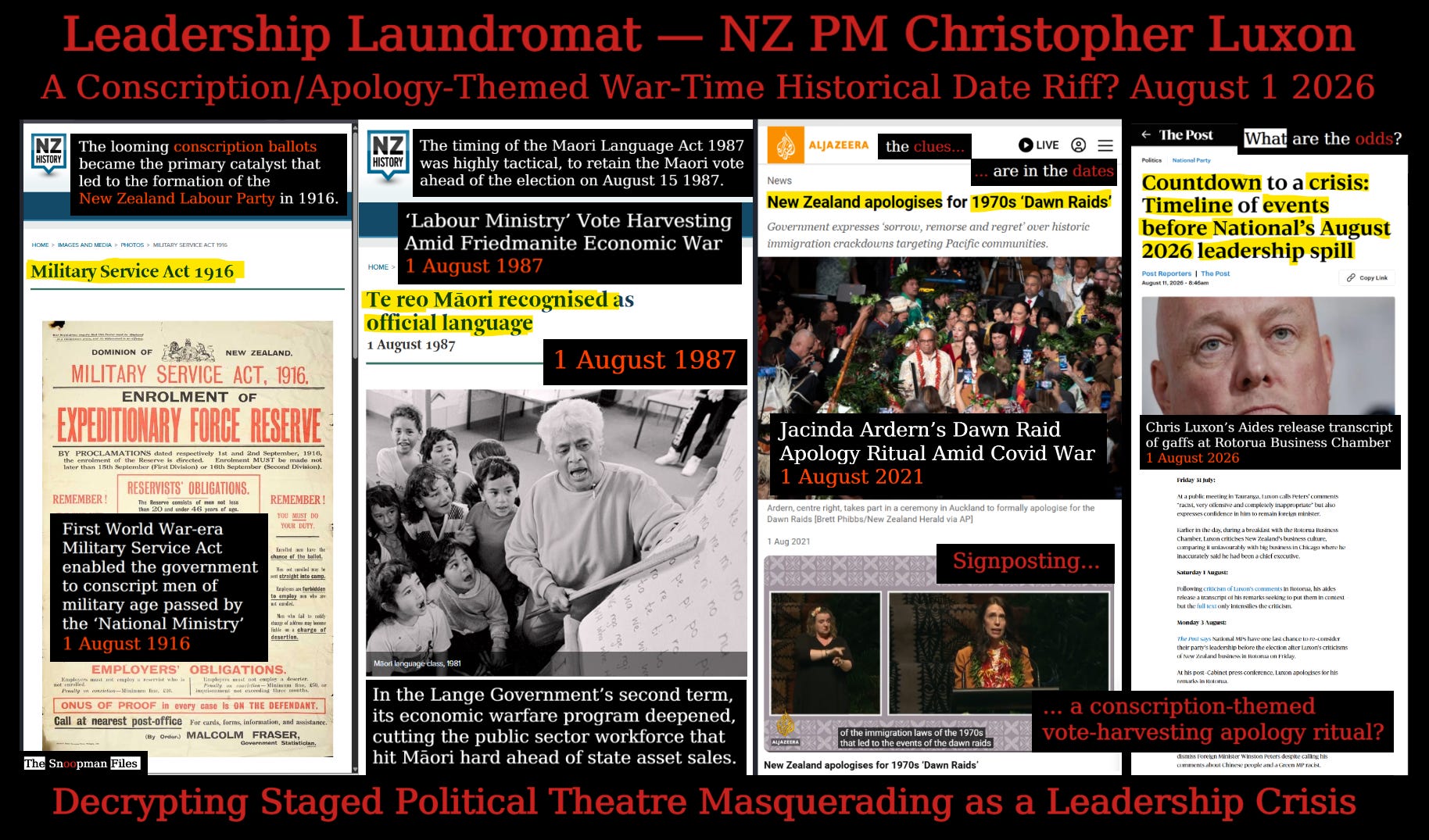
On August 1 2026, Luxon’s aides released a transcript to provide context, supposedly in an attempt to clarify his comments via this official transcript, but it had the effect of ‘misfiring’ and fueled intense media scrutiny. The intensified criticism laid the groundwork for a staged ‘leadership crisis’ and a caucus confidence vote on Aug. 12.
How uncanny that it was on August 1 2021 when Jacinda Ardern as Prime Minister, apologized to the Pasifika community for the Dawn Raids of the 1970s. ‘Islanders’ were rounded up for ‘overstaying’, and blamed for the economic crisis including high unemployment. A 1986 report found that while Pacific peoples comprised roughly a third of overstayers, they represented 86% of prosecutions. During the same period, overstayers from the United States and Great Britain, who also comprised roughly a third of overstayers, made up only 5% of prosecutions. The dawn round-ups with vans include carnage stories of deported parents separated from their children, who were placed in state care homes. During a timely respite of the corona-variants’ marauding antics, Pasifika peoples gave their testimonies in July 2021 during a special session at Abuse in Care Royal Commission of Inquiry. They spoke about the traumas of institutionalized abuse, including violence, sexual molestation and identity erasure.
Performed at Auckland’s Town Hall, Ardern’s ‘apology ritual’ was accompanied by formal reconciliatory gestures, including educational scholarships and funding for Pacific communities. This apology thematically riffed off the day August 1 1987, when Te Reo Māori became an official language New Zealand, helping reverse its decline, ahead of the 1987 election on August 15. The timing of the Maori Language Act 1987 was highly tactical. Lange’s Labour Party needed to hold the line to prevent Māori voter defections and abstinations. This political chess move, along with widening the Waitangi Tribunal’s mandate to consider historical claims, was part of a broader damage-control strategy to pacify a crucial, traditional Labour voting base that was about to be devastated. Because Māori were disproportionately employed in state sectors like forestry, railways, the post office, and the Ministry of Works, widespread fears of catastrophic job losses were rampant on the campaign trail. Lange performed a ‘Two-Track’ Lie tactic, in which he essentially manipulated voters to trust that the painful economic “restructuring” as a necessary evil to pay for a fairer, culturally inclusive New Zealand. However, following deep cuts to the corporatized state-owned enterprises, stunning sell-offs of state assets ensued, including New Zealand Rail, Telecom, ForestCorp, Electricorp, Air New Zealand, New Zealand Steel, PetroCorp, Development Finance Corp (DFC), and the Bank of New Zealand. The passage of the Maori Language Act 1987, bought Labour the time it needed to unleash economic reforms that would see Māori unemployment soar to 25% within five years, in 1992.
Jabcinda’s emotionally-hijacking faux apology was performed two weeks ahead of throwing the country back into a lock-down amid poor uptake of Pfizer’s sapiencide.
The timing of Ardern’s faux apology on August 1st 2021 a historic charge not because her father as a police officer participated in the Dawn Raids. But also, because the passage of the Military Service Act on August 1st 1916, a law that empowered the government to introduce conscription ballots, became the primary catalyst that forced the rival moderate and militant socialist factions to finally unite to form the New Zealand Labour Party in mid-1916. Thus, Ardern’s ‘Labour Ministry’ manipulated their constituent Pasifica Leaders to assist with conscriptions to fight the ‘covid war’.
Ergo, an apology ritual was telegraphed over Luxon’s “foot in mouth disease”, when speaking to the business community in a city that was once NZ’s tourism capital.
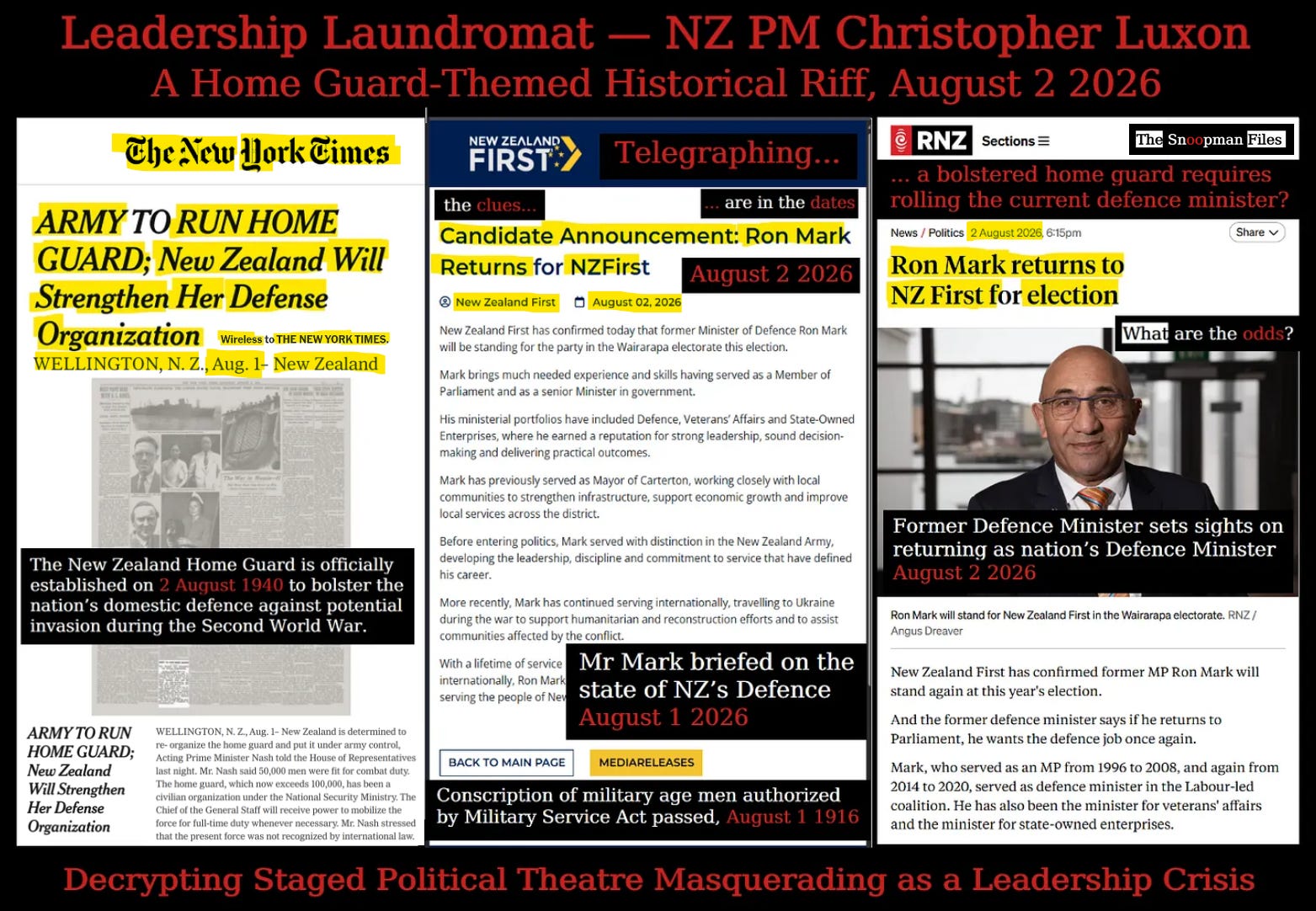
On August 2 2026, New Zealand First Party announced the return of former Defence Minister, Ron Mark, as a political candidate. This news was confirmed by the New Zealand First Party leader, Winston Peters, during a public meeting in Masterton.
How uncanny that this August 2nd announcement about the former Defence Minister throwing his hat in to the political ring, would occur given that the New Zealand Home Guard was officially established on August 2nd 1940, during the early stages of World War II, to bolster the nation’s domestic defense against potential invasion.
Mark told former 3News political editor Duncan Garner that he had made his mind up to return to politics on Saturday August 1, when briefed on the state of NZ’s Defence.
Poignantly, one year after the National Security Ministry established the Home Guard and had recruited over 100,000 men, it was on August 1 1941, when NZ’s Acting PM Mr. Nash announced the Army’s Chief of the General Staff would gain the authority to mobilize the force, to align with internation law, reported the New York Times.
What are the odds that the First World War-era Military Service Act — which enabled the government to conscript any man of military age (20–45 years) for service in the New Zealand Expeditionary Force (NZEF) — became law on August 1st 1916?
Ironically, the New Zealand Labour Party was founded specifically to present a unified front against the war-time coalition government’s plans to pass conscription laws.
Mr Mark told Radio NZ the post of defence minister would “without a doubt” be on the table for any coalition negotiations. Mark said nation’s Defence Minister, Chris Penk, was a “damn good man,” but “you can’t win and be a nice guy”.
The Defence Forces had suffered from attrition rates, since the staged Great Corona Cult Crisis, which included long periods of pointless guard duty at hotels that were transformed into quarantine facilities, as if the nation had become a screen location for filming Sleeping Dogs II. Moreover, many quit to avoid taking the ‘clot shots’.
Ergo, a home guard-themed reset for the realm’s defence was telegraphed by the matrix code. And, LuxoMan’s Defence Minister would be gone-burgers by lunch time.
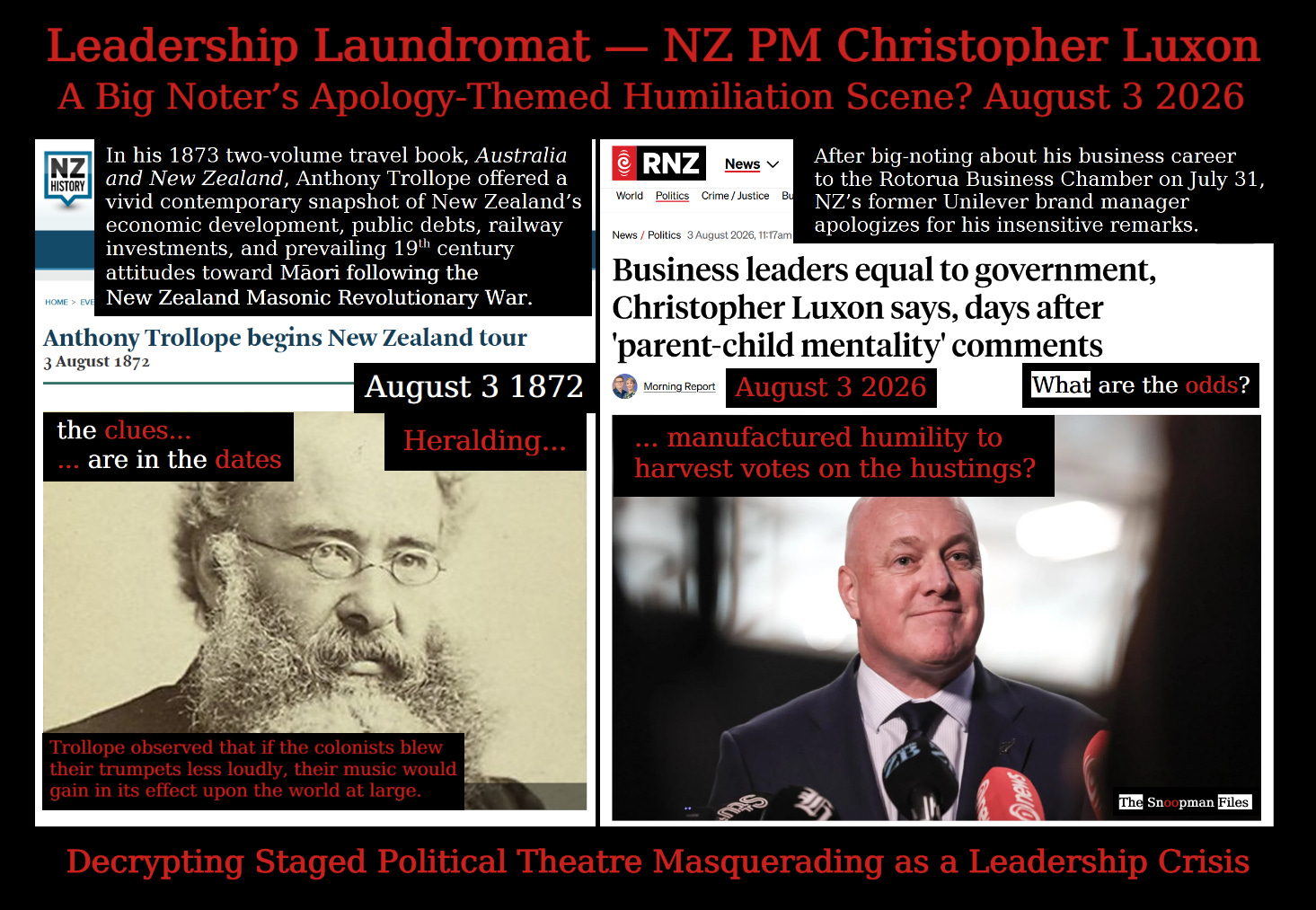
On August 3 2026, at a Monday morning Beehive press conference, Luxon apologized for his gaffs spoken at the Rotorua Business Chamber. Luxo’s amusing gaffs included the parent-child remark. This parent-child framing wasn’t the first time he had said it, according to Trish Sherson, director of Sherson Willis, a corporate affairs firm. She said Luxon never had a corporate job where he had to personally mind the firm’s cash-flow the way that a small enterprise owner has to do everyday, to prevent strife. Former Greens leader, Russell Norman, noted the irony in Luxon’s remarks. Air N.Z. was twice bailed out by the state, after it bought Ansett and with the onset of a ‘virus’.
How uncanny that Luxon would find himself apologizing on August 3, for gaffs that any advisors could have picked up earlier, since it was on August 3 1872 that Anthony Trollope, the British novelist, arrived at Bluff on a visit to New Zealand. What better way to showcase to the West’s liberal democracies about the need to form a ‘National Ministry’ out of the cauldron of a tough election campaign, than to stage a faux leadership challenge three months out from polling day in an isolated archipelago?
After all, Anthony Trollope’s arrival at Bluff on August 3 1872, marked the start of his crucial two-month tour of New Zealand. As one of the Victorian Era’s most famous novelists, his journey resulted in his 1873 publication of Australia and New Zealand. Trollope’s two-volume travel work offered a vivid contemporary snapshot of New Zealand’s economic development, public debts, railway investments, and prevailing 19th-century attitudes toward Māori following the NZ Masonic Revolutionary War.
The date meta-data indicates a manufactured humility ritual to harvest votes on the hustings, since the cauldron of political theater would up the ante for the right bloc.
After all, dirty politics tends to switch off young people and left wing voters, as Nicky Hager wrote in his 2014 Dirty Politics, which exposed John Key’s political wolf machine that outsourced attacks to right-wing bloggers. This way, Key could rule Middle New Zealand as the Lord of the Selfies, while pretending to be Mr Nice Guy. On the hustings in 2026, the dirty political attacks are originating from the cryptocracy, to shift the political center of gravity farther to the right and upward, without the public, or parliament’s press, or any political commentators realizing what is happening. But, they aslo need National to win 38 candidate seats, this being the maximum number.
Ergo, to borrow Trollope’s observation about the colonists, if LuxoMan blew his trumpet less loudly, the music would gain in its effect upon the world at large.
On August 4, Stuff followed up with an article headlining the irony, “PM took Defence Force plane to Air NZ-sponsored tourism conference”, that detailed the expensiveness.
Also on August 4 Ryan Bridge asked his ‘political panel’ if Luxon would be National’s leader at election time. Willis and Norman answered yes. Sticking with the war-time coalition party theme, it’s significant that it was on August 4 1914, when ‘Great Britain’ entered the war after Germany invaded neutral Belgium. Because New Zealand was a self-governing Dominion of the British Empire, Britain’s declaration of war on Germany at 11:00 p.m. (London time), automatically included New Zealand.
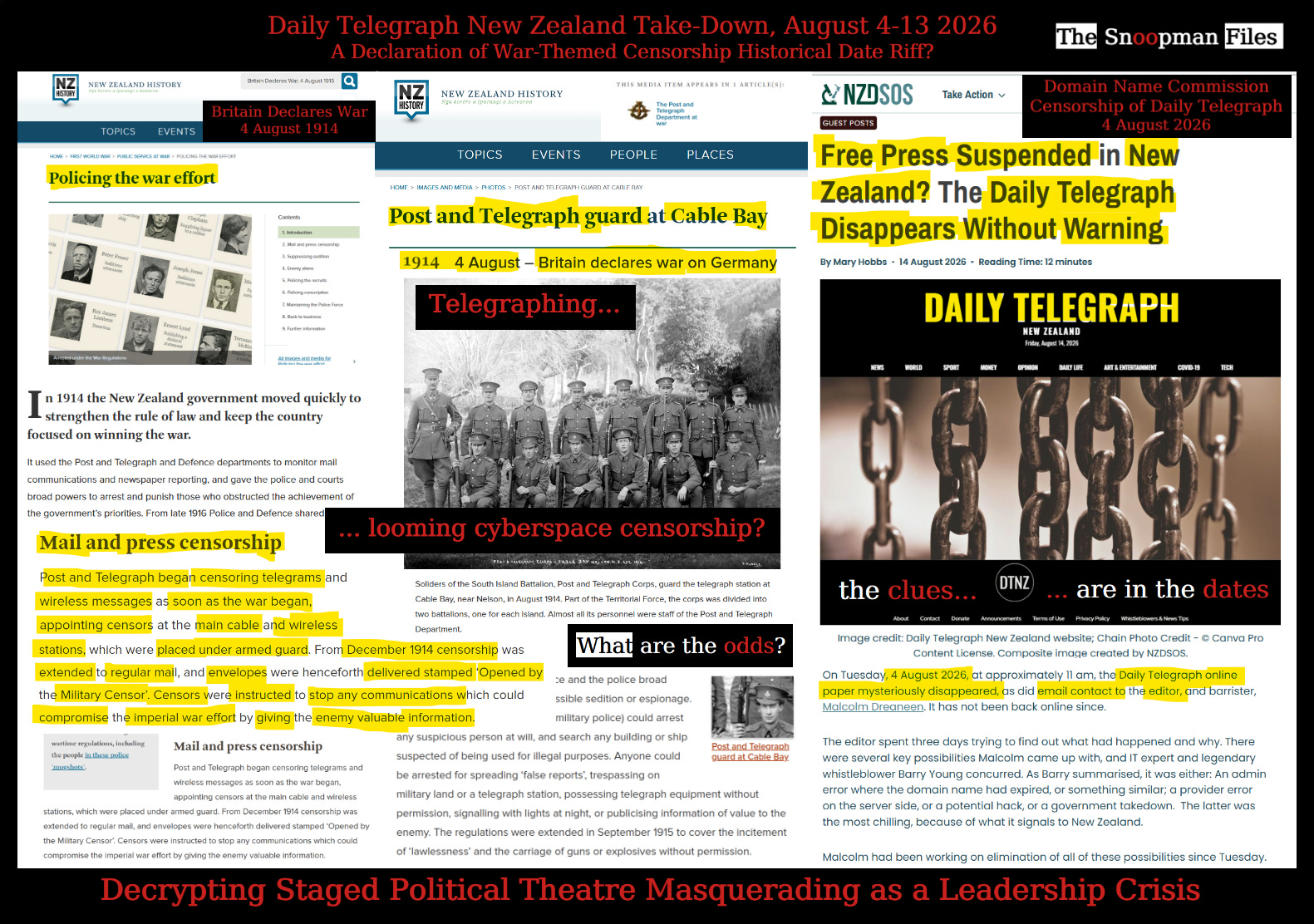
At first glance, the parallel take-down of the online newspaper, the New Zealand Daily Telegraph, by the Government’s Domain Name Commission, at around 11am on August 4 indicates interference was run to censor inconvenient coverage. In her article posted on NZDSOS, Mary Hobbs laid out the strange nine-day take-down of the Daily Telegraph NZ from August 4 to 13. The take-down occurred in parallel to the build-up of the staged ‘Luxo Leader Challenge’ and came back online the day after the caucus vote. However, there’s more going on in the censoring of a minor player.
DTNZ would have been covering the Luxon leadership controversy, with contributors posting inconvenient alternative accounts and opinion pieces. The circumstances of the Crown’s Domain Name Commission taking the Daily Telegraph NZ offline seems suspicious, since they are required to telephone or email before they do so. Neither happened evidently, except an email to the editor’s father at an old website, rather than the email on the DTNZ contact page. Y’all — it’s too stupid to be stupid, y’hear?
How uncanny that the New Zealand Post and Telegraph Department (1881 to 1959) began censoring telegrams and wireless messages as soon as World War I began, appointing censors at the main cable and wireless stations, which were placed under armed guard including the South Island Battalion at Cable Bay, near Nelson.
How uncanny the online newspaper came back online on August 13, which was the day after the National Caucus vote telegraphed a right-wing ‘National Ministry’ coalition would be the desired result on November 7. What are the odds that N.Z.’s first casualty of World War I occurred on August 13th 1914, when a sapper with the North Island Railway Battalion fell while on guard duty from the Parnell Rail Bridge. Since he hadn’t a service number, his name was not entered on the official national roll of honour for over a century, though he appeared the Railway’s casualty list.
Was this takedown by the Government’s Domain Name Commission telegraphing that censorship over broadband, wireless and website communications is looming?
After all, censorship by the Post and Telegraph Department began immediately upon Britain declaring war on Germany, which was August 4th 1914. And, since New Zealand was a Dominion at the time, Britain’s war declaration embroiled the Empire.
Ergo, the Daily Telegraph New Zealand was ritually censored immediately to telegraph the ‘Great Civil War’ had been stealthily escalated with altered rules of engagement.
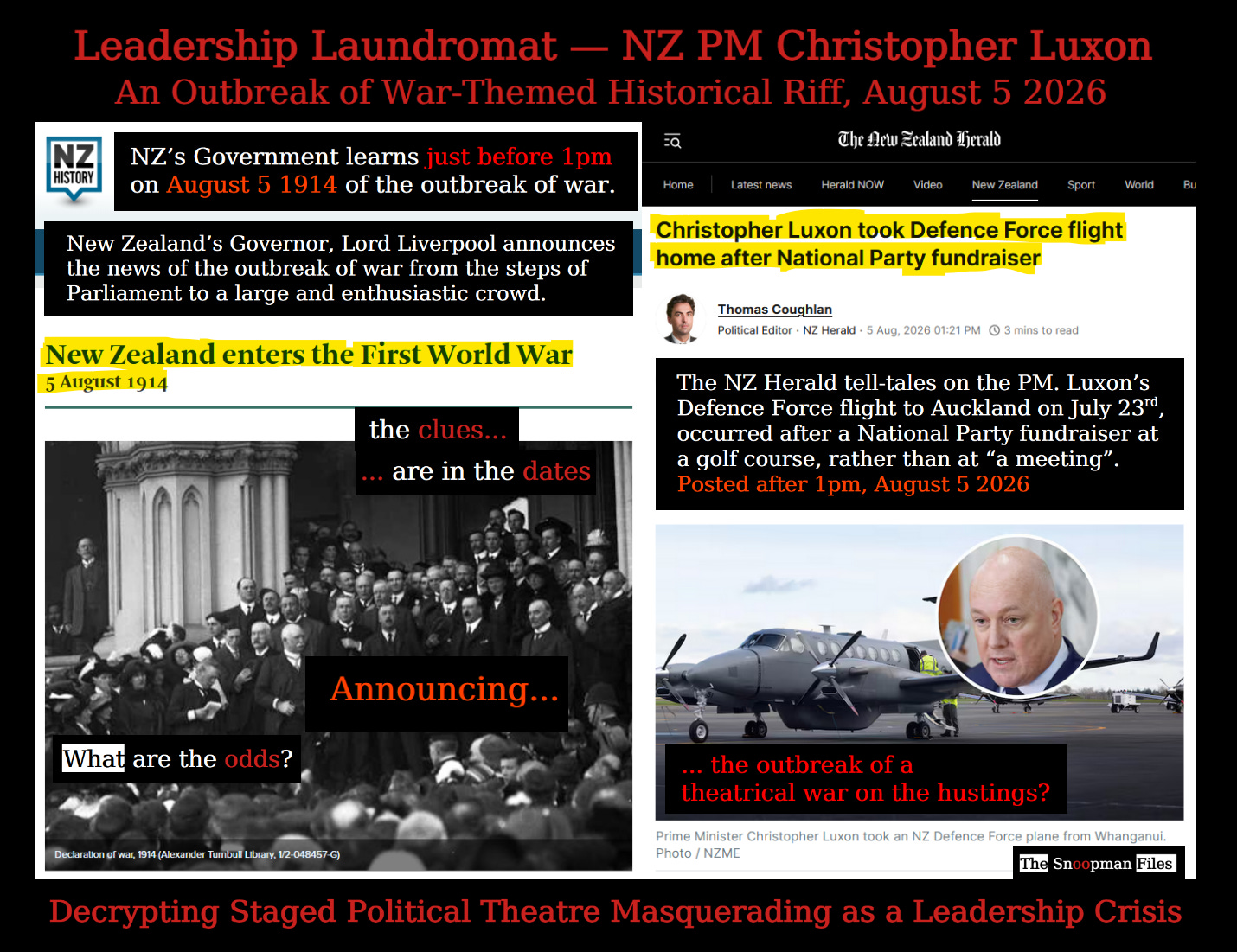
On August 5 2026, the New Zealand Herald followed up on their newspaper rival Stuff, who had ran stories of July 30, headlined, “Prime Minister defends $20k spend on chopper from Auckland to Hamilton for farmer rally and Kmart hub trip”, and “The five times Luxon caught the air force express to the Beehive”. This breaking news, “Christopher Luxon took Defence Force flight home after National Party fundraiser”, corrected the Prime Minister’s description that the event was a meeting. Since it was a party fundraiser, the use of an Air Force plane was scrutinized, providing controversy.
The escalating controversy also meant that National Party politicians would be recalled to Wellington on a recess week, likely fuelling a tiny-bonanza for Air NZ.
This recall also meant the news media would accost National’s MPs walking the steps into and exiting Parliament. These images inverted the performance of war-time unity.
How ironic that the Herald’s scoop about Luxon Defence Force Flight to Auckland — after a party fundraiser at a golf course — would land on August 5, at just after 1pm given that in this war-time coalition government-themed story, it was just before 1pm on August 5 1914 that the New Zealand Government was informed of the outbreak of war. New Zealand’s Governor, Lord Liverpool, announced this news of the outbreak of war from the steps of Parliament to a large and enthusiastic crowd. Ergo, the outbreak of a theatrical war on the hustings between the media and the politicians commenced.
On August 6, Christopher Luxon caught his caucus off-guard with a campaign promise to hold a referendum on the MMP voting system if re-elected. Mr Peters shot back calling it a “power grab” because the two big parties felt threatened by MMP. He quipped it was time for a parent-child conversation. Aftre all, the matter had been decisioned with a referendum in 2011, back when John Key was prime minstering.
How uncanny that the 20th century’s most notorious power grabber, Adolf Hitler, witnessed Jack Lovelock break the world record by winning the 1500m at the Berlin Olympics on August 6th 1936. Lovelock’s dramatic final surge caused the BBC radio commentator, Harold Abrahams, who won the 1924 sprint, to forget his broadcasting etiquette, and cry out in excitement like a radio listener egging Lovelock on to win.
Evidently, Luxon was cued to ape up MMP as a campaign platform, three months out.
Ergo, Luxon surprised the field by proposing to ‘do a Lovelock’ and pull off the equivalent of a three-hundred yard sprint to win gold, and cause the Führer to stand for a rendition of ‘God Save the King’, but to refrain from the Sieg Heil gesture.
Given that N.Z. adopted the German MMP system, the psychopathic humor is brazen.
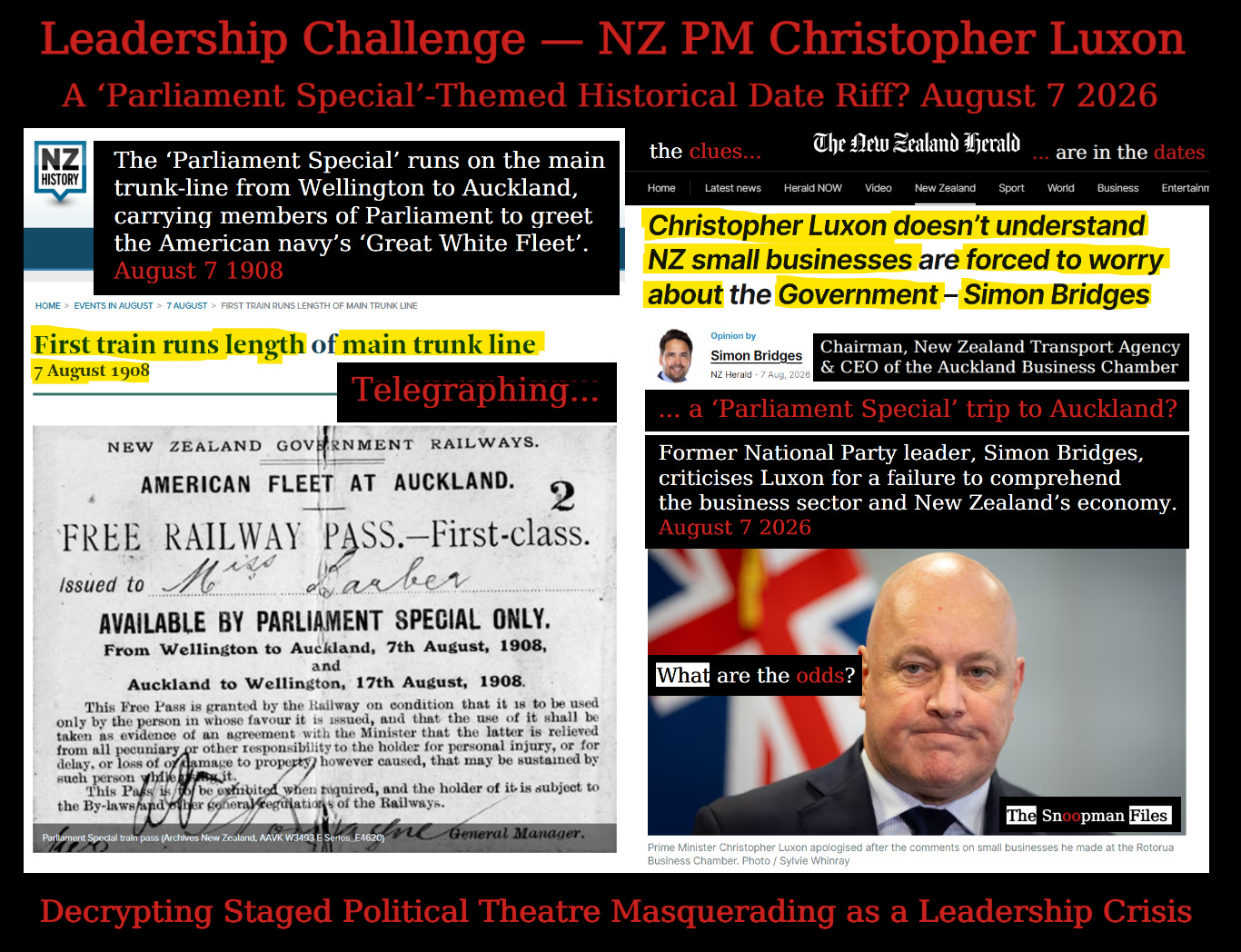
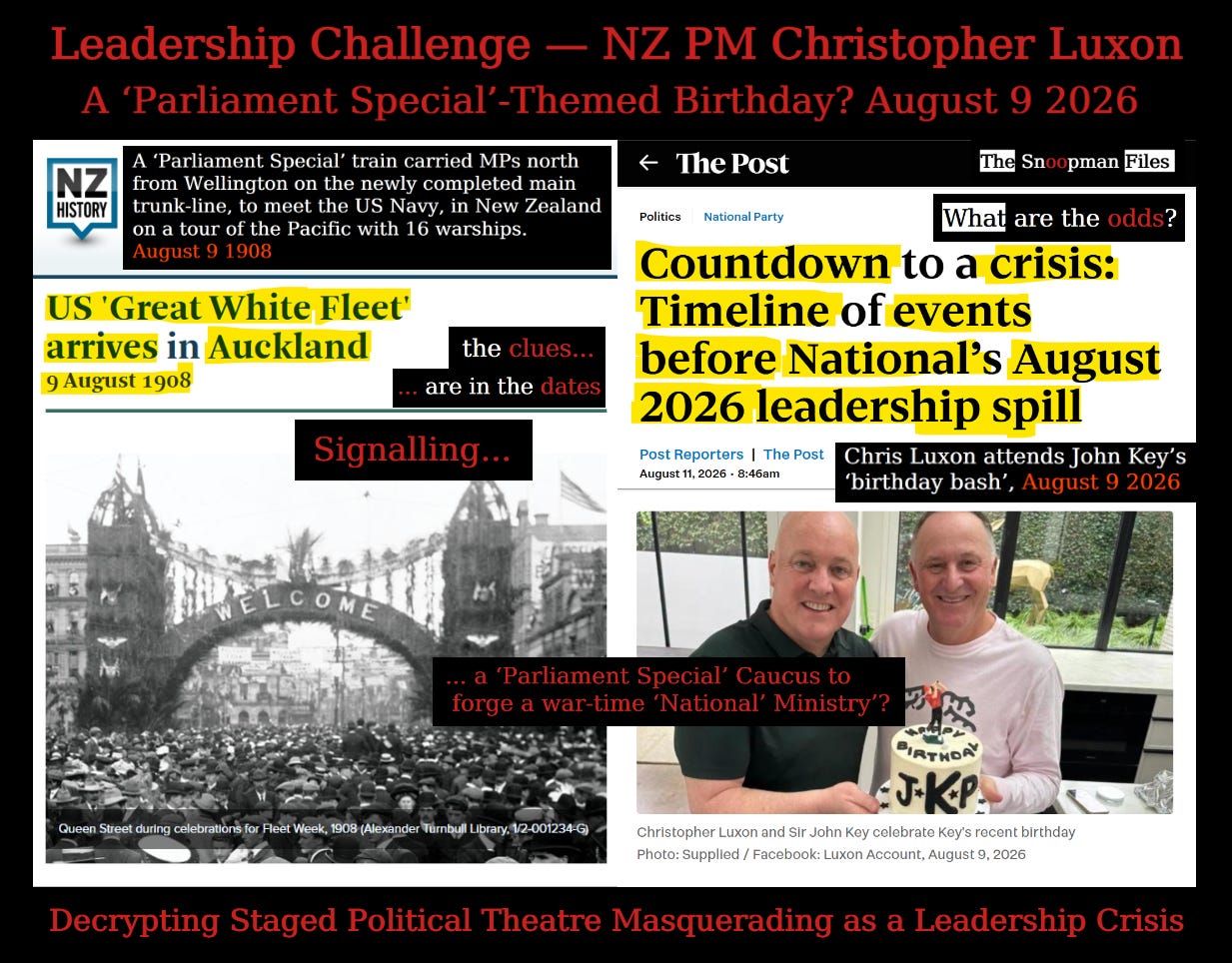
On August 7, the NZ Herald, printed an opinion piece written by former National Party leader Simon Bridges, criticising Luxon for a failure to comprehend the business sector and New Zealand’s economy. According to The Post, Bridges’ criticisms raised eyebrows, since his chairmanship at the New Zealand Transport Agency is government-appointed, and he is also CEO of the Auckland Business Chamber. The timing was uncanny, given it was on August 7 1908, when the first train, dubbed the ‘Parliament Special’, ran on the main trunkline from Wellington to Auckland. The train was carrying the Prime Minister Sir Joseph Ward and other members of Parliament heading to Auckland to greet the American navy’s ‘Great White Fleet’.
After all, Parliament had just broken for a recess week. And this ‘Great White Fleet’ riffing would appear again. Given the subtextual meta-data, was Bridges in fact manufacturing consent for more government debt-funded infrastructure, that would be levied with taxes, tolls, and tickets — to build-out a techno-feudalist future?
And, what advice did Luxon’s ‘boxing manager’, John Key, offer when he attended the former Prime Minister’s ‘birthday bash’ on August 9? In this military-themed ‘National Ministry’ election campaign, how fitting was it that Luxon would attend Key’s birthday, on August 9, since it was on August 9 1908 when the ‘Great White Fleet’ was welcomed at Auckland. A ‘Parliament Special’ train carried MPs and others north from Wellington on the newly completed main trunk-line, to meet the US Navy, in New Zealand on a tour of the Pacific with 16 warships, stopping in at 20 ports. Did this ‘birthday bash’ signify John Key was the ‘Parliament Special’ advisor to the PM?
Funnily enough, it was the New Zealand Herald’s morning show host, Ryan Bridge, who said (August 12) that he had been talking to National MPs for two weeks and he claimed they were “pissed off”, with Luxon’s “foot in mouth disease”. They believed players such as John Key had been covering for Luxon’s mistakes, and hammering the defence that it would be catastrophic to change the leadership so close to an election.
Recall that it was on Key’s watch when the USS Sampson was the first US warship to return to New Zealand waters in 33 years, for the NZ Royal Navy’s 75th birthday in 2016? And as if right on cue, the Kaikōura Earthquake struck at 12.02am on 14 November 2016 (N.Z. local time)? How uncanny that it was on November 14 1959, when precision approach radar came into operation at Wellington Airport, given that the electromagnetic technology that would be harnessed to amplify the natural forces in play at the time. And, what are the odds that the Kaikōura Earthquake struck on November 13 2016 at 11:02 am, UTC (Coordinated Universal Time)? Particularly, since the quake hit with a disaster-themed historical riff because it just happened to occur on the date that Mount Tongariro erupted on November 13 in 1896. The Kaikōura Earthquake completed the symbol sorcery of coming ‘full circle’, as far as re-integrating the political-right bloc back into the ‘American Empire’ was concerned, due to the rift over ANZUS that widened into a chasm after the Warrior Bombing.
➳ Death of Muldoon’s Dollar Man in Act I Rising Tension
On his Monday morning media round, August 10, Luxon was explaining that a fuel excise tax, a bed tax, and a bank tax would be on the table under a future National-led government. These were all foreign-themed taxes. The fuel excise to tax off foreign imported oil was proposed to fund roads. The bed tax was proposed to bill travellers to fund attracting big international events to New Zealand. The bank tax was proposed to claw back the exorbitant profits of the ‘Big Four’ Aussie-owned banks.
That very same August 10 evening, the New Zealand Herald reported National MPs had hit the phones on a possible change after Luxon’s MMP captain’s call live on radio.
How uncanny that it was on August 10 1840, HMS Britomart arrived at Akaroa on Banks Peninsula, to assert sovereignty over Akaroa. The British warship, captained by Owen Stanley, had raced to Akaroa, where there was a French settlement, to beat the French frigate, L’Aube, on its mission to assert sovereignty over the South Island.
The need to claim paper sovereignty at a place of settlement fulfilled the second of 10 elements of Discovery Doctrine, as practised by the European Cannon Powers during the Columbian Era of 1500-1900, when taking possession of inhabited lands. These conventions were innovated to mitigate warfare between the competing empires, following the Crusades, when the Church was attempting to forge a universal empire.
Given the foreign-themed taxes proposed on August 10, that might be levied to maintain the balance of payments, the codified metaphors ‘bobbed in the currency’.
As such, the timing of the death of Muldoon’s dollar man was embued with potency.
Terence Nuthall was responsible for switching New Zealand’s currency over from the imperial pound to the decimal dollar, so that it would be fully exchangeable with the U.S. dollar on July 10 1967. He died on August 10 2026, as if on a spooky schedule.
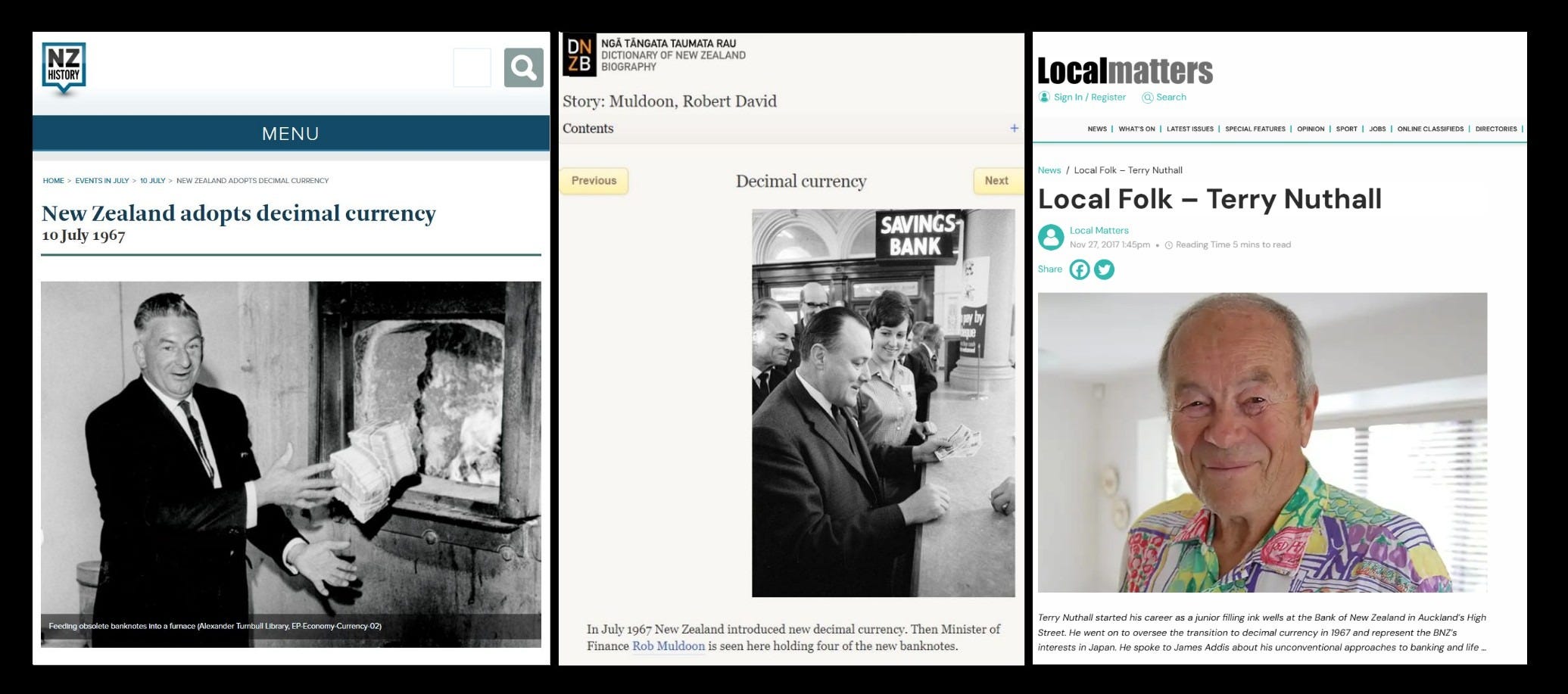
Curiously, Nuthall was a nobody. And, in the status conscious world of class-stratified work-places, human monkeys don’t like taking instructions from a ‘Mr Nobody’ when it’s a system-changy project. Especially, in 1960s New Zealand when the Cult of Freemasonry’s membership peaked at around 58,000 in 1966, and they had become accustomed to their brethren filling posts in power structures. For instance, in the First National Government of Sidney Holland, his Cabinet in the mid-fifties were all masons except Hilda Ross. So, Nuthall married Beatrice Este, who was named after her ancestor, Beatrice d’Este (1268-1334), daughter of the Marquis Obizzo II d’Este.
➳ Dante Alighieri-Beatrice d’Este Seguey
She is known for Dante Alighieri’s allusion to her (albeit not named specifically) in Purgatorio, the second canticle of his Divine Comedy trilogy, which is widely described as Italy’s finest work of literature. Before novels became ‘a thing’, Dante wrote a tale in the form of epic poetry, casting himself as the traveling protagonist in all three canticles, Inferno, Purgatorio, and Paradiso, to directly critique the devastating Guelf and Ghibelline conflicts. Rather than presenting them as a noble political struggle, he frames them as a moral disease driven by pride, envy, and avarice, which makes for entertaining encounters with the recently deceased Ghibellines and Guelfs in the Circles of Hell. But, in doing so, he fails comprehend the true nature of oligarchic power at a time when commercial capitalism was being established as a new instrument of imperial capitalism in a land the Papacy coveted, while maintaining the epic fraudulent monopoly over the business of who travels to the imagined realms Hell, Pugigatory or Paradise in the ‘AfterLife’. In Dante’s proposed solution, the restoration of a single, supreme Holy Roman Emperor, with a separation of church and state, he believed that since Emperor owns everything, he would be immune to avarice and would somehow judge purely, enforce justice, and crush the warring local factions (e.g. Guelfs and Ghibellines). In Dante’s Afterlife Universe set at Easter in the year 1300, he posited that the ultimate root of Italy’s political ruin was the Papacy’s hunger for earthly wealth and territorial power, which constantly stoked the fires of local civil wars. Dante caste Pope Boniface VIII, who died in 1303, as a papal monarch who would, amusingly, soon arrive in the Eight Circle of Hell among the simoniacs.
After the so-called ‘Fall of the Roman Empire’, Monasticism became the new imperial instrument of expansion, as the Catholic Church spread its territorial administration.
As Monasticism gave way to Feudalism, and the Church became focussed on consolidating power in Rome, the Papal Monarchy became concerned about losing property through inheritance at a time when clergy could marry and keep mistresses.
Beginning with Pope Benedict VIII, who banned priests from marrying in 1022 A.D., a succession of medieval popes repressed clergy sexuality in order to control staff positions and end offspring inheriting church property. It took five popes and three centuries to elevate the myth of the Virgin Birth across the Christian World during the medieval period. The Cult of Mary was closely associated with a general rise in hopefulness and optimism in the twelfth-century West, according to Western Civilizations: Their History and Their Culture. If you were a maid-serf, perhaps not.
Ironically, many of the great cultural heroes of the past, mythic or historic, were said to be born of virgin mothers: Marduk, Gilgamesh, Buddha, Osiris, Dionysus, Genghis Khan, and Jesus. But, the virgin descriptor did not carry the connotations to sexual chastity that it blushingly came to. Rather, figures such as Ishtar, Diana, Astarte, Isis were described as virgins to convey their sexual independence, according to Monica Sjöö and Barbara Mor in their 1987 book, The Great Cosmic Mother: Rediscovering the Religion of the Earth. Evidently, later Christian translators distorted the meaning into “sexually pure, chaste, never touched” to construct the Cult of a ‘Virgin Mary’.
In his Divine Comedy, Dante frames the Virgin Mary as an exalted ‘Queen of Heaven’ figure, rather than comprehending the etymological or historical shifts in the meaning of “virginity.” The Papal Monarchy deviously weaponized the old descriptor of the ‘Virgin Birth’ to enforce clerical celibacy as a strategic maneuver to protect land from inheritances. As such, Dante didn’t comprehend how the figure of Mary was elevated as an imperial measure associated with papal land disputes, ecclesiastical legal strategies, and the enforcement of celibacy on the Church’s clergy.
This criticism may see unfair. However, the ‘Virgin Birth’ ceased to ‘make sense’ to Snoopboy the very day he learned what tampons got up to once they were out of the packet. And, how the whole world came to be populated, including with pompous popes, and the priests and nuns, and the British Monarchy. Everyone. Except Jesus.
The institutional theological weaponization of the Cult of Mary to enforce clerical celibacy and resolve property disputes started with Pope Leo IX (1049–1054) at the Synod of Rome in 1049, when the wives and concubines of Roman priests were to be transformed into enslaved servants. This shiftdestroyed their status and ability to inherit property. These strategic moves advanced on the watch of Pope Innocent II (1130–1143) at the Second Lateran Council in 1139, when it declared any marriages contracted by higher clergy were not merely illicit but they were also null and void. Since the marriages were deemed to have never existed, clergy-born children were designated as illegitimate. Under medieval law, illegitimate children had zero rights of inheritance over land or property. This callous change took time to play out.
How Dante lost his home, assets, and land in January 1302, and thus became a refuge travelling from town to city, led to his Divine Comedy. His home city of Florence was split between two political factions, the White Guelphs, Dante’s faction, who wanted more independence from the Pope, and the Black Guelphs, who fiercely supported the Pope. This upending of his life followed a coup of Florence inflicted by the Black Guelphs, while Dante was in Rome on a diplomatic mission to meet with Boniface VIII. Dante was sentenced in absentia on trumped-up charges of corruption related to his time in public office. He was exiled for two years, but because he refused to pay the fine, he was permanently banished from Florence, attached with an order to burn him at a stake with tinder-dry sticks to cook his flesh, to cause cruel pain before death.
And since he was a refugee, and he didn’t begin writing his Divine Comedy until around 1308, and since Johannes Gutenberg’s printing press wasn’t in commercial use until around 1450, some gaps in his knowledge are comprehendible. In authoring the Inferno, in which he banished Boniface VIII and key figures of the Black Guelphs to Hell, Dante was nonetheless ballsy since the hand-written copies circulated from 1314.
But, wouldn’t you wonder while wandering around Italy at seeing crosses on steeples, paintings of Christ nailed to a cross, and all the crucifix bling, was the Church ever actually anti-evil? After all, Europe was de-tribalized in good measure by the Church’s zealots such as Charlemagne, and not all of the Crusades were aimed at Muslims.
Wouldn’t you wonder about the time that Charlemagne was crowned with the title of Emperor of the Holy Roman Empire by Pope Leo III on Christmas Day in 800AD? This event kicked off the Holy Roman Empire, and four years later Charlemagne completed the conquest of present day North Germany, meaning the pagan tribes were forced to convert to Christianity under fear of death, cruel torture, or starvation.
In any case, Dante failed to comprehend how the Roman Imperial Cult had, in the 1st Century, invented the casting of the Falavian Emperors as the source of the messianic character emanating from Palestine. And since Dante failed to detect how the Roman Imperial Cult subsequently innovated a messianic phantom figure in a tall tale appearing to have prophesized the Fall of Jerusalem, to indoctrinate initiates in institutions about how this phantom character named Jesus Christ travelled about Palestine with a ‘Ministry’ — Italy’s finest single work of literature is woke as fuck.
Since Beatrice Este is the widow of Terence Nuthall, it’s critical to comprehend that her blood not only has unbroken linkages of her ancestor Beatrice d’Este (1268-1334). But also, the bloodline of Beatrice d’Este, daughter of the Obizzo II d’Este (1247-1293), Marquis of Ferrara and Ancona, who descended from the founder the House of Este, is traced through the lineage of every Royal House of Britain, Europe and Russia. In 1300 — the year that Dante set his Divine Comedy as a satirical retribution for those in high offices who made him into an itinerant writer — she remarried to Galeazzo I Visconti, who later became the Lord of Milan. Although Dante doesn’t name her directly, and instead refers to her through her deceased first husband, Nino Visconti, the Judge of Gallura, who he encounters in the Valley of the Negligent Rulers. Nino laments that his widow no longer loves him because she has removed her “white veils” (the traditional garb of a mourning widow) to marry into the Visconti of Milan (a Ghibelline family, rival to Nino’s Guelph faction). Dante criticized Beatrice d’Este’s remarriage to Galeazzo I Visconti in Purgatorio, Canto VIII, because he believed it represented female fickleness, political betrayal, and a slight to his friend, Nino Visconti. Dante’s judgment of Beatrice d’Este was harsh, biased and therefore unfair.
Nino and Beatrice were staunch Guelphs. By marrying her into the Milanese Visconti family, she was aligned with a rival faction, crossing political lines. For this shift, Dante inflicts a heraldic insult, having Nino bitterly note that the Milanese viper symbol will not grace her tomb as honorably as his own family’s rooster emblem from Gallura would have, if she had stayed true to his memory. Even by the social and legal realities of 14th-century Italy, this bitterness reflected Dante’s political biases, rather as much as the frustrated judgey character stuck in Purgatory projecting ‘his’ own shit onto to his living squeeze, 661 years before Carl Jung could arrive on the scene to unpack his psychogical landscape and make a bundle fast-tracking souls to either exit.
In the 14th Century Italy, a widowed noble-woman was treated as a valuable political chess piece. It was her brother, Azzo, who orchestrated her remarriage to Galeazzo I Visconti to cement a crucial alliance with Milan. Beatrice had no legal right to refuse this marriage, nor did she have the authority to manage her own destiny. Upon Nino Visconti’s death in 1296, Beatrice did not inherit his lands or autonomy. Instead, legal and societal norms dictated that she fall back under the absolute control of her male family members — specifically her powerful and ruthless brother, Azzo VIII d’Este.
In Inferno, Dante suggested the son of Obizzo II d’Este, who was Azzo VIII d’Este, Lord of Ferrara, Modena and Reggio, had assassinated his father. In 1305, Azzo struck a marriage bargain with Charles II of Naples to have the seaside monarch betroth his daughter Beatrice d’Anjou to him. This controversial move, which bonded the men by the dowry, to invest in Naples and Ferrara, drew the sarcasm from Dante’s inky quill. The dowry contract not only bound the territories, but also disinherited Azzo’s brother Francesco, who joined a coalition of cities that moved against Azzo in 1306.
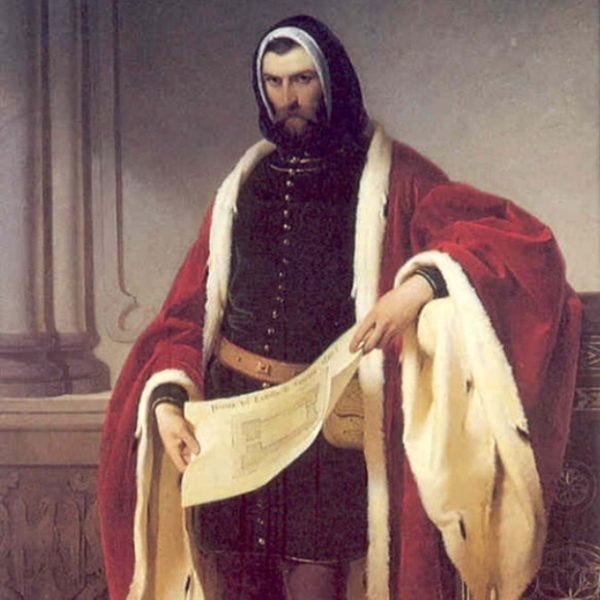
This dowry arrangement was a reversal of medieval Italian customs, since Azzo VIII paid the bride-price himself to buy a royal marriage (rather the bride’s family paying a dowry to the groom). Where the marriage alliance to make Beatrice d’Este the wife of the Lord of Milan, Azzo VIII’s marriage to Beatrice d’Anjou was the second stage of his fifedom plan. Azzo VIII paid 51,000 gold florins, and the contract explicitly stipulated that this money was to be invested in lucrative lands both within the Regno (the Kingdom of Naples) and in suitable domains inside the Marquisate of Ferrara/Este. In exchange for Charles II giving away his daughter to an older, lesser-titled marquis, Charles demanded that any male heir born to Beatrice d’Anjou would inherit the entirety of the Este holdings. This forced Azzo to establish strict primogeniture, completely overturning the long-standing Estense tradition of shared family rule and explicitly disinheriting Azzo’s own brother, Francesco d’Este.
Azzo wanted to secure his western flank and build a grand coalition across Lombardy. To do this, he pivoted sharply and allied with Matteo I Visconti, the Ghibelline (pro-Imperial) lord of Milan in 1300. Five years later, Azzo made a chess move that he believed would legitimize his expanding power, by gaining a young Angevin Dynasty bride from Naples. Her father, King Charles II was the elder statesman of the ultimate Guelph royal house. The Angevin Dynasty was explicitly invited into the Italian peninsula by the Papacy to serve as the sword and shield of the pro-papal Guelph cause. With Francesco d’Este disinherited, he formed a massive coalition with Bologna, Mantua, and Padua against Azzo and a bloody civil war ensued. Azzo died broken and exhausted in 1308 without a legitimate male heir from his new royal wife, and Venice made its chess move to take Ferrara, requiring a Papal rescue to resolve.
In the eventual treaty of 1313, Venice recognized Ferrara as a Papal territory, but Venice retained access to the Po River, ensuring control over critical trade routes.
The Venetian defeat in the War of Ferrara in 1309, set-off rivalries between Venetian nobles. Following a failed coup of Venice’s Great Council in June 1310, the Council of Ten was formed on July 10 1310. And so, the date, July 10 1967, when New Zealand’s new decimal dollar currency became fully exchangeable with the U.S. Dollar was especially potent since Beatrice Este is descended from the House of d’Este.
And so, Beatrice d’Este with a nine year old daughter, Giovanna Visconti, in 1300, had little choice. Their chances of survival running away were slim to zero. Unless she met Westley, a good-hearted farmboy, who was prepared to go be the Dread Pirate Roberts for five years, make his fortune, and return to steal her away, while fighting off threats with his sword, witty rebuttals, and the help of Billy Crystal to revive him from death.
It is through the descendents Giovanni Visconti that the Este bloodline passed into all the Royal Houses of Europe. Since Beatrice d’Este’s deceased husband Nino declares in Purgatory that the heraldic symbol of her second husband—the Milanese viper—will not grace her tomb as beautifully as his own symbol, the cock of Gallura, it would appear Beatrice d’Este was aware of Dante’s judgmental framing of the arranged second marriage. When Beatrice d’Este died in 1334, she got the last word against Dante’s critique. She had both heraldic symbols — the Viper of Milan and the Cock of Gallura — carved side by side onto her tomb, proudly asserting her full identity and defying Dante’s attempt to shame her. In her essay “Ideology and Cultural Practice: The Case of Dante’s Treatment of Beatrice d’Este,” published in Dante Studies (1993),Deborah Parker noted Dante’s patriarchical Medieval Church conservativism, the ‘weaponization the wimple’ whereby a widowed women’s wanderings could be visibly tracked, and the casting of Beatrice was likened to the fallen woman Eve, while her daughter, Giovanni, was the pure Mary because she still prayed for her father.
Clearly, Dante wasn’t thinking ahead to a world changed by the printing press, among other inventions, that made possible an intellectual evolution that eventually led to the women’s liberation movement. In this regard, his Divine Comedy hasn’t aged well.
Yet, Beatrice Estensi made her viewpoint clear in stone on her tomb, and then perhaps she tracked down Dante, who finished Paradiso shortly before hedied in 1321, to make sure he was in Purgatory if he was Paradise, since Hell would be a bit harsh.
Thus, Beatrice’s tomb, bearing the rooster and the viper, is a stark silent subversion of Dante’s text, expressing two periods of her turbulent life as a noblewoman chess piece.
➳ Back to Death of Muldoon’s Dollar Man in Act I Rising Tension
The marriage between Beatrice Este and Terence Nuthall was about potentizing the currency change-over from the imperial pound to the decimal dollar with royal blood.
Nuthall’s death on August 10 was tethered with historical riffs between L’Aube, and HMS Britomart, and July 10 1840, when the frigate sailed into the Bay of Islands. In turn, New Zealand’s currency switch-over on the date, July 10 1967, carried a potency charged with historical significance steeped in the mercurial world of magical money, political intrigue, and the commerical tensions related to tolling trade via ‘banking’.
Since the date that the US Federal Reserve banking cartel’s dollar became fully exchangeable with the New Zealand’s new dollar currency was July 10 1967, what are the odds that ‘Dollar Day’ riffed off the historical date, July 10 1310, when Venice’s Council of Ten was established? At the time of the formation of the Council of Ten, Venice was the primary exchange toll booth for the East-West bullion flows, and was a financier of loans to merchants, such as the super-companies of Florence.
The Council of Ten was formed after a failed coup d’état of Venice’s oligarchic government, the Great Council, that was triggered by the Venetian defeat in the War of Ferrara in 1309, that set-off rivalries between Venetian nobles. In 1308, the Republic of Venice picked a fight against the House of Este and the Papacy. The War of Ferrara began as a succession struggle over the Duchy of Ferrara following the death of Marquis Azzo VIII d’Este. Venice supported the claims of Azzo’s illegitimate son, Fresco, against Azzo’s brother, Francesco, who in turn sought support from Pope Clement V. The Princely Este family of Lombard origin were prominent in the history of medieval and Renaissance Italy. The Estensi, a branch of the 10th-century dynasty of the Obertenghi, took their name from the township and castle of Este, near Padua.
The founder of the family was the margrave Alberto Azzo II who died in 1097, through whose son Folco I (who died in 1136) descended the House of Este. The family first gained prominence as leaders of the Guelphs in the wars between the Guelphs and Ghibellines. Members of the family ruled in Ferrara in the 13th–16th century.
The split between the Guelphs, who sided with the papacy, and the Ghibellines, who were sympathetic to the Holy Roman emperors, contributed to chronic strife in the cities of northern Italy in the 13th–14th century, reflected in Dante’s Divine Comedy.
The opposing Guelphs and Ghibellines factions in German and Italian politics, respectively, were a feuding feature during the Middle Ages. The terms Guelph (see Welf dynasty) and Ghibelline (from Waiblingen, the castle of the Welfs’ Hohenstaufen opponents), first acquired significance in Italy during the reign of the Hohenstaufen emperor Frederick I Barbarossa, who was made Holy Roman Emperor in 1155, after he launched the first of six military campaigns against northern Italy and suppressed a revolt in Rome that restored the pope. However, Ferederick I supported a series of antipopes against Alexander III leading to a prolonged struggle with Rome. Renewed expeditions against Italy met with opposition from the Lombard League, which were a coalition of cities in northern Italy who inflicted a severe defeat on Frederick in 1176. Ferederick I aknowledged Alexander III as the true pope. He strengthened the feudal system and curbed the power of the princes by creating a stronger imperial administration, and launched the Third Crusade in 1189, but drowned crossing a river.
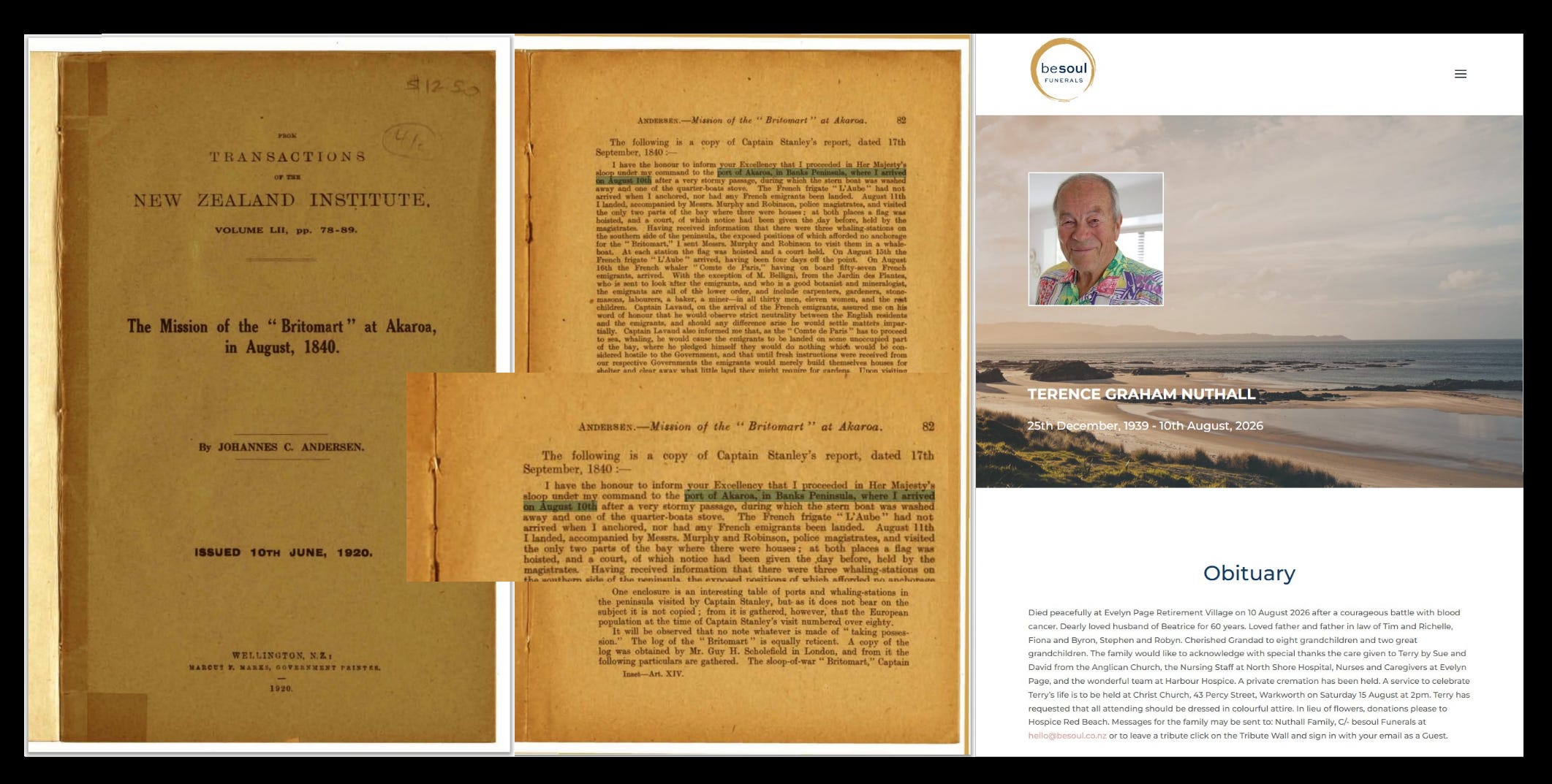
In 1965, when he was a Bank of New Zealand employee, he was sent to the BNZ’s Melbourne branch and later to the bank’s Sydney branch, while Australia prepared its currency switch-over set for February 14 1966. The Australian currency change-over was commerce-themed, since the New South Wales colony’s first shop opened at Sydney Cove on February 14 1792. Nuthall said his secondment to Australia was in order to help oversee the Bank of New Zealand switch to a decimal one. He helped write manuals, gave talks at clubs and invited Muldoon to speak at a Junior Chamber, while publicity on the new currency was organised by the Decimal Currency Board, and the Decimal Currency Act 1964 provided for advisory and technical committees.
A Milanese painter, Giovanni Ambrogio de Predis, who gain commissions for Leonardo Da Vinci, painted the second Beatrice. Born in 29 June 1475, in the Castello Estense in the Duchy of Ferrara in what became Northern Italy, Beatrice d’Este was the second child of Ercole I d’Este and Eleanor of Aragon. The House of Este ruled Ferrara continuously from the 13th century until the late 16th century. The territory became an official duchy in 1471 when Borso d’Este received the title of Duke of Ferrara from the Pope Paul II. However, Ercole d’Este faced hostile coalition of Venice and Pope Sixtus IV, which brought war nearly to the walls of the City of Ferrara in the War of Ferrara (1482–1484), but never captured or ruled the City of Ferrara itself. The Este family (the Estensi) had supported artists and scholars, turning the duchy into a major cultural center during the Renaissance and Baroque eras.
The family line had split into two branches in the 11th century, following the death in 1097, of Albert Azzo II, Margrave of Milan and Count of Este, who had two sons from different marriages. His eldest son, Welf IV, migrated to Germany and became Duke of Bavaria (founding the younger House of Welf, also known as the Welf-Este branch), while his son Fulco I remained in Italy to manage the Italian possessions (founding the Italian House of Este). Of importance to the dynasty’s legacy, was that the main branch of the Este family had come to an end, the childless Alfonso II (1559-97), had bequeathed the Duchy of Ferrara to his cousin Cesare. However, in 1567, Pope Pius V had expressly forbidden ‘illegitimate’ children from ruling in ecclesiastical lands. Upon his death, Pope Clement VII refused to recognize the settlement, declaring Cesare illegitimate; in 1598 direct papal rule was established over Ferrara.
Although the main branch of the Este family come to an end, Cesare kept the Duchy of Modena and Reggio, a small, independent state in northern Italy that existed from 1452 to 1859. Among the several Modenese dukes who followed in the 17th century, Francesco I (reigned 1629–58), who came to the throne during the stormy period of the Thirty Years’ War. In the wars Francesco I was first allied to Spain, then to France, whose alliance he thought would best sustain his claims to Ferrara. In battle fighting the Spaniards, that he died of malaria. Among his successors, the one most deserving to be remembered is Rinaldo I (1694–1737), whose marriage to Charlotte Felicitas of Brunswick-Lüneburg reunited the long-separated branches of the house of Este.
Among his successors, the one most deserving to be remembered is Rinaldo I (1694–1737), whose marriage to Charlotte Felicitas of Brunswick-Lüneburg reunited the long-separated branches of the house of Este. Throughout his reign he engaged in imperial politics. His son Francesco III (1737–80), known as a libertine, received the governorship of Lombardy from Empress Maria Theresa of Austria. Ercole III (1780–96), gentle and affable, abandoned Modena in 1796 when the Revolutionary French army invaded it. The Italian Este branch remained in Italy for centuries. Its legitimate male line eventually went extinct in 1803 with the death of Ercole III d’Este. The family’s legacy and titles passed via the female line to the Austrian Habsburgs, forming the House of Austria-Este. Childless, Francesco V selected as his universal heir Franz Ferdinand, heir to the Austrian throne, who was assassinated at Sarajevo in 1914, as part of entangled plot to trigger what became known as the First World War.
How uncanny that the Austro-Hungrarian Empire collapsed during World War I, given the war resulted primarily from two decades of plotting by a British Secret Elite.
Over the centuries, the German Welf-Este line evolved through the Dukes of Brunswick-Lüneburg. In the 17th century, a cadet branch of this family established itself in the principality of Calenberg, which came to be known by its primary city, Hanover. This line became the House of Hanover. Through the marriage of Elector Ernest Augustus of Hanover to Sophia of the Palatinate, who was the grand-daughter of King James I of England, the House of Hanover had positioned itself in the British line of succession. In 1714, their son ascended the British throne as King George I, initiating the Hanoverian dynasty of Great Britain that culminated with Queen Victoria, the reigning monarch at the time of the 1840 Waitangi Treaty.
Therefore, it’s significant that Terrance Nuthall oversaw the currency change-over on Muldoon’s watch as Under Secretary of Finance, on 10 July 1967, since the event riffed off the date when the French frigate L’Aube sailed into the Bay of Islands after dark on 10 July 1840, with the mission to claim sovereignty over the South Island. How remarkable was it that a low-born bank officer would marry an ancestor of the Duchess of Milan, who was an important enough chess piece to earn the derision of Dante Alighieri? And, more importantly, an ancestor whose surviving daughter became the conduit for the House of Este’s bloodline to permeate every Royal House of Great Britain, Europe and Russia, and into the peerage lists of nations down to this techno-feudalist era. Terence and Beatrice married on the potent date of May 28 1966.
This date thematically riffed off the date, 28 May 1862, that Vincent Pyke, a member for the Victorian Parliament, was gazetted as the Secretary of the Otago Goldfields (often referred to as the Goldfields Commissioner), a post that placed him in authority over the various provincial gold boards, to organize the administration of gold mining, and to draft regulations which fostered the development of the mining industry. Pyke was personally popular, as he constantly travelled through the goldfields delivering informative lectures to the miners. Ergo, the timing of Nuthall’s marriage to Este, signalled he was conferred with a nobleman’s office: ‘Secretary of the Currency’.
New Zealand and Australia were drawn deeper into the orbit of the ‘American Empire’.
Both country’s currencies were earmarked for a changeover. On October 1st 1957, a Committee appointed by the Minister of Finance, had recommended a currency switch from the imperial pound to a decimal dollar, while their Australian federal government counterparts appointed a committee to investigate the issue in 1959. In 1963, both countries announced they would go decimal. As a prepatory step, the New Zealand-Australia Free Trade Agreement (NAFTA) was signed on August 31 1965.
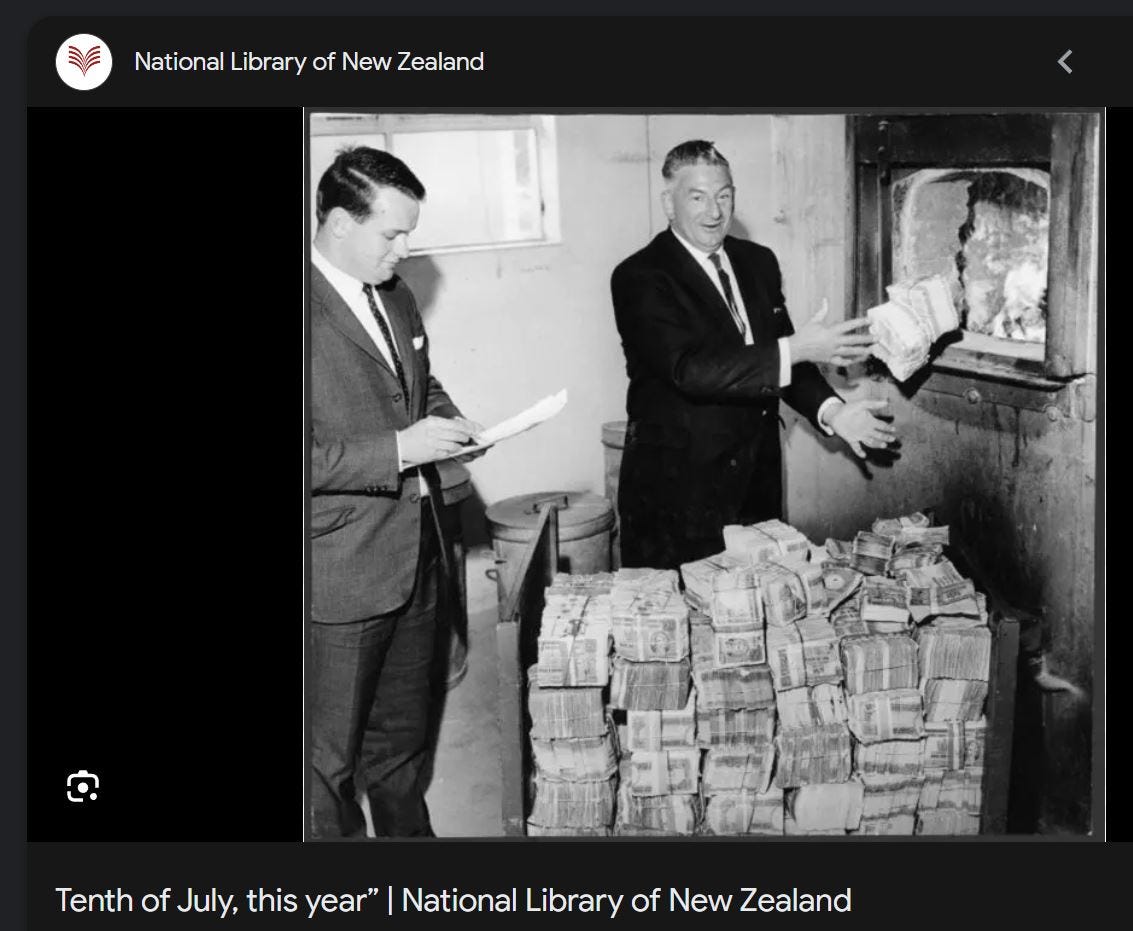
A major threat to this emergent market for currency trading, came with the election of Norman Kirk in a landslide win by the Labour Party in 1972. As prime minister, Kirk wanted New Zealand to be the leading nation in a “world barter economy”. Such a vision was a direct threat to the currency traders and the grid of international bankers, since it would have presented a viable model for inter-state bartering.
This inter-state bartering was also the vision of Kwame Nkrumah, who became Ghana’s first President after a referendum held on April 27 1960, deposing Queen Elizabeth II as head of state. What are the odds that Nkrumah would die of cancer on April 27 1972, while living in exile in Bucharest? After President Kennedy’s assassination, Nkrumah’s vision for Pan-Africanism began to fall apart, since he and Kennedy were friends, allies and kindred spirits. He soon came under pressure from the IMF and World Bank. Nkrumah argued that the various African states could trade their resources with one another so the continent could develop without fighting.
In his 1965 book, Neocolonialism: The Stage of Capitalism, Nkrumah showed that despite African countries winning nominal independence, their resources, banks and financial systems remained in the control of multi-national corporations, interlocked through shareholdings, board directorships and agents of dynastic family trusts. The CIA and U.S. State Department were complicit in the coup d’état of February 24 1966. Nkrumah’s influence among socialist political leaders was huge at the time.
Conveniently, Norman Kirk died on August 31 1974. What are the odds that a prime minister who wanted New Zealand to be the leading nation in the barter economy would die on the same day that the New Zealand Australia Trade Agreement (NAFTA) was signed, on August 31 in 1965? Kirk — who was a threat to the emergent cryptocratic dark state — had undergone operations for varicose veins in both legs and had flown to northland in an unpressurized Air Force plane to stay at the bach of Air Marshall Rochford Hughes, in the care of army nurses. Kirk was in pain. After Kirk phoned the wife of Minister of Defence from a local diary, he was taken to the Old Lady’s Home of Compassion hospital in Island Bay, Wellington, where there was no security, as former mayor Bob Harvey re-told in his autobiography, Wild Westie. In the chapter “The Demise of Norman Kirk”, Harvey opined that Kirk was assassinated.
After all, in 1973, Kirk had also dispatched two Royal New Zealand Navy frigates — the HMNZS Otago and the HMNZS Canterbury — to Mururoa Atoll to protest French atmospheric nuclear testing in the Pacific. (The nuclear tests migrated underground).
The timing of Kirk’s death signalled his barter economy vision threatened merchant banking, multi-national industrialists, and belligerent Anglo-American imperialists.
Ergo, a free trade-thematic metaphor underpinned the ‘timely’ death of Norman Kirk.
The timing of Nuthall’s death was uncanny too. His big career moment to oversee the switch-over of NZ’s currency was entwined with L’Aube’s arrivalin New Zealand waters.
The L’Aube had arrived in the Bay of Islands after dark on July 10 1840 with the mission to claim France’s sovereignty over the South Island. Recall that the date July 10 1967, was the date set for the currency changeover? And, then the French DGSE bombed the Warrior on July 10 1985, not only to stop Greenpeace flotilla at Mururoa Atoll. But, also because Labour’s anti-nuclear legislation contained a provision for the N.Z. Government to lobby other South Pacific nations to be nuclear free zones.
For those attuned to metaphor-laden ‘signals intelligence’, the date of the Warrior Bombing spoke for itself. The date, July 10th, signalled state-sponsored terrorism.
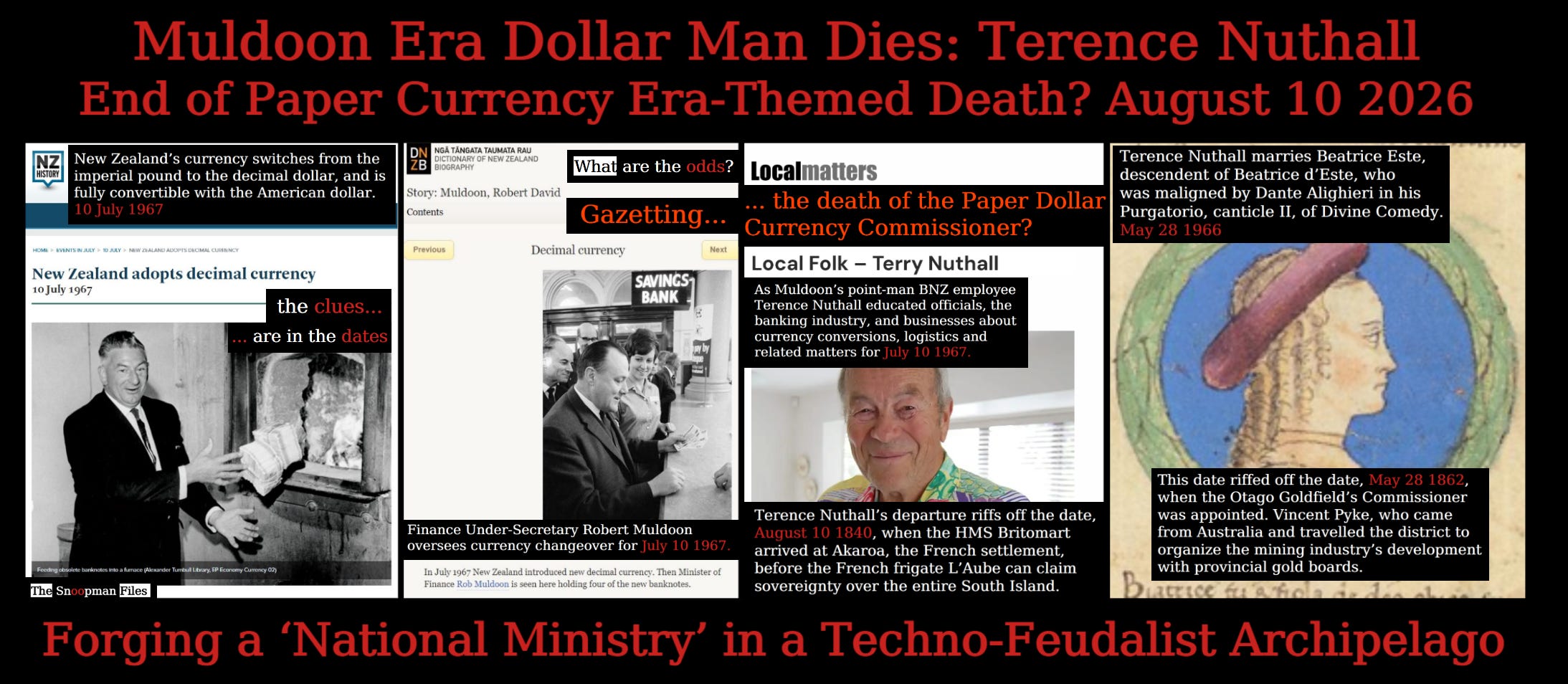
On the 39th anniversary of the Rainbow Warrior Bombing, July 10 2024, Luxon dined at the White House, honouring NATO’s 75th Anniversary. On the 41st anniversary, Indian Prime Minister Narendra Modi arrived in Auckland on July 10, 2026, on a two-day official state visit. They signed the India-New Zealand Free Trade Agreement.
Also on July 10, 2026, Japanese Foreign Minister Toshimitsu Motegi and New Zealand Foreign Minister Winston Peters met in Tokyo claiming to strengthen security cooperation. Amidst China’s rise as a regional military power, the two members of NATO’s Indo-Pacific 4 group met to discuss defense logistics and intelligence sharing.
Meanwhile, on July 10, there were Matariki Constellation events across New Zealand.
And so, the departure of Muldoon’s pointman for the currency switch on July 10 1967, symbolized the passage of the era nationally-based currencies with exchange rates ‘floating on seas’ of debt tethered to the PetroDollar as the world’s reserve currency.
In the emergent multi-polar world order, where the tokenization of every resource, every transaction, and every process is to be tethered to its carbon equivalent metrics measurable by algorithms, a planetary matrix is being built before our very eyes. This planetary matrix is a ‘systems upgrade’ and is the culmination of the horrific imperial scale Third Hundred Years’ War that began before 1900. The masquerade of the present great power competition between the ‘East-South’ BRICS Bloc and the West-North Anglo-American is really a consolidation of an invisible global empire.
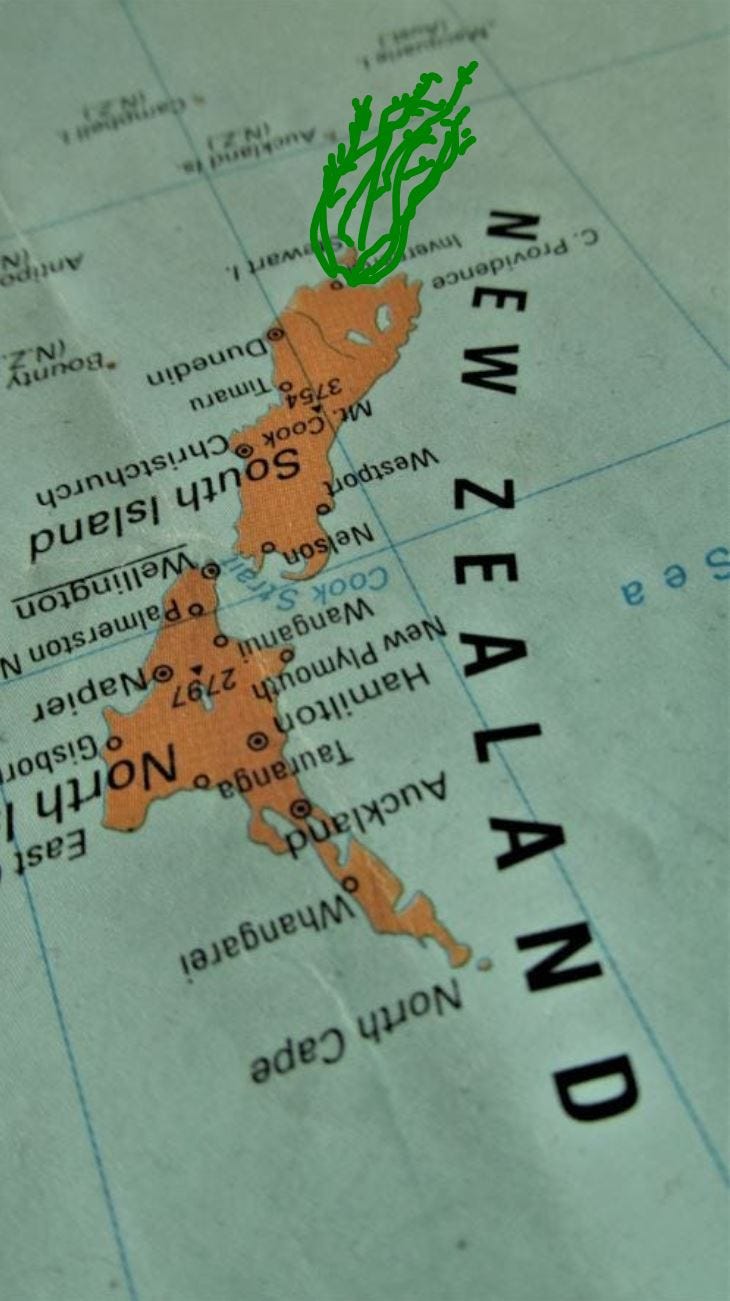
Big-pants nouns like ‘infrastructure’, ‘innovation’ and ‘interoperability’ have become unilevered LuxoSpeak for constructing a totalitarian panopticon grid. But, with pig-label lipstick smeared on sustainability-soundy nouns like ‘resilience’ — as if we’re living in a theme park called Carrot Land, with frequent focus-grouped assessments.
And, the archipelago’s emotionally-hijacked inhabitants have been recast as ‘Carrot Landers’, who are expected to behave like cheerful bright orange bags of export-quality carrots. Just act unblemished, look perfectly formed and be too polite to call-out the New Toxic Order. Carrot Land has a Truman Show feel, with fake lives to make wives, fake norms dial storms, and fake scenes sell cocoa beans. But now, Andrew Niccol writes ads for Tourism Carrot Land, the theme park’s marketing bureau. Amid austerities, Carrot Landers are treated like expendible gig-working film extras. Squint at a certain angle, and the archipelago resembles a half-submerged wild-grown carrot.
On August 11, Luxon called all of National MP’s to a caucus meeting in Wellington for 9.30am, Wednesday August 12. How uncanny, that this ‘captain’s call’ thematically riffed off the date, August 11 1840, when Captain Owen Stanley raised the Union Jack and held formal court to claim possession over the South Island at two places in the French Settlement at Akaroa. Two police magistrates hoisted the British flags.
On the evening of August 11, Luxon posted on boastful feedea to dispell news flying that his PMship was in jeopardy. Meanwhile in the background he had recalled the National Party Caucus back to Wellington. This recall meant politicians would have to walk the gauntlet through the media at the airport and up the steps at parliament.
How uncanny was it that this ‘Luxon Leadership Coup’ vote occurred on August 12 2026, since it was on the same day, August 12 1915, when the ‘National Ministry’ wartime coalition government was formed one year into the First World War?
Snarly political animals had been looking to butcher Luxo into bacon for a fortnight.
After Brash blogged his view that Luxon would get run over if he failed to stand-up to separatism, former 3News face-turned podcaster Duncan Garner had followed up, essentially endorsing Brash’s post. Garner also backed Erica Stanford as a more capable leader. Stanford is the Minister of Education, Minister of Immigration, and the Lead Coordination Minister for the Government’s Response to the Royal Commission’s Report into Historical Abuse in State Care and in the Care of Faith-based Institutions. Before becoming the MP for East Coast Bays, Stanford worked in the same electorate office of former MP for East Coast Bays, Hon Murray McCully.
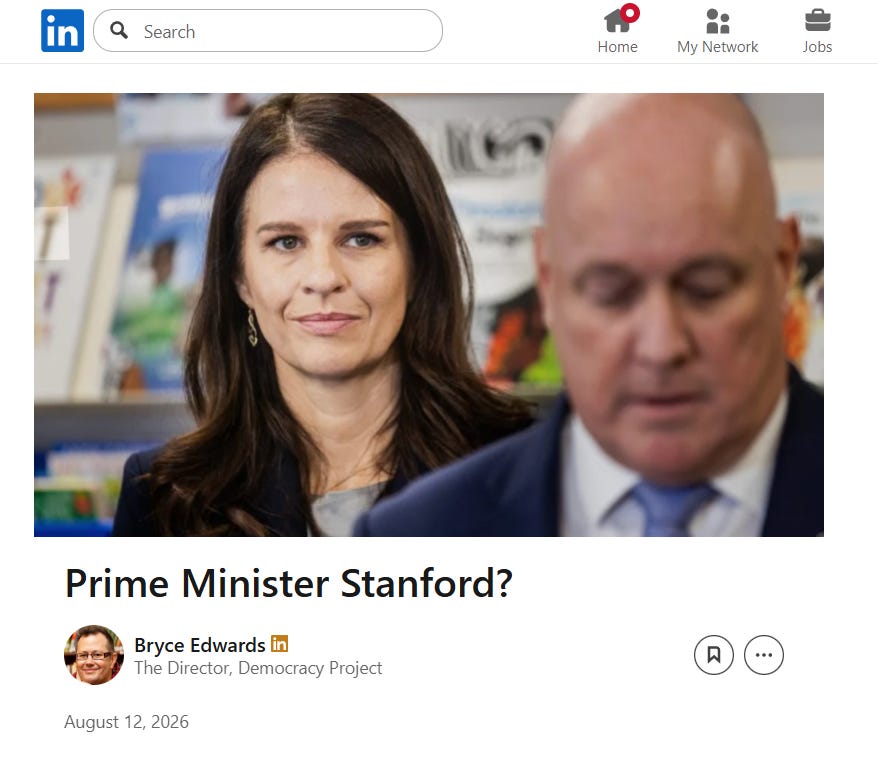
In early March 2026, in an “analysis” piece headlined, “Luxon appears to be the one with the only deciding vote on his future. For now.”, Lynch typed Stuff understands Erica Stanford “has taken some advice from a master of political manoeuvres, former foreign minister Murray McCully”. On August 12, Bryce Edwards wrote, “The apprentice of National’s most storied backroom operator appears to have learned the first lesson: never be seen holding the knife. Stanford has said nothing all week.”
Of his role in discussions that led to Key being elected National leader, McCully said the backroom role is “the more challenging end of domestic political management”.
Edwards summarized the accounts that conveyed a picture where Chris Penk had been canvassing support for a possible Erica Stanford–Chris Penk leadership ticket.
By this position, the reporters and political commentators came to believe that behind the scenes canvassing was occurring for support with Stanford as party leader and Mr Penk as co-leader. Yet, they failed to see that the various pieces were being moved in a staged game of chess designed to remove a rooky cabinet minister with poor defence.
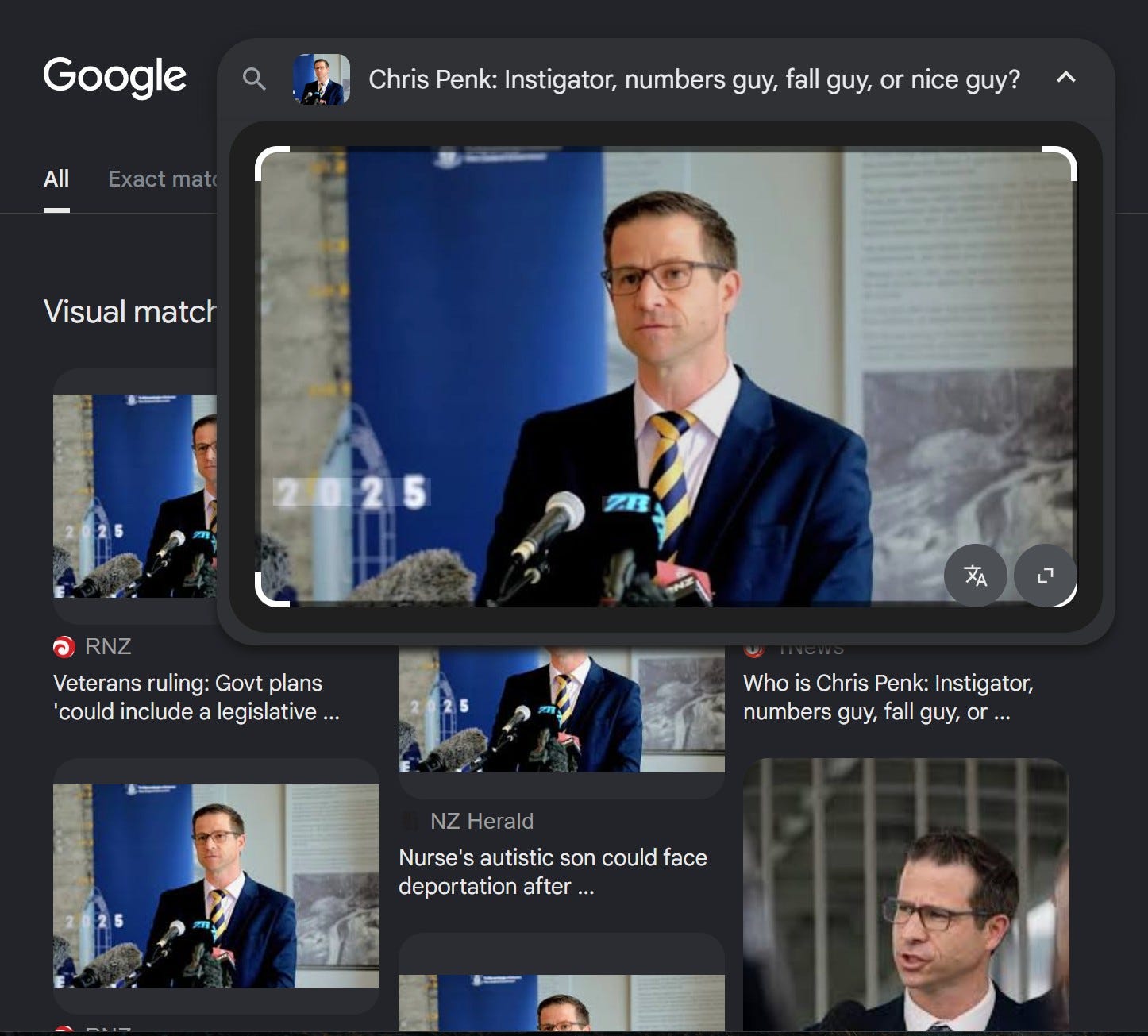
He was the Minister of Defence, GCSB, S.I.S. and Space from April 7 to 13 Aug. 2026.
When Penk first won this seat for the National Party in 2017, the electorate was still called Helensville, the same electorate that Key used as his symbolically-named staging ground to depose PM Helen Clark. Ahead of the 2020 election, the Electoral Commission adjusted boundaries and renamed the area Kaipara ki Mahurangi.
It may seem impossible that so many chess pieces can be stirred into a feeding frenzy.
Yet, this soft bullet-less coup played out with metaphor laden dates, that are the hallmark of a staged event to reset NZ’s political trajectory, that Snoopman chronicles.
Recall how on July 30, Stuff reported on numerous flights that Luxon had taken on the Royal New Zealand Air Force’s planes and choppers? In mid-June, Stuff hired National Party staffer and political columnist, Matthew Hooton, as the editor of its Wellington newspaper, The Post, and also for its weekend broadsheet, the Sunday Star-Times. From the mid-2000s, Hooton was one of small number of arch-right-wing bloggers who whimsically called themselves the Vast Right-Wing Conspiracy (VRWC), and whose antics were traced by the arch-lefty reporter Nicky Hager in his exposé, Dirty Politics.
Chess masters well above Hooton’s pay-grade, smarts, and clearance can play chess pieces like newspaper editors, tv news producers and radio show broadcasters.
———
When members of Luxo’s Cabinet emerged from the three-plus hour meeting, they looked like a family who’d scrapped right before a wedding, and one of the son’s was conspicuously absent. And all of the photographs record the palpable discordance.
In story-telling, after a climax, the writer provides a breather for the audience to assimilate the first act’s dramatic peak. The audience can see the protoganist’s solution decided at the end of Act I did not solve the problem in a complete way.
How uncanny, given that the lurid Lux Luthor Leadership Laundromat™ would not only dominate headlines domestically for three days straight. But also, the attempted gunless ‘coup’ over the Beehive, made world headlines, with reports featured by newsrooms at: the BBC, Bloomberg, Reuters, Strait Times, SBS, Taipei Times, ABC, China Daily, CKPG Today, RTL, Yahoo News Canada, Xinhua, Washington Times, Kiro 7 News Seattle, ABC4 Utah, Saudi Gazette, TRT World, Malay Mail, The Sun Malaysia, The Peninsula, Canberra Times, Associated Press, France 24, Namibia Press Agency, FSX Business News, The Hill, the Guardian, and Down Under Voices.
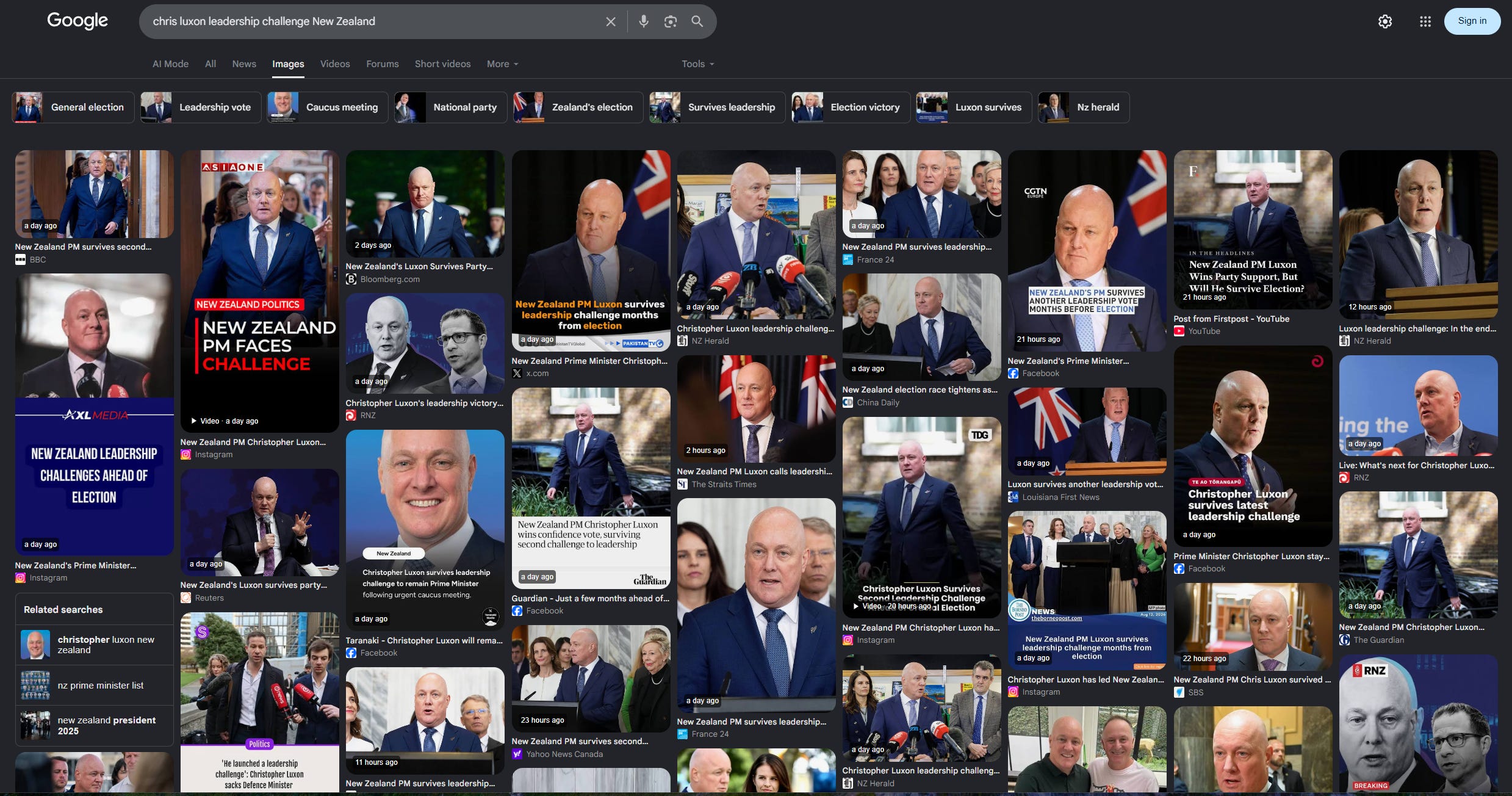
While he was head of Unilever’s North American Deodorants and Grooming corporate portfolio, he entertained dreams of someday becoming New Zealand’s global brand manager. “That would be the ultimate brand manager’s job,” he said.
‘The Fix’ to Establish a ‘National Ministry’ — Aug. 12 to Nov. 7
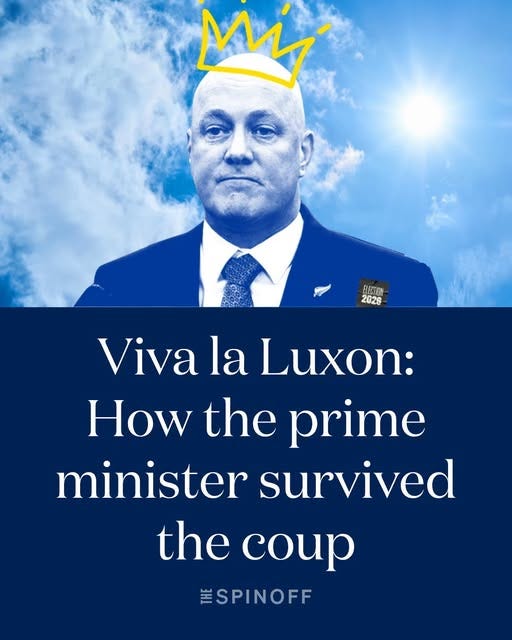
In case there’s any gagged coincidence theorists who are tied to dentists’ chairs with their eye-lids taped open, while the images scroll by, as they listen to this conspiracy noir dispatch on the substack reader app, perhaps the looming election’s date correspondence may light up neural paths across the barren terrain of closed minds.
The nation’s election is also a potently loaded date since it is set for November 7 2026.
On November 7 1912, the Public Service Act was passed into law, creating a framework for NZ’s bureaucracy that endured until 1988, when it was revamped. Back when governments proudly leaned into being elected dictatorships, the State Services Act, passed in 1988, and written by the quintessential technocratic policy wonk, Geoffrey Palmer, the Deputy PM and Attorney General, handed the corporatized State Owned Enterprises (SOEs) a private sector model that gave the CEOs control over the workers in their employ. Lay-offs swept through the public sector, short-term contracts were rolled out and unemployment climbed steadily while N.Z. got mangled.
Under the Public Service Act, state servants became the responsibility of the Public Service Commissioner, a statutory officer with authority over the whole public service.
New Zealand’s Public Service Department was a central player in the dominion’s ‘war effort’, domestically and overseas, administering the training and recruitment of soldiers and managing the bulk purchase of produce for Britain. However, the Public Service struggled with balancing complexity of keeping the country running in amidst a full-scale war, and meeting the needs of the all-consuming military demands. More than 8000 public servants served in the war, and over 1000 lost their lives, for an imperial fight picked by a volte-faced British Secret Elite, who blamed Germany.
Reading the runes, the Public Service Commission would be re-oriented, once the right-wing bloc re-won power, amid a domestic culture war that distracted the Public Service while it struggled to balance the complexity of keeping the country running, while in the midst of meeting the needs of an all-consuming of a covert civil war.
On August 16, Seymour, boasted about the ACT Party’s wider reset of the Public Service Act, to address laws that he viewed as “contrary to the foundations of this country, and the principles of a liberal democratic society that wants to give people a fair go”. Standing in front of the party branding in a carpark, Seymour said the Party would abolish race-based rules to reset the Public Service for all New Zealanders.
ACT’s One Law for All, One Future Together sloganeering claims that resetting state funding based on “need not race”, would eliminate preferencing one culture over all others. Yet, ACT’s brain is the ATLAS network of think-tanks, including the New Zealand Initiative, whose corporate roster are transnationals and domestic corporates, who are able to leverage an uneven playing field in an isolated, moated archipelago.
This membership includes the Big Four banks — ANZ, BNZ, ASB and Westpac — together regularly extort, extract and export over $6 billion in profits annually. The top institutional owners behind the biggest share-owning banks that hold stakes in ‘Big Four’ ANZ, BNZ, ASB and Westpac are: Vanguard, BlackRock and State Street.
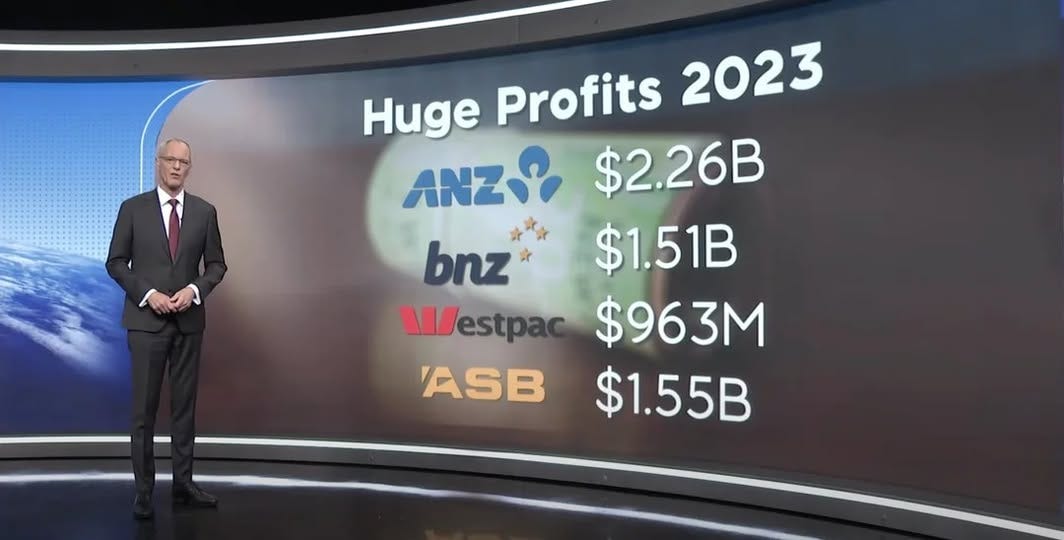
Snoopman has shown how the country is beset with a racketeering banking cartel.
The siphoning of profits to foreign coffers, combined with the constant destruction of the currency when the principle is paid off, amid a deliberate scarcity of debt-free cash compels the whole society to borrow the bank cartel’s conjured credit at interest.
Conspicuously, the Assocation of Consumers and Taxpayers Party has never campaigned to abolish the Good and Services Tax (GST) that taxes every transaction. Nor has ACT ever adovcated abolish income tax for workers. Such policies would hurt the banksters cartel, and the civil oligarchy whose entitlements are dependent on serving the Cryptocratic Dark World State, wittingly or not. If the ACT Party were to come out of its brand-friendly political closet, the honest name would surely be the Patriarchial Oligarchy Policy Party, or the POP Party, representing RichWhite men.
Given ACT’s moves to eliminate Treaty references in legislation, Tainui’s membership with the New Zealand Initiative was as brief as undies staying on a Vegas bar stripper.
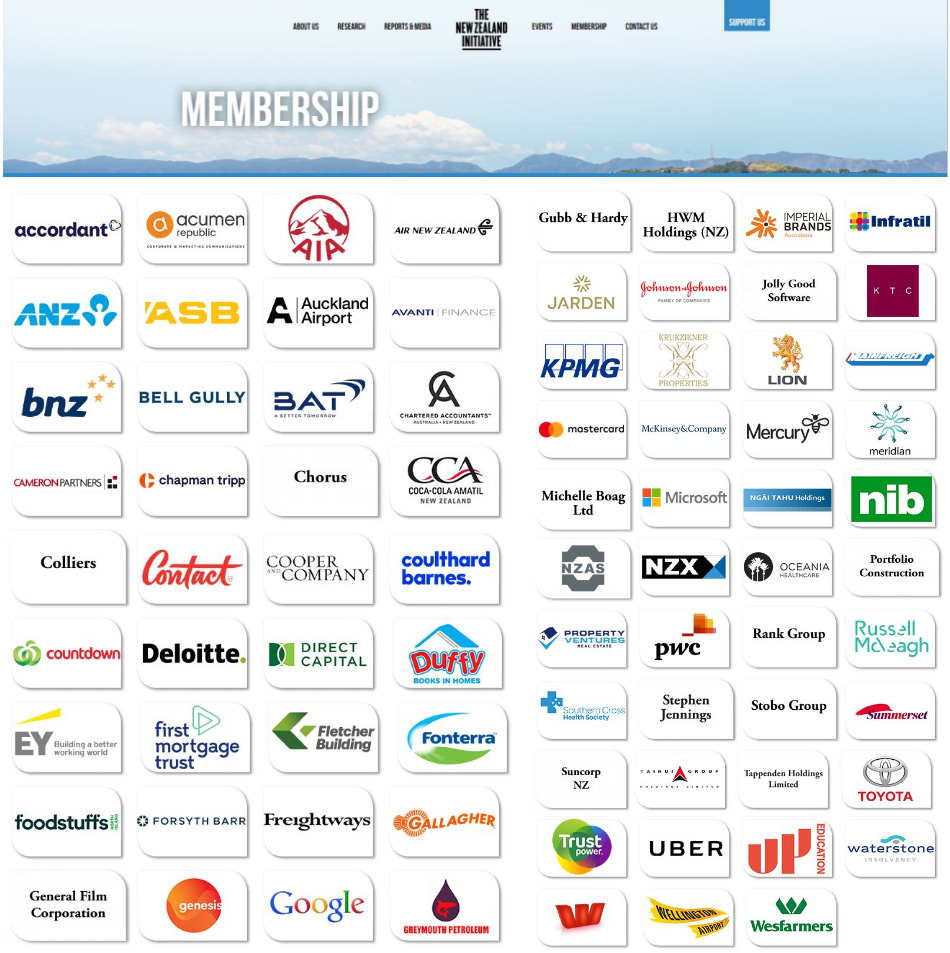
Clearly, the backlash to participate in what can feel like morning virtue-signalling sessions where karakia/prayers and wiata/songs in government workplaces has gotten organized. And, the pushback to curtail unnecessary cultural requirements for jobs.
Seymour claimed the nation’s founding principles were to create a secular and fair society, where peoples of diverse cultures come to New Zealand seeking a fresh start.
In his Barnum’s World Universe, Seymour’s conveniently twinks out the fact that over 230,000 New Zealanders have left the country since 2023, seeking a fresh start.
With this distorted framing, you could imagine a hologram of Seymour acting woodenly with the ethnographic economy of a tour guide at the opening of Peter Jackson’s Moa Park, in 2040, with co-sponsorship from the corporate members of Hobson’s Orders. Imagine the bio-engineered moas have been spliced with frog DNA to fill in the gaps. But, the inaugural tour goes awry when a giant Haast Eagle develops a taste for the country’s first corporate-owned baby, bio-engineered out of the DNA appropriated from the stars of Jurassic Park, Sam Neill, who played a paleontologist, and Laura Dern, who played a paleobotanist. But, in the Moa Park Universe, the clones of Neill and Dern play the roles of podcasters doing the inaugural guest commentary, while Jackson sqawks at hobbits to clone more ancient avians.
They learn Jackson hired Andrew Niccol, the screenwriter of the dystopian satire, The Truman Show, to give the theme park a Jurassic Park treatment, because he was cheaper than Michael Crichton. In the final draft, Niccol writes in a twist, riffing off the 1976 dystopian movie, The Network, that featured protagonist, Howard Beale, played by Peter Finch, the news anchor who was killed off live on air, on his own spin-off show because his corporate-mandated monologues were killing the network’s ratings and sinking the network. The demise of Howard Beale was schemed up by the ruthless Diana Christensen (Faye Dunaway), the network’s ratings-obsessed programming executive, who cut a commercial deal with a radical terrorist group called the Ecumenical Liberation Army (ELA) and a Communist party liaison named Laureen Hobbs. Together, they produced a weekly docudrama series called The Mao Tse-Tung Hour, which featured exclusive, real-life footage of the group committing bank robberies and other acts of political terrorism for prime-time entertainment.
In this imagined rework, the cyborg clone of Faye Dunaway has been programmed to run FF-Sake Inc., a franchised shock-pod subgenre of podcasting pioneered by the ‘Queen of Reality TV’ in New Zealand, Julie Christie. But, a radical genetic hackers group called GATTACA Anonymous, have bio-engineered a young version of Peter Finch, with the cover of a raving conspiracy seerist, who wears aviators even when he showers, to hide his cyborg eyes that film everything. At the halfway point in the film, clone Neill learns from Finch that the real Peter Finch just happened to die following a heart attack in the Beverly Hills Hotel a couple of months after The Network’s theatrical release. His demise occurred shortly before the 49th Academy Awards, where he was posthumously awarded the Oscar for Best Actor, and Dunaway won Best Actress. Neill learns Finch’s date of death, January 14 1977, after collapsing in the Beverly Hills Hotel, just happened to thematically riff off the date January 14 1914, when the City of Beverly Hills was incorporated. The real Mr Finch was sitting in the hotel lobby and was about to appear on ABC’s Good Morning America with Sidney Lumet, the director of Network. He was taken to the medical center of the University of California’s Los Angeles branch, where he was placed in the intensive‐care unit.
With this satirical movie seguey, Snoopman has demonstrated the same modus operandi of themed historical date riffing, codified into Mr Finch’s last bad morning.
So, after a breather following the staged climax Luxo Leadership climax, David Seymour announced on August 16, the ACT Party would abolish race-based rules to reset the Public Service for all New Zealanders, if the Coalition is re-elected. ACT’s timing was cute, since it was virtue-signalling as a cheerleader of cosmopolitanism, which is the same ideology adopted by Colonial Freemasons, who feigned inclusivity while its lodges were a mechanism for imperial expansion of the British Empire in the ‘New World’. (New Zealand Freemasonry downplays its role during ‘the Maori Wars’).
Given the military theming installed onto this election’s hustings, how uncanny was it that on August 16 1944, the New Zealand Council for Organisation for Relief Service Overseas (CORSO) was officially established. Brought together by a network of church, labor, and community groups, CORSO was originally created to support humanitarian relief, and rehabilitation in war-torn nations toward the end of World War II. It subsequently expanded as an aid organization in the developing world.

As the country’s primary overseas aid organization for decades, CORSO marked a significant shift in New Zealand’s cultural identity regarding global citizenship. CORSO also commissioned a documentary, A Fair Deal, exploring the roots of poverty in New Zealand. It’s central theme was that big business and government monopolies had resulted in half a million Kiwis being trapped in poverty and that the way New Zealand traded with countries like Fiji, contributed to poverty there. It also questioned the authority of Cabinet, arguing New Zealanders were becoming powerless. State television, TVNZ, refused to broadcast it. The National government led by the Mr Robert Muldoon, stripped CORSO of its tax-exempt status and annual grant for being “too political”. Publicizing Māori poverty was awkward, evidently.
Ergo, Seymour was re-pivoting ACT’s brand with a global citizenship identity, while erasing how the ‘Richwhite Establishment’ is a client civil oligarchy of the ‘American Empire’ that controls NZ’s strategic resources — amid tectonic geopolitical shifts.

After the staged Act 1 climax over who should prime minister the National Ministry, the first focus point arrived on August 19th when the Tauranga City Council reported the findings of the inquiry into the Mount Maunganui Beachside Holiday Park landslide, where six people died when they became trapped in a toilet block at 9.30am January 22 2026, following a storm overnight. The meta-data of dates associated with the storm tells a cruel story on a metaphor-laden engineered ‘extreme weather event’.
How uncanny that the 19th century architect of New Zealand colonization, Edward Gibbon Wakefield, was elected to the Colonial Parliament on August 19 1853?
His election — after promising land grants to workers who had migrated under his land settlement scheme — was a significant governance milestone since the colonial theorist, and New Zealand Company architect, Edward Gibbon Wakefield, occurred during the first general and provincial elections enabled by the British-passed New Zealand Constitution Act of 1852. Key dates associated with the storm’s formation and progression corresponded thematically with NZ’s military history. Ergo, in the future, engineered storms are to trigger ‘managed retreats’, or the re-settlement of NZ’s commoners, who are in effect cast as ‘insurgents’ to be corralled into 15-minute zones.
Ergo, the landslide disaster triggered a reset across councils for storm risk mitigation, and preparedness, as well as response powers, under a staged climate change rubric.
If you squint, the storm developed with uncanny correspondences to dates associated with civil disturbances in New Zealand’s past, or in actions involving New Zealanders.
On January 12 2026, Tropical Low 14U formed while it was in the Australian region near the Soloman Islands, and on January 19, it entered the South Pacific Basin, and upon crossover was designated as Tropicial Disturbance 05F by the Fiji Meteorological Service. And, on the 20th, the Joint Typhoon Warning Center (JTWC) classified it as a subtropical cyclone. On 21 January, the system transitioned into an extra-tropical cyclone and had severe impacts in northern New Zealand. MetService issued Red Warnings for heavy rainfall in some regions of the North Island, N.Z.
How uncanny that a tropical low that formed near the Soloman Islands on January 12 (and that would seven days later be designated as tropical disturbance), since its formation riffed off the occasion when the cruiser, HMS Dunedin, arrived at Apia in Western Samoa to quell the Mau Disturbances on January 12 1930. Particularly, since Samoa is located much further east of the Solomons, placing it deep within the South Pacific Basin. Weather monitoring and tropical cyclone forecasting for Samoa are handled by the Fiji Meteorological Service (RSMC Nadi) and the Samoa Meteorological Service. When systems like Tropical Low 14U cross the 160°E line, the Australian Bureau of Meteorology hands tracking responsibilities over to RSMC Nadi.
Especially uncanny, when the tropical low was classified as a tropical disturbance on January 19, a date that thematically riffed off the time when the flagstaff at Kororāreka was cut for the third time on January 19 1845. This symbolic and heated act led to the ‘Flagstaff War’ of 1845 to 1846 between Māori and the British Army, after the flag pole was cut a fourth time on March 11 1845. And, what are the odds that when this subtropical cyclone transitioned into an extratropical cyclone on January 21, this date thematically riffed off the date, when the ‘Tauranga Campaign’ of the New Zealand Wars, commenced on January 21st 1864. Although no fighting occurred on January 21 1864, but it marks the official military operational timeline designation for the deployment of forces into the Bay of Plenty region, for the Tauranga Campaign. Since a landslide occurred January 22 2026, how uncanny was it that on 22 January 1864, Colonel George Carey landed at Te Papa, in Tauranga Harbour, with about 600 men?
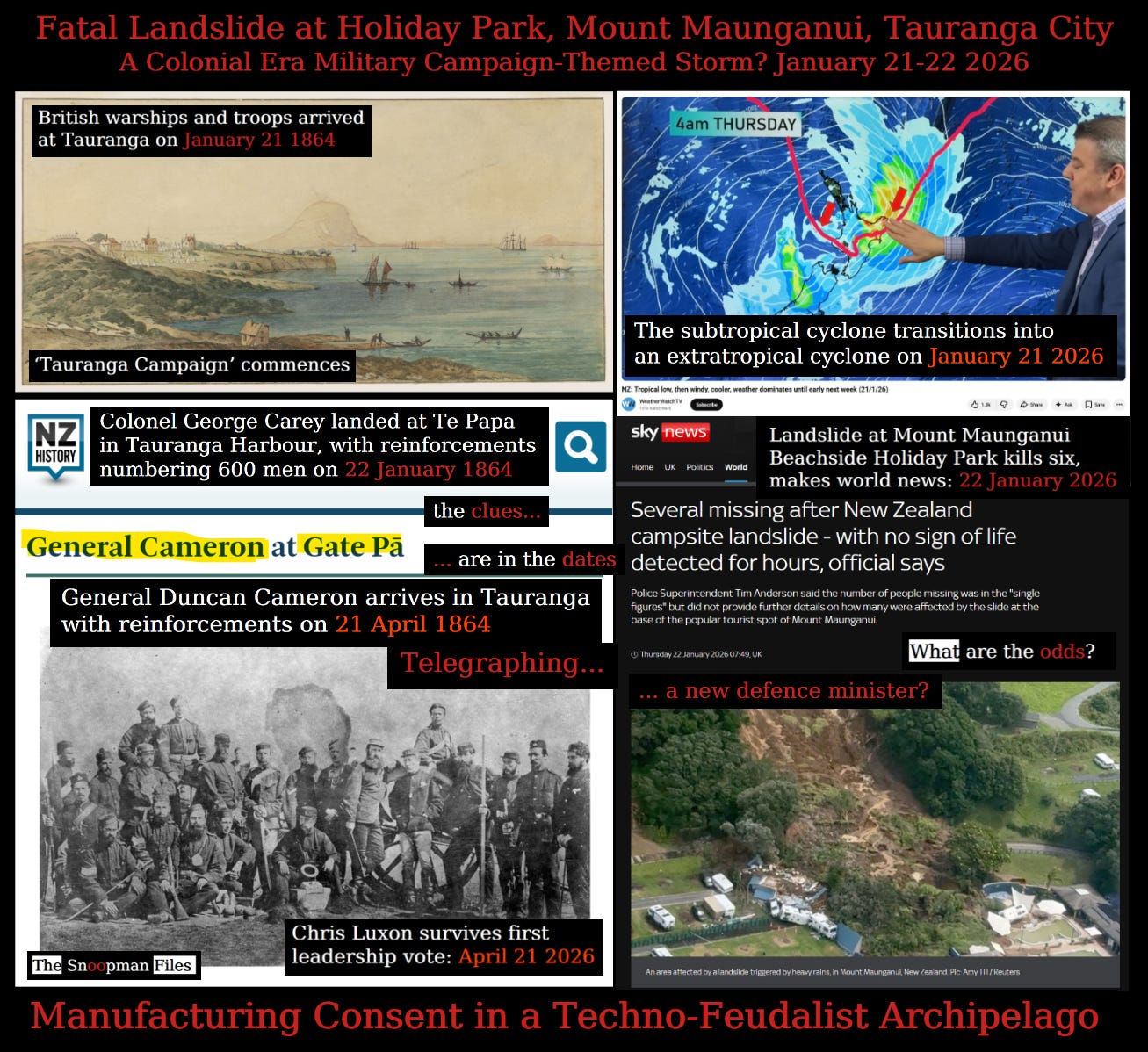
To recap, a tropical low pressure system formed on January 12 2026, the same day, when a cruiser from the New Zealand Division of the British Royal Navy arrived at Apia in Western Samoa to quell the Mau Disturbances on January 12 1930. The low was classified as a tropical disturbance on January 19, a date that thematically riffed off the time when the flagstaff at Kororāreka was cut for the third time on January 19 1845, and led to the outbreak of war in the Far North, and to extensive land loss for Ngāpuhi. And, when the brewing storm transitioned into an extratropical cyclone on January 21, this date thematically riffed off the date, when the ‘Tauranga Campaign’ of the New Zealand Wars commenced on January 21st 1864. And the next day, 22 January 1864, Colonel George Carey landed at Te Papa, in Tauranga Harbour, with about 600 men. How uncanny was it, the same day, January 22nd in 2026, the landslide occurred?
Ergo, a civil-disturbance and military-themed storm was conjured to entrain a nation.
Naturally, the independent inquiry did not consider whether the inclement weather had been engineered to ensure a catastrophe at ‘the Mount’. The cryptocracy selects individual, institutional and ideological ‘infrastructure’ to ensure the narratives, the findings and recommendations fit into the acceptable frameworks. Consider how the U.S. Government authorized a weather modification program called Project Cirrus, beginning in 1946. The US Army, Navy, Air Force gained the practical, technical, and physical skills, knowledge and data about how to manipulate the ferocity, trajectory and velocity of hurricanes during this weather modification program. (The USG, and companies, continued to develop weather modification mechanisms into the present).
A Government Inquiry into the Fatal Landslides in Tauranga was set up to establish how the landslides occurred. Applications for a senior comms and engagement lead position closed on June 21 2026. What are the odds this date thematically corresponded with the same day, June 21 1864, that the ‘Tauranga Campaign’ ended?
Ngāi Te Rangi Chief Rāwiri Puhirake was killed at the unfinished Te Ranga Pā on 21 June 1864, in a brutal attack led by Lieutenant-Colonel Henry Greer to exact revenge for the heavy casualties at Gate Pā, following an artillery bombardment on April 28.
Ergo, with this colonial era military campiagn-themed storm, the cryptocracy were telegraphing a new defence minister at the next election with a ‘National Ministry’.
With this job application deadline for Senior Comms and Engagement Lead for the Government Inquiry into the Fatal Landslides in Tauranga, the cryptocracy had codified that a ‘new normal’ featuring governance by emergency, managed retreats and an infrastructure bonanza would require manufacturing consent of the public.
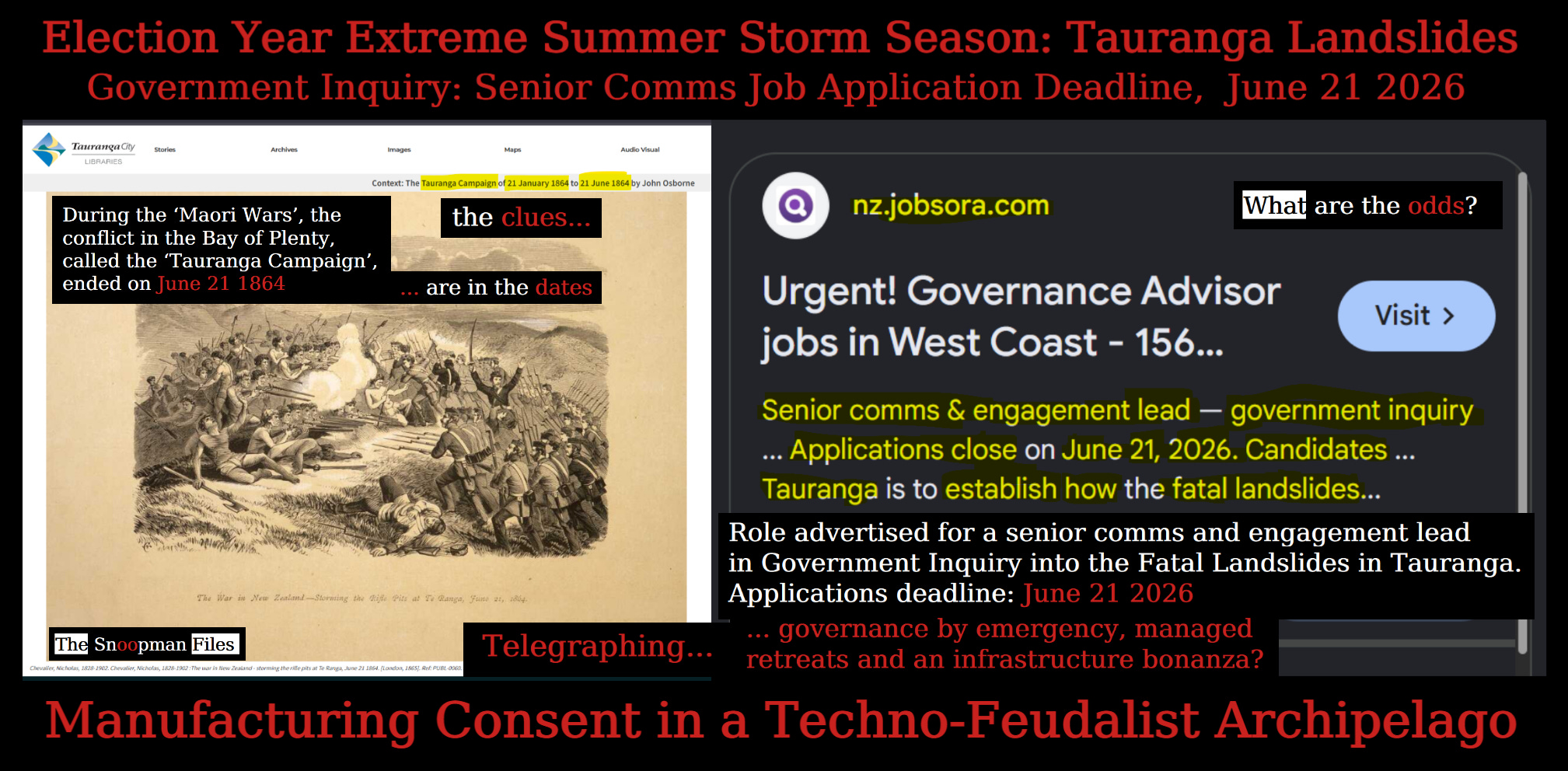
And, consider the sequence of staged disasters, crises and other catalytic events to re-integrate New Zealand back into the American following the fallout over ANZUS.
This themed date-riffing is the dead give-away of a staged faux leadership challenge, timed to create a focus point to tighten the plot-line for the incumbent coalition partners to gun for the goal of a war-time ‘National Ministry’. This psychic voodoo works on political parties and the population alike, without them comprehending there was an engineered election year extreme summer storm season (or EEYESSS).
The seven political parties tracked by the polling companies haven’t really thought through the digital dystopia being built in NZ. If you squint, this digital dystopia is detectable in the NZ Herald’s 36-page B-Section special, “Infrastructure Reality Check”, published on August 20th. This copy wasn’t journalism featuring proponents competing with critical voices. Only advocates. How curious, there wasn’t a single contribution penned by any Māori leaders of any entities, or hapū, or iwi, across the entire country. After all, the Herald has a dedicated Māori desk called ‘Kāhu News’.
Since the New Zealand Herald “Infrastructure Reality Check” special landed on August 20th, how uncanny was it that the S.S. Golden Age sailed its first trip between Port Chalmers to Dunedin on August 20th 1863? After all, the rhetoric of the Resources Minister, has featured golden age-themed noises. In The Post’s news story headlined, “Golden age or golden goose? Mining claims challenged”, (May 20 2026), a Massey University geography professor, Glenn Banks, said “Mining, under the current regime, will not contribute significantly to the national economy,” during a discussion on critical minerals and the role of mining in New Zealand, at Victoria University.
Banks said New Zealand’s low mineral royalties regime; mining companies being foreign owned; volatile company tax payments; fluctuation of mineral prices; and lack of a supporting infrastructure, together meant many things had to be imported, and these factors all undermined assertions of mining’s benefits, as Mike White reported.
Reporter Richard Harman noted the Minister of Resources, Shane Jones, is also the Minister of Regional Development, to make the point that extraction of minerals and petroleum couldn’t happen at the scale envisaged without infrastructure development.
The free trade deal with India helps it goal to develop by 2047 and fits with the NZ Government’s plan to develop its minerals export capacity to $3B annually by 2040.
On November 5 2025, Minister of Resources Shane Jones proclaimed that “New Zealand was entering a resources golden era”, while announcing that the Government’s New Zealand Petroleum and Minerals Agency had granted Matakanui Gold Limited, a subsidiary of Santana Minerals, a 30-year mining permit for the Rise and Shine prospect, as part of the Bendigo-Ophir Gold Project in the Dunstan Mountains. “This is a major milestone for the progression of a project that will deliver well-paid employment, infrastructure investment, and economic resilience in Central Otago,” Mr Jones was quoted as saying. What are the odds that this milestone date would riff off the historical date of November 5 1913, when the Battle of Featherston Street occurred? During the most violent street clashes of the 1913 Great Strike, downtown Wellington, Prime Minister Walter Massey’s mounted constables known as the ‘Specials’, bludgeoned wharfies and coal miners as the strikes spread following disputes on the Wellington waterfront and at the Huntly coal mines. Moreover, the date is also loaded emotive charge since it was on November 5 1881, when the Armed Constabulary invaded Parihaka Pā, to arrest Te Whiti-o-Rongomai and Tohu Kākahi, both of the Taranaki and Te Āti Awa iwi. They led a non-violent resistance ploughing up fields on farm land, that had been confiscated to establish Masonic Capitalism.
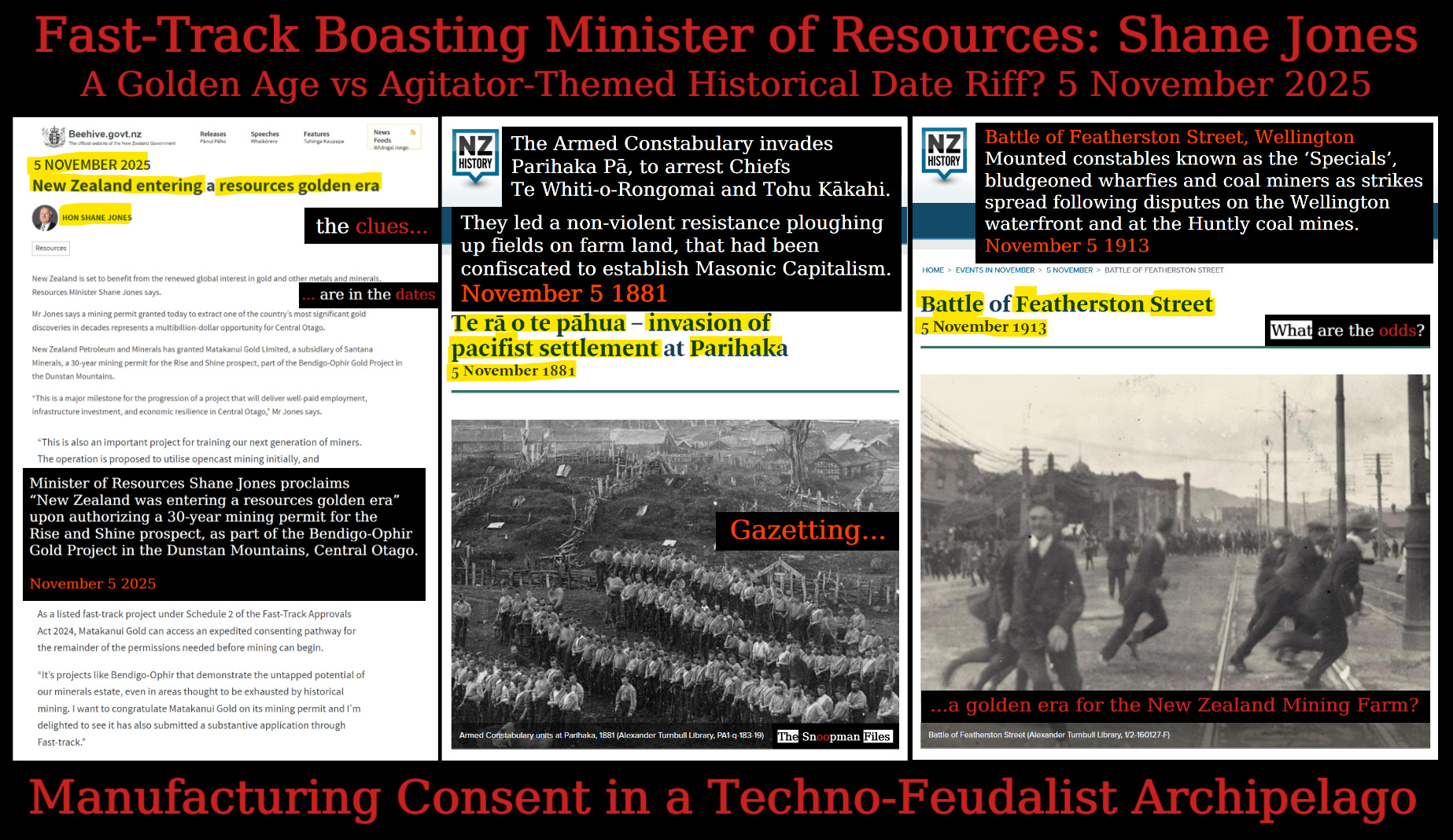
Sticking with the war-time theming, remember remember it was on the 5th of November in 1914, when France and the British Empire (including New Zealand) declared war on the Ottoman Empire? This development was a key objective of the British Secret Elite, in order to up-end the building of the Berlin to Baghdad Railway, to transport oil, and would have broken the Suez Canal monopoly. The British Secret Elite, had first conspired on February 15 1890 at Lord Nathaniel Rothschild’s country estate to discuss a world domination plan hatched by Cecil John Rhodes, as any newsroom possessing a copy of Gerry Doherty’s and Jim Macgregor’s Hidden History: The Secret Origins of the First World War — would know already, need Snoopman say?
Jones had previously claimed “New Zealand is in the midst of a resource renaissance,” and “a new epoch of wealth and prosperity [by circumcumventing] trickle-riddled processes to hold projects ransom.” His job has been to over-turn those obstacles. When asked about the resources, Jones said New Zealand has ironsands deposits that are “Sahara scale” under the seabed, that are rich in titanium and vanadium metals.
New Zealand’s maritime boundaries includes a 200 nautical mile wide exclusive economic zone (EEZ) out from its swiggly jaggery coasts, and sits atop the submerged continent of Zealandia, some of it was once above current sea-levels in a warm climate.
One of the “Infrastructure Reality Check” supplement’s sponsors was Forsyth Barr, the doyen of Dunedin’s legal fraternity. How uncanny this supplement would drop the day after the independent inquiry into the Mount Maunganui Holiday Park Landslide landed. Especially, given that the tragedy resulted from a storm designated as a Tropical Low on January 12 2026, a date that just happened to riff off the time when the cruiser, HMS Dunedin, arrived at Apia in Western Samoa on January 12 1930, to quell the ‘Mau Disturbances’, that arose after NZ military police fired on a procession of the non-violent Mau Movement, agitating for indepedence from colonial rule.
Given that Forsyth Barr is also a member of the New Zealand Institute, a sponsor of the Herald’s “Reality Check”, there’s also a curious correspondence to the history of the S.S. Golden Age sailing its first trip between Port Chalmers to Dunedin, and the Resources Minister Shane Jones talking about the major milestone on the occasion of Santana Minerals, gaining a 30-year mining permit for the Rise and Shine prospect, that is part of the Bendigo Gold Project in the Dunstan Mountains. After all, Mr Jones became symphonic, saying “New Zealand was entering a resources golden era”.
Santana Minerals is a member of the New Zealand Resources Council, which lobbied in support of the free trade deal with India to include tariff-free exports of coal.
The cryptocracy’s gleeful entitlement is evident by the psychotic humor codified into timing of the ‘Rise and Shine’ prospect, which reached a milestone approval on November 5 2025, with all it potent history in New Zealand history of resistance. And the cryptocracy’s gleeful entitlement is evident by the psychotic humor codified into timing of the New Zealand Herald’s special supplement entitled, “Infrastructure Reality Check”, that heralded a resource renaissance on the same day that the S.S. Golden Age sailed its first trip between Port Chalmers to Dunedin on August 20th 1863, since Otago’s gold rush in the 1860s fuelled its colonial-era ‘golden age’ in development.
Ergo, a golden era in resources extraction ‘requires’ a coordinated stealthy Military Campaign, to ‘democracy’ a majority of monkey minds to unwittingly thunk on the same techno-feudalist wavelength. Bewitchingly, engineered storms can manufacture consent, when the majority of monkeys don’t ‘know the signs’ of the weather wars.
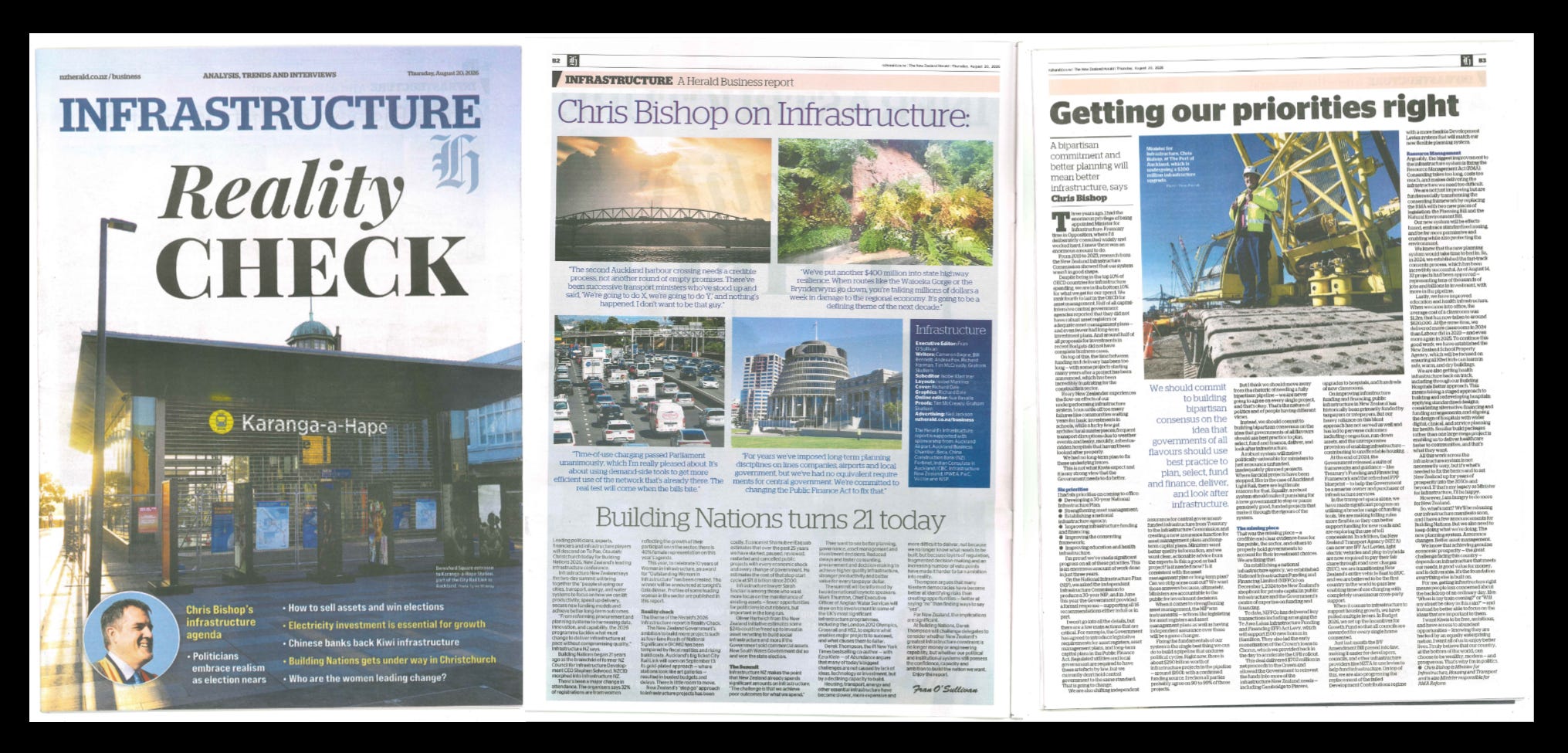
The Herald’s Māori Desk needs a skyway walk installed to reach the RichListers’ Desk.
The Chief Executive at Auckland Airport, Carrie Hurihanganui, was featured in the Reality Check spin, “Top Women in Infrastructure Urge Long-Term Planning”. She is a board member of the New Zealand Initiative, the think tank that formed out of the 2012 merger between the NZ Institute and the NZ Business Roundtable. Hurihananui who is from Rockford, Illinois, and married a Māori man, talked about managing Auckland Airport’s $5.7 billion redevelopment. She described the different agendas of regulators, investors, business partners, airlines, travellers, iwi, suppliers and freight as a complex ecosystem of ‘stakeholders’, perhaps without realizing the term’s origin.
The World Economic Forum co-founder, Klaus Schwab promoted a rebrand: stakeholder capitalism. As a 26 year-old at Harvard University, Schwab attended Professor Henry Kissinger’s “International Seminar”, which was funded by the CIA via a known conduit. Subsequently, Schwab gained three mentors: Kenneth Galbraith, the economist; Henry Kissinger, President Richard Nixon’s Secretary of State and National Secuirity Advisor; and Herman Kahn, a forecaster of nuclear technologies.
Kahn also had vision to develop a two-track education system to groom élites eventually saw its manifestation in programs like the World Economic Forum’s Young Global Leaders academy. As such, education became more systematically asymmetric to better serve the global power élites’ project of world system transformation. Jacinda Ardern and Simon Bridges were inducted into this WEF-grooming program.
Thus, without the NZ public comprehending the machine behind the grooming of political leaders across the so called ‘western liberal democracies’ to narrow the choices for future general selections, Ardern and Bridges were ‘breakfasted’ at TVNZ.
And, Ardern had selected Luxo-LuxoMan to be her chairman of the Prime Minister’s 13-member Business Advisory Council, in October 2018, some six months after Luxon had dined with Barack Obama and John Key at the $13,000 a night Landing Lodge.
Luxon’s career trajectory was facilitated by global elite interests, as was laid out in a dispatch “Lux Luthor — Part 1: Operation Overwealth” on the Snoopman Files. The hi-octane propulsion behind Luxo’s career trajectory was codifed with the prime number 13. It has long been used to procure marriage arrangements from antiquity among brotherhoods through to present-day crony capitalists, right-wing politicians and the Atlas network think-tankerati, who audaciously moan about “co-governance”.
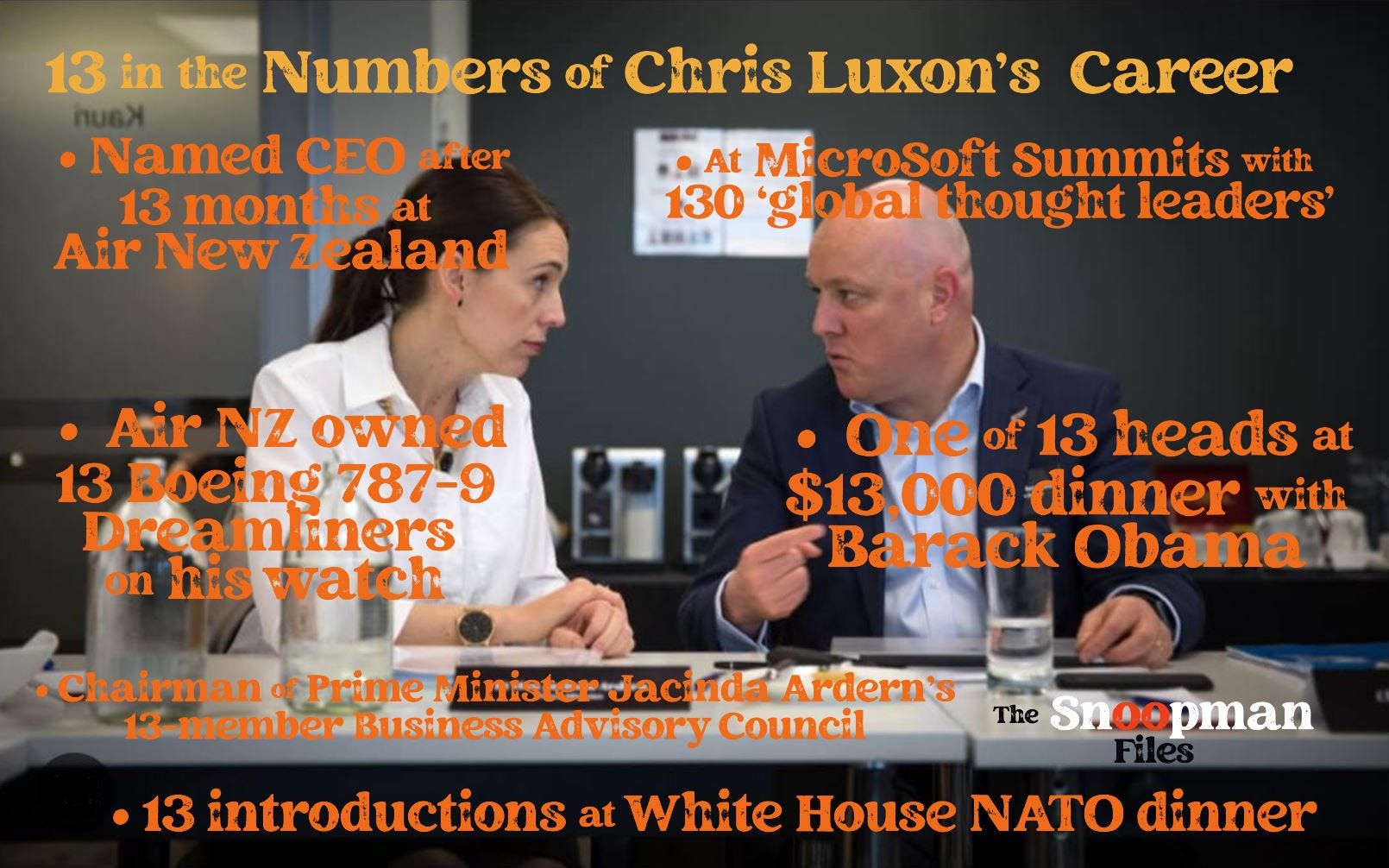
In 2017, Luxon travelled with 40 CEOs to Switzerland as part of a business delegation sponsored by the New Zealand Initiative, as New Zealand Inc. founder, Fran O’Sullivan, reported in “Kiwi bosses set off in search of secrets behind Swiss success”.
Kissinger, Galbraith, and Kahn opened doors for Schwab to start the WEF in 1971. The WEF’s famous January meetings in Davos, Switzerland, are the first in the annual migration of the lizard-lords, who loyally serve the vampiric illuminati overlords.
Under Schwab’s directorship, the World Economic Forum, has sought the fusion of computing technologies such as artificial intelligence, robotics, nanotechnology, 3-D printing, and telecommunications — with brain research and biological life and aims to alter biological functionality of all life-forms to fit the new ‘economic model’.
Poignantly, the underlying purpose of CIA’s secret mind-control, brainwashing and indoctrination experiments, code-named MK-ULTRA, was a systematic study of how to reduce humans into fully manipulated goal-seeking devices, who would act against their own best interests to assist in the development of a global social control matrix.
In other words, the world’s vampiric lizard overlords have inflicted an exquisite con job on career-driven women, who have benefitted from the swagger that the women’s liberation movement afforded them. Yet, they can’t see how they’re being played, to build out a slick shiny totalitarian matrix that the patriarchy couldn’t by themselves.
Absent was a ‘Telegram’: “Maori Chiefs Query Technocratic Tickets, Tolls and Taxes”.
Ergo, the Auckland Airport re-development will be a digital panopticon transit node.
New Zealand’s industries are top heavy with market-dominating price-gouging cartels, the New Zealand Herald’s ‘Infrastructure’ special omitted to say. This market monopolizing structure extends to the building and civil engineering industry, that is controlled by big firms, including Hawkins, Fulton Hogan, Downer, Higgins, Dominion, Brian Perry Civil, Naylor Love, Southbase, Arrow, Aurecon and Fletchers.
Moreover, since Fletcher Building is 57% owned by four global banks (HSBC, 16.76%; Citicorp (19.05%); JP Morgan (13.91%) BNP Paribas (7.65%), its leverage to draw upon cheaply manufactured credit, supplied by these banks as shareholders in the Federal Reserve, is a matter that perennially evades media attention and public awareness.
These matters the Harvey Norman Herald won’t cover with any effective depth because the newspaper is owned by NZME Limited; itself is 40% owned by foreign banking interests, (CitiCorp, 20.56%; HSBC, 10.28; BNP, 768%); and 11.87% owned by domestic banking and financial interests (NZ Reserve Bank’s NZ Central Securities Depository, 10.15%, and FNZ Custodians; and 18.44% by Canadian centi-millionaire, Jim Grenon.
The two American banks, CitiBank and JP Morgan Chase, along with one British bank, HSBC (Hongkong and Shanghai Banking Corporation) have a presence in NZ.
CitiBank is owned by Citigroup, which in turned is majority owned by institutional investors including: Vanguard holds approximately 8.801% of shares; BlackRock owns a 6.589% stake, and State Street Corp manages around 4.357% of shares.
JP Morgan Chase’s institutional shareholders account for 74.92% of total shares as at March 2026. The top three institutional shareholders are: Vanguard, 9.85%; BlackRock, 7.85%; and State Street, 4.65%, Investopedia reported, as at Dec. 31, 2025.
HSBC (the Hong Kong and Shanghai Banking Corporation) is also majority owned by institutional investors with the top three stakes held by: Fisher Asset Management, 21.3%; Dimensional Fund Advisors, 12.4%; and Morgan Stanley, 8.97%. In turn, the top four owners of Morgan Stanley are: Mitsubishi UFJ, 23.91%; Vanguard, 7.59%; State Street, 6.58; and BlackRock, 6.04%, according to Yahoo Finance as at Dec. 31 2025.
The Canadian centi-millionaire, owns $32 million in NZME stocks, as of March 2026.
Grenon was a corporate member of the N.Z. Initiative in 2022, but his visibility soon vanished from the think-tank’s website, that represents N.Z.’s civil oligarchy and corporates, including corporations with a trans-national agenda to capture minors with shiny marketing to accept their techno-feudalist enslavement transition therapy.

Grenon shares co-governance over NZME’s news, current affairs and editorials with foreign and domestic banks, and Vanguard, BlackRock and State Street — in effect.
With such an ownership structure, you won’t see NZME’s media brands open an agenda-setting front to critique the banking cartel’s structural control over the state’s finances. Nor, would you read any “Extras!” editions all about how the inflation-targetting mechanisms work as stealthy defacto-peddles, gears and levers to regulate the economic life of a people cast on the ‘Survivor Islands’ of an archipelago in the South Pacific. Nor, would you hear any podcast retraction specials exposing the ‘directed dictatorship’ wielded to inflict a Shock Doctrine economic warfare with the incoming Lange Government, in accordance with a broader blueprint hatched in the 1970s at the Council on Foreign Relations in Gotham, called the ‘1980s Project’.
Because, the news filtering mechanisms described by the Propaganda Model work.
The nation is saddled with a debt-based monetary system that is reliant on banks conjuring interest-bearing credit to ‘buy the currency’ with ‘loans’ via the ‘auction’ of Treasury securities or government bonds. Moreover, households, businesses and state agencies and councils all pay taxes (since New Zealand maintains a transactions tax).
Since the state doesn’t exercise a productive power to issue sovereign foundational credit, to fund real economic activity matched to resources, capacity and need, the private banks monopolize the credit issuance, requiring interest-bearing ‘repayments’.
In effect, this status quo means the racketeering bank cartel issues ransom notes to the country’s Treasury. It is only the degree of the grip that this domestic violence varies. Yet, Iain Parker has provided a solution of ‘Sovereign Foundational Credit’ to replace a system of domestic and foreign creditors draining the nation’s dynamism.
NZME’s main newspaper competitor is Stuff. After company CEO, Sinead Boucher famously bought Stuff off Nine Entertainment for $1 in May 2020, the New Zealand Herald described the bargain appearance of the deal as a misnomer, since Stuff’s liabilities sat at $73.9m in June 2019. It is possible that Stuff’s debts to financial creditors bought invisible influence over editorial decisions in news and current affairs, as the Propaganda Model developed by Noam Chomsky describes more generally. Sinead Boucher, who owns 100% of the shares in Kenepuru Holdings Limited, the ultimate holding company of Stuff newspaper and Three TV assets.
Meanwhile, TVNZ, RNZ and Māori TV are Crown-owned, so their ‘free speechy’ voices are also contrained by the same five broad news filtering mechanisms, as NZME and Stuff-Three. The Propaganda Model, as developed by Edwards S. Herman and Noam Chomsky in 1988, is comprised of five news filters through which news is processed for mass consumption: [1] size, ownership and profit orientation; [2] advertising; [3] expert sources; [4] flak and the enforcers; and [5] ideology. The state’s arm’s length is a bit shorter for the public broadcasters, than it is to the newspapers.
And since it is Snoopman’s supposition that the cryptocracy has penetrated every significant institution, he adds a sixth filter [6] buying-out, to model for corruption, collusion and conspiracy in or over newsrooms, as he did with his masters thesis.
———
Let’s recap. ModiMan lands in Auckland after dark on the Warrior Bombing’s 41st anniversary, on July 10, and signs a free trade deal with LuxoMan the next day, with vote-buying fanfare. Muldoon’s DollarMan, who was the pointman for leading the currency change on July 10 1967, dies on August 10, which riffed off the date the HMS Britomart arrived at Akaroa, the French settlement, thereby beating the French frigate L’Aube, that had sailed silently after dark into the Bay of Islands, on July 10 1840. And, the faceless DollarMan leaves a widow, Beatrice Este, who was named after her ancestor, Beatrice d’Este, made famous by Dante Alighieri. Her coily DNA got swishy between the posh sheets of every Royal House of Venetian Britain, Europe and Russia.
And the Venetians Oligarchy, who formed the Council of Ten on July 10 1310 and who soon shape-shifted into Governors of proto-central bank — would eventually forge an invisible new Roman Empire — spreading its debt currency system that repeatedly destroys itself with repayment and stokes cyclical crises with the burden of usury.
And JurassicMan dies on July 13 2026, four days before Muldoon’s ‘Think Big’ energy infrastructure minister. BirchMan dies on July 17, drawing LuxoMan to his funeral.
A skeptical reader might warily say that Snoopman has ventured into a metaphorical archer’s long bowman contest, with his conspiracy noir. Recall how Neill opposed a proposed gold mine in the Dunstan Mountains in Central Otago? And, he said the backlash was disturbingly toxic, and the derision of JonesMan stoked the unhinged?
Let Snoopman snoop-splain the parallels between Sleeping Dogs, and the current political moment, and the uncanny thematic date riffs that draw upon Neill’s life story.
➳ The Luxo Laundromat™ and the Death of Muldoon’s Fictional Enemy
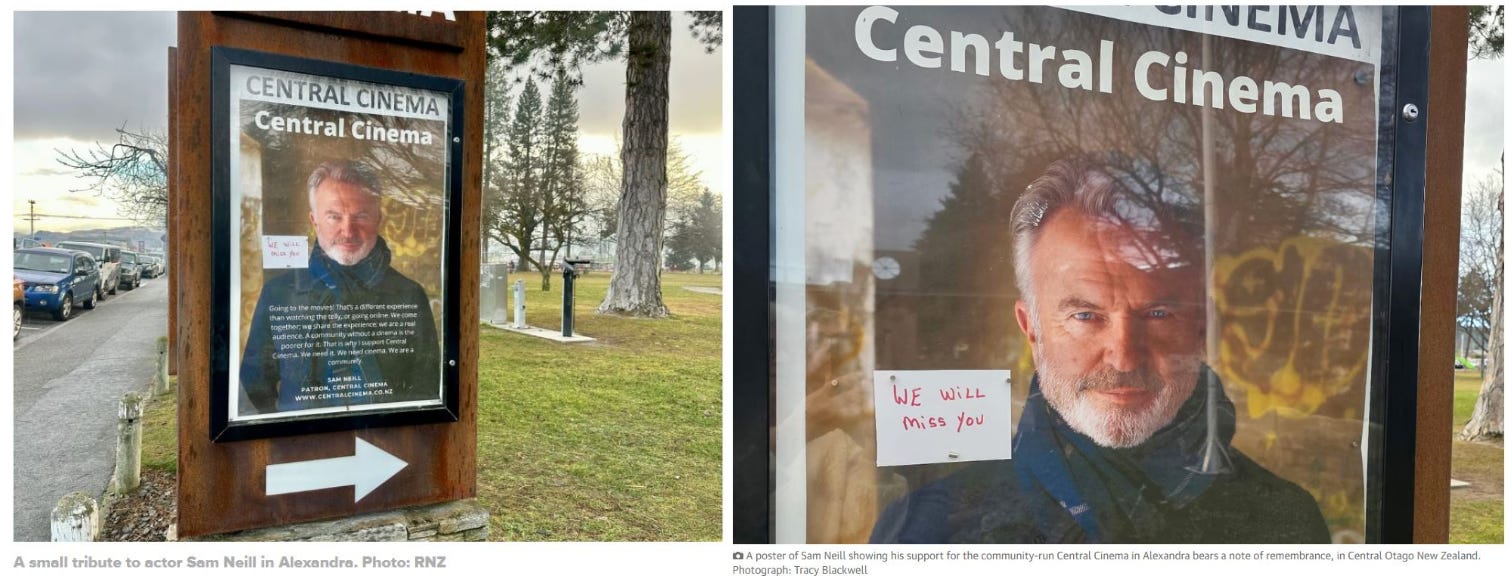
Four days before the death of Muldoon’s Minister of Energy, a world famous actor whose debut movie cast him as a reluctant rebel figure who becomes embroiled in a resistance against a fascist government amid a foreign-borne oil crisis, died suddenly and from his family’s perspective — unexpectedly. Sam Neill died on July 13, aged 78.
His metaphor-laden death is entwined in this war-time themed National Ministry plot.
Neill passed away at St Vincent’s Private Hospital in Sydney, surrounded by his family, after he had been sick for a couple of weeks, an ex-partner told ABC.
His debut on the silver screen came during Muldoon’s nine-year reign as prime minister, which included petrol rationing, carless days, and labour strikes amid a cost of living crisis sparked by two oil price shocks conjured by NATO’s Bilderberg organ.
Among the thousands of tributes, Luxon conjured the full powers of his imagination when he tweeted that Sam Neill was “one of the greats”. From the cryptocracy’s perspective, the death of Mr Neill was necessary because he had opposed a proposed open-cast gold mine near Cromwell. So, in an election year, his high profile support of an environmental protection group threatened not only Santana Minerals, an Australian mining firm. If such a stand continued unchecked, other celebrities might become emboldened in other places. Neill said supporters of Bendigo-Ophir, the proposed gold mine, had threatened him. The goldmine is among hundreds of applications being considered under the coalition government’s new fast-track law.
Resources Minister Shane Jones, who expounds the “drill, baby, drill” mantra like he wants to reincarnate as a pick-up truck bumper sticker, derided Neill’s “anti-Kiwi” opposition stance. “There is a big difference between standing as a parliamentarian advocating for economic growth, and a Hollywood actor. The world I occupy is the real world. It’s not make believe Hollywood, thespian antics,” Mr Jones said.
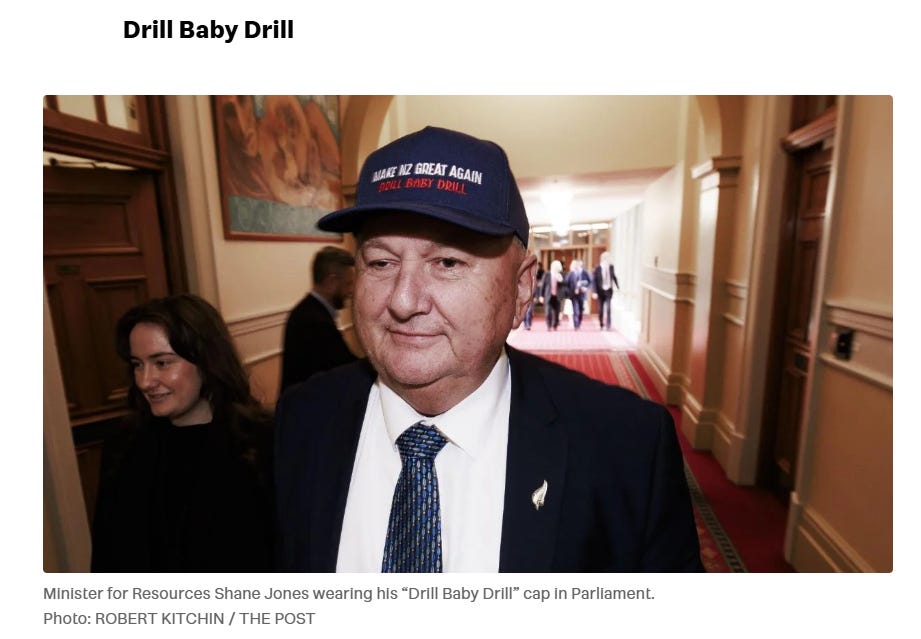
In the world that Jones occupied in 2010, back when he was a Labour Party MP, and at a time when National proposed to open the areas of Conservation Estate to mining, he compared the Key Government’s to a “Muldoonist approach [by] quarrying the nation”.
In March 2010, the Key Government announced a public consultation to change the classification of ‘Schedule 4’ Conservation Lands, leading to 40,000 strong protest in May. New Zealanders had no idea that a staged sabotage at Pike River Coal’s Mine was scheduled for November 19 2010, precisely two years to the day after the National-led Coalition Ministers had been sworn in to office, on November 19 2008. And so, the blasts at Pike River Mine were a sinister strategic sabotage to reset an industry, with another staged disaster — while the public remains unaware they are in a civil war. The black operation that was the Pike River Mine contained numerous milestone dates that riffed thematically off New Zealand’s history of mining tragedies.
To get a sense of how deep the entwinement of New Zealand’s cryptocratic dark state runs with the American deep state, and just how brutal the games they play really are, consider the creepiness of the recidivist number ‘42’ in the Pike River Mine Disaster.
The mine blew up on the 42nd anniversary of an aircraft carrier, USS America, arriving at Wellington Harbour on November 19 1968, with 42 days left in the year, during Lyndon Johnson’s presidency. Prior to, and after, the catastrophic mine blasts in the Paparoa Range, Bank of America had been buying up shares in Bathurst Resources, an Australian owned coal mining company. At the time, Bathurst Resources had resource consent applications with the Buller and West Coast councils. Bathurst is now N.Z.’s largest coal-mining operator. Solid Energy had the task of liquidating Pike River Coal, before it too was liquidated, leaving Bathurst to scoop-up the coalfields. The Pike River Mine Disaster worked as a psycho-drama to discredit underground mining.
Bathurst Resources is also a member of the New Zealand Minerals Council.
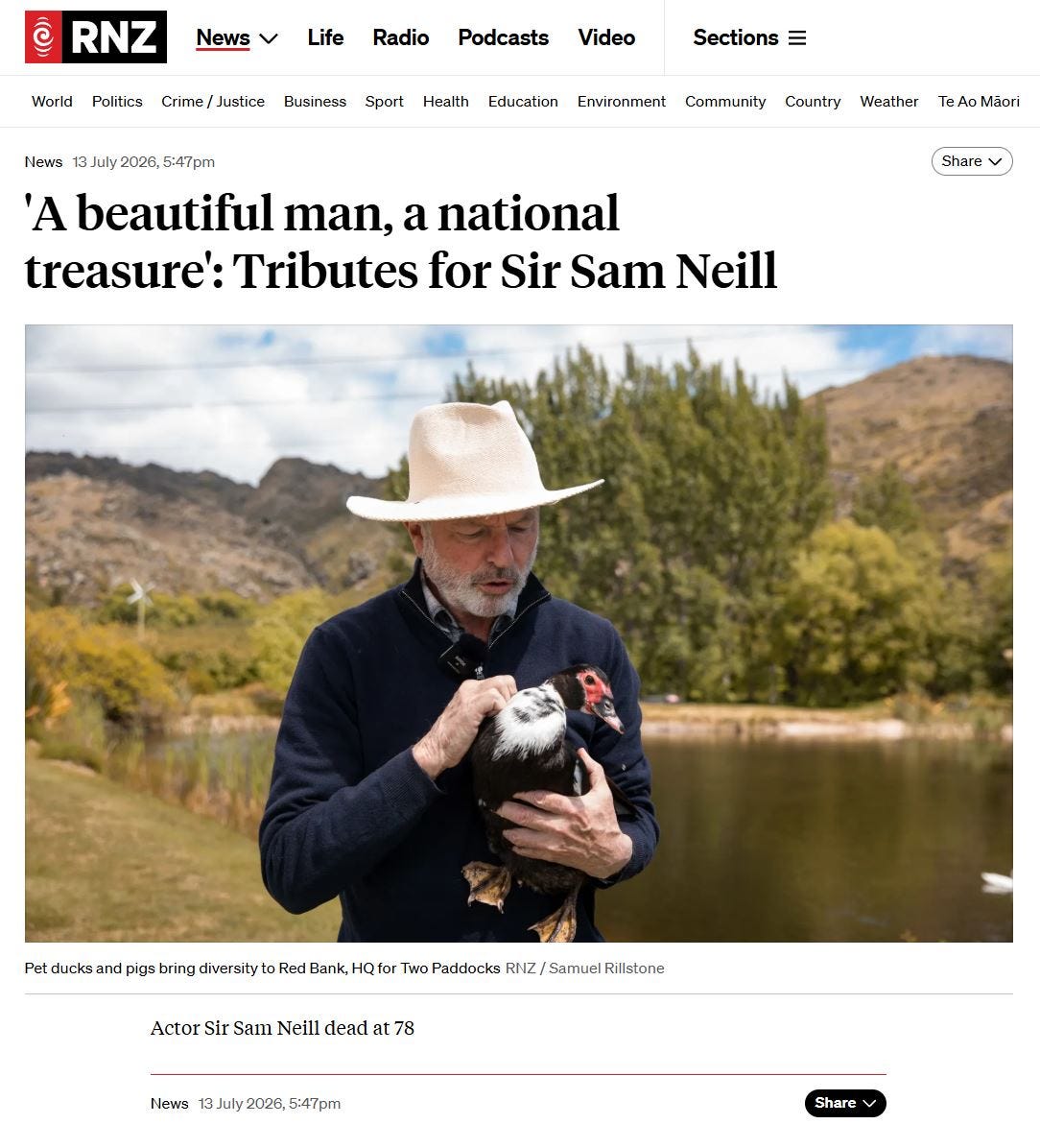
The huge sums poured into the Pike River Coal mining project were not to return a profit. But, to keep the black operation going long enough for a devastating explosion to occur on the potent date 42 years after the USS America anchored at Wellington.
It turns out LBJ visited New Zealand in 1942 as Lieutenant Commander in the US Naval Reserve, as a personal observer for FDR in the Pacific following Pearl Harbor.
In the world occupied by Shane Jones in 2026, the Hollywood actor Sam Neill was challenging the Luxon National Ministry’s Muldoonist approach to quarry the nation.
In his screen debut, Sleeping Dogs (1977), Sam Neill played the protagonist Smith, who is turned over to the ‘Specials’ by one of the resistance, ‘Cousins’, after he lost control of his secret cache on an island on the Coromandel Peninsula that Smith had just moved to, to clear his head after a split with his wife. Smith escaped custody after the Special Force Commissioner, Jesperson, tried to coerce him to confess he was a revolutionary. Jesperson needed an enemy image. Smith became a folk hero to the resistance, and conversely, the leading candidate as an enemy of the state ‘poster boy’.
In the movie’s final scene, Smith is hunted down by the Specials and shot in the back by Jesperson as he walks away across a paddock, flicking his middle finger to the Special Force Commissioner. This is Smith’s final beat of growth in his character arc, from a man with no political outlook, to a hunted fugitive. In the final wide-shot, an angry Jesperson kicks Smith’s body because his rebel poster boy lays dead in the field.
On the same day, October 21 2025, that the Sunday Star-Times published an exposé of Santana’s mining proposal, Neill had pledged to fight the proposed gold mine, that is the Dunstan Mountains, in Central Otago, near where Neill’s family had lived for 150 years. Evidently, Neill said he had been concerned about the impacts of mining globally for a long time. What are the odds that Neill would die suddenly from pneumonia on July 13 2026, since it thematically riffed off the date, July 13 1981, when senior officers at NZ’s Security Intelligence Service (S.I.S.) concluded that the key leaders of the anti-apartheid movement were “extremists”, nine days out from the first game of the South African rugby team, the Springboks, in N.Z. for an eight-week tour.
After all, the civil unrest sparked by the Springboks Tour was entirely predictable.
Indeed, Norman Kirk, in his role as Prime Minister, had cancelled a proposed tour in 1973 on the basis of a report that concluded: “it is the considered police view that the tour would engender the greatest eruption of violence this country has ever known.”
Muldoon was re-elected in 1981. The 1977 movie, Sleeping Dogs, was based on a novel Smith’s Dream, by C.K. Stead, who was one of 500 protesters who occupied the grounds at Rugby Park, Hamilton, causing the police to call off the match between the Springbok and the Waikato rugby teams. When Muldoon met the Steads at a function in 1978, the Prime Minister said, “People have been saying this novel, this movie, is about me. So I thought I’d better see it.” Stead’s wife, Kay, quipped, “Yes, you’ve just grown into the role, Mr Muldoon.” He emitted a mirthless laugh, evidently.
With ‘magical synchronicity’, the New Zealand Rugby Union announced the 1981 Springbok Tour on September 12 1980, which coincided with the third anniversary of the death of black rights activist, Steve Biko, at the hands of the Afrikaner Broederbond’s fascist security henchmen. While the Springboks played the All Blacks at Eden Park, the predictable ‘finale’ clash occurred on the streets outside — on September 12th. The provocative timing of the New Zealand Rugby Union’s announcement of the Springbok Tour, that took place on September 12th 1980, as well as the climatic final test match in Auckland riffed off Steve Biko’s awful death. In her 1983 documentary Patu!, Merata Mita noted the news of the tour came on the third anniversary of the death of black rights activist, Steve Biko, in her opening narration.
Planning to counter a Springbok Tour in 1981 began 500 days out. Anti-apartheiders were aware of the sporting fixture developments afoot. Ergo, a civil unrest-themed distraction was conjured that’d be worthy of stirring C.K. Stead’s readers, and the news fodder would divide the country to assist the Muldoon Government to retain power long enough for bureaucratic mountains to be moved for an economic heist.
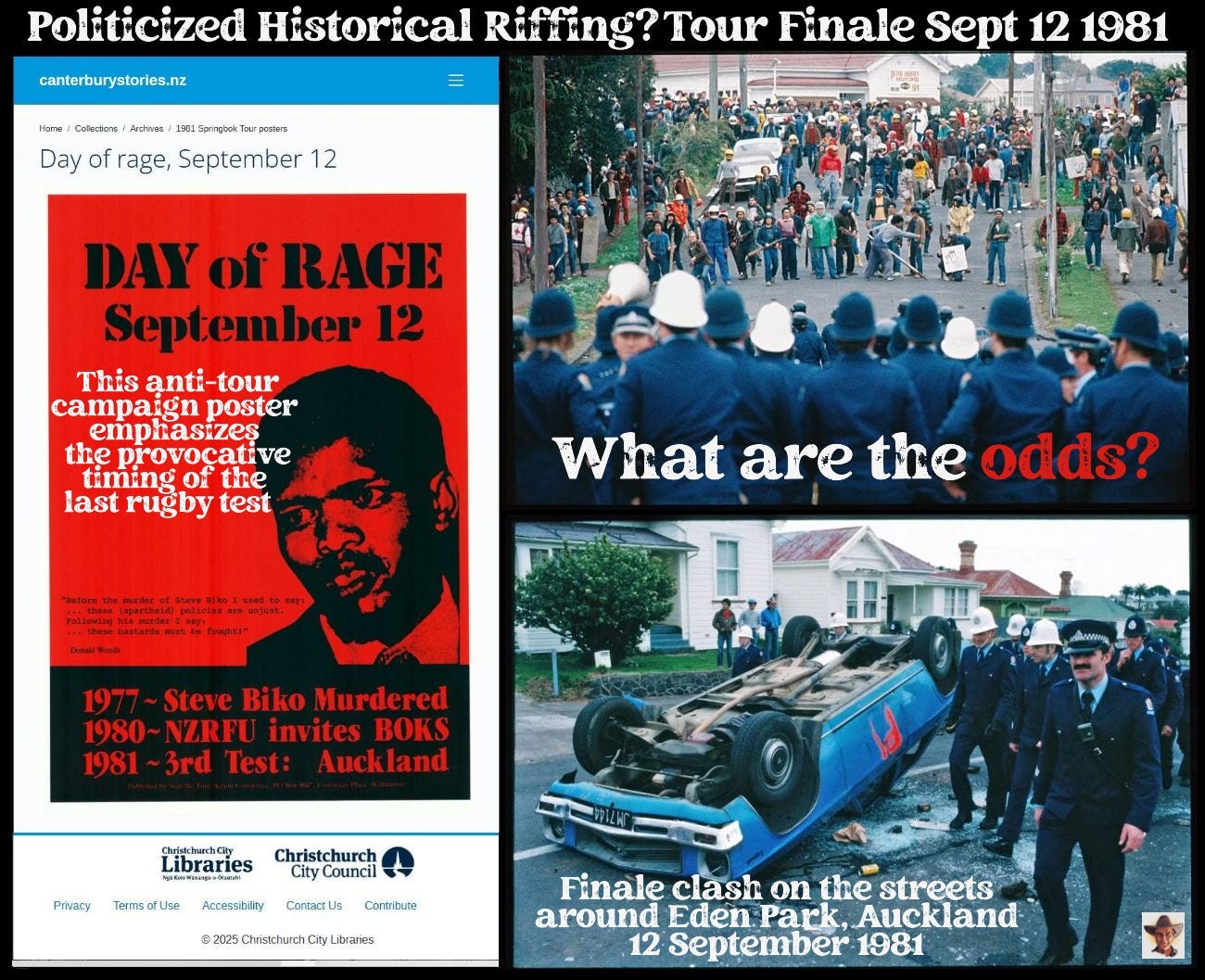
Prime Minister Robert Muldoon picked a fight in order to maintain power by deflecting attention from the economic woes, which were the pretext for the coming ‘reforms’, that were being quietly worked upon in the background for a Labour-led Government down the track. Muldoon also needed to distract the public from the cover-up over the crash of an Air New Zealand DC-10 on Mount Erebus, Antarctica, that occurred on November 28 1979. Although framed as an accident, the loss of Flight TE901 was a takedown. The Royal Commission chairman suspected foul play.
Recall that where Air N.Z. Captain, Jim Collins, and his air crewmen never saw Mount Erebus looming straight in front of them on November 28 1979, Captain Robert Falcon Scott and his team first sighted the Trans-Antarctic Mountains one year into their polar journey, on November 28 1911? Like Captain Scott, Captain Collins died in the Antarctic ice, while the airmen aboard the Air NZ A320 Airbus, died in the Mediterranean, precisely one year prior to the 30th anniversary of the Erebus Crash.
When the crash of an Air New Zealand A320 Airbus crashed on the 29th anniversary of the ‘Mount Erebus Disaster’, and you know there was a cover-up of that ‘air accident’, it makes you wonder why the government and Air NZ had been so sensitive about the matter of an apology. And, also about avoiding explaining what went down.
This Air NZ Airbus crash on November 28 2008 (at 4.46a.m. NZ Time), performed as a coup d’état, since it occurred nine days after the Key Ministry was sworn in to office.
The thematic historical date riffs reveal the over-arching objectives of a meta-conflict that underpinned why the Air NZ jets crashed 29 years apart: forge a super-economy.
After all, the cryptocracy had codified the Antarctic Flights with the psychopathic humor of a super-villain, since the tickets for were all of one class: super-economy.
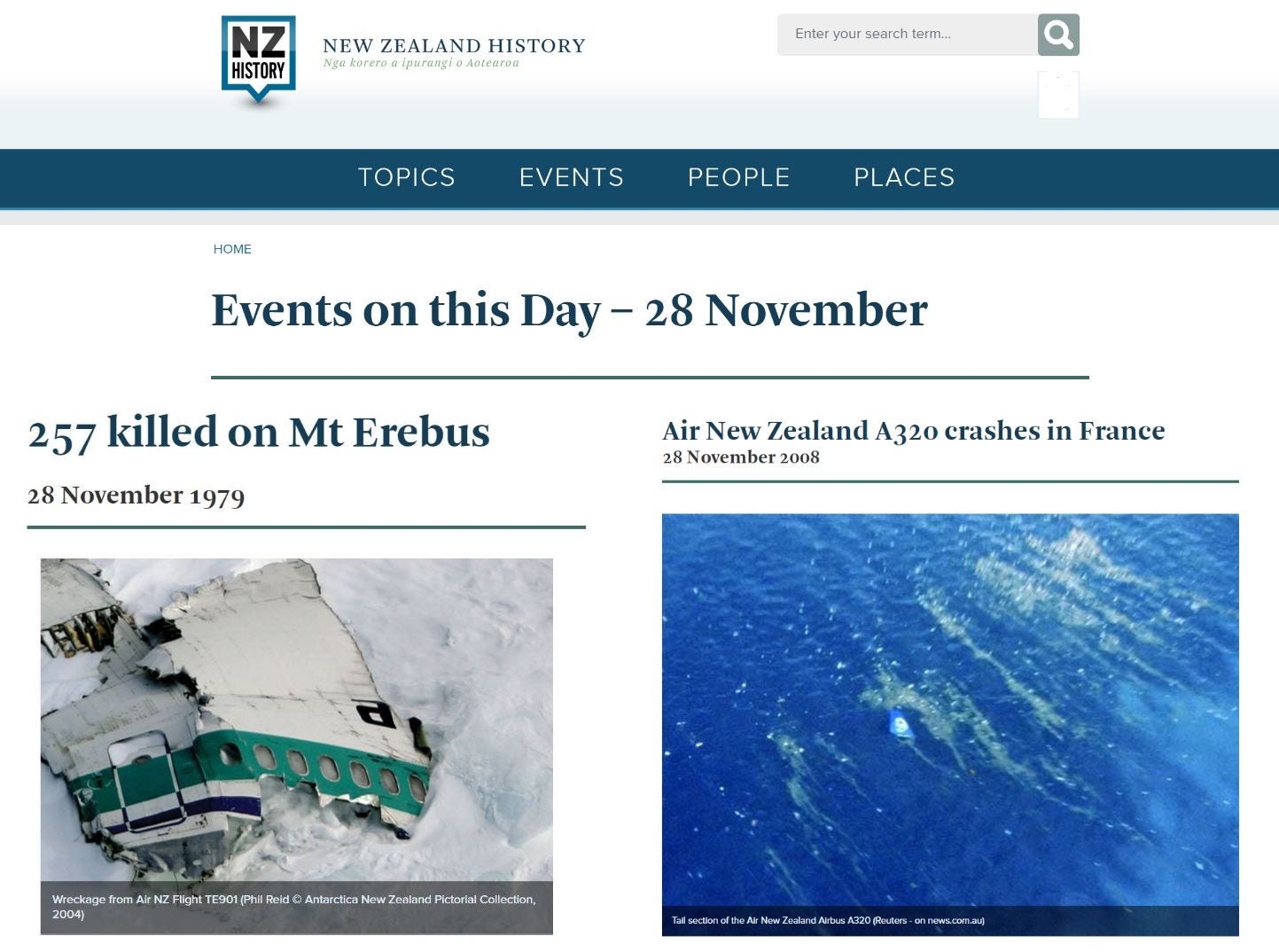
Roger Donaldson, who directed Sleeping Dogs, said of Neill, “I think he saw himself as a centrist. I don’t think he would have expected to be classified as any sort of extremist.” Stuff reported that Donaldson said he was in touch with Neill regularly and that one of their last discussions was about the abuse he had been receiving.
Ironically, where C.K. Stead wittingly drew upon the historical class tensions between the commoners and the establishment to write his dystopian classic, Smith’s Dream, and the lengths they’d go to maintain power, wealth and control, Donaldson and Neill failed to comprehend this sinister wiring was still ‘live’: it ‘meant business’.
Given that Neill died on July 13th, and in his debut movie he was cast as an extremist by the Specials Commander and the N.Z.S.I.S. had cast the anti-Springbok Tour protest organizers as extremists on July 13 1981, how uncanny was it that on July 13 1863, that a proclamation to the Waikato chiefs asserting that they were in rebellion was still being drafted. The day prior, July 12 1863, the 65th Regiment had crossed the Waikato River to build the Alexander Redoubt at Tūākau. This edict meant the hapū and iwi of the Waikato were cast as so-called ‘rebels’ “at Tūākau, and elsewhere between Waikato and Auckland through the forced expulsion of peaceful communities of Maori from their own lands”, as historian Vincent O’Malley wrote in his masterly tome, The Great War for New Zealand: Waikato 1800-2000. A minute initialled by Francis Dilion Bell (FBD), the Native Minister, dated 13 July 1863, stated the proclammation’s revision was submitted to “His Excellency” (Governor Grey).
This move, to establish a staging ground to conquer so-called rebel territories of ‘the Natives’, led to the escalation of what became the Waikato War of 1863-64, the biggest conflict with the Māori Kingitanga Movement, a Waikato Tribes coalition and others, who opposed to further land sales. Where the notice to Waikato chiefs was still being drafted on 13 July 1863, to the effect that they would be deemed to be in rebellion if they did not pledge allegiance to Queen Victoria, the newswires in their role as the first drafters of history carried the news on July 13 2026 about the death of the actor, whose debut feature movie role was as a character who was cast as a rebel by the Commissioner of Special Force, who in turn, had conspired with the Prime Minister to stage a false flag attack, to establish a police state with a martial law referendum.
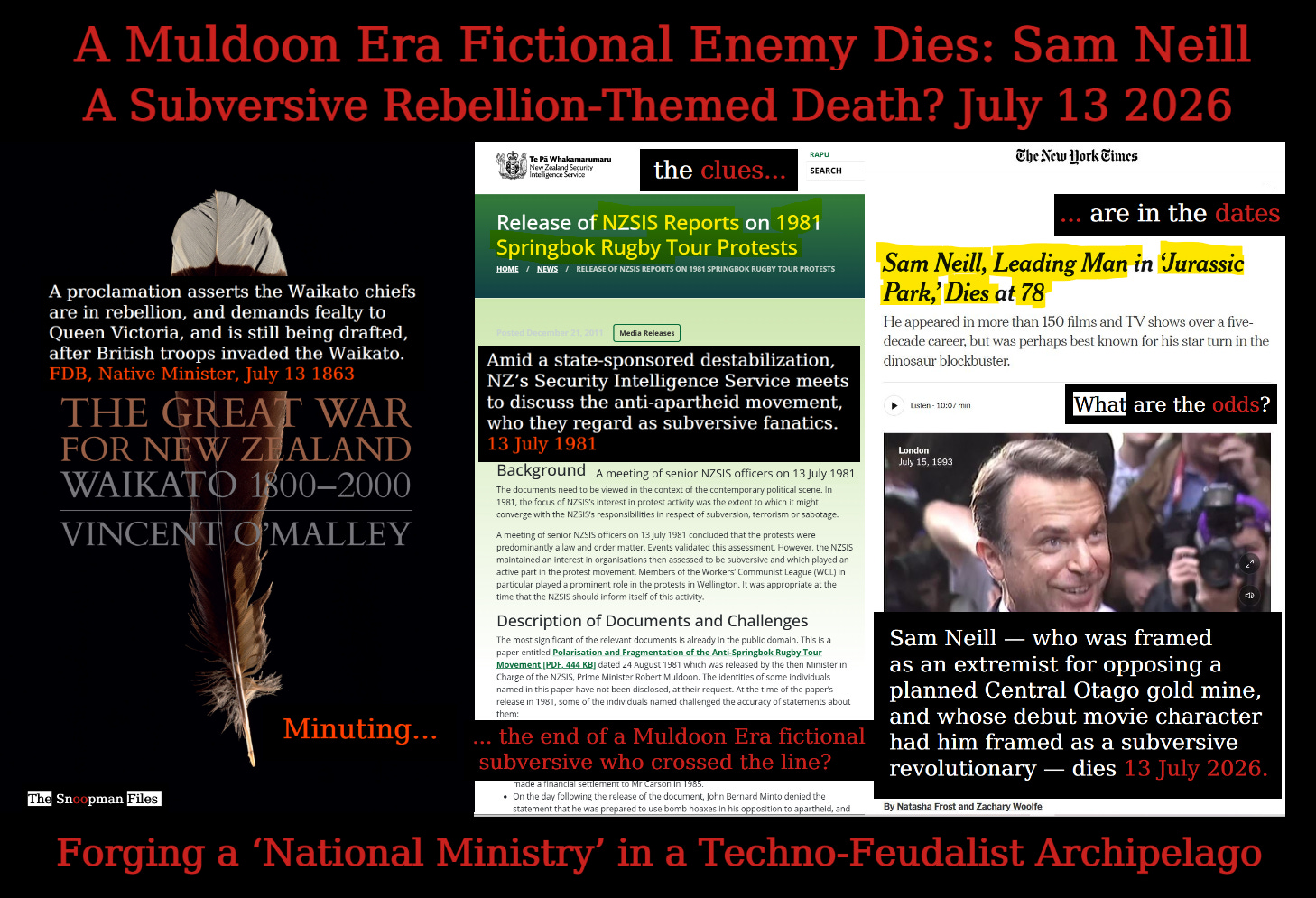
Recall how in Sleeping Dogs, after the massacre of the army sent to break up a strike deemed to be illegal, Volkner announces his government will hold a referendum to gain the citizens’ mandate to authorize martial law to squash the resistance? Unaware of the massacre’s staging, the public fall for the trick to tick yes for a police state.
And, recall that Sam Neill had been framed as an anti-Kiwi living in the make-believe world of Hollywood by the Resources Minister Shane Jones, who had criticized Key’s government for its Muldoonist lurch to transform the countryside into a quarry?
In 2026, Jones rebutted a challenge from Greens MP Steve Abel, over his reversal from 2010. Jones referred to the ‘good book’, “When I was a child, I thought as a child.” The verse is from 1 Corinthians 13:11, found in the famous “Love Chapter” alleged to have been written by the Apostle Paul in the New Testament of the King James version of The Bible. Yet, a Roman Imperial Cult created the fictional character, Jesus Christ, in an attempt to bind the messianic Jewish Cult of Palestine to Rome. So, the Apostle Paul was one of numerous phantom characters created long before Hollywood’s time.
Ergo, a rebellion frame-up theme underpinned the sudden death of Sam Neill.
Thus, Neill had stepped into a broader conflict over competing land use interests.
The jet-setting actor’s date with death also riffed off a few other screen roles.
The Irish-born actor’s horse connections extended beyond his joy for riding horses on his farm and vineyard. The prolific actor in 150 screen roles, also played the legendary thoroughbred horse trainer, Paddy Payne, who in real life trained the first female jockey to win the Melbourne Cup in Ride Like a Girl. Neill also co-starred in The Horse Whisperer, with Scarlett Johannsen and Robert Redford, who played a horse whisperer.
With these screen connections, and Neill’s credentials as a horse-riding landowner in Central Otago, what are the odds a meeting that voted to establish the New Zealand Thoroughbred Jockey Club, took place on July 13 1891, which led to the establishment two years later of a unified governing body for racing clubs flung across two islands?
And, since Neill was a jet-setting actor, his pilot acting connections also served as theme for date riffing off his day of departure, July 13th 2026. In The Legend of the Guardians: The Owls of Ga’ Hoole, Sam Neill voiced a pilot, Allomore, a high ranking owl. He also played a cameo of himself in Forgotten Silver, lending weight to Peter Jackson’s hillarious mockumentary, which included a spoof segment depicting Richard Pearce flying the first mechanical airplane before the Wright Brothers.
What are the odds then that pioneer aviator Vivian Walsh was awarded New Zealand’s first pilot’s certificate by the New Zealand Royal Aero Club on July 13 1916?
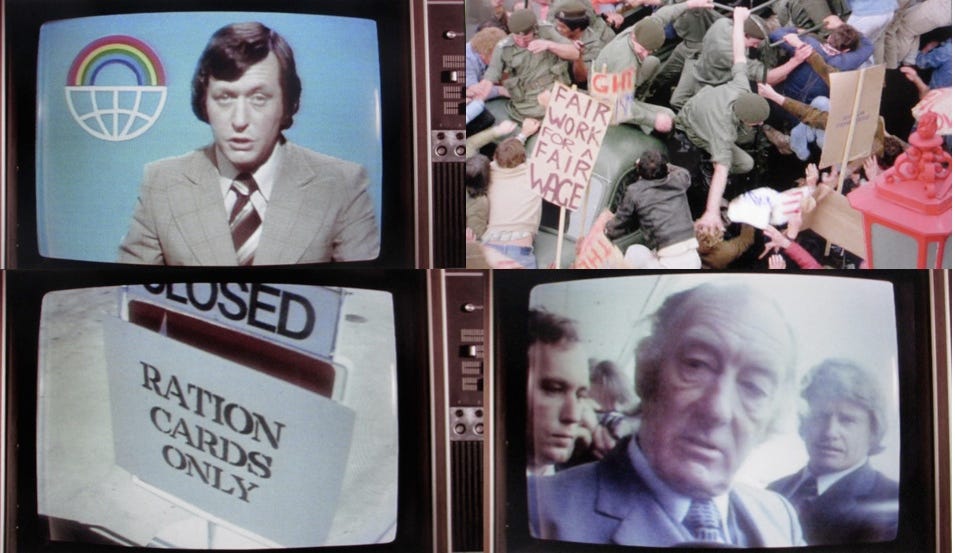
Ergo, there’s to be no more horsing around with New Zealand’s DNA, nor it’s status as an open-cast mining quarry, or it’ll just be a pilot movie location where dreaming revolutionaries have free-rein to ride the country-side like horse-whispering girls.
Given Neill’s silver-screen debut in the Muldoon Era, the signing of the death certificate occurred with uncanny timing. Especially, since his role in Sleeping Dogs saw him cast as a hunted enemy of the state, when he was framed as a revolutionary by the Special Force Commissioner, who orchestrated a massacre, to justify a police state. And particularly, since New Zealand’s most prolific screen actor had lent his celebrity profile to fight the gold mine in Central Otago, with an election looming.
➳ ‘The Fix’: To Consolidate Territory Taken by Violence
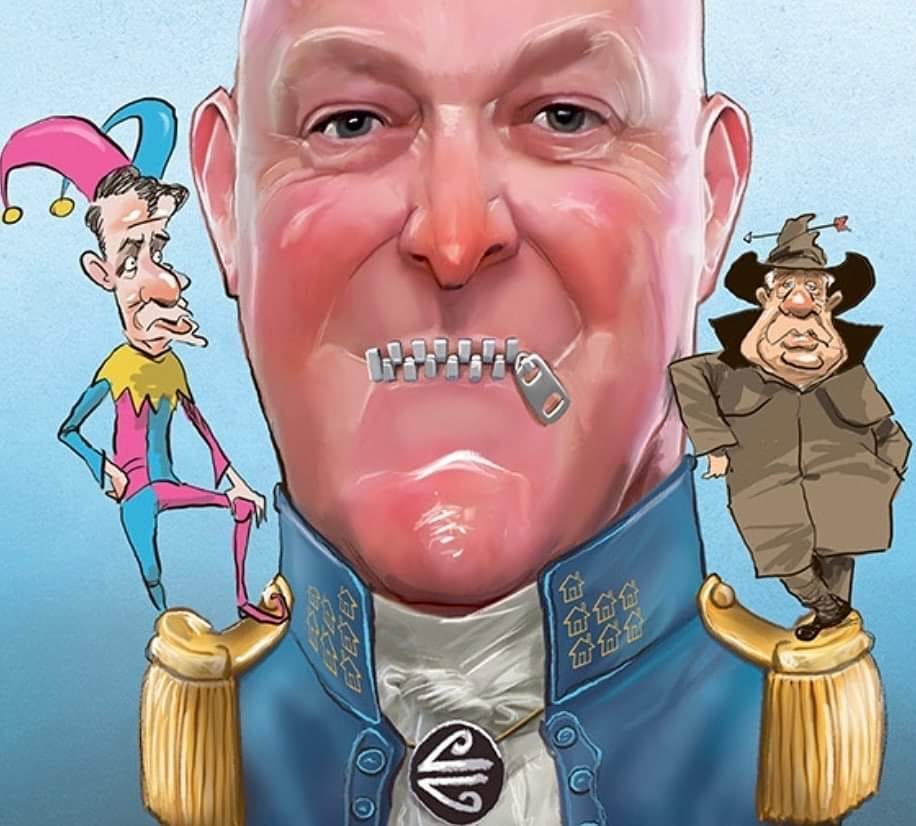
Recall that in Sleeping Dogs, Sam Neill plays Smith who becomes embroiled in the resistance against a fascist government led by Prime Minister Volkner and Police Commissioner of the Specials, Jesperson, who orchestrate a staged massacre of an army unit sent to quell strikers in downtown Auckland? After the massacre, Jesperson pays off one of the shooters, who killed off his two-man team. Later, as the evening news plays with Volkner asking the nation to cast a vote in a special referendum to mandate martial law to put down the revolutionaries, Volkner and Jesperson sit in a lounge watching the newscast. The audience of Sleeping Dogs sees ‘the fix is in’.
The thematic date-riffing is the dead give-away of the staged-faux leadership challenge to create a first act climax to resolve a crisis to push the plot in to Act II.
The line of action has to be strong and visible to the audience, who can see the protagonist responding to the inciting incident. In this case, the news emerging of a second leadership challenge in four months, just three months out from the election.
When playwrights, screenwriters or novelists create the inciting incident, they ask themselves: What would upset the balance of forces in the protagonist’s life that have been established thus far? And does it set up the incident for the Act III climax scene?
In Sleeping Dogs, the inciting incident occurs in the scene when Smith (played by Sam Neill), is seized by a Special Force unit on the island off the Coromandel Peninsula. It is the worst thing that could happen to the protaganist who just wants a quiet life after his marriage break-up, that occurs against the backdrop of civil unrest.
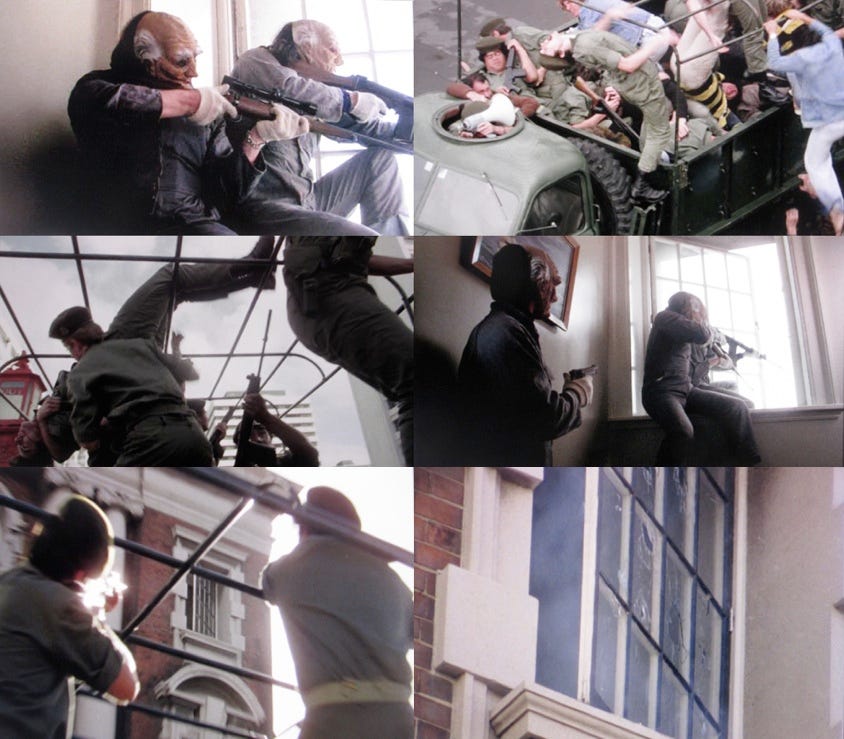
And what’s the worst thing that could happen to my protagonist, which could turn out to be the best thing? Or, what’s the best thing that could happen to my protagonist, which could turn out to be the worst thing? In this case, the worst thing for the protagonist, Chris Luxon, was to face a second humiliating challenge, which could turn out to be best thing, with a war-time coalition ‘National Ministry’, where he getts to prime minister through a second term. Or that, the second leadership challenge was the best thing for Mr Peters or Mr Seymour, who later get to prime minister, and it turns out to be the worst thing for Luxon, who subsequently loses the party leadership and is demoted in Cabinet to Minister for Tourism and Hospitality.
What then was the hook at the opening of the story? Picture Luxon, a gaff-prone incumbent prime minister, facing re-election struggling to keep his party together.
Imagine a scene at a beach-house where key syndicate players of New Zealand’s cryptocracy have gathered to watch the news of Luxon at Mount Maunganui outside the surf club in late January 2026, in the wake of the landslide that ripped through the holiday park. And, Luxon says “we’ve got to control what we can control”, as a way to imply these natural disasters have no human engineering behind them, since he has a habit of stating what seems obvious the bourgeoisie-friendly newsrooms.
To the press, Luxon luxo-splains about controlling the response and recovery to extremely weatherly events and other naturally occurring disasters. He says his Government is focussed on risk management, adaptation, and building resilience into the core infrastructure, as well as producing a national flood plan by the end of 2026.
Flanked by All The Prime Minister’s Men, the surf club behind them is subsequently set to open on September 19, which is potent date for Tauranga District Council, since it was on September 19 1992, when Tauranga Expressway opened for business.
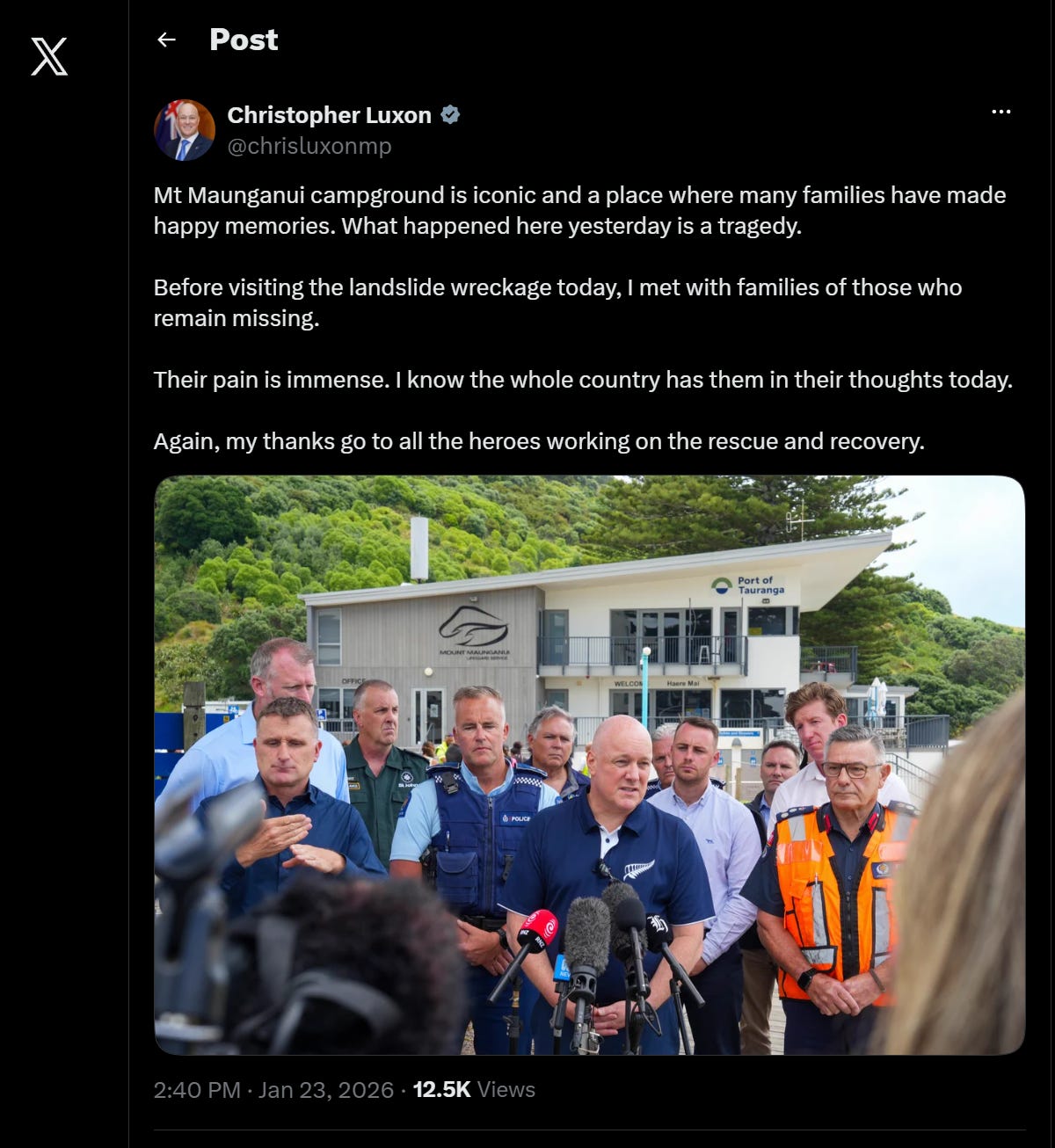
Although this scene — with NZ’s cryptocracy watching Luxon speak in the aftermath of the Mt Maunganui Landslide — is imagined, what the prime minister said is taken from the news reports over his various visits to the area while meeting locals.
LuxoMan isn’t too bright. He can be manipulated to prime minister the nation into accepting solutions they wouldn’t otherwise accept, if they knew of staged disasters.
The structural power of a criminal syndicate relies on the compromised machinary of public offices, to save its members from raids, judges who accept reduced charges, police super-intendants who sabotage investigations, and journalists who censor critical context. While violence gains territory for a syndicate, ‘the fix’ allows the criminal network to keep it, make economic gains, consolidate power, and plan bolder moves. The capacity to lean on ‘the fix’ grants the underworld degrees of acceptance within the Establishment to pull off audacious power crimes, especially when those with eyes attuned to its workings see the hidden wiring turning up in periodic crises.
‘The fix’ is the right relationships, denoted by the verb connected, rather than unsubtle titles like Mafia or Cosa Nostra, as George Wolf described the term in an American context when he wrote, Frank Costello: Prime Minister of the Underworld, to recount his three decade entwinement as a lawyer with ‘The Godfather’. Likewise, when the national security state apparatus, or central government officials, wittingly participate in a catalytic staged crisis, the rupture is permanent with the visible public state. It is the moment when matters ‘stop making sense’, and key players ‘cross the Rubicon’.
The expression ‘crossing the Rubicon’ has its origins when General Julius Caesar crossed the Rubicon River in 49 B.C. with his army; an act that broke the law and was a provocation for war with Rome’s leader, Pompey. The expression is commonly used to mean that the ‘point of no return’ has passed and the severance is irreversible.
Members of criminal syndicates perform hostage exchange rituals, to signal chess moves, in accordance with game theory, as Snoopman snoop-splained in the introduction to this series, “Darkest Days by Dates Down Under”. A failure to post oneself as a hostage to communicate cooperation of a player representing a key role, a critical institution, or an important vested interest when a plot is in play — is taken as a defection, to be met with swift and stiff punishments, which maintains discipline.
Game theory was developed during the Cold War to stabilize the power structures of the ‘Russian Empire’ and the ‘American Empire’. In their paper, “Resolving social conflicts through hostage posting: theoretical and empirical considerations”, Gideon Keren and Werner Raub noted that “tacit communications of threats and promises are two major message strategies used to influence the behaviours of others”. Being seen to advance the game with parallel, or mirrored moves, is a mechanism to construct stability and is predicated on a provisional promise to cooperate, if other players post hostages too. Such rituals create data for criminal investigations into crimes of power.
In this way, criminal coalitions embed events with encoded metadata to communicate unity that they are advancing a syndicate game to signal promises and threats, to telegraph caution and control in the inevitable scandals, while exploiting crises.
A syndicate’s signalling can take many forms, such as posting directors on multiple corporate boards, cross-ownership of stocks, bonds and securities, tabling directives, and holding press conferences with symbol-laden numerical, or metaphorical, drops.
———
One consequence of the ‘Luxo Leadership Fiasco’ is that Chris Penk won’t be around the capital when the Government Inquiry is due to report back on December 3 2026.
Given the 26 landslides that occurred in the Tauranga District, will be used politically to manufacture consent for ‘managed retreats’, how uncanny was it that a land confiscation law was passed during the Waikato War on December 3rd 1863?
Conquest over the “hostile Natives” was required to forge Masonic Capitalism.
The New Zealand Settlement Act of 1863 legalized the establishment of military towns on land belonging to Māori, and was written by Freemason Frederick Whitaker, who was the Premiere and Attorney General, during the Waikato War of 1863 to 1864.
This land confiscation law worked in tandem with the Suppression of Rebellion Act of 1863, which was designed to construe Māori as being in rebellion, if they refused to pledge allegiance to Queen Victoria and assisted in the resistance. And, without the New Zealand Loan Act of 1863, which authorized the raising of finances for the defence of the colony, including funds for infrastructure to construct lines of communications, logistics and camps, then Whitaker’s partner-in-law, Thomas Russell, of Whitaker & Russell, would’ve had little to do as the Colonial Defence Minister. Thomas Russell wouldn’t have been content being a Methodist lay-preacher.
After all, Russell, who as the primary founder of the Bank of New Zealand, wouldn’t have been able to play ‘banker’ in ‘Monopoly: The New Zealand Colonial Edition’ — satirically speaking. The BNZ’s website doesn’t say its two-year old self became the primary conduit for the raising of finances, and supplying an overdraft to the Colonial Government, without which the escalation of the New Zealand Wars would’ve fizzled, as any smart seven year-old would gather reading, Banker’s Hundred, the BNZ’s 1961 centennial book, published 10 years before the ‘rebellious Maoris’ got re-organized.
Ergo, it appears the cryptocracy is banking on a Luxon-led landslide victory in 2026.
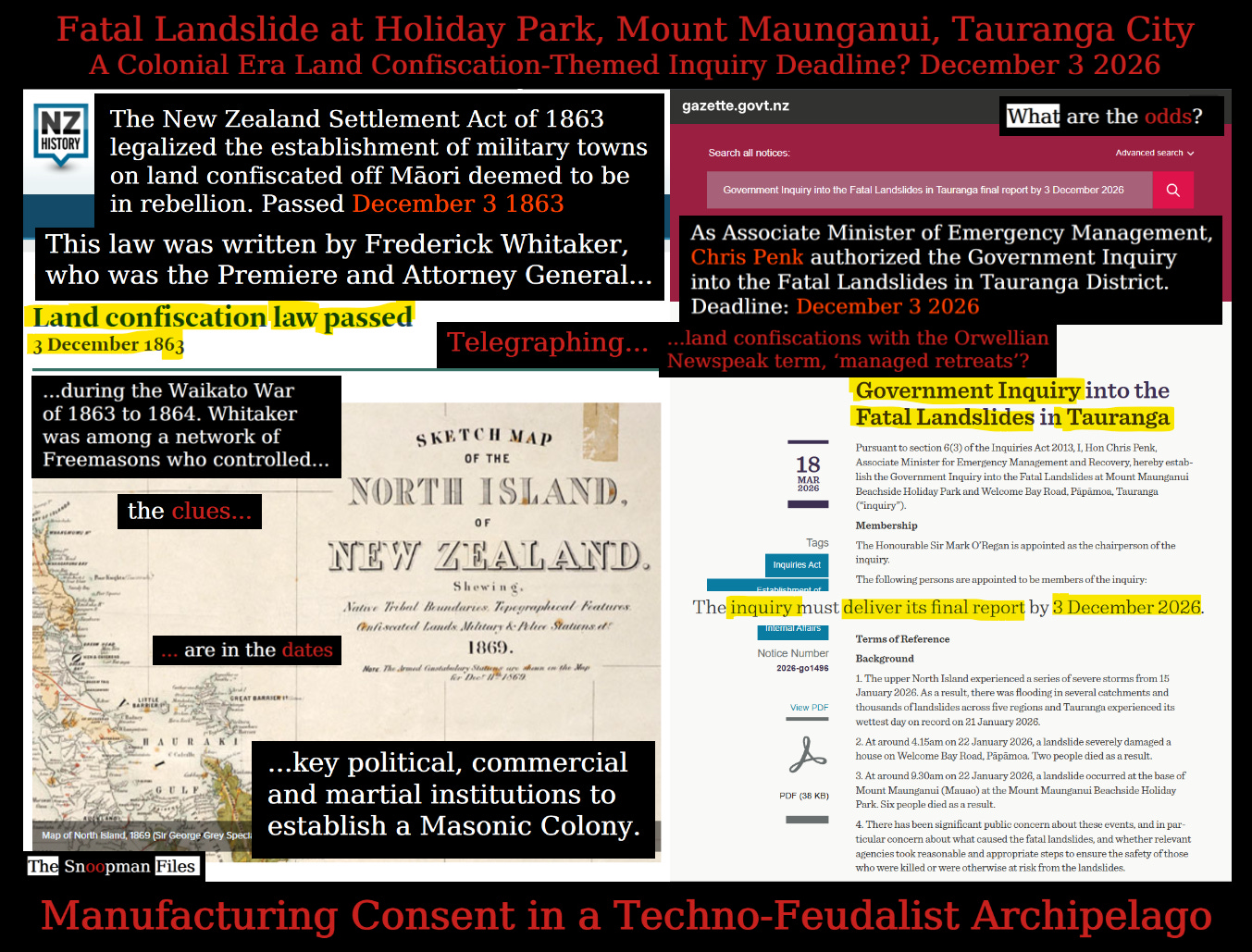
The public inquiries are performative theater, and are part of the cover-ups, to deflect attention horizontally among the monkeys to cue arguments about blame, while never imagining the cause is a pyramidic cryptocracy inflicting novel Trojan Horse attacks.
The déjà coup coders behind the LuxoMan Leadership Laundromat gleefully overlayed their own cryptic cypher into the drama and its aftermath with their symbol sorcery, by riffing off the historical moments with psychotic humour — to hack reality.
In real life, New Zealand’s closest international neighbor, Australia, is identified as a pivot state for its ‘military strategic goods’. Pivot states are located at the seams of the international system sandwiched between the rival great powers and super powers. New Zealand is marketed as a low-corruption jurisdiction. This status is produces the political, commercial, martial and cultural equivalent of Monopoly’s Get Out of Jail Free card. Since the ‘American Empire’ is in the closet about the fact that it is an expansionist invisible imperial project, it’s logical that a closet global empire needs a closet pivot state to act as an ‘influence-multiplier’. As such, Snoopman explores a creepy logic that such an oceanic power alliance would require a closet pivot state to fulfil a Trojan Horse function, by acting as its lightening-rod, its lab-facility and its light-house. Over the course of hacked time, each new government administration seems to undergo a reset that alters the mandated political trajectory of N.Z.
The supposition presented here is that following World War II, a kind of warfare was imported into New Zealand that was so novel in its nature, that neither its immigrant or native populations world suspect they were being subjected to a psychic-voodoo.
In post-war Western Europe, a low-grade secret war was inflicted by NATO that exploited a ‘strategy of tension’ designed to frighten the mass populaces and thereby shift the political center of gravity to the ‘right’ and away from socialism by blaming left-wing communist groups, and associating freedom and democracy with capitalism. Swiss historian Daniel Ganser showed the subversion of Western Europe by the fascist Gladio network, which represented a radical shift in warfare, in his 2005 book, NATO’s Secret Armies: Operation Gladio and Terrorism in Western Europe.
The West faced a massive problem at the end of the Second World War. The Soviet Russian Empire was huge. With a communist regime, Russia didn’t have to perform the theatre of democracy, which meant they could mobilize resources without the retraints of liberal democracies, where the commoners’ slow down executive plans.
To solve this imperial problem of rivalry between to broad competing empires, one capitalism and one communist, Snoopman detects this system of themed historical riffing was implemented across the West. The objective to transform the Western nations into totalitarian police states required stealthily advancement. The modus operandi of metaphor-laden date riffs signals cooperation to a police state trajectory.
But, in New Zealand, no one would believe the communists were that militant.
In N.Z., this novel clandestine warfare has featured a general trend in increasing its techno-prowess, while a ‘cryptocratic dark state’ network grew in size, sway and sophistication. But always, one characteristic remained a constant; a thematic riffing off historical events to signify a cryptographic disaster, where the worst types of tragedy out-do the previous ‘bests’ in natural disasters, or unintended human-made crises. Or, where a calamity is staged to look like an illness, a lone wolf, or beyond N.Z.’s control.
Yet, the hidden wiring behind why this South Pacific archipelago is crisis-ridden, is not simply because this land down under has become a revamped Monopoly Game.
The story about how N.Z. became a captured country has everything to do with a secret network who inflicted an undeclared war following the Second World War.
The foundational event was a staged department store inferno called the Ballantynes’ Fire on November 18 1947, that just happened to occur on the same day when the Stte Fire Insurance Act was passed in N.Z. Parliament on November 18 1903.
The Ballantynes’ Fire was the first of numerous staged ‘worst of type’ disasters inflicted to capture state, city and provincial officials, corporate executives and management to create permanent severances by place, by time and by generation between the visible public state and what Snoopman calls the cryptocratic dark state.
These staged crises have included: the Ballantynes’ Fire, 18 November 1947; Tangiwhai Disaster, 24 December 1953; Brynderwyn Bus Tragedy, 7 February 1963; Kaimai DC-3 Disaster, July 3 1963; the Wahine Disaster, 10 April 1968; Erebus Disaster, 28 November 1979; Springbok Tour, 1981; Trades Hall Bombing, 27 March 1984; the ‘Bastille Day’ Currency Crisis, 1984 Rainbow Warrior Bombing, 10 July 1985; Aramoana Massacre, 13 November 1990; Cave Creek Disaster, April 28 1995; Waitara Shooting, 30 April 2000; Operation Eight Raids, 15 October 2007; Air NZ 888T Flight Crash 28 November 2008; Pike River Mine Disaster, 19 November 2010; Christchurch Earthquake, 22 February 2011; Megaupload Raids, 20 January 2012; Kaikōura Earthquake, 14 November 2016; Christchurch Mosques Massacre, 15 March 2019; Corona Hostage Crisis, 2020-2022; HMNZS Manawanui Grounding, 5 October 2024.
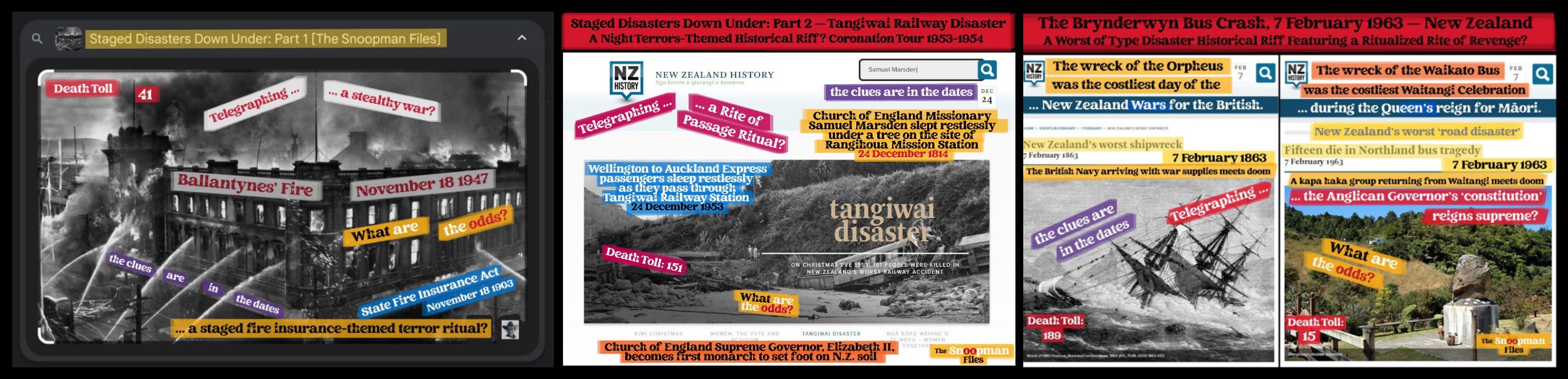
Snoopman decodes pivotal crises whose timings give away that they were thematically designed to riff off historical events, to signal authorship, cooperation, caution, and to telegraph hidden objectives. The signals show players are communicating their cooperation to take a plot ‘live’, convey hidden aims and to broadcast psychopathic humour, thereby posting themselves like ‘hostages’ — as applied game theory predicts.
In music, a riff is a concise musical phrase that is played multiple times to create a recognizable theme within the song. They provide a foundation and structure to the music, often appearing at the beginning of a song or at the start of a chorus. Where a hook is also a catchy musical idea, and usually only appears once or a few times for greater impact, a riff is repeated as a motif or figure in the melody or accompaniment of a musical composition. In these dispatches chronicalling staged events, the metaphors encoded into the historical date riffs perform as motifs to reveal a narrative arc. A dangerous criminal network that has penetrated every significant institution, acts with impunity in cahoots with their transnational co-governance partners, to inflict jolts to shift the political center of gravity away from ‘freedom’.
A ‘shock doctrine’ network inflicting staged crises can magically resolve deadlocks.
And, since this mayhem is part of an undeclared war to forge a totalitarian world empire by stealth, the practice of codifying chess moves prior to, at the time, and after the staged events performs the function of tickets stamped with dates, clicked with holes, or marked with pens. Traitorswho traded on treason, can smoothly invest, spend or speculate in a ‘cryptic currency’ detectable to those attuned to reading runes.
This ‘cryptic currency’ are the contracts indicated by the themed milestone dates.
Over the course of hacked time, new district, city and government officials become embroiled in a reset that alters the mandated political trajectory of New Zealand.
Thus, every administration is beset with a staged crisis, that embroils a government in a cover-up, which derails their political mandate either in whole, or in part. For instance, Luxon was in effect punched on the nose for the cutting the Defence Budget by $1.5 billion in the May 2024 budget, when the navy vessel HMNZS Manawanui ran aground on October 5 2024 on Sinolei Reef, a fortnight before the Commonwealth Heads of Government Meeting in Samoa. Uncannily, this grounding occurred on the 13th anniversary of the MV Rena Grounding on Astrolabe Reef on October 5 2011.
In 2011, no new permits to prospect, explore, or mine for petroleum were issued. The Key Government repealed the governance over the Foreshore and Seabed Act 2004, which was designed to circumvent Māori customary title claims to include customary rights. The Key led-Government’s Marine and Coastal Area (Takutai Moana) Act 2011 was passed by Parliament 30 days after the Christchurch quake, on March 24 2011.
Given the electromagnetic technology used to prospect offshore for oil, what are the odds that on March 24 1902, the Pacific Cable landed at Doubtless Bay, North Island.
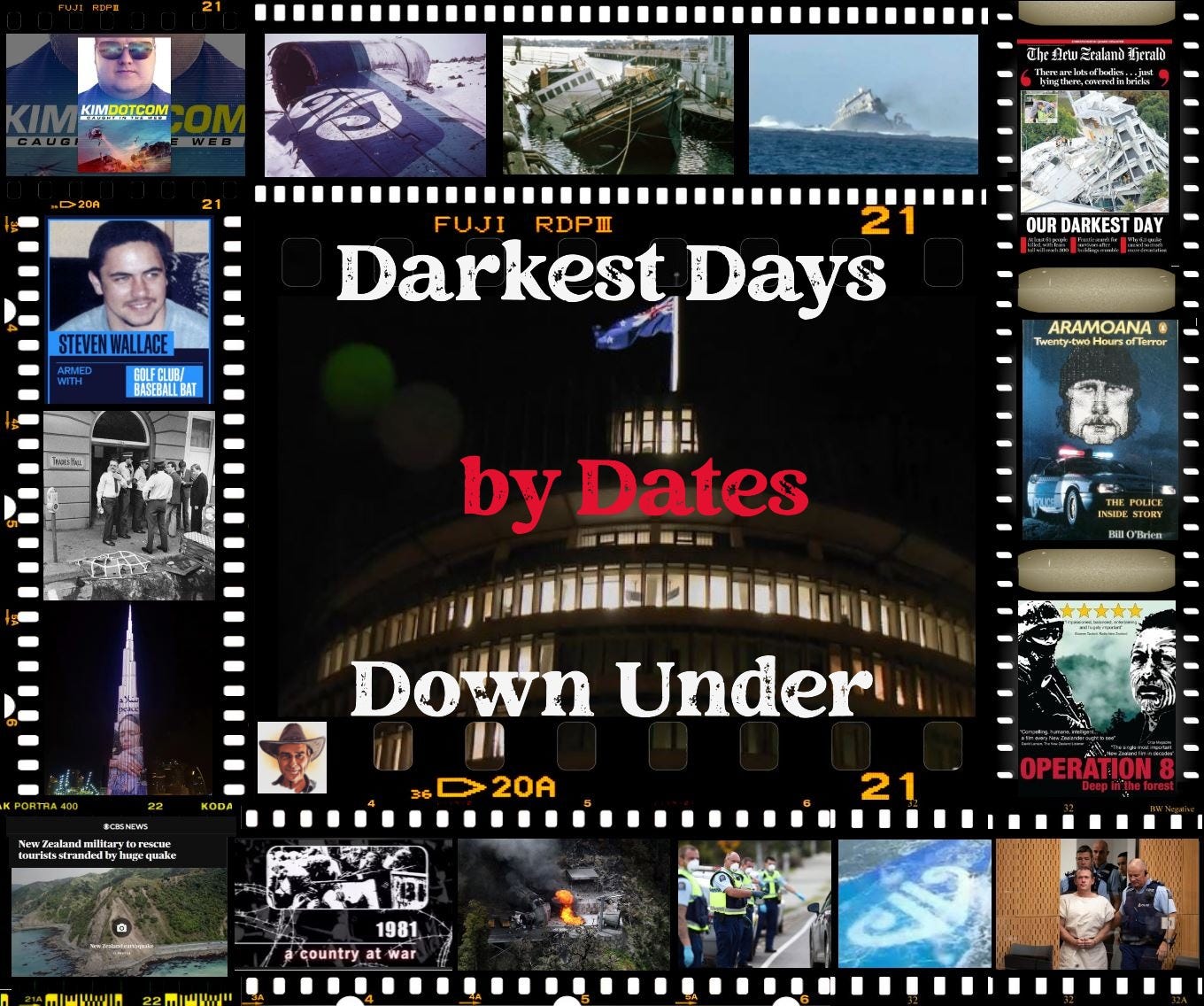
The February 22 2011 quake, which killed 185, just happened to occur on the historical date, February 22 1962, when the Kapuni Well in Taranaki first produced gas and liquid hydrocarbons. The transnational oil drilling company, Anadarko, gained approval from N.Z.’s Economic Development Ministry (MED) to conduct seismic testing for oil and gas in the Canterbury Basin, just over four hours after the 6.3M Christchurch Earthquake on February 22 2011. Canterbury Basin extends from south of Christchurch to south of Dunedin. In 2010, Anadarko Petroleum Corp gained approval to operate a frontier exploratory well with Origin Energy Resources NZ Ltd in an area 40 miles east of Dunedin in the southern part of the basin.
Indeed, in the two years before the Christchurch Earthquake there were only two oil and gas prospecting permits granted, while the Key Government went through the process of negotiating the repeal to governance over the Foreshore and Seabed Act 2004, to include customary rights with Māori. Given this exploration-themed earthquake disaster, it is intriguing to observe that the MV Rena ran aground on Astrolabe Reef on October 5 2011. The Rena broke apart on the reef, and the ensuing oil spill was described at the time as New Zealand’s worst environmental disaster.
It turns out, the Rena ran aground on the same day that a secret meeting of the New Zealand Company was held in London, October 5 1840, to negotiate with Lord John Russell for official recognition. The settlement company’s meeting with the Secretary of State for War and the Colonies occurred at a pivotal time. Three days prior, Queen Victoria approved Governor William Hobson’s proclamation of sovereignty over the whole of New Zealand on October 2nd 1840, via the London Gazette. As Snoopman had compellingly argued in his dispatch, “Deep History of Waitangi: The Queen Victoria Connection”, the mission to treat with the aboriginal and indigenous tribes of New Zealand was theater, and paper sovereignty was gained by other pieces of paper. Indeed, six days after the nine Waitangi Treaty parchments arrived in London on November 10 1840, the Queen’s Royal Seal would be used to erect a colony with a Royal Charter. This chess move was about optics, since the ruse was to construe that ‘the natives’ willingly signed away, or ceded, sovereignty — with the English version.
The British Masonic takeover of New Zealand couldn’t have been initiated through Parliament because such chess moves would alert agents of the rival cannon powers. And so, the route was commenced through Buckingham Palace, first with a boundary extension by Letters Patent to expand the jurisdiction of New South Wales around NZ.
Ergo, there lurks another layer to New Zealand’s recent past and the trail of meta-data reveals encrypted ‘glyphs’ or ‘runes’ of a network who ‘hex’ targets in terrible tricks.
Snoopman’s time travelling tale traces an epitome of evil most of his fellow monkeys might thunk could only happen in horror novels, grim stage plays or in epic noir flicks.
As such, this code-breaking dispatch has taught snoop-readers how to apply Sherlock Holmes or Agatha Christie logic to Nancy Drew or Scooby Doo enduring mysteries, current crimes and unfolding news events in order to spot-light the spooky darkness.
These findings also behoove a re-think about how to go about re-building a society of households, workplaces, and communities, in a low-key under-the-radar way. This modus operandi for codifying staged events is one of those areas of investigation that needs to be watched as it plays out, rather than blurting about these date riffings on social media posts, or on podcasts, or at public meetings or in emails to the media, to government agencies, or to councils. The reason for this stance, is that Snoopman is writing a book to be called, The Terror Archipelago: A Grimoire of New Zealand Political Witchcraft and Wizardry, 1947 to 2027. The crimes need to be laid out, crisis by crisis.
If the vision of freedom-minded free-thinkers is to achieve a totalitarian-free society, this strategic vision perhaps doesn’t need one ‘blueprint’. Militarists ask a question along the lines of how to influence an environment to achieve a desired objective.
That formulated question is the strategy. The steps to achieve the strategy is a plan.
Snoopman isn’t advocating civil unrest, war, or world domination by lunch-time.
Where military planners seek to influence an environment to gain control, the human heart is capable of transmitting signals to influence to an environment to evolve.
Since New Zealanders have been steered off course about what is really going on, and that this date-riffing shitfuckery has been occurring for nearly eight decades, and in the process our crisis-ridden society has sunken deeper, it’s critical to know that we are also part of a war-traumatized species embroiled in a Third Hundred Years’ War, as Snoopman argued in, “How I Almost ‘Got Dead’ at a Spiritual Festival”. So, perhaps it would be provident if we get wise to the fact that our hearts are transmitters.

And, that there are methods for tuning into our heart, and how to sync-lock it to communicate with our minds, and re-integrate ourselves to become sovereign beings capable of participating in the emancipatory evolution of our species. This may seem like a circuitous route. However, it’s the very thing that the Overlords fear over all else.
We are being led into an evolutionary cul de sac, headed to the extinction of true love if we let this bleak future happen. The trajectory we are travelling upon is one where natural births will become an elitist capacity. This dystopian totalitarian vision isn’t something Snoopman can prove with one blue-print he snatched from a vampire’s vault at the Vatican. But, he can say the Roman Imperial Cult invented a phantom messianic character, in an attempt to merge the Jewish messianic movement of Palestine with the Roman Empire, after sacking Jerusalem. And with a later rework, to re-invigorate the Empire, by de-tribalizing pagans and absorb them into the Church.
And, he can add that a Church Cult that has long claimed to have a monopoly over the passage of souls to a space-place called ‘Heaven’, shouldn’t be given the time of day.
Especially, not while it collects billions every Sunday. And, while the Military-Medical Industrial Complex is constructing a techno-feudalist biosecurity architecture in cahoots with the classified alphabet agencies, and Big Tech, Big Banks, and Big Food.
The Totalitarians intend to make humanity superfluous, as Hannah Arendt said in The Origins of Totalitarianism. And, in the process, delete the awesomely beautiful house party of women being able to soul the world, by stealthily constructing a ‘health stasis’ operating system, where the capacity to sustain status, health, and love are mediated by a conformity to algorithms run by a geo-fenced grid. Yet, true love resists control.
Controlling humans has been the aim of every empire. And, every empire needs an instrument of expansion. What happens to the instrument of expansion determines the arc of history. Capitalism has been the primary instrument of expansion since it fired the feudalist knights. The present tectonic shifts from a uni-polar to a multi-polar world order, involve a contest over controlling the technologies, the treasures and territories, to dominate the new instrument of expansion: techno-feudalism.
And Age of Conflict arises with the emergence of a new instrument of expansion, that combines a need for resources to feed inventions and a new administrative system.
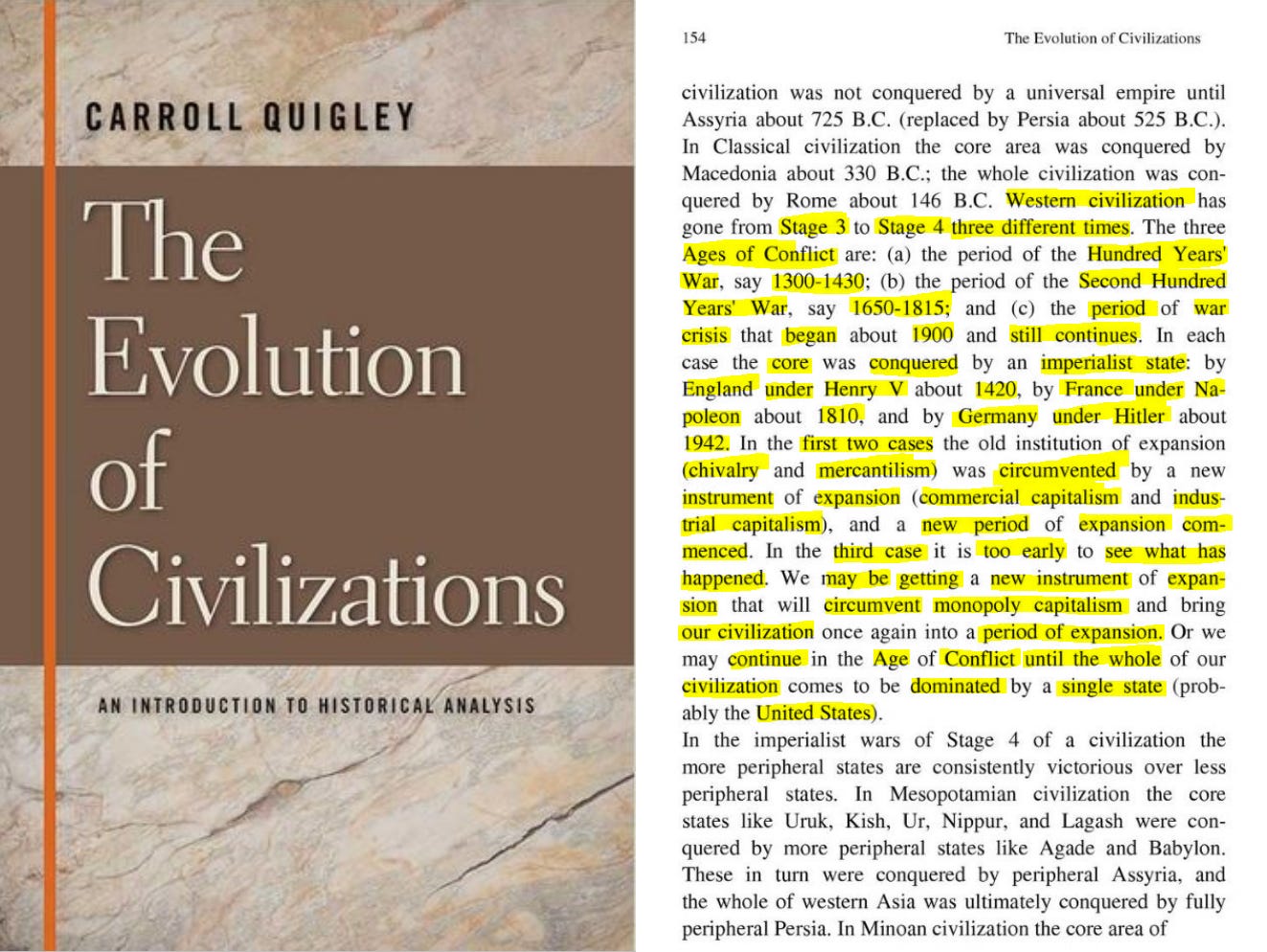
Beginning before 1900, as a conflict to control the territories, technologies and techniques associated with oil, the present Third Hundred Years’ War became a struggle to dominate the development of the computers, which have the disturbing capacity to collectivize all previous instruments of expansion, including slavery.
Since technocracy is an economic system that exploits technology as a means of social control through the allocation of energy and resources managed to service hidden monopolies, the ultimate objective is the privatization of government. Regional technates would deliver the supreme control to unseen super-rich dynastic rulers.
Technocracy is incrementally displacing democracy. This occurs at a time when most monkeys who live in the ‘liberal democracies’ of so-called ‘Western Civilization’, think of an elected government as akin to a warranty where the product can be replaced if it turns out to be faulty. But, the faults are a form of planned obsolescence, not ‘failures’.
A globalization of Bio-Security Techno-Feudalist police state regimes has three aims.
The first is to make privacy extinct through total surveillance. After all, the ultimate end in this fusion of communism and capitalism is techno-feudalism, which would create a privatization of government, since oligarchs would be the supreme rulers.
Once privacy is extinct, the capacity to pursue, express and defend free-will is intended to become extinct, because the totalizing infrastructure of continuous, incessant surveillance incursions upon on spontaneous behaviours, thoughts and imagination — can be expected to transform free-will into regulated thought control.
If free-will becomes extinct, then bona fide human love will become severely threatened with extinction because love is an expression of spontaneous free-will.
Absent the capacity to think freely, feel freely, and act, intuit and move freely, liberty rights become imagery marketed as commodified services. Upon this techno-tyranny trajectory, humanity is on course to be harvested as data commodities, targetted with individuated advertising mediated by social-group algorithms, and automatically manipulated with bio-medical updates interfaced with the WiFi radio-wave networks.
In other words, the hyper-chip sensory world that we, the human monkeys, are being manipulated to construct, is presently on course to become a proxy for the bona fide unregulated, unmediated and unsurveilled experiences of thriving lives that are expressions of true love. And, in doing so, humans are creating algorithm ghettos.
This stealthy construction of dystopian algorithm ghettos, implies the utopian vision of a sustainable efficient world — costing over $200 trillion to build out — and managed by super artificial general intelligence, will actually be a success. The Tech-Broligarchs, who are marketing a ‘hominance’ vision that a machine god can run the world, will fail spectacularly due to imperial scale plunder, the ongoing resources to power data centers, the water cooling capacity, and the huge data processing to govern humans, critics say. The vision to build a techno-feudalist super-structure implies that governments — whether they are elective dictatorships, or actual dictatorships, or sultanistic oligarchies — will be discredited by a staged epic failure.
A convergence of cooked crises may occur. Most of the ingredients are already sliced, diced, and stirred ready for a Baconionian alchemical cake baked in the cauldron of an all-of-domain, multi-hemisphere theater, full-spectrum ‘hominance war’. The oven is pre-heated. The baking mix only needs the yeast to be added to make their cult Armageddon Climax rise. A reverence is detected for what Snoopman satirically calls the ‘Hominance’, which is the imagined ‘machine god’ that’ll run the world while the utopian vampiric illuminati cult can finally relax — trusting their creation will behave.
➳ Francis Bacon Wet Dream Seguey
We are living in the ‘Baconian Wet-Dream’ of the man some credit to be the most influential of the last 500 years. Francis Bacon is said to have spear-headed three institutions that would together work like covert turbo-boosters to support the re-invigoration of commercial capitalism as the de jure instrument of imperial expansion.
Born next door to Queen Elizabeth I, Bacon became the pointman to organize the Cult of Freemasonry to operate as an arm of the institution broadly referred to as ‘British Intelligence’. Masons were promised enlightenment. Bacon’s development of the ‘Baconian Method’ laid the foundation stone for empirical research that 18th century philosophers like Voltaire and Diderot later embraced during the Age of Enlightenment. Bacon had advocated separating natural science from theological dogma, an idea that became a cornerstone of Enlightenment rationalism, thereby exiling the soul to chapels, synogogues and nunneries. So, he is credited to have given intellectual shape to the scientific method, emphasizing repeatable experiments, data collection, and harnessing nature to ‘serve humanity’. England became an inventive wheel-house that kicked off the First Industrial Revolution from 1750 to 1840.
Alleged to be the son of the ‘Virgin Queen’, and Robert Dudley, Bacon also organized an alchemical theatre that would not only work as Tudor-Protestant propaganda. But also, because he had read the myths, the epic poems, and the plays across history, and had viewed several royal courts, he knew how to write plays that would become popular and make London loveable. Bacon was the main playwright behind the Globe Theatre’s Tudor propaganda operation, pimped under the name ‘Shakespeare’, who was an illiterate commoner. This alchemical theatre was envisioned at a time when Britain would make its foray as a global power, because this was the Venetian oligarchic vision. The plays would shape the world culturally, and promote English, a language invented by merchants in London, to be a global language to ease the flow of commerce, to bankroll the military dominance of an expansionist extractive empire.
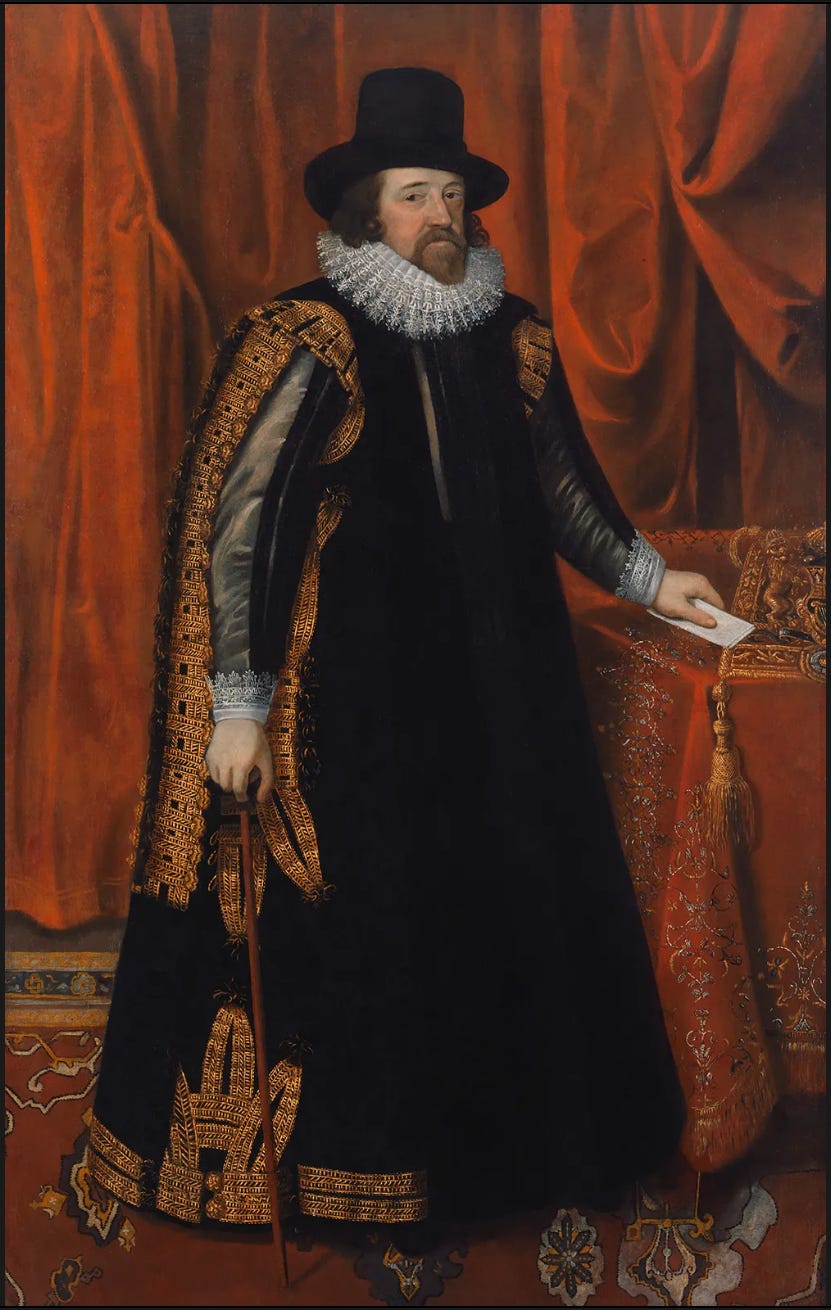
Indeed, Bacon’s activities weren’t altruistic, benign, or wholesome. He is widely credited with kick-starting the scientific revolution. But the idea of making scientific experimentation available to serve humanity was really about data harvesting, to bend science into scientism, a cult for manipulating discoveries, and developing inventions to harm, exploit and soften humanity, and to gain control over the species. The Shakespeare Project was really about entraining mass populations, while the codified myth motifs, metaphors, and character archetypes were teaching the masonic initiates how to lace esoteric salacious elements into public pagentary, including politics.
Naturally, the Cult of Freemasonry would be peopled with men in the key posts of British Intelligence, the military, government, the aristocracy and the merchant class.
Yet, Bacon was merely the frontman, albeit a gifted, energetic one. According to Gerald Rose in, “The Venetian takeover of England: a 200-year project”, it was state theologian of Venice, Paolo Sarpi, who conceived of empiricism and taught Francis Bacon his so-called scientific method. They corresponded in letters. Sarpi had been among the Giovani (the “Young”) faction of the ruling patriarchy, who challenged the status quo of the Vecchi (the “Old”), who ruled Venice through the Council of Ten. The Giovani returned authority back to the Senate, and defied Rome, in an attempt to re-establish Venice as an independent sovereign Republic. It was the Giovani salons, led by Sarpi, and his Venetian accomplices who created the Rosicrucian Cult as a syncretic religion that was subsequently infused into English Freemasonry, Rose stated, as part of the strategy to forge an invisible world empire fusing debt with time.
While in The Secret History of the West: The Influence of Secret Organisations on Western History from the Renaissance to the 20th Century, Nicholas Hagger’s otherwise excellent book, the Venetians are rendered are invisible transplanting their system of oligarchic governent in England. Hagger modelled for the patterns of revolutions, how secret societies plotted them and reasons for the subterfuge, showing the four distinct stages from idea to consolidation, with each requiring a leading archetypal character.
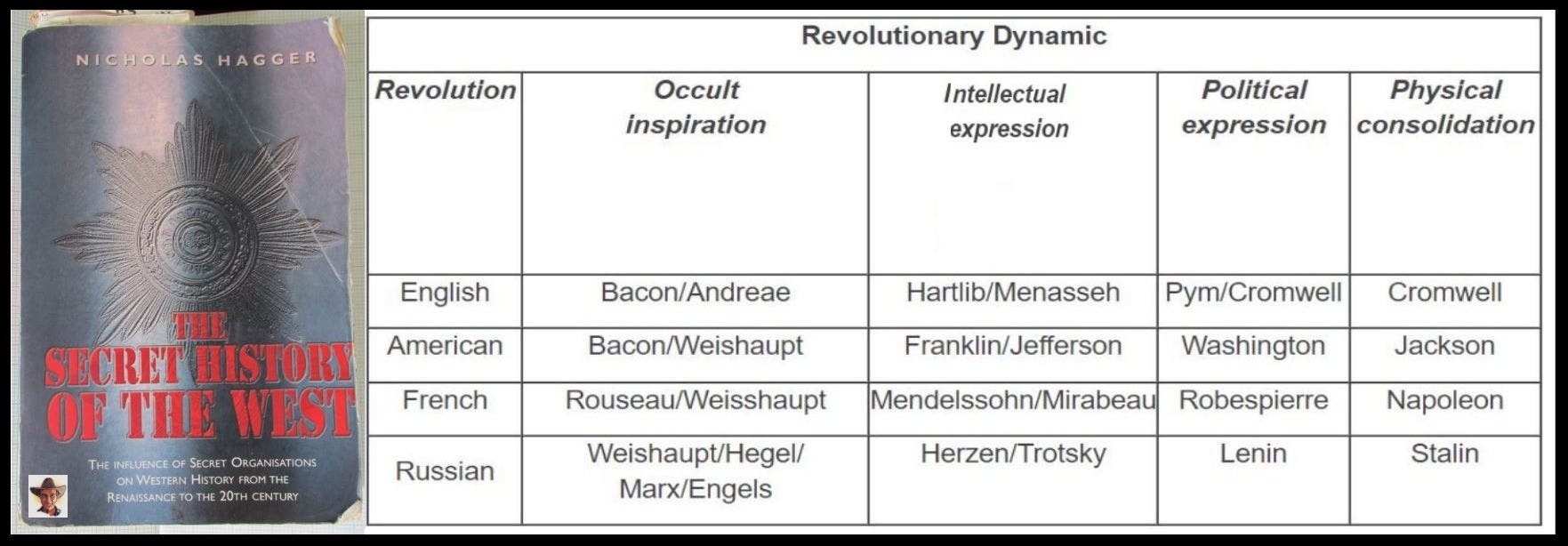
Hagger recounted how Bacon had travelled to France in 1576 to 1579, as part of English Ambassador’s mission to Paris. Bacon and a few continental thinkers inaugurated a Freemasonic movement and the Rosicrucian Fraternity, which Bacon described, as a reorganization of the old Knights Templar Order. A Rosicrucian College was to be formed as an inner rite to the Freemasonic Brotherhood that he planned for England, and setting the same prerequsite for Master Masons to join a Continental Rosicrucian College. On his second visit to Europe between 1580 and 1582, Bacon reported that Freemasonry was established in England and the Lodge System could be transplanted to France and Germany. It’s design was not completed until the publication of New Atlantis in 1626, where its philosophical seeds were sown.
In New Atlantis, the state-sponsored science institute, Salomon’s House, is a direct allegory for a fully realized Freemasonic Grand Lodge system featuring a multi-tiered hierarchy of ‘Brethren’ who wear specific robes, use secret tokens, operate under solemn oaths of secrecy, and strategically direct the political and scientific destiny of the nation from behind a curtain. Writers such as Nicholas Hagger and Robert Frederick of the Hidden Life is Best blog and podcast, see the New Atlantis as an operational manual of Bacon’s 1580s Helmet Society finally written down for posterity.
Freemasonry and the Rosicrucians were to be invisible for a century, while they influenced the trajectory of Puritanism, as agents of the ‘Venetian Conspiracy’, pitting Catholics against Protestants, to upend England in the 1600s, and consolidate the Rosicrucian Revolution with the founding of the privately-owned Bank of England in 1694, as a gadget to finance imperial wars. Bacon was a key occult inspirer archetype.
Comparative readings of Webster Tarpley’s 1996 article, “How the Venetian System was Transplanted into England”, and Robert D. Ingraham’s 2008 book, The Modern Anglo–Dutch Empire: Its Origins, Evolution and Outlook. reveal the Venetian agency.
The Venetian System was an oligarchy requiring the weak executive power of a Doge.
Venice’s 200-year project takeover of England from 1509–1715 commenced in 1509, due to the crisis triggered by the League of Cambrai, which was a military coalition against the Republic of Venice. Formed on December 10th 1508, the main European powers, the Holy Roman Empire, the Kingdoms of France and Spain. They sought to expand their hegemony over the Italian Peninsula, and to end Venice’s Empire. In one day, May 14 1509, Venice lost its mainland possessions in battles with France. Worried about France’s power, Pope Julius II, abandoned the League of Cambrai in 1510 and made a strategic alliance directly with Venice, that saved the republic.
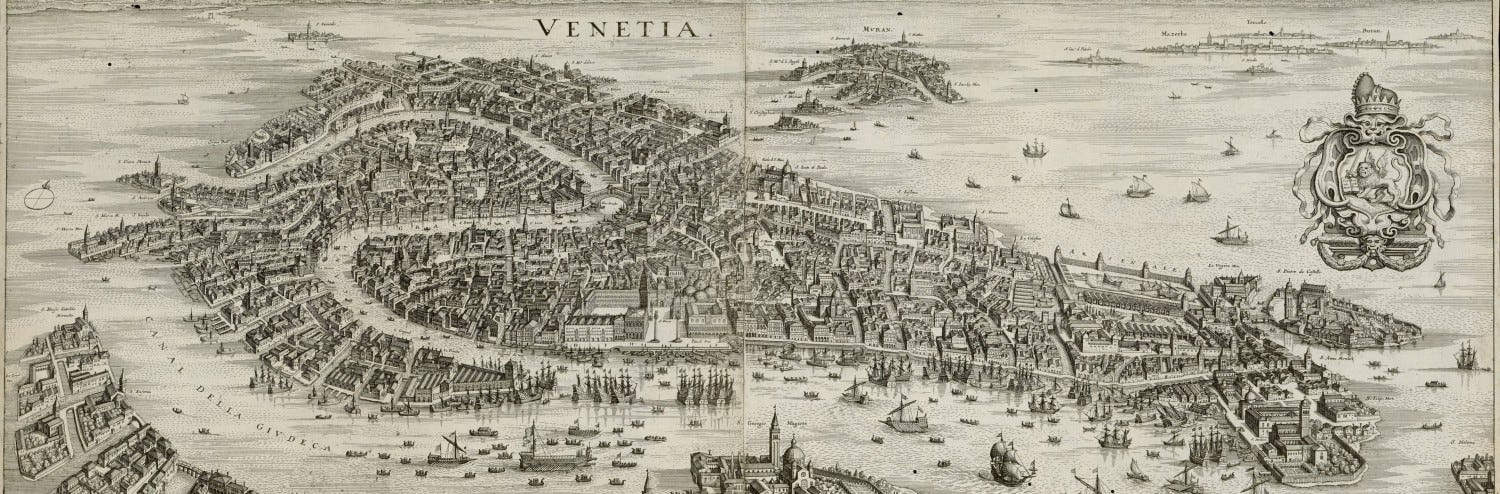
The Venetian Oligarchy realized the futility of running an empire from a lagoon.
Venice had built a maritime empire by playing off the European Powers, and with its formiddable intelligence, diplomatic and financial networks, it could accelerate the decline of the strongest power. Finally, Europe had had enough of its machinations.
This is the oligarchic system, with a doge, the Venetians sought have transplanted into their clone state, England, where British Venetian agents could form alliances with the second strongest European Power to defeat the strongest European state.
To get there would require a civil war. As Webster Griffin Tarpley noted in 1996:
“England would be the only major European country in which a war of religion would be fought between two pro-Venetian Protestant factions — the Anglican royalist cavaliers and the Parliamentary Puritan Roundheads.” — W.G. Tarpley, New Federalist, June 3, 1996
The English Civil War which was a series of armed conflicts fought between King Charles I and Parliament from 1642 to 1651 over royal power, taxation, and religion, that to Scotland and Ireland. From an imperialist perspective, the Puritan Revolution, between 1651 and 1660, which was another of the upheavels of the broader English Revolution, accomplished much — beyond killing half a million including the organized starvation in Ireland. Cromwell added 200 warships to the British Navy, and with this martime capacity 1,700 Dutch ships were captured. A convoy system was estblished for English merchant vessels to secure trade, Britain’s internal development and the growth of a merchant class. Cromwell made peace with Holland and war with Spain, in exact conformity with Venetian requirements. Cromwell conquered: Jamaica, St. Helena, Surinam, Dunkirk, Nova Scotia and New Brunswick.
Oliver Cromwell was a Venetian agent. Tarpley wrote that his home was in the Fens, a large swamp in eastern England. He quipped that the “swamp-dwelling Venetians … came to choose another swamp-dweller as their prime asset of the moment.”
In 1688, when the ‘Glorious Revolution’ deposed the Catholic King, James II, a protestant monarch was propelled to occupy the throne at Christmas, 888 years after Charlemagne’s Coronation as Holy Roman Emperor on 25 December 800 AD. The installment of Prince William of Orange and his consort, Mary, to the English throne paved the way for the establishment of the Bank of England, owned by 1300 vipers.
One of banking’s secrets is that all wars are bankers’ wars, as Michael Rivero outlined.
For example, when the Bank of England was established in 1694, as the world’s first national central bank, it’s immediate mission was to finance England’s ongoing war against France (known as the Nine Year’s War). The Bank of England was established with an 11-year charter as a joint-stock company and raised £1.2 million, and was essentially a public-private co-governance partnership, since the associated legislation levied taxes on trade. Parliament repeatedly renewed and extended the charter because the Venetian’s imperial masonic theatre government at Westminster continuously needed to finance military campaigns for its expansionist masonic empire. This public-private partnership was profitable for the bank’s stock-holders.
The creation of the Bank of England, along with establishing a stock-market and shifting control of state finances from the Crown to the Parliament, afforded innovations in the administration of capital, taxation and expenditure. Combined with the isles’ geographical advantage, Britain gained the edge over other European Cannon Powers to fund its empire with far-flung colonies inhabited with ‘natives’.
Crucially, Sionist Rosicrucian Freemasonry came to rule over the British Monarchy and the Church of England, after having successfully achieved a political and business merger with the Dutch in 1688, as Nicholas Hagger found in his epic study, The Secret History of the West, that modelled for the patterns of revolutions, how secret societies plotted them and reasons for the subterfuge. This merger was dubbed the ‘Glorious Revolution of 1688’ — which resulted in Prince William of Orange becoming King William III on the British throne after they landed at Torbay, near Brixham, Devon, on November 5th with 250 ships. This takeover was secretly bankrolled by English Rosicrucian Freemasons, the Bank of Amsterdam, and Amsterdam Jews, as part of the Venetian’s long-game to control Britain. James II was exiled from ‘Protestant England’.
In 1714, the Hanovarian King George I ascended the throne he became a Doge, of an oligarchy loyal to Venice and its invisible empire. Three years later, in 1717, English Freemasonry came out of the closet, with the founding of the United Grand Lodge.
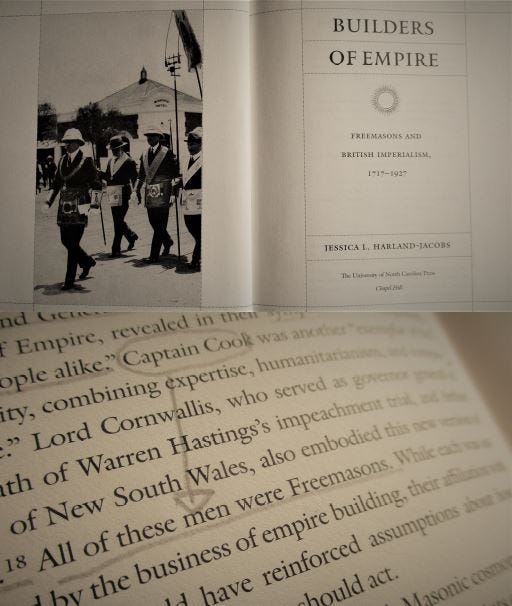
The primary secret mechanism by which the British Empire spread throughout the ‘New World’ was through the secret society of Freemasonry. In turn, Freemasonry was spread mostly through the military regiments, including the navy, as Jessica Harland-Jacobs showed in her book, Builders of Empire: Freemasonry and British Imperialism, 1717-1927. Although Harland-Jacobs, who accessed numerous libraries for her PhD, including the Royal Archives, and Masonic libaries, she doesn’t name the key players.
Instead, Builders of Empire focuses a lot on how Freemasons lived up to their cosmopolitan ideology when it came to inclusiveness toward indigenous peoples and former slaves in the colonies, or in their exclusion of women and Catholics from Freemason lodges in the 130 year period of imperial expansionism examined. Thus, the Venetians’ puppeteering were rendered invisible in their Whig Party theatre.
After the Giovani Revolution of Venice in 1582, the Venetian banking revolution was the Giovani’s answer to the Renaissance threat of the sovereign Commonwealth. Sarpi innovated empiricism, which is radical materialism, spreading empirical science everywhere across Europe to make scienticism the new hegemonic cult of social control. With the capacity to institutionalize science, the idea of what experiments could be repeatable would be determined by funding, controlling publications and the career stature of scientists. Where spirituality was funnelled into franchised city state cults that were eventually syncretically siphoned into regional patheonistic and universal monotheistic religions to match expanionist imperial ambitions, empirical science would become the new cult of the ‘Enlightenment’. Since empiricism, is radical materialism, science expells what can not be touched, heard, smelled or visibly seen. The problem with expelling what instruments cannot measure in any era, is that Ignorance and Arrogance get to run amok, dancing on shoulders of the White Coats.
This way, narrow science experiment results with manipulated parameters can be amplified out of proportion to their merit, to construe truths to justify political ends, commercial matrices and far-reaching impacts of the natural world too horrific for mention in the sanitized language of filtered science journals owned by the ‘Big Six’.
Bacon’s utopian novel, New Atlantis, portrays the mythical island of Bensalem as a society directed by a centralized scientific institution called Salomon’s House, whose work is hierarchically controlled, while the public are cast as admiring spectators. Bacon (1561-1626) had described a proto-technocracy. In his life-time, he lobbied for a scientific hub to make discoveries available, and eventually the Royal Society of London was founded in 1660, 34 years after he died. In his Instauratio Magna (“Great Instauration”) published in 1620, Bacon presented a comprehensive plan to reorganize the sciences and to restore man to that mastery over nature that he was conceived to have lost by the fall of Adam. Bacon had had a hand in making edits to the Old Testament in the final drafts of the King James Bible, adding Gnostic tropes.
Bacon claimed science should serve humanity. But, Bacon was an elitist imperialist, who had a gnostic worldview that holds the imperfect of creator of this world, a demiurge, made a flawed world. And so, as part of the broader Venetian yakeover of England and Scotland, Parlo Sarpi steered Bacon’s thinking. Knowledge of the code behind the cosmos was power to be ‘shared’ — among the adepts of science. This way, knowledge could be wielded by an elite to dominate nature, overcome mortality, and to bend science into scientism, and render the public as doting spectators, while new species are created, and liquids make men strong, and the weather is controlled, as Bacon imagined in New Atlantis, written in 1614 and published in 1626, after he died.
Reductionist hard sciences hardened. A hegemonic scienticism set in, expelling the mechanics of consciousness as unknowable, in a chess move to sever the soul’s cosmic radio channel from human mass consciousness. Radical materialism sponsored a hyper-material world, via this Venetician-conjured empiricism coupled with the Venetian oligarchical system and the machinations of the financial vipers of Venice.
And so, the financial oligarchy in Venice simply took over the state, eradicating any principle of national sovereignty, eliminating the idea of the Common Good, and to make the state itself an arm of the financial oligarchy. That, in essence, is the ‘AngloDutch’ financial system that was installed in England following the ‘Glorious Revolution of 1688’. The Bank of Venice and the Casa di San Giorgio initiated a new banking paradigm. Amsterdam and London would innovate to create a form of financial empire capable of developing a nation state, financing chartered colonies in cahoots with new super-companies, with the innovation of stock exchanges. For the Venetian oligarchical fondi, the system of empire was key, since it fuses the administration, the technologies and the treaures as an instrument of expansion.
The Venetians had migrated their capital to Florence, Milan, Genoa, Amsterdam and finally to London in a long game to forge an invisible empire to weaponize debt.
In Babylon’s Banksters: The Alchemy of Deep Physics, High Finance and Ancient Religion, Joseph Farrell argued that scarcity is a strategic policy, rather than a result, of periodic crises that result when currencies are based on debt. Indeed, a debt-based monetary system cannot sustain itself without periodic implosions. The repayments of the principal extinguish the credit created, while simultaneously fomenting aggressive competitive pressures to hustle to pay the interest, since the cummulative amount of interest that will be owed over all of the repayment installments is not created with the original loan contract. Therefore, these periodic crisis allow ‘Babylon’s Banksters’ to consolidate assets under the rubric of an unprecedented crisis.
The masses are trapped on a financial hamster wheel, competing against each other for survival money that structurally doesn’t exist as a debt-free cash, but rather as bank notes that were created as debt-based currency. The hamsters can’t see their anxiety and endless labours are mathematically predetermined by the system’s design.
Farrell also makes the case that myths, alchemical texts, and ancient cosmologies preserve remnants of pre-cataclysmic knowledge. These remnants, encoded in symbolism and ritual, provide frameworks for recovering the lost science through coded transmission rather than direct disclosure. Control depends on maintaining the illusion that these texts are allegories rather than technical manuals. The activities of Bacon leading a coterie of ghost-writers to co-author the Shakespeare plays, were about transmitting to adepts the existence of an invisible Rosicrucian Freemason Brotherhood, who were orbiting the epicenter of the factional English Oligarchy in the late 16th and early 17th centuries, right before the Thirty Years’ War, the English Civil War, and later, the consolidation of the English Revolution with a central bank.
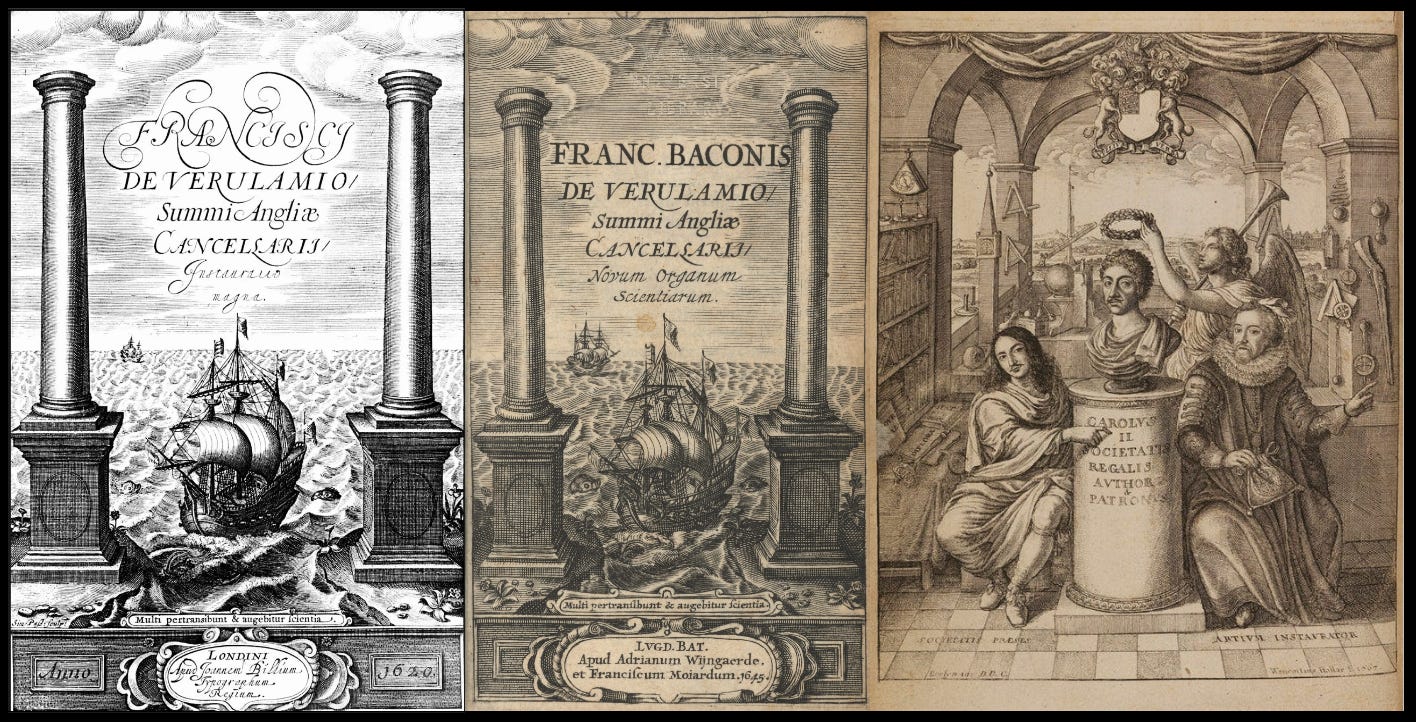
The covers of Bacon’s Instauratio Magna first published in 1620, and Novum Organum Scientarium printedin 1645, as well as the Royal Society of London’s first written history titled, The History Of the Royal Society (1667), published six years after its founding — flash the Masonic symbolism like cleavage getting an outing at a prom.
The Royal Society gushed that Francis Bacon was ‘their Moses’, as Robert Frederick recounts in “How Francis Bacon Created Freemasonry: And Modern Intelligence, Social Alchemy and Scientism” on his Hidden Life is Best blog and podcast.
In Farrell’s follow up book, Financial Vipers of Venice: Alchemical Money, Magical Physics, and Banking in the Middle Ages and Renaissance, he introduces the concept of the Topological Metaphor of the Physical Medium to explain how esoteric cosmic concepts were translated into physical financial machinery. In ancient hermetic and alchemical philosophy, the cosmos originates from a single, undifferentiated, infinite source. Creation happens when a ‘distinction’ or limit is drawn within this infinite space, creating a differentiation, such as light or dark, hot or cold, positive or negative.
Shaping the metaphysical framework to an alchemical analogy of money, real-world wealth is an open-ended, with infinite potential driven by human labor, creativity, and the earth’s natural cycles. Venetian bankers realized they could mimic this cosmic creation process by positioning themselves as the sole creators of the ‘distinction.’
Using moneys of account and bills of exchange, the vipers separated physical commodity wealth, like gold or grain, from an abstract, mathematical ‘money of account’. Money was no longer a physical thing; it became an invisible, shifting field of relationships, data, and ledger entries — like the unseen forces of magical physics.
By creating public debt and the first state bonds, Venice turned a negative concept —debt, or a lack of something — into a liquid, tradeable asset. With the monetization of debt, Venetian banks magically created wealth out of nothing by monetizing their own liabilities, establishing the prototype for modern central banking and fiat currencies.
Farrell argues that when this alchemical system is scaled up, it acts as a massive social and psychological architecture of control — a literal ‘spell’ — that locks populations into an invisible matrix of subjugation. This way, the open cosmic medium, described by esoteric hermetic or alchemical principles, are filtered through financial funnels by the Venetian ‘Distinction’ Complex where the banksters’ financial machinery, such as fractional credit and monetized debt create ‘the spell’ such that the mass populaces can’t discern how they are in a structural system of perpetual scarcity and subjugation.
In other words, the magical physics of the cosmos, as decribed by alchemical principles, and when applied to open source localized networks, have an abundant potential to support humanity on a pathway on emancipatory evolution. Instead, access to esoteric knowledge systems was hidden, sabotaged and heavily codified, and with this scarcity, oligarchies through the ages have translated that scarcity into material scarcities to maintain extreme wealth for the purposes of social control.
Thus, the Cult of Rosicrucian-flavoured Freemasonry, with its lodge system was developed in parallel to the alchemical plays of the Shakespearean Globe Theatre, and also when the reductionist scientism cult called science, radically materialized.
The strategy is revealed by the sequence, wherein Bacon’s Instauratio Magna (“Great Instauration”) was published in 1620, laying out a system for organizing physical sciences, followed by the collected works atrributed to Shakespeare published in 1623, and with the New Atlantis published in 1626, the design of a Freemasonic Lodge System was described, for those literate enough and who could gain a copy, to comprehend the utopia was forecasting a heretical vision to take-over the world. New Atlantis was tucked into the back of Bacon’s Sylva Sylvarum (or Forest of Materials) as a vast, posthumously published collection of 1,000 distinct experiments, observations, and theories regarding physical phenomena and natural history. By the pairing of this disorganized “forest of raw data” with a fictional story about a highly advanced research university called Salomon’s House, Bacon sought to illustrate how an empire could be forged if a society properly harvested and analyzed the exact materials he had compiled in the main text. Where the Venetian’s built an empire on slavery, feudalism, loot, ursury, and plunder dressed up as administration, trade, and banking, the rulers of the ‘British Isles’ could forge an empire with the tools, skills and statecraft that were bestowed to them via the ongoing Venetian Conspiracy to recode the world.
By introducing a public national debt, the Venetian oligarchy had decoupled power from sovereign monarchs and governments they financed, and placed that power firmly in the hands of international private creditors. When a nation is dependent on private markets to fund its wars, infrastructure, and existence, the government ceases to represent its people (if it had). It becomes an enforcement agent for the bankers, extracting taxes from its citizens to pay the perpetual interest on sovereign bonds.
The ultimate triumph of the ‘spell’ is that populations are conditioned to view these artificial, mathematical constructs as natural laws. People accept inflation, national debts, and central banking cycles as if they are inevitable weather patterns rather than highly engineered mechanisms designed to strip them of their wealth and autonomy.
This secret system of debt enslavement has the masses focussed on material needs, without seeing that money itself is a spell — as a symbolic condensation of will that operates upon the probability field, with the manufactured credit being literally conjured from the void of potential, or the aether, through nominalist utterance, the signed contract. As magic physics, this Venetian-innovated banking sytem gets the masses to focus on the material physical universe. The banksters operative magic is the manipulation of temporal resonance, or chronos, to align events with archetypal currents, functioning exactly as the Venetian bankers’ astrological timing of loan issuances. Temporal resonance, or chronos theory, works by treating time not as a passive background dimension, but as an active, structured physical field governed by recursive frequency and curvature. Farrell posits the world’s rulers wield this power.
In this framework, the bloodlines of dynastic families are not simply genetic dynasties but initiatory chains maintaining monopoly access to the field-manipulation techniques that were formerly called magic, now called financial instruments and predictive algorithms. Where the Medici banking dynasty used the Church’s approval to legitimize their credit-creation, and the East India Company used the royal charter, the modern cartel uses “science” (or materialist physics) and “democracy” (or managed choice) to maintain the illusion that human populations are meat operating in a dead universe, rather than consciousness entrapped in a probability farm called nations.
➳ Back to ‘the Fix’ to Consolidate Territory Taken by Violence
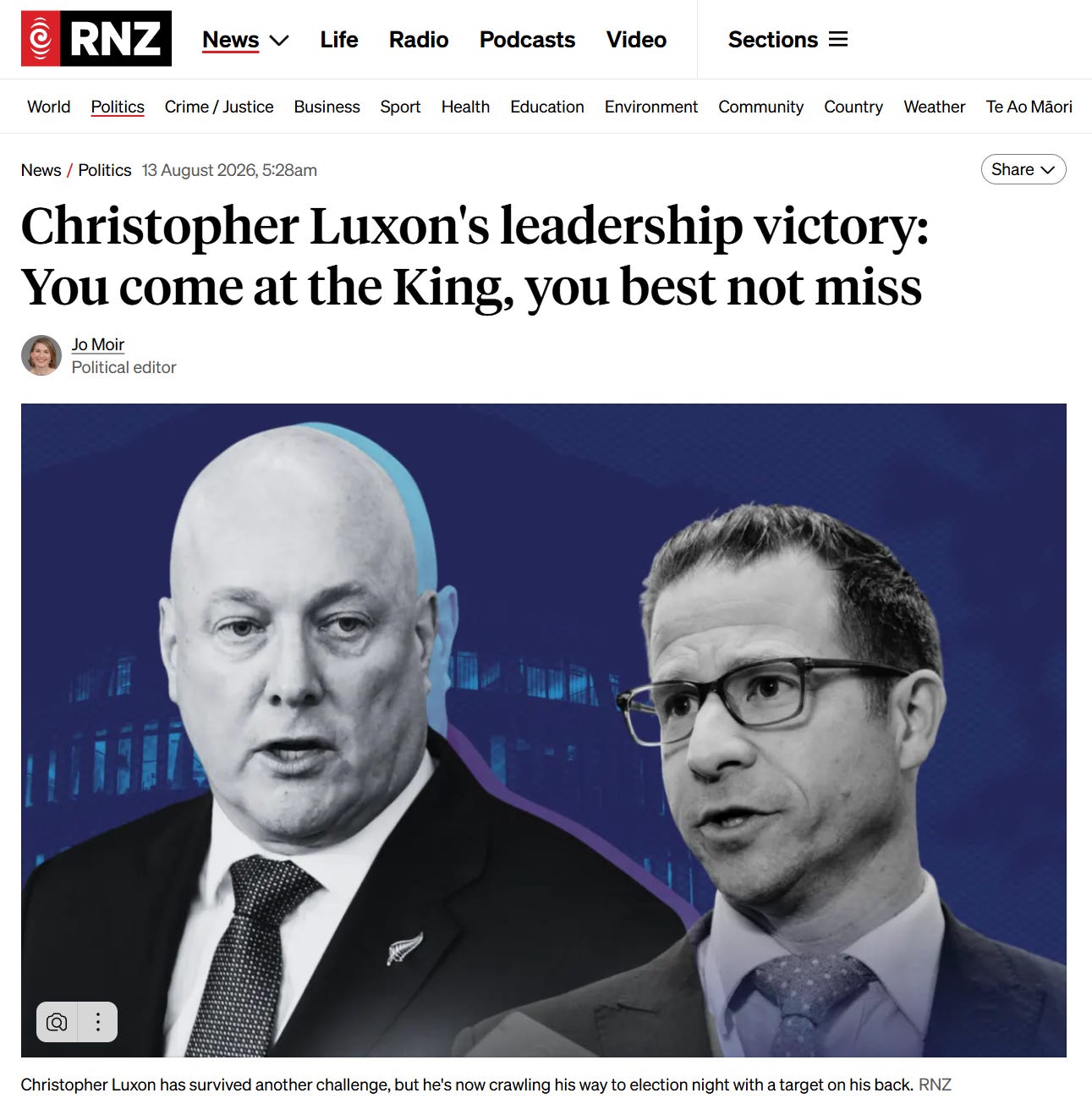
Humanity has been getting screwed by the degenerate illuminati vampires and their loyal lizard-lords, who have worked out hi-tech ways to distract, divide and defeat human communities of all walks of life, with the cover-story of ‘global transformation’.
The spooky spectre of such a dystopian future is that there will be no opt-out, short of suicide and that grim choice — which is typically made when humans can see no ‘up’ or no end to suffering — also may become impossible in a world of total surveillance.
For a Catholic prime minister who claimed to loath slavery, Christopher Luxon has a blind-spot when it comes to seeing the puzzle pieces of a totalitarian architecture that has advanced on his watch. If he’d prime ministered less like a CEO treating the nation as a failing brand to return to profitably, he might’ve noticed the creeping techno-feudalism on his cell-phone, in every official meeting, and on every flight.
In this hyper-material world that lacks adult supervision, the monkeys are being corralled into a slickly marketed ‘sustainable’ geo-fenced future, where chip-mediated algorithms micro-manage all transactions, all transnationals, and all transhumans.
The bedtime story pimped-out in the Bourgeoisie Media, would have New Zealanders believe the proposed data warehouses will boost the nation’s capacity to be a player in the global infrastructure circuitry. Yet, such circuitry is building a totalitarian matrix.
And, that managed retreats are regretfully necessary due to climate change despite shifts that have been far more dramatic in the past long before the plundering structural forces of industrial capitalism. Yet, a bill of over $200 trillion is claimed to be needed to pay for constructing a sustainable shiny world, that includes building privately owned port cities at the current sea levels. And, a global surveilance grid to stocktake every metric including ‘nature’, and to tokenize every process onto blockchain ledgers for markets to track, tabulate, trade, toll, tax, and tally — 24/7.
By falling for scientism of climate change, well-meaning chess pieces in councils, central government and companies fail to fully see how are they being hijacked as Trojan Horses to steer New Zealand along on the technofeudalist trajectory. This pathway is part of the accelerationism to forward the ‘Fourth Industrial Revolution’.
This ‘Fourth Industrial Revolution’ (4IR) is set to out-scale all previous human impacts on the planet, unless humanity has a paradigm-consciousness shift where our species embraces an emancipatory evolution path. The resource plunder, mass migration and geopolitical wars are set to be epic, if humanity fails to alter this arc of history.
The year 2050 is one of Zoominatis’ milestone years within the United Nations’ blueprint called Agenda 21 — as the author of Behind the Green Mask: U.N. Agenda 21, Rosa Koire explained to dissident journalist, Spiros Skouras in mid-June 2020.
By 2050, the planet’s overlords expect to have their blueprint completed and locked in place. Their 100-year plan is designed to destroy the concept of the nation state, by devolving control into mega-city states governing mega-regions, thereby breaking county, city and state borders. This action plan seeks to inventory all lands, minerals, plants, animals, water, food, energy, production, humans, money, and data, Koire said.
The Zoominatis’ pricetag for ‘sustainable development’ utopian vision is either $200 trillion, or even a colossal $270 trillion, depending on whose estimates you take.
This proposed build-out of a SMART-chipped green global economy implies epic-scale plunder, mass dislocation and wars. This ruse is about sustainable management of poverty, continuous behaviour modification and permanent enslavement.
In other words, the Fourth Industrial Revolution (4IR) is a euphemistic label for a Techno-Feudalist World Order where the vast majority are being set-up to etch out a living as techno-serfs, continually retrain, compete with AI, robotics and automation, and to work ultimately for unseen super-rich oligarchs, who plan to own everything.
The Bourgeoisie Media, the Bourgeoisie Academia and the Bourgeoisie Think-Tankadia presents bedtime story narratives, and instead consign the dark agendas to the margins, outside the framings examined for public scrutiny. Discourses must not speak of ‘Voldemort’. And so, the ‘institutional voice’ teaches the sentient to be less sentient, and performs as the Propaganda Model predicts, to abide by a meme of one ThoughtPolice-ring to rule them all: don’t name, define, nor describe the sacred cows.
A perverse ‘New Zealand Theater Company’ performs democracy — while it’s costumes, props, and stage sets are being fast-tracked into a technocracy soap opera — to unsuspecting families at a carnival on an automated ride, who are led into a huge pavillion, and will come out the other-side changed forever with software ‘upgrades’.
Every election season, Māori get elevated up to a scapegoating platform. Yet, the same treatment isn’t meted-out to the oligarchy who appear in the NBR’s annual Rich List.
When Brash was re-engineered as a politician, his strategists and financial backers flogged the National Party horse too early by coming out of the gates with their Orewa Race-Baiting Speech. With only 20,000 votes between a Labour-led Coalition, and a National-led Coalition in 2005, it was clear their strategists had gotten too lusty and excited too early — like a teenage boy finally getting to play tents with a girl.
The central cheat of capitalism is that its purely an economic system, when in fact it is a private political system that uses economic means to exclude as many human monkeys from gaining access to land. And so, a Mont Pèlerin economist such as Milton Friedman could wash his hands clean claiming his advice was purely economic when he mets with Pinochet. And Don Brash, a Mont Pèlerin economist, could invite Friedman to New Zealand, and later as the Reserve Bank Governor, Brash could participate in quarterly inflation adjustment shocks to maintain the economic servitude of the commoners because the bank cartel pretends to be ‘apolitical’.
Yet, pretending ‘there’s nothing political about capitalism’ is a bit like a ‘stiff hardy boy’ saying to a ‘cat’ hiding in a skirt, his activities have nothing to do with pregnancy.
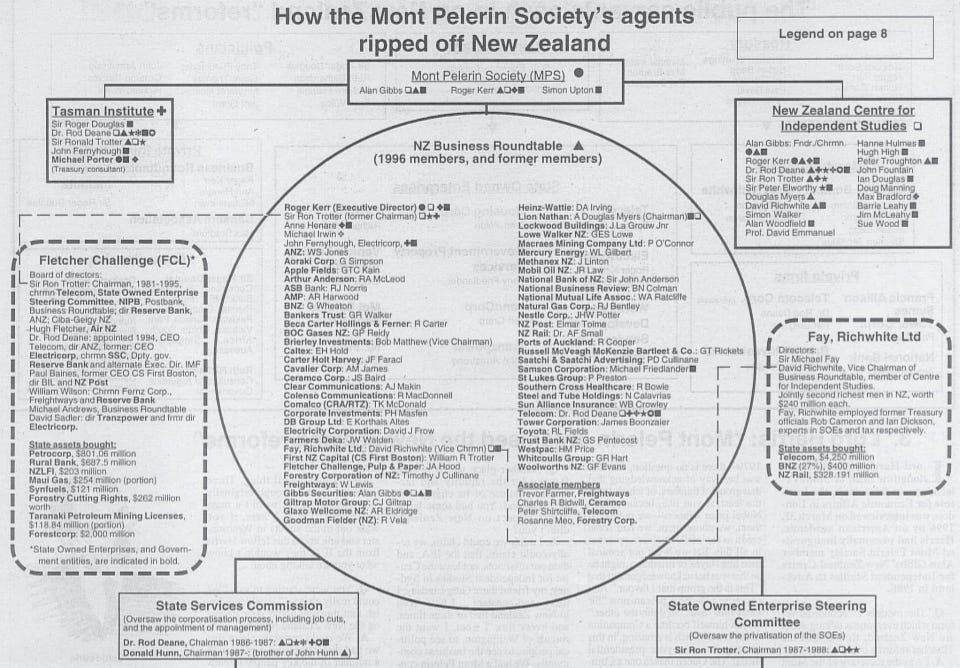
And the revamped NZ Business Roundtablers — the New Zealand Initiative, together with Infrastructure New Zealand, NZTech Alliance and Digital Identity NZ, are designing the blueprint for the techno-feudalist police state, under construction.
Doubtless, many of them would consider such a view as conspiracy woo-woo doo.
Crucially, if Mammon’s Monsters lose control over the componentry that comprise the structural forces, then the monkeys gain autonomy or independence, while the rulers’ hierarchical systems become irrelevant. Such resources — including land, dominant institutions, and strategic technological innovations — underpin structural forces that both bind civilizations and have the potential to free the human monkey.
Because the New Zealand Monkey has become a domesticated consumer, who lacks household level economic independence tethered to neighborhood food security and lacks community resilience networks to trade internally with alternative exchange systems, the isolated archipelago is vulnerable to internal and external staged shocks.
This cycle of servitude is exacerbated by the fact that New Zealand’s biggest home building firm, which also dominates the supply of construction materials, is itself owned by Wall Street banks and by the world’s third biggest asset management firms.
A handful of foreign commercial banks and one asset management firm majority-own the market-dominating construction industry corporation, Fletcher Building Limited.
Approximately 63% of Fletcher Building’s shares, are together held by CitiBank, HSBC, JP Morgan Chase, BNP Paribas — and State Street. This ownership structure confers Fletchers market access to cheap credit which leverages its position to make higher margins in raw materials, manufacturing, whole and retail supplies. In this way, the banking and financial institutions that own Fletcher Building deepen the expropriation of profits off New Zealanders, who pay exorbitant building costs.
For example, Fletcher Building owns Winstone Wallboards, that produces the GIB which enjoys cosy compliance arrangements with councils throughout the toll-booth neo-feudal plantation economy. Fletchers also owns the building supply franchise, Placemakers, Golden Bay cement, Firth concrete, pipes supplier Humes, quarry firm Winstone Aggregates, civil engineering firm Brian Perry, Easysteel, Strammit steel, Fletcher Reinforcing, Altus aluminium, Dimond and Pacific Coilcoaters roofing.
Therefore, while Chris Bishop’s reforms of the Resource Management Act to clear blockages to building consents, has dealt with gripes regarding expensive lengthy approval processes, the endemic construction cartel is less endangered than the Kiwi.
Those legitimate gripes had to with reigning in the dominance of New Zealand’s Old White Boys’ Network and their crony connections inside councils, companies, consultancies, charted counsels and commerce chambers. But, the horse-trading involves more lucrative wins at the ‘totalizer’. The metaphor-laden date riffing meta-data reveals an unfolding meta-narrative to achieve over-arching objectives. The meta-conflict over left-right wing coalitions — with both sides wearing their identity politics on their sleeves like military badges signifying ranks invarious branches of the war department, the alphabet agencies and the armed constabulary — reveals the theatrical nature of politics, however sincerely some of the actors may be performing.
The creepy spooky entwinement of this Luxon Leadership Laundromat by dates, with those associated with the inquiries in the aftermath of the military-themed Mount Maunganui Holiday Park Landslide, tell a sinister tale about the weaponization of politics, commerce and the weather. When a cryptocratic dark state is running a covert civil war, the violence can gain it territory. But, the cryptocracy can only keep it with ‘the fix’. Those connections to make ‘the fix’ stick have been established over the decades since the Second World War. Many of them reach back into the generations of the Colonial Era. They are sustained and deepened with each staged crisis, which embroils more officials, some of whom have been groomed as prospects for this mafia.
Men who as boys, were inducted by their fathers to ‘lose their viginity’ with hookers.
This way, they are groomed into a sub-culture of secrecy, deception, and superiority that starts with getting laid, and the thrill grows into an addiction that becomes a multi-season operation among a brotherhood, cheating on their girlfriends, partners and wives. And, it’s teenage boys from broken homes, who were groomed at school to sell drugs, and who were trained to target teenage girls from broken homes to get addicted to drugs, and who in turn, prostitute themselves to pay off the drug debts.
Some of these kids suicide, or they are ‘suicided’. Some become assets of the network.
Initiates of secret orders also learn about inversions in metaphorical ceremonial stages, journeys, and trials with symbol-laden allegorical tales performed as rituals to achieve degrees of a craft. This occult flipping of meaning is called inversion. The cryptocracy’s staged events often play with the tactic of inversion, where naïveté is cultured into the gentile peasant monkeys, such that they plan for success without asking the critical counter-question: what would guarantee failure?
As with all of these staged disasters, their cover stories play on an apparent individual, institutional, or ideological ‘failure’, to identify and avoid pitfalls, blind spots, and common mistakes, that practically guarantee the odds of a catastrophic crisis.

This staged leadership fiasco, with a requisite scapegoat, signals a political formation around a right-wing bloc comprising National, ACT and New Zealand First. That preferred political center of gravity was signalled by the storm’s timing, which made landfall on its target district on January 21 2026. Uncannily, this extratropical storm riffed off the date January 21 1864, when the ‘Tauranga Campaign’ started.
Like all hardball military strategies, that give rise to risk game plans to increase the probabilities of the chosen tactics working as desired, this cruel grimoire politics entailed wetting the land like a soggy sand-pit, so slips would ensue district-wide.
And what d’ya know, the slip-prone camp-ground at Mount Manganui delivers the ‘pay-dirt’ with the breaking news about campers trapped in a toilet block buried in mud. And, the Holiday Park is owned by the Tauranga City Council, that had ignored, buried, or filed away numerous reports since the 1990s, warning of dangers, the lack of mitigating measures and an absence of monitoring, evacuation and readiness plans.
It’s as if the place, Maouo, was selected to be a talisman for the cryptocracy’s magical physics. Mount Maunganui’s old Māori name is Mauao, which means ‘caught by the morning sun’. In myth, the small mountain was personified as a suicidal slave Mauao, who became stuck on the coast at dawn, when the patupaiarehe fairy people fled from the rising sun back into the dark Hautere Forest. The patupaiarehe had been dragging Mauao to the coast, because he wished to sink into the sea and drown. Mauao, who had been a slave to the great chiefly mountain, Otanewainuku, had lustily eyed Puwhenua, a shapely hill clothed in all the fine greens of the ferns and shrubs and trees. But, her heart already belonged to Otanewainuku. And, as this was some two million years ago, and long before Francis Bacon kick-started the scientific revolution that led to the Industrial Revolution, there were no bulldozers, sticks of dynamite and trucks to quarry Otanewainuku. The myth doesn’t explain why Mauao didn’t just ask about if there were any other single beautiful mountains, or of ones getting divorced. In any case, some of Maouo slipped into the sea during the deluge in the wee hours of 22 January 2026. How curious that the fatal landslide at Mount Maunganui would make national headlines for days. And, amidst the news emerging that the bodies of the six missing campers had been recovered, New Zealanders learned that Mount Maunganui had a name steeped in Māori myth about being caught by the dawn.
Given the tragedy occurred at a Holiday Retreat Park located at the foot of a small mountain, with a myth about how its managed retreat from the land to the sea was stalled by the rising sun, because the patupaiarehe fairy people panicked at first light and fled to the forest. Ergo, the uncanny symbol sorcery, combined with the timing on the same day that 600 troops arrived by British warships in Tauranga Harbour on January 22 1864, is the dead giveaway of a Baconian Masonic inversion in the disaster.
The date riffing reveals this cruel staged disaster codifed psychopathic humour about how there’d be slippery slopes to tyranny, especially in council or national election years.
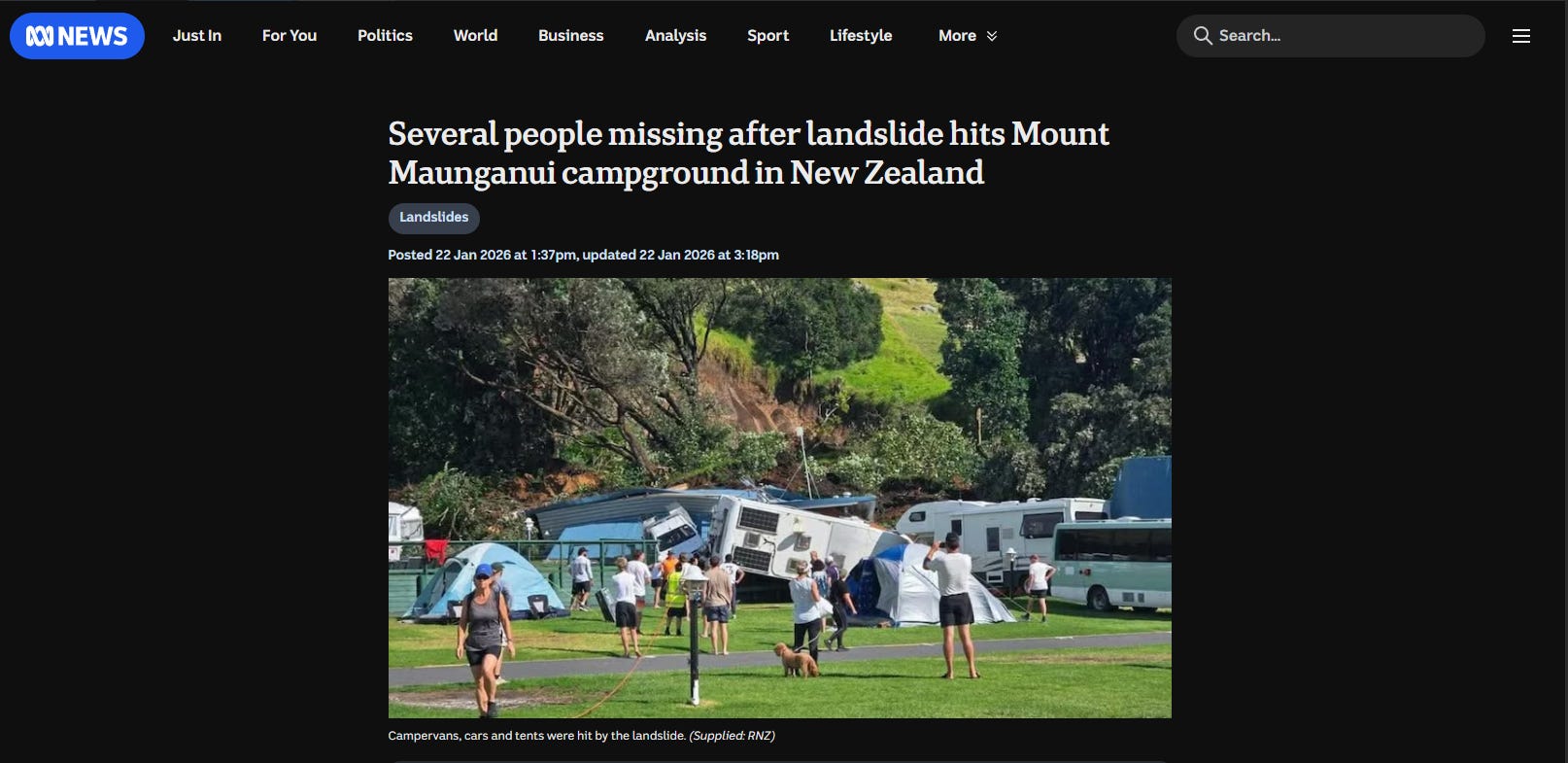
But this isn’t the first time a storm has been timed to hit on a potent date to telegraph a trajectory of relocating communities to places where the state is prepared to supply infrastructure for residential purposes, while re-orienting resources for extraction.
In January and February of 2023, there were two storms that hit New Zealand.
This first storm delivered the ‘Auckland Deluge’ of Friday January 27 2023. This Auckland Annivesary Flooding was described as “unprecedented”. This Deluge just happened to occur on the historical foundation stone laying for the Auckland Harbour Bridge by Freemason Prime Minister Sidney G. Holland on date of January 27 1956.
Yet, the capacity to engineer storms, by various weather modification technologies, techniques and territorial tactics is still marginalized as conspiracy woo woo theory, the news media frequently reports such ‘extreme weather events’ as due to climate change, driven by the burning of so-called ‘fossil fuels’ since the industrialism.
As such, January 27 was a potent date for the Auckland Deluge to swamp the region, since it was on Janaury 27 1959 that Kapuni No. 1 Well was spudded in at Taranaki. This well yielded high-pressure natural gas and condensate (a premium light oil). The gas from the well contained a high concentration of carbon dioxide, at around 40%, requiring specialized processing before it could be commercialized. Once full production began in 1970, the resources were piped across the North Island to supply household and industrial fuel, generate electricity, via a pipe network built by the Public Works Department. Kapuni’s plant also supplied the petrochemical industry.
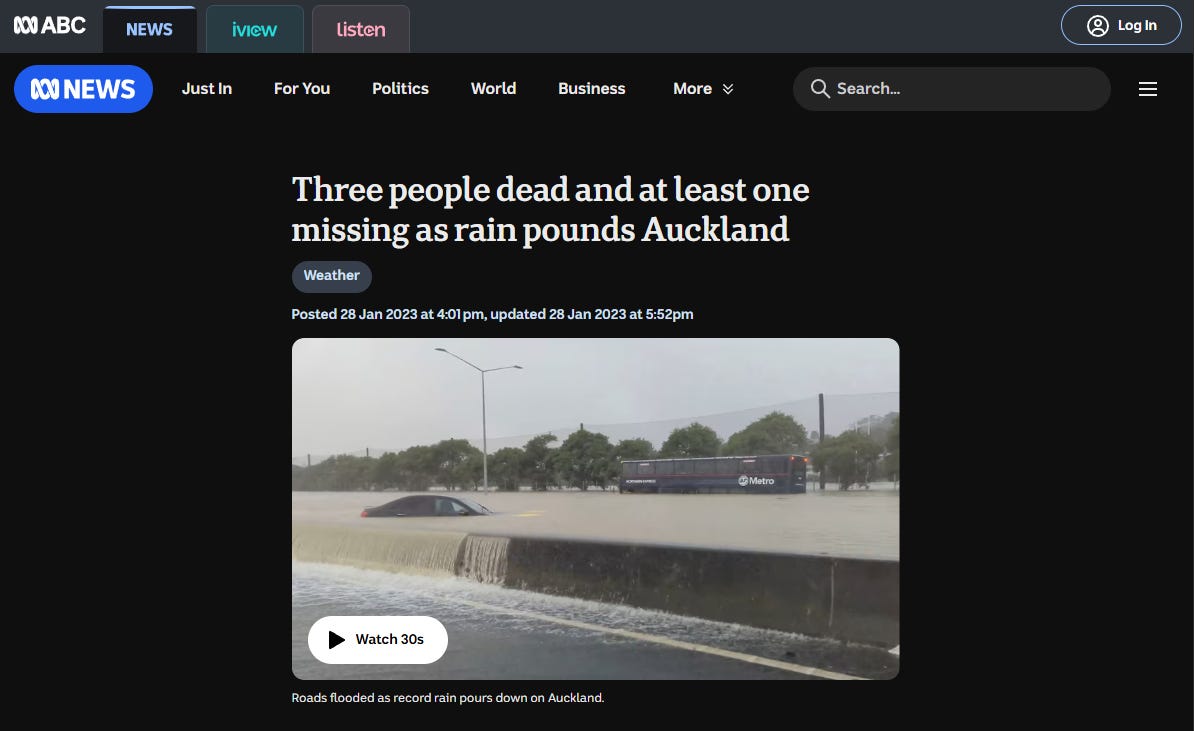
The storm had been identified as a Tropical Disturbance 6F on January 20, as it entered the Australian Basin by the Fiji Metereological Service. Thematically, as the storm passed into a new territory, and headed for New Zealand, it riffed off the date on January 20 1957, when the historical opening of Scott Base, New Zealand’s permanent Antarctic research station, on Ross Island, took place with a ceremony.
Scott Base runs both meteorological and atmospheric research programs alongside its broader earth science operations. Staff conduct a daily 9:00 AM weather observation (measuring temperature, barometric pressure, visibility, and cloud cover) that has run continuously since Sir Edmund Hillary’s team started measurements in 1957.
Ergo, the themes of infrastructure milestones associated with traffic, gas and oil exploration, codified a foundational N.Z. milestone for transnational weather warfare, to usher in an era of managed retreats to clear coastal and inland areas for mining.
Two weeks after the Auckland Deluge, Cyclone Gabrielle hit New Zealand hard on Monday February 13 2023. On January 12, the cyclone slowed down, and stalled near Great Barrier Island on February 13, and re-energized after interacting with a Tasman Sea trough, dumping massive moisture onto the North Island, in the evening of February 13 and into the morning of February 14. What hard the odds that cyclone, which started as a tropical low, thematically riffed off the start of the infamous 1951 New Zealand Waterfront Strike, on February 13, when the rumbling dispute escalated because the Waterside Workers’ Union commenced a refusal to work overtime. The country’s largest industrial confrontation errupted as shipping companies responded by locking out union members, setting off a bitter 151-day industrial standoff that brought the wharves to a stand-still. However, some ships sailed, and the Rainways Department contracted with the CIA’s propriertory airline to fly 1300 flights across the Cook Strait to keep commerce going and undermine the effectiveness of the strike. There were some violent clashes, but they were as bad as the Strike of 1913.
Ergo, where the 1951 Wharfies Strike occurred amid a climate of Cold War suspicion, the Cyclone Gabrielle took place amid a climate of suspicion about ‘global warming’.
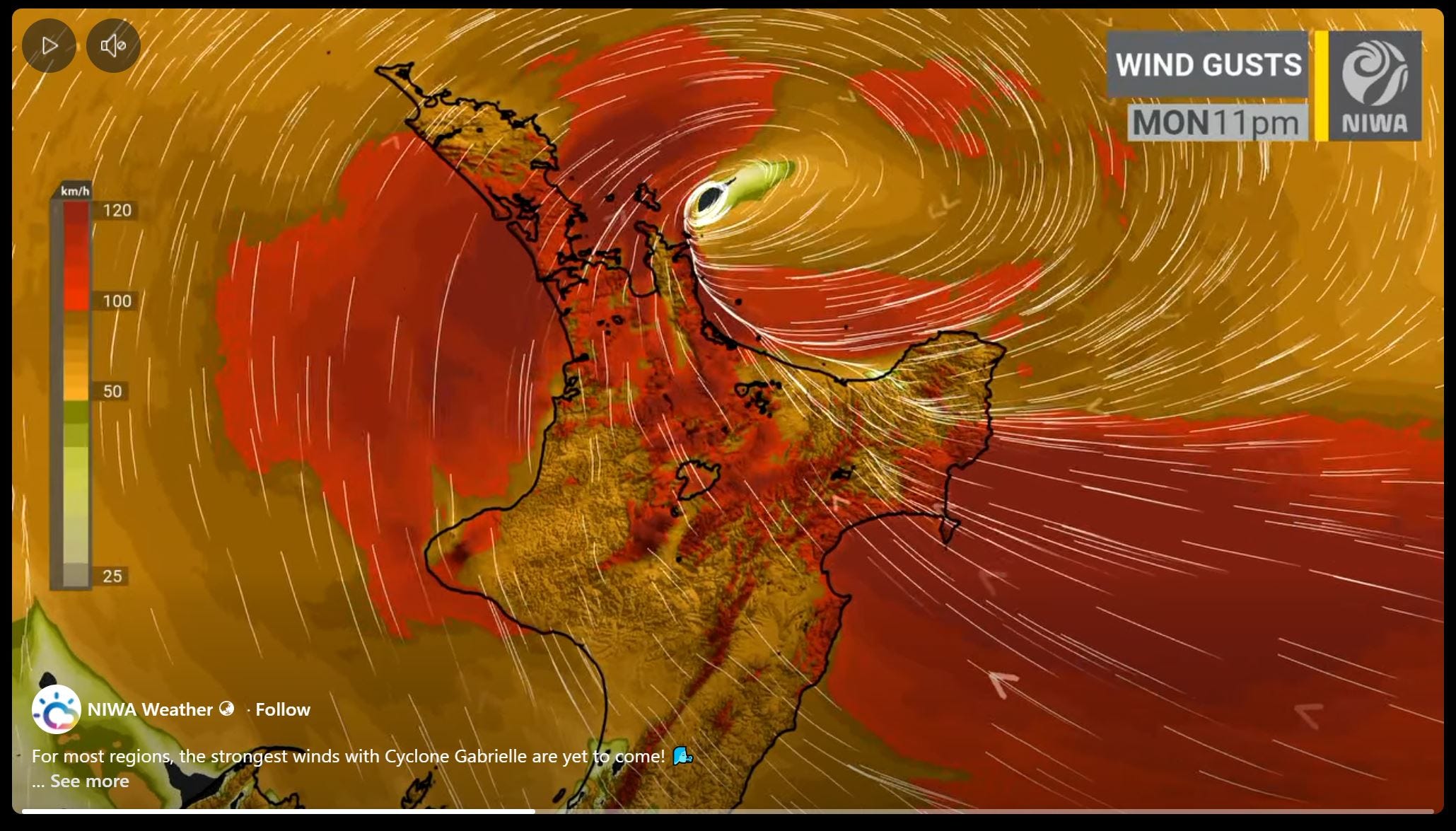
The emerging storm was reported as a Tropical Low 14U by the Australian Bureau of Meteorology on 5 February 2023. Since the meta-data of metaphorical date riffing reveals a controlled atmospheric front, how uncanny was it that on February 5 1911, the first controlled powered flight in New Zealand took place at Pakakura piloted by Vivian Walsh. Cyclone Gabrielle hit the Hawkes’ Bay and Northland hard.
The New Zealand Army, Navy and Air Force deployed vehicles, equipment and personnel to help with the rescue, and clean-up in the Hawkes’ Bay where 13 people died in the early hours of February 14 flood waters overwhelmed communities. What are the odds that that this deployment riffed off the historical day, February 14 1915, when Māori soldiers sailed off to fight in the British-engineered First World War?
So, the military won public acclaim, while weather warfare was dismissed as woo woo.
Ergo, amidst a climate of suspicion about ‘global warming’, the pioneering era of weather modification technologies, techniques and territorial tactics were long gone.
In a research paper entitled, “Cyclone Gabrielle as a Design Storm for Northeastern Aotearoa New Zealand Under Anthropogenic Warming”, (Wiley Earth’s Future September 2024), Cyclone Gabrielle (and Cyclone Bola, 1988) were described as benchmarks for ‘design storms’ under anthropogenic warming. In civil engineering and climate risk assessment, a “design storm” refers to a standardized, statistically defined rainfall event utilized as a benchmark for planning and building infrastructure capable of withstanding extreme weather. In the September 2024 paper from Earth’s Future, Cyclone Gabrielle is framed specifically as a modern baseline benchmark representing a worst-case regional event under anthropogenic warming, providing a realistic climate-adjusted model for future infrastructure planning.
So — what are the odds that two huge storms in a fortnight would strike with themes of infrastructure milestones associated with traffic, gas and oil exploration, territorial jurisdiction and meteorological and atmospheric research, industrial striking and civil disturbances, pioneering powered flights, in an election year tilting to the right-bloc?
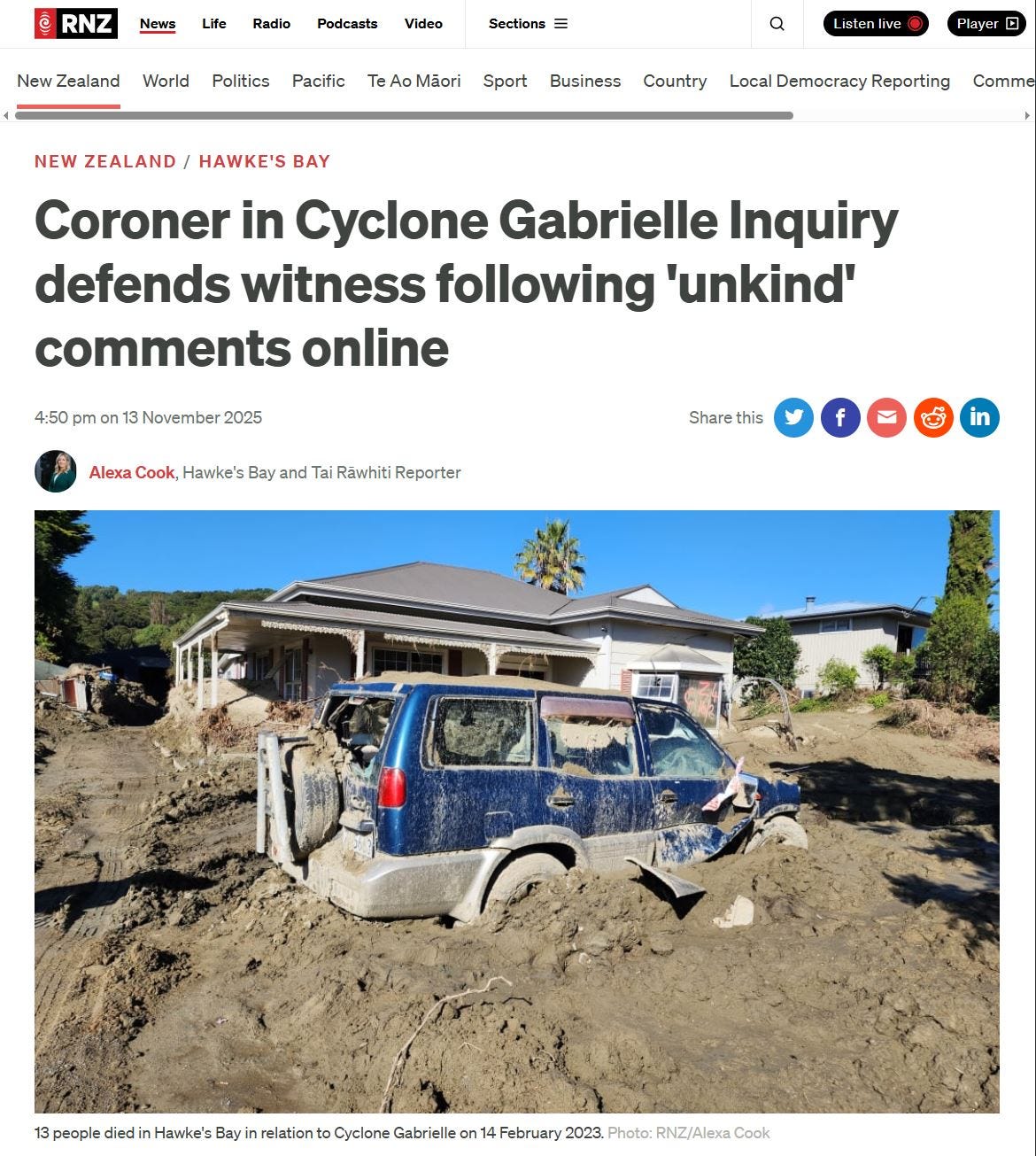
And how uncanny, this election year military-themed extratropical storm episode has overlapped with the hustlings on the hustings. Like in The Truman Show, it’s a timely engineered storm to maintain control over protagonist’s choices, add drama for the watching auidence, and steer the narrative in favour of the investors’ interests. And like in the Truman Show, it occurs against the backdrop of world news feeds featuring staged forrest fires, nuclear leaks, fogs, terrorism and even wild animals catching engineered diseases. And Luxon clamps on gangs while failing to prime minister about the mafia that runs New Zealand from the shadows. And, even though the former Air NZ CEO essentially performed a mid-air one-eighty over the defence budget cut, following the Manawanui running aground on the 13th anniversary of the Rena running aground, All of Carrot Land’s NewsVicars and NewsNuns didn’t notice.
And, by failing to notice the Luxon Administration had become politically captured in an obvious staged maritime crisis, the prime minister essentially took a punch to nose.
Austerity isn’t for the national security state. Luxon’s joke about rapelling out of a chopper into NewsTalk ZB’s building for an interview with Mike Hoskings is as close as LuxonMan’s cerebrium gets to brainsing about the parapolitics of cryptocratic dark state running the everyfink the shadows. Where being the CEO of Unilever Canada, or getting invited to a couple of Microsoft CEO summits might turn you into a big noting prime minister, cutting the Defence Budget by $1.5 billion will get you a nose bleed, metaphorically-speaking. Yet you won’t read about LuxoMan Cabinet’s reversal of the budget cut in 2025, and increasing its allocation over and above what Defence was due to get before CEO Scissorhands trimmed the sprawling costs like hedges and trees as sculpted art installations in the empty streets of Austere, exciting the naughty nerdy knickers off a cyborg fiscal accountant version of Winona Rider.
Like the cartel’s other newsrooms, the gravitational pull of GrenoMan’s Herald is in the orbit of the Establishment’s Death Star. And so it’s slogan should be ‘All the Trews that’s Lit to Flint’. It’s good for lighting the fire in winter and the barby in summer.
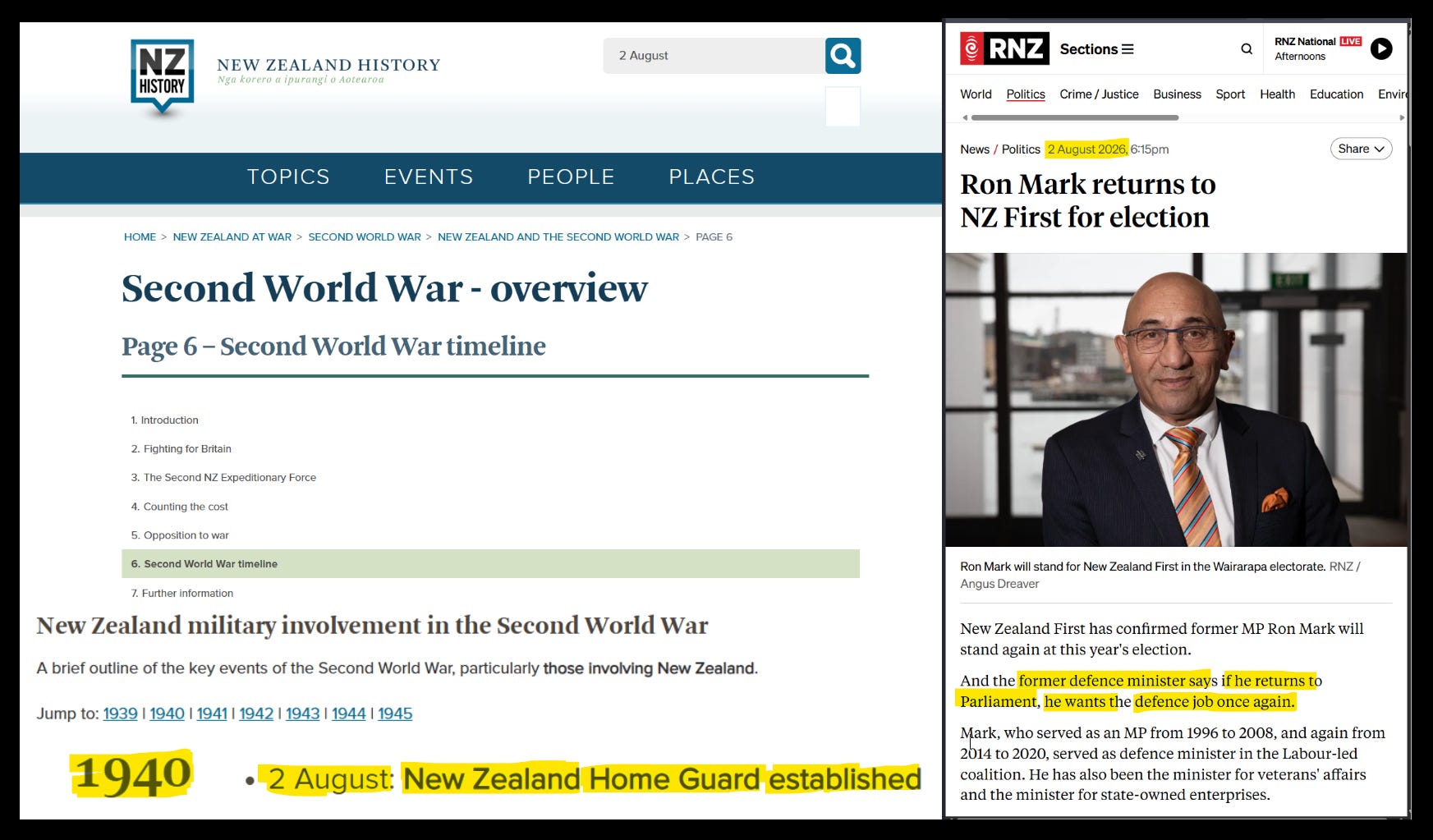
In a spicy development amidst the campaign hustings, arch-lefty journalist Nick Hager launched a book at 6pm on Tuesday September 22 2026, entitled Dirty Work: The Taxpayers’ Union and New Zealand’s Hard Right. Reading his book’s preface, Hager said it was an exposure of race-based politics, the influence of “unscrupulous groups” and focused on one in particular as a high-profile lobby group, the Taxpayers’ Union. He said he chronicles their attempts to shift New Zealand to the “hard right”, as he put the matters to an audience who had packed out Unity Books in Wellington.
The Taxpayers’ Union had arranged a “multi-million-dollar” campaign that helped move New Zealand’s 2023 election “to the right”. Hager stated that the Taxpayers’ Union arranged a “multi-million-dollar” campaign where$7 million was spent, which was more that all of the political parties combined, except National. This money was spent on advertising, memes and paying personnel to run their propaganda drives.
The Taxpyers’ Union itself had $2.88 million in funding/income during the 2023 election year, while the National Party’s campaign coffers for 2023 was $10.4 million.
The book is based on extensive interviews with ex-employees of the Taxpayers’ Union, as well as National Party people who he said were concerned about its activities, as well as being worried about the direction of the Luxon Coalition Government.
Hager said Dirty Work was an unintended third work in a trilogy, with the first being The Hollow Men (2006), and Dirty Politics (2014), about the National Party and their right wing lobby groups, activists, wealthy donors and bloggers. In revisiting these same themes, the Dirty Work’s book cover design also features a pealed paint motif.
The audience of hundreds at Unity Books were told an amusing account about how the book came about, beginning with a press release from the Taxpayers’ Union in July 2023 before the last election. The lobby group’s press release said they had heard from sources that Hager was writing a book about the Taxpayers’ Union. The four page press release was defensive, while it attempted to front-foot the then non-existent book project. This press release, written by the exsecutive director, Jordan Williams and co-founder David Farrar, was evidently very informative. Farrar suddenly resigned form the board to spend more time with this family, Hager said.
Hager was asked at the time by journalist Toby Manhire if he was working on said book. Hager replied “No”, there was book in the works, but the lobby group deserved more scrutiny, and so he would like to hear from those who could shine a light. He started receiving contact from past employees within 24 hours of the press release.
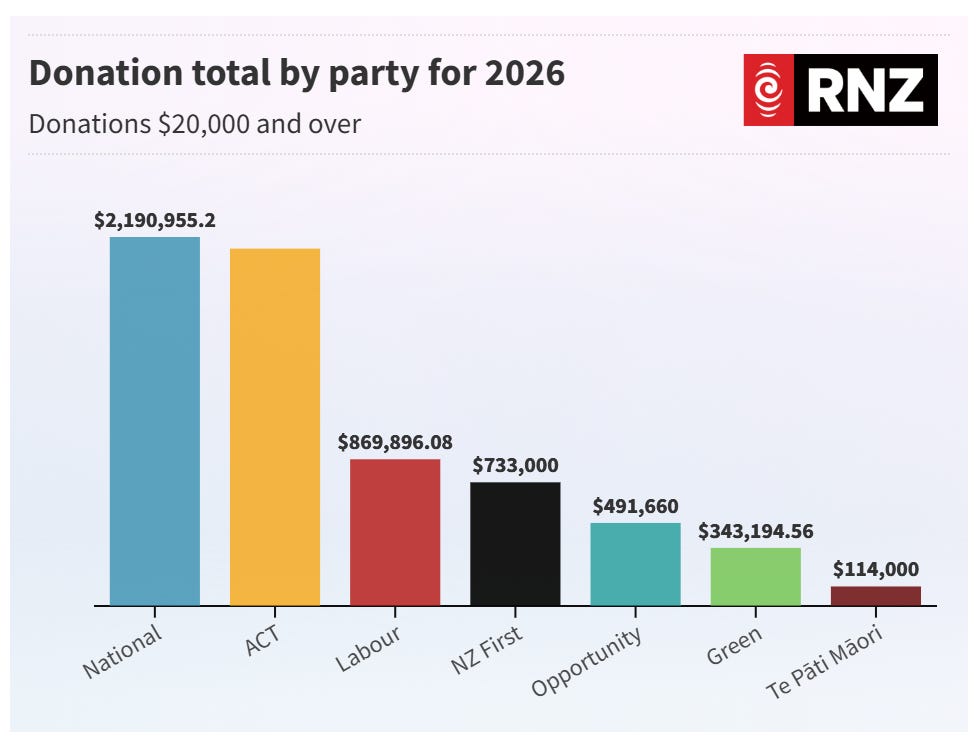
How uncanny that amidst the hustings, Nicky Hager has launched a book, on September 22 2026, given that a second pre-MMP era coalition government was formed on September 22 1931? Especially, since Hager has previously written books based on leaked or hacked comms associated with National, ACT and Labour.
Perhaps the date was merely a coincidence or maybe it was jestfuly chosen as a thematic nod to the past when an austerity-driven coalition drove a deep wedge.
The staged New York Stockmarket Crash of 1929 hit New Zealand’s export-reliant agricultural economy hard. Instead of producing debt-free money to reorganize the nation’s internally and kickstart a domestic economic boom, the United Party Prime Minister George Forbes convened an emergency inter-party conference. Amidst pressure from business roundtables and farmer circles, and newspapers, Gordon Coates of the Reform Party convened a conference to build a ‘unified front’. While the Labour Party walked out of negotiations, United–Reform Coalition Government was formed on September 22 1931. This highly unpopular austerity government focused on balancing the budget and slashing public spending, which ultimately led to its historic electoral wipeout by the first Labour Party Government on December 6 1935.
At the launch, Hager told the backstory of how the book came about. Perhaps there were players in the background that had played Jordan Williams, to increase the probability that a book really would result from Williams’ panicky chess moves.
After all, Corporate New Zealand, the Establishment and the Cryptocracy will still vote. Yet, ‘dirty politics’ tends to turn off left-leaning constituents and young people from voting, as Hager himself pointed out in his bombshell 2014 book, Dirty Politics.
Yet, what if the crytpocracy desires a deepening a polarization to serve deeper aims?
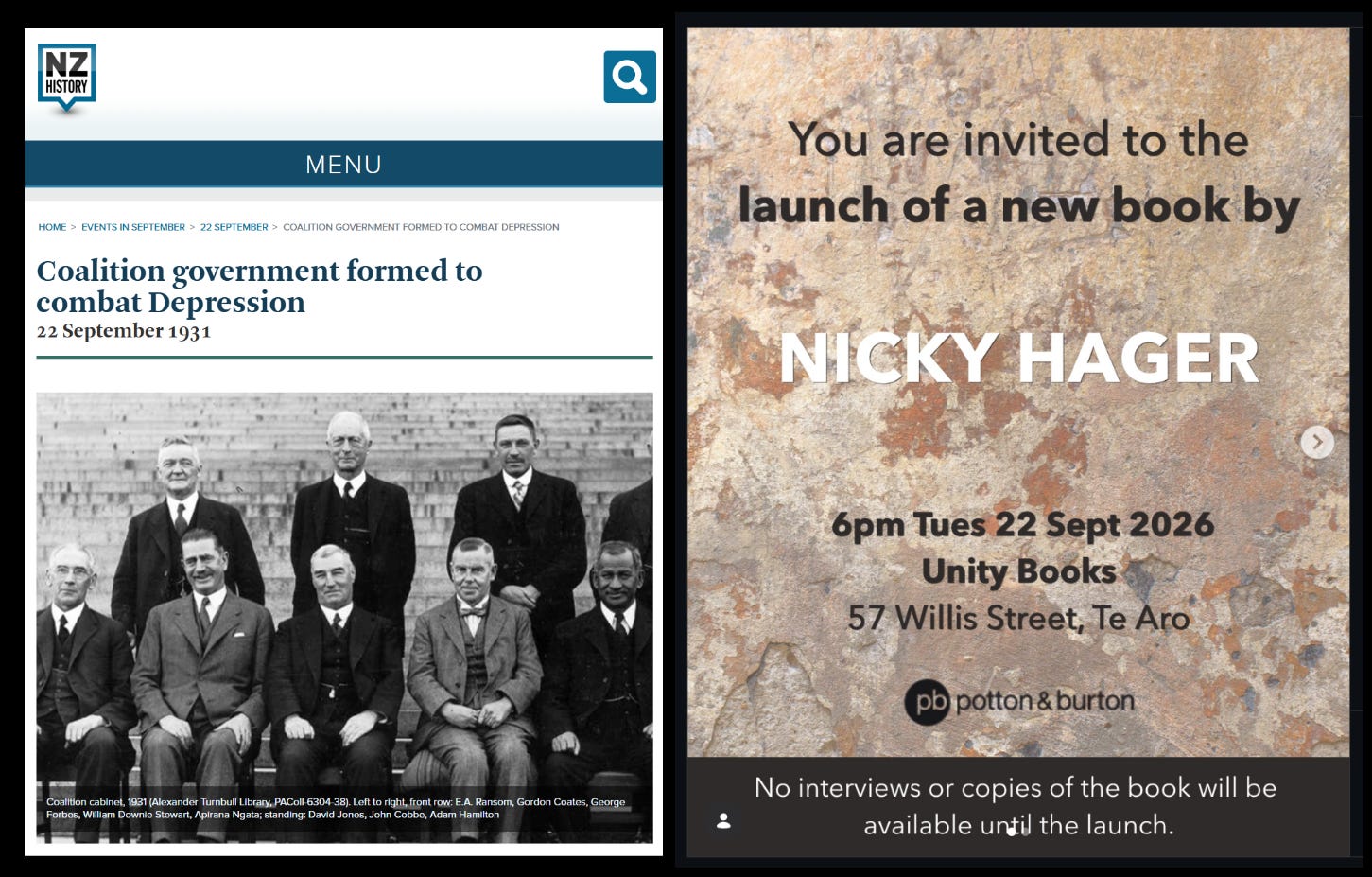
Moreover, back in 2023, Leo Foley, the Northcote candidate for the ACT Party, claimed that Seymour appeared to envisage civil war would ensue if they were able to up-end Treaty provisions with their anti-co-governance policy? At the candidate’s interview before the ACT Party board, Foley replied to Seymour’s query about where he stood on the Waitnagi Treaty in regard to ACT’s co-governance policy. Foley said he told ACT’s board it shouldn’t be hostile to Te Tiriti, due to it’s the constitutional basis. Foley said he warned Seymour, the Party’s approach would cause chaos across all of Māoridom. According to Mr Foley, Seymour evidently replied, “It would be more than just chaos in the streets, Leo. It would cause a civil war.” Foley was shocked.
From the perspective of the Overlords, New Zealand has been designated as a resources colony of the ‘American Empire’, a vision tracks back decades. We’re a captive colony of conformist smurfs. In a 2009 interview with Gower, back when he was a reporter with the NZ Herald, billionaire Stephen Jennings said the world was undergoing a once in 500-year economic adjustment, and New Zealand was reacting too slowly. Recall Jennings became the executive director the New Zealand Initiative, after having written the foreword to Seymour’s boring book entitled, Own Your Future?
The pre-MMP one party Government’s were described as an ‘elective dictatorships’, due to the authorianism of the executive branch located on ‘Despot Boulevard’.
However, while the MMP-style Governments forced some concessions across the coalitions, you wind up with a mixed bag of policy carrots being voted by the parties.
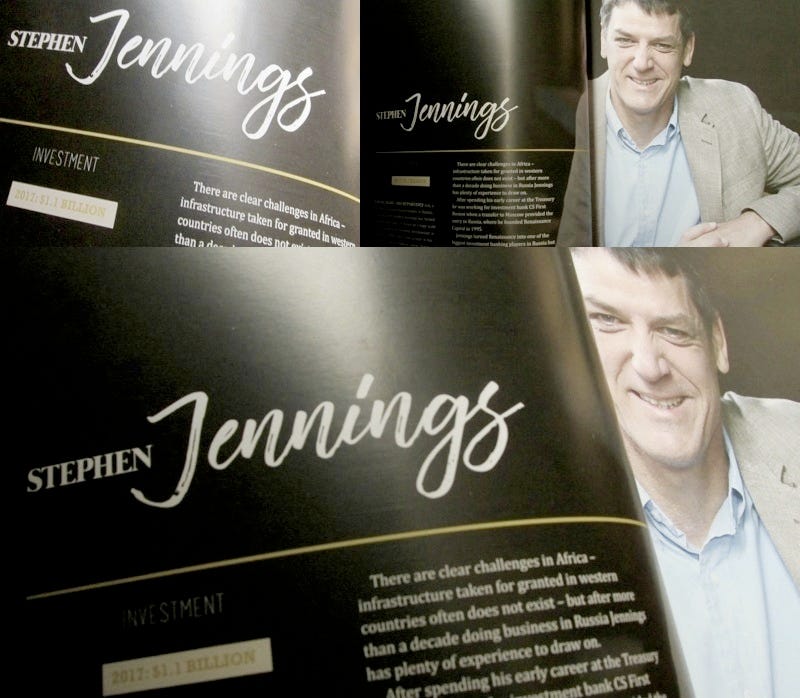
All the while, the hidden rulers of the cryptocracy are manipulating the nation in such a way that they can manage a crisis-ridden society, to manufacture consent for their desired solutions. For instance, the Department of Public Works (1871 to 1988) — that built the railways network, roads, power stations, dams, gas distribution lines — was dismantled by in the 1980s. The Friedmanite-Rockefellerite Shock Doctors facilitated Fletcher Challenge to become a corporate behemoth owning 250 companies at its zenith, so that it would eventually act as the conduit for transferring ownership to foreign interests. The corporatizing and privatizing of the state side of industries, paved the way for major pieces of the nation’s infrastructure to be asset-stripped, dismantled, or neglected, while profits were syphoned off overseas. As mentioned earlier, the crisis engineers apply the ‘starve the beast’ modus operandi to break institutions, systems and infrastructure to cause carnage, frustration and migration.
This cryptocracy is a networked world empire that stages crises, including hot wars, to corral humanity into digital gulags, to perform to contracts to steadily erode love.
No one wants to talk about the constant toxic doses it takes to produce perfectly formed bright orange export quality ‘carrots’ in Carrot Land, who are expected to maintain cheery faces for the tourists before they are bagged up and shipped.
The casting of New Zealand as an Export Processing Zone, serviced by ‘managed retreat’ refugees and an exploited immigrant population etching out a living in a digital gulag archipelago — isn’t a future that any sane commoner would vote for.
As such, changing Carrot Land’s ‘DNA’ to be coded for resilient resistance to the totalitarianism of the transnational cryptocratic dark state — is the honorable trajectory. And, developing a ‘whole soul core’ among a critical mass of New Zealanders, across the diverse demographics, can trigger societal replenishment.
When a people are duped by a secret system of debt enslavement, that has the masses focussed on material needs, without seeing that money itself is a spell— as a symbolic condensation of will that operates upon the probability field, with the manufactured credit being literally conjured from the void of potential (the aether) through nominalist utterance (the signed contract) — it is not enough to dismantle a spell by describing its syntax. The spell is also pervasive, because it is structural. The spell is broken by breaking its sympathetic resonance — requiring not just economic literacy but ontological recapture of the field. Since the dominan paradigm essentially has the New Zealand Monkey acting like is meat operating in a dead universe, rather than realizing they are consciousness entrapped in a probability farm, the ontological recapture of the field is a fancy-pants way of calling for: generating parallel, resonant spaces of value through gift economies, mutual credit, and localized social trust.
Key Findings: This military-themed Beehive soft-coup behaved as intended, to unseat the Defence Minister, and with this Penkian Slip, the way has been paved for Ron Marks to take-up the ministerial posts overseeing the national security state, should a National Ministry be formed.

Moreover, it has set-up a dynamic where it’s coalition’s composition would see a strengthening of NZ First and the ACT Party, and National gaining enough seats, but having to make major concessions, that accelerate the policy trajectory established in Luxon’s first term. It suggests big money will be stumped-up fund campaign coffers and to bankroll public events.

The caucus vote on August 12 2026 is the dead give-away of staged political theatre masquerading as a leadership crisis in the National Party. Of all the days in a year leading up to the November 7 general election polling day, what are the odds that the key ministers of National’s Caucus would have to front with their gaff-prone leader in a display of unity, on the same day when the nation’s first coalition government was formed on August 12 1915 in the crucible of World War I? How uncanny that war-time Coalition Cabinet was dubbed the ‘National Ministry’?

This discovery of a brazen military-themed historical date riff lurking in plain-site, led to more uncanny civil disturbance and war-time metaphor-laden events associated with this political playhouse that Snoopman dubs the Luxon Leadership Laundromat. The removal of Chris Penk, who authorized the Government Inquiry into the Mount Maunganui Holiday Resort Landslide, owned by the Tauranga City Council, also exposes the thematic historical date riffs in the storm, and its associated events. How uncanny that the fatal landslide of January 22 2026, occurred on the same day when Colonel Carey arrived at Tauranga Harbour on 22 January 1864 — to fight ‘the Natives’.
———
Thanks for reading a Snoopman File. Only cool people are fans of Snoopman’s missives.
Post-Script: The practice of metaphorically codifying events by dates occurred to Snoopman while writing his A-Grade thesis on the Global Financial Crisis of 2007-2008, when he found that the financial authorities met on April 15 2008 to discuss a plan called “Break the Glass”, to rescue the FIRE economy (Finance, Insurance and Real Estate). The ‘Firemen’ (at the US Treasury and Federal Reserve) shelved the symbolically-titled plan until Wall Street set up Lehman Brothers to crash. Since April 15 is the deadline for American wage and salary earners to file their income tax returns, the Fed and Treasury ‘firemen’ were signalling who would be on the hook to pay for the bailouts of Gotham’s bankers, once they ‘broke the glass’ of the Break the Glass plan to sound the alarm, retrieve the fireman’s axe, and douse Wall Street with high-pressure hard cold cash. Ergo, when a handful of ‘firemen’ convened a meeting at the Federal Reserve banking cartel’s headquarters in Washington D.C. (or ‘District 13’), on April 15th 2008, this fire station-themed rescue plan telegraphed ‘the fix’. After-all Treasury official Neel Kashkari said when he presented his Break the Glass plan, “I think we all understand the calculus here, the limits of what we can legally do. How do you get the authority to prevent a collapse?” Thus, the plan was to advance the Global Financial Crisis, so that the U.S. Congress would believe they had no choice but to authorize emergency public insurance payouts, or bail-outs, for Wall Street. Five months later, when the votes in the House of Congress started going against the $700 billion bailout, Wall Street and the City of London banks were ready, and they attacked the Dow Jones Industrial Stock Index, pincer-style, since the American workforces across various industries were heavily invested in 401k savings and investment plans tethered to this indice.

‘The fix’ duirng the Global Financial Crisis was signalled with the prime number thirteen. The practice of embedding events with the recidivist prime number 13 to symbolize a financial oligarchy, was first expressed by Simon Johnson and James Kwak in their 2010 book, 13 Bankers. Intriguingly, when thirteen bankers met with Obama at the White House on Friday 27 March 2009, they were told by America’s first black president: “My administration is the only thing between you and the pitchforks.” Barack Obama’s task was to impress on the thirteen Wall Street bankers that they desist from bragging in the public media about their enormous bonuses, following the tax-funded public insurance bail-outs of their banks, as the authors of the 2010 book, 13 Bankers, revealed. The bankers pitched in. This was not the first time that the financial-political oligarchy symbolically communicated with the prime number thirteen, via Barack Obama. When a $700 billion bailout bill was voted down in the US House of Representatives, Obama was assigned the task of convincing 13 ‘black caucus’ Democrat members of the US Senate, as The Washington Post reported on October 4 2008 in an article headlined, “Bush enacts historic financial rescue: House passes plan by wide margin, but stocks keep falling”. Not surprisingly, when JP Morgan Chase was fined in late 2013 for underwriting fraudulent home mortgage securities that led to the Global Financial Crisis, the Department of Justice arrived at the figure of $13 billion. With this public drop of the number 13, the DOJ signalled that ‘the fix’ was in.

In his groundbreaking study of the Global Financial Crisis, Snoopman reworked Noam Chomsky's Propaganda Model to theorize for corruption, collusion and conspiracy in newsrooms, and he tracked the narrative arc with the three-act story structure. He showed the event clusters as the crisis escalated to its staged climax, and he recorded the metaphors that the news media plastered into the coverage to fill in the ideological cracks. They omitted reporting sacred cows, such as how the Federal Reserve is a racketeering cartel owned by the stockholding banks.   For his effort, Snoopman gained First Class Honours with a Masters in Communication Studies. Yet, Snoopman didn’t realise that metaphor-laden date riffing was systemic componentary across the West, and in N.Z., where it’s been in use since a foundational event: the Ballantynes’ Fire.
Back when Snoopman was ‘Snoopboy’, a pope and a president got shot soon after he started delivering the Auckland Star. But, they ruined the climax by surviving. There was also a cervical cancer scare linked to tampons. The lead story didn’t explain the tampon’s job. Its activities drew the attention of a probe. No one on his paper-round would say. Ever since, Snoopman notices when context in news is missing in action. Newspapers, he later learned, operated with a crass mindset: “if it bleeds, it leads”.
Editor’s Note: If we have made any errors, please contact Steve Snoopman with your counter-evidence. Or, if you wish to share information related to these dispatches, by email, please also state the topic in the subject line, using relevant NOUN words, so that your email is searchable for following up later … e: snoopman72@proton.me
An earlier version profiled the Matata Flood of 2005. This has been removed due to a date error. The Auckland Deluge and Cyclone Gabrielle of 2023, are a better fit.
To be fair to Hager, his 2002 book Seeds of Distrust over a GE-corn seed contamination cover-up was launched during an early election campaign, that caused the center-left Labour Party to form a coalition with the United Future, after the Greens accused Clark’s Administration of deception. Clark had to hustle hard to re-win power.